

Appearance
Performance: GPU and CPU nodes, uniform-grid scaling
What a GPU node buys over a CPU node, what sets the cost of a cell on an A30 and on an H100, and how FLUME scales inside a node and across nodes, on two machines: medooza (4 A30 per node, no GPUDirect RDMA) and ESA SpaceHPC (4 H100 per node, GPUDirect RDMA). Scaling is measured and claimed on uniform 3-D grids only. Runtime AMR (the host regrid, 2:1 seams, reflux, the runtime rank layout) and the 2-D quadtree path (ghost layers along the null axis) are implemented for accuracy and not yet optimised for performance: their timings are kept as baselines at the end of the page (The accuracy-first paths), with no scaling claim.
The measurements are the speedup matrix of #133 and its grid study; the harness, the protocol and every table are in src/tests/flume/speedup/README.md, the raw tables in its results/2026-11-23/, results/2026-11-24/ and (the H100 nodes) results/2026-11-25-spacehpc/. The kernel-level profile of one GPU (where a step's time goes inside the A30) is the companion study profile-couette3d.
The matrix
Three flows (legs), each on a uniform grid and on two AMR grids that refine to the uniform grid's spacing, so that the solution where the AMR grid is finest and the global time step are the same: the per-step ratio is the time-to-solution ratio.
| Leg | Flow | Grid | Scheme | Uniform cells |
|---|---|---|---|---|
| 1 | Woodward–Colella Mach 3 forward-facing step, three realms glued by auto seams | 2-D quadtrees, h = 1/1280 (L4), runtime AMR from L1 | WENO-7 characteristic, SSP-54 | 4.13 M |
| 2 | Mach 2 shock diffraction over a sphere, immersed boundary (Euler wall) | 3-D octree, 24³ blocks, h = 1/384 (L4), runtime AMR from L2 | WENO-5 characteristic, SSP-33 | 56.6 M |
| 3 | Coleman–Kim–Moser channel, M_b 1.5, Re_b 3000, isothermal walls, Re_τ ≈ 202 | 3-D octree, 32×24×16 blocks, L3, runtime AMR from L2 (r = h/η marker) | hybrid-kep-weno, viscous, SSP-54 | 6.29 M |
Each leg has three cases: uniform (U), runtime AMR (R: regrid every 10 steps) and frozen AMR (F: R's grid and state with [amr] frequency = 0). Every backend and rank count starts from the same restart dump (written once, repartitioned for the reading rank count). A step cost is the median over three repetitions of
The scaling cases are the uniform sphere (2a and the grid study's wg-* cases, the same flow on other grids) and the uniform channel (3a).
Hardware. medooza prod-gn: a node holds 4 NVIDIA A30 (24 GB) and two Intel Xeon Gold 6338 (64 cores, 4 NUMA nodes). A GPU node is 4 A30 with one MPI rank per GPU (FNL, OpenACC); a CPU node is 64 MPI ranks (CPU backend).
GPU node against CPU node
T(CPU node) / T(GPU node) on the uniform grids:
| Case | Grid | Blocks | GPU node / CPU node |
|---|---|---|---|
| 2a sphere (3-D, WENO-5, IB, SSP-33) | 56.6 M cells, L4 | 4096 of 24³ | 13.8 since #156 lever 2 (11.4 before it; 16.3 before the CPU build flushed subnormals) |
| 3a channel (3-D, hybrid, viscous, SSP-54) | 6.29 M cells, L3 | 512 of 32×24×16 | 14.4 with the CPU fix of #161 (16.2 at HEAD before it, 13.8 before the GPU's C4) |
| sphere, grid study | 7.08 M cells, L3 | 512 of 24³ | 11.9 |
| sphere, grid study | 28.1 M cells, L3 | 512 of 38³ | 12.6 |
A GPU node runs the uniform 3-D flows 11 to 14 times faster than a CPU node; on the same flow the factor moves with the grid. On the CPU node the sphere costs 14.4 µs per cell-step per core on 2a, 12.4 on the 24³ grid and 10.2 on the 38³ grid. The 2a figure is inflated by subnormal arithmetic in its developed state, which slows a few CPU ranks and not the GPU (What does not scale): with flush to zero 2a costs 8.74 µs, the cold 24³ grid 8.81–9.54. The two grid-study grids load the GPU node with 1.8 and 7.0 M cells per A30, below 2a's 14.2 M (what a cell costs). Larger blocks make both nodes cheaper per cell. The channel's CPU node was 8-20 % slower per step at HEAD than with the build of the first table (the same node, the executables alternated): the CPU ghost exchange without its barrier, located and fixed in #161 (see What does not scale, lever 4). With the fix it costs 3.20 s per step, 1.0 % above the #133 build; the step case did not slow down (1.26 → 1.22 s with flush to zero).
On the H100 node (ESA SpaceHPC; #160): the same comparison inside one machine, the CPU backend on its 2 AMD EPYC 9454 (96 cores, gfortran 16.2.0 with flush to zero, the medooza CPU leg's toolchain) against its 4 H100, from the same window dumps:
| Case | CPU node (s) | GPU node (s) | GPU node / CPU node | medooza |
|---|---|---|---|---|
| 2a sphere | 3.90 | 0.187 | 20.8 | 14.2 |
| 3a channel | 1.47 | 0.0609 | 24.2 | 14.4 |
| step (2-D) | 0.578 | 0.0863 | 6.7 | 5.7 |
The H100 node runs the 3-D flows 21–24 times faster than its own CPUs: the H100 is 2.5–3.6 times the A30, the EPYC node 2.0–2.3 times the Xeon node (1.35–1.53 per core). GPU costs of the C4 tree, as the medooza column here. The channel's CPU costs are those of the #161 fix on both machines; on the EPYC node the fix is neutral (HEAD ran as fast in the same job), on medooza's Xeon nodes it removed the slowdown.
What a cell costs on one A30
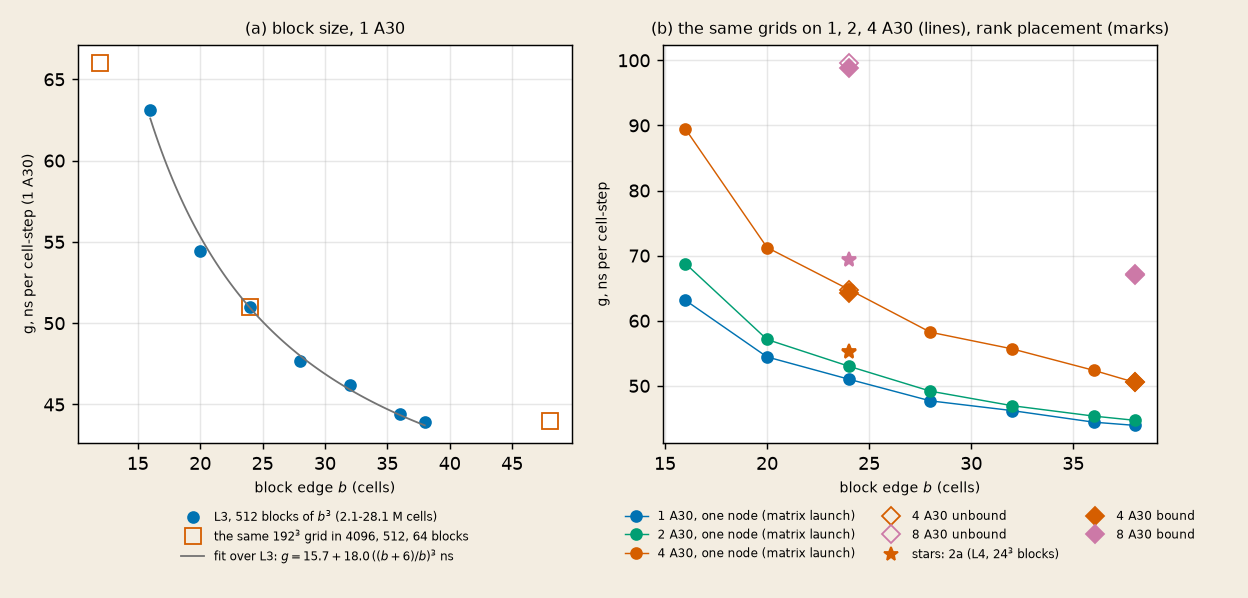
The uniform sphere on grids of 2.1 to 28.1 M cells, 1 A30, from 20-step cold starts (the per-cell cost does not depend on the flow state: 0.5 %, measured on 2a):
| Block edge b (L3, 512 blocks) | 16 | 20 | 24 | 28 | 32 | 36 | 38 | 40 |
|---|---|---|---|---|---|---|---|---|
| cells | 2.10 M | 4.10 M | 7.08 M | 11.2 M | 16.8 M | 23.9 M | 28.1 M | 32.8 M |
| g, ns per cell-step | 63.1 | 54.4 | 51.0 | 47.7 | 46.2 | 44.4 | 43.9 | does not fit |
- The block size sets the cost of a cell. The same 192³ grid costs 66.0 ns per cell-step as 4096 blocks of 12³, 51.0 as 512 of 24³ and 44.0 as 64 of 48³: a block of b³ cells stores (b + 6)³ (WENO-5, 3 ghost layers), and the ghost cells are filled and partly computed every stage. Above a few million cells per A30 the load itself matters little: 7.1 M cells in 48³ blocks cost what 28.1 M cells in 38³ blocks cost.
- The matrix's 24³ blocks leave ~16 % on the table: 51.0 against 43.9–44.0 ns with 38³–48³ blocks.
- An A30 holds 28.1 M cells of the sphere (38³ blocks, 88 % of the blocks budget); 32.8 M is refused at initialisation (the budget, 0.85 of the 25.2 GB the A30 reports, holds 510 blocks of 46³ stored cells, 512 needed).
Inside a GPU node
The same grids on 1, 2 and 4 A30 of one node (the right panel of the figure above):
| b | 16 | 20 | 24 | 28 | 32 | 36 | 38 |
|---|---|---|---|---|---|---|---|
| g, 2 A30 / g, 1 A30 | 1.09 | 1.05 | 1.04 | 1.03 | 1.02 | 1.02 | 1.02 |
| g, 4 A30 / g, 2 A30 | 1.30 | 1.25 | 1.22 | 1.18 | 1.19 | 1.16 | 1.13 |
Two A30 cost 2–9 % more per cell than one; four cost another 13–30 %. The node explains the step: its A30 are NVLink-bridged in pairs (GPU 0–1 and GPU 2–3, 4 × 25 GB/s each way), while between the pairs, and from every GPU to the InfiniBand card, the path is PCIe plus the inter-socket link. The four GPUs hang off NUMA nodes 0, 1, 3 and 3.
Rank placement is not the cause. The default launch leaves three of the four ranks on host cores away from their GPU's NUMA node (ranks 1 and 3 on NUMA 2, which has no GPU). Pinning each rank to its GPU, to 8 cores of that GPU's NUMA node and to its memory changes the grind time by −0.8 to 0 % on one and on two nodes (2a, and the 24³ and 38³ grids), inside the spreads. The halo exchange posts MPI on device buffers (no host staging), so the host core is off its path, and the cost of the fourth A30 is the link between the NVLink pairs. Pinning does one useful thing: unpinned, every rank also opens a context on GPU 0, which then has 0.9 GB less free memory than the others; pinned, all four have the same.
Scaling across nodes
Strong scaling of the uniform sphere (2a, 56.6 M cells, 24³ blocks; step cost in s, efficiency against one node):
| Node | 1 | 2 | 4 | 8 |
|---|---|---|---|---|
| GPU nodes (4 A30 each) | 0.780 | 0.491 | 0.260 | 0.167 |
| efficiency | 1 | 0.79 | 0.75 | 0.58 |
| GPU nodes, since #156 lever 2 | 0.5745 | 0.311 | 0.160 | 0.0852 |
| efficiency | 1 | 0.92 | 0.90 | 0.84 |
| cells per A30 | 14.2 M | 7.08 M | 3.54 M | 1.77 M |
| CPU nodes (64 cores each), gradual underflow | 12.7 | 6.48 | 3.24 | 2.31 |
| efficiency | 1 | 0.98 | 0.98 | 0.69 |
CPU nodes, linked with -mdaz-ftz | 8.92 | – | – | 1.22 |
| efficiency | 1 | – | – | 0.91 |
CPU nodes, -mdaz-ftz, since #156 lever 2 | 7.9 | – | – | 1.17 |
| efficiency | 1 | – | – | ~0.84 |
Since #156 lever 2 (2026-11-26, the immersed body's ghost exchanges cut from 12 to 3 full ones per step, the other 6 restricted to the cells its eikonal sweeps read) one node runs the sphere 26 % faster and 8 nodes keep 0.84 of its throughput instead of 0.58: on medooza, without GPUDirect RDMA, the body's exchanges were most of the multi-node loss. What remains at 8 nodes is mostly the load: 1.77 M cells per A30 in 24³ blocks is where the one-node curve already rises. The CPU node gains too (8.92 → 7.9 s, the same fewer exchanges), but its runs scatter: two jobs of 3 repetitions each gave 7.7–8.3 s on one node and 1.04–1.19 s on 8, so its efficiency (~0.84 against 0.91) is within that noise. The largest run is the L5 sphere, 453 M cells on 32 A30 (8 nodes), at 0.604 s per step (0.98 before).
Weak scaling of the uniform sphere (g in ns per cell-step; inter-node efficiency = g on one 4-A30 node / g on 8 nodes at the same cells per A30 and the same blocks: an octree level is 8 times the cells, so 4 A30 pair with 32):
| Cells per A30 | Blocks | One node, 4 A30 | 8 nodes, 32 A30 | Inter-node efficiency |
|---|---|---|---|---|
| 14.2 M | 24³ | 55.1 (2a, 56.6 M cells) | 69.3 (L5, 453 M cells) | 0.80 |
| 7.02 M | 38³ | 50.5 (L3, 28.1 M cells) | 67.0 (L4, 225 M cells) | 0.75 |
| 7.02 M, no body | 38³ | 37.1 | 41.3 | 0.90 |
| 14.2 M, since #156 lever 2 | 24³ | 40.6 | 42.7 | 0.95 |
| 7.02 M, since #156 lever 2 | 38³ | 38.4 | 41.4 | 0.93 |
- The multi-node loss followed the ghost exchanges. Without the immersed body the same 8-node pair kept 0.90. In both runs leaving the node cost 9.7–9.8 ms per ghost exchange; the body's eikonal extension exchanged the ghosts 4 times per stage instead of once (12 exchanges per step against 3), so it lost 4 times as much. Since #156 lever 2 the extension's exchanges fill only the few block faces next to the body: with the body the pairs now keep 0.95 and 0.93, and a cell of the sphere costs 26–24 % less on one node.
- Leaving the node cost 20–25 % per cell on 8 nodes with the immersed body at 7–14 M cells per A30 before #156 lever 2, 5–7 % since. The pair at 38³ blocks loses more than the one at 24³ although its blocks carry fewer ghost cells: its cells are 15 % cheaper, and at half the load per A30 the same exchange weighs more. In throughput the two 8-node runs are equal (478 and 462 M cell-steps per second).
- The weak efficiencies of the first version (0.72–0.73 at 3.5–7 M cells per A30) mixed two costs: their 1- and 2-A30 references left out the cross-pair cost of the fourth A30 (13–22 % at those loads), which belongs to the node, not to the network.
- The CPU node scales to 8 nodes since its builds flush subnormal numbers (2a: strong 0.91 from 1 to 8 nodes, weak 1.01). Before that it lost half on 8 nodes (weak 0.53, strong 0.69) to subnormal arithmetic on a few ranks, not to the network (What does not scale).
What does not scale, and why
A measurement-only build timed 22 phases of the step on both backends: face fluxes, local ghost fill, MPI ghost exchange (pack, post, wait, barriers, unpack), boundary conditions, immersed boundary, integrator, reductions. It compared one node with 8 at the same load per device.
On the GPU the multi-node loss is the MPI ghost exchange, all of it (ms per step, 7.02 M cells per A30, 38³ blocks):
| Phase | 1 node, no body | 8 nodes, no body | 1 node, sphere | 8 nodes, sphere |
|---|---|---|---|---|
| step | 260.5 | 289.0 | 355.3 | 467.0 |
| face fluxes | 208.5 | 208.0 | 207.4 | 208.4 |
| MPI ghost exchange | 12.7 | 43.7 | 50.0 | 172.2 |
| ... waiting for the data | 10.3 | 36.0 | 40.7 | 144.2 |
| ... the two barriers | 0.3 | 3.8 | 0.8 | 12.5 |
| local ghost fill + boundary conditions | 16.7 | 14.4 | 66.7 | 57.4 |
Every compute phase is flat from 1 to 8 nodes; the exchange's growth is 109 % of the step's, nearly all of it waiting for the data. The reason is the transport: medooza has no GPUDirect RDMA, so the GPU halos travel between nodes at 1.5 GB/s, against 23.5 GB/s for the same messages from host memory over the same InfiniBand link (ucx_perftest; no UCX setting tried exceeds 1.9 GB/s). Inside a node, GPU to GPU is 88.5 GB/s across an NVLink pair and 17.7 GB/s between the pairs. The immersed body makes it worse: its eikonal extension refreshes the ghosts 4 times per stage, 12 exchanges per step instead of 3, so with the sphere on 8 nodes the ghost update is 49 % of the step, more than the face fluxes. The two global barriers of each exchange cost 0.4–1.2 % on the GPU.
On the CPU the culprit is subnormal arithmetic, not the exchange. The developed state of the sphere holds 745,771 subnormal values (below 2.2 · 10⁻³⁰⁸, in the transverse momenta ahead of the shock) on 76 of 512 ranks. x86 cores handle them many times slower, so those ranks compute twice as long, and every other rank waits for them at the barriers and reductions. With flush to zero the same 8-node run drops from 1988 to 1044 ms per step (−47 %), the weak efficiency rises from 0.51 to 0.93–1.0 (perfect within the CPU node's spread), and one node of 64 ranks runs the 56.6 M-cell sphere in 7.73 s instead of 11.83 (−35 %). The GPU node / CPU node factor of 16.3 on that case therefore overstated the GPU: with the CPU build flushing subnormals it is 11.4.
Ranked, with proposals (the first applied):
| # | Cost | Gain | Proposal |
|---|---|---|---|
| 1 | subnormal arithmetic (CPU) | −35 to −47 % per step on developed states | applied: the GNU builds link with -mdaz-ftz, flush to zero from the start (build notes) |
| 2 | GPU halo between nodes at 1.5 GB/s | up to ~9 ms of the ~12 ms per exchange (estimate) | GPUDirect RDMA on the cluster: on the H100 nodes, which have it, an exchange between nodes waits 0.9–1.4 ms (below); host staging in the code was declined as specific to medooza |
| 3 | 12 ghost exchanges per step with an immersed body | up to 9 of the 12 | applied (2026-11-25/26, bitwise): no exchange after the last eikonal sweep (12 → 9), then the two remaining eikonal exchanges restricted to the ghost cells the sweeps read; over both, the step −16 % on 4 H100 and −26 % on 32, the sphere −39 % on 32, and the body no longer costs a multi-node loss (on one H100 node those, not MPI, carry the body's cost; on 8 H100 nodes the MPI exchange is its largest part); #156 |
| 4 | two global barriers per ghost exchange | 0.4–1.2 % on the A30 nodes, 0.1–2.5 % on the H100 nodes (timed off on 8 nodes: −1.3 %); on the CPU a loss | applied to the GPU exchange (2026-11-25, update_ghost_mpi_gpu; suites bitwise). Reverted on the CPU (#161, 2026-11-27): without them the CPU channel was 9–20 % slower per step, the time spent in the exchange's MPI_WAITALL (its messages go by rendezvous, which advances only while both ranks are inside MPI), so update_ghost_mpi keeps one barrier before its posts |
| 5 | the link between the NVLink pairs (17.7 GB/s) | part of the 13–30 % of the third and fourth A30 | place neighbouring subdomains on the same NVLink pair (medooza only: the H100 nodes join every pair by NVLink and show no such step) |
Another machine: H100 nodes with GPUDirect RDMA
The same uniform sphere on ESA SpaceHPC (2026-11-25): 4 NVIDIA H100 per node, every GPU pair joined by NVLink (124.8 GB/s GPU to GPU, all pairs alike), one 400 Gb/s InfiniBand card per GPU, and GPUDirect RDMA working: GPU to GPU between nodes at 52.4 GB/s, 34 times medooza's 1.53 (9.8 GB/s with GPUDirect RDMA switched off). The toolchain is nvfortran 26.3 with CUDA 12.9; every job checked first that no GPU was throttled.
- A cell costs 2.5–3.0 times less than on an A30 at equal blocks (15–25 ns per cell-step against 44–63), 3.1 times on the 4-GPU node with the 56.6 M-cell sphere (0.254 s per step against 0.780; since #156 lever 2, 0.195 s against 0.575, 2.9 times). An H100 holds at least 147 M cells of this case (an A30 28.1 M).
- The block size weighs more: 24³ blocks cost 30 % more per cell than 64³ (on the A30, 24³ against 38³, 16 %). The per-cell compute fell 5.5 times, the cost of the stored ghost cells only 2.2 times.
- Inside a node there is no penalty for the third and fourth GPU: above ~14 M cells per H100, four GPUs keep 0.97–0.98 of one GPU's throughput. Below ~2 M cells per H100 a quarter or more is lost: a load that keeps an A30 busy is a light one for an H100.
- Across nodes the sphere keeps 0.99, 0.95 and 0.92 of its throughput per GPU on 2, 4 and 8 nodes since #156 lever 2 (re-measured 2026-11-26; before it 0.93, 0.81 and 0.69; the A30 nodes since lever 2: 0.92, 0.90 and 0.84), and the 225 M-cell grid 0.99, 0.98 and 0.95 (before: 0.96, 0.90 and 0.83). On 8 nodes the sphere has 1.8 M cells per H100 and loses 1.2 ns per cell-step (15.0 against 13.8); before lever 2 it lost 8.1, of which 5.9 came from the small load, most of it the body's ghost work that lever 2 removed.
- At a fixed load, leaving the node costs 2–3 % since #156 lever 2: from one node to eight (32 H100) the sphere keeps 0.98 at 14 M cells per GPU (453 M cells) and 0.97 at 7 M in 38³ blocks (before lever 2: 0.92 and 0.91, 0.97 without the body; the A30 nodes since lever 2: 0.95 and 0.93). An exchange between nodes costs ~1 ms (medooza: ~10 ms on the same loads).
- The immersed body's cost is ghost work: on one node it adds 152 ms to a 710 ms step, of which the local ghost fill 85, boundary conditions 36, the MPI exchange 14 (mostly packing), its own kernels 10; on 8 nodes it adds 40 % (37 ms on 93), the MPI exchange the largest part (15), and it takes the strong efficiency of the 225 M-cell grid from 0.955 to 0.83. Cutting its 12 exchanges per step has to cut the local fills and the boundary conditions too. The first cuts are applied (bitwise): the exchange after the last eikonal sweep was redundant (12 → 9 per step), and the two exchanges left around the sweeps now fill only the ghost cells the sweeps read (a few block faces next to the body). On 8 nodes the body's extra cost fell from 36 to 2 ms per step, and the 225 M-cell grid keeps 0.959 of one node's throughput on 32 H100 instead of 0.837; the step is 16 % cheaper on one node and 26 % on 8, the sphere 39 % on 8.
- Neither barriers nor adapters are the limit: the two barriers per exchange, already removed from the GPU exchange, cost 1.3 % on 8 nodes (as on the A30 nodes); using all four network adapters instead of the site's two changes nothing.
The tables, the jobs and the method are in the speedup README's "ESA SpaceHPC" section. How far the ghost fill itself is from the GPU's memory floor (10–16 % of the copy rate today, 43–57 % with structured slab copies, 3–5.5 times faster) is measured in the ghost-fill benchmark, and so is the 2:1 fill of an AMR grid, whose density guard now runs once per fine ghost (20–43 % faster on the H100, #157).
Device memory
FNL allocates every block-sized device array at the block capacity that its budget computes from the device memory (memory_fraction × memory / realms / (fields × 8 B × stored cells per block)), not at the blocks in use. Measured with three values of ADAM_MEMORY_FRACTION per case on 4 A30 (nvidia-smi peaks; the peak is a straight line in the stored-cell slots of the capacity, residuals below 5 MiB):
| Case | Bytes per stored-cell slot (doubles) | Budget's fields per slot | Memory outside the capacity, per GPU | Needed per A30 at its layout |
|---|---|---|---|---|
| step (3 realms, WENO-7, SSP-54) | 404.9 B (50.6) | 64 | 3.40 GiB | 7.7 GiB (1a, 4 A30) |
| sphere (IB, WENO-5, SSP-33) | 392.4 B (49.1) | 54 | 1.95 GiB | 12.1 GiB (2a, 4 A30) |
| channel (hybrid, viscous, SSP-54) | 493.4 B (61.7) | 69 | 0.75 GiB | 6.7 GiB (3a, 1 A30) |
The budget overestimates a slot by 10–26 % (it counts the face fluxes as full stored blocks), and at its default fraction 0.85 an A30 keeps 2.5–4.9 GiB free. GPU 0 holds 0.87 GiB more than the others in every run (not identified). The budget, not the device, sets the sphere's ceiling of 28.1 M cells per A30.
The accuracy-first paths: runtime AMR and 2-D
Runtime AMR and the 2-D quadtrees are implemented for accuracy; their performance is not optimised yet, and the numbers below are baselines for that work, not scaling results. Their CPU timings were measured before the GNU builds flushed subnormal numbers (2026-11-23), so on the developed flows they include that slowdown.
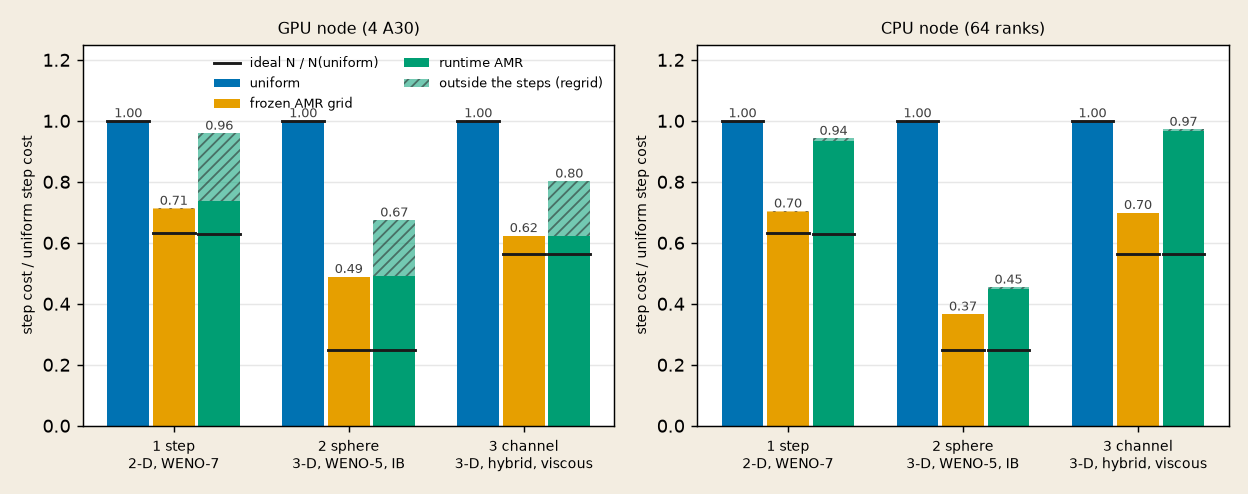
| Leg | Node | AMR speedup T(U)/T(R) | Ideal N(U)/N(R) | Frozen grid T(U)/T(F) | Grid efficiency | T(R)/T(F) − 1 |
|---|---|---|---|---|---|---|
| 1 | GPU (4 A30) | 1.04 | 1.59 | 1.40 | 0.89 | 34 % |
| 1 | CPU (64) | 1.06 | 1.59 | 1.42 | 0.90 | 34 % |
| 2 | GPU (4 A30) | 1.48 | 4.02 | 2.04 | 0.51 | 38 % |
| 2 | GPU (4 A30), since #157 | 1.73 | 4.02 | 2.37 | 0.59 | 37 % |
| 2 | CPU (64) | 2.20 | 4.02 | 2.73 | 0.68 | 24 % |
| 3 | GPU (4 A30) | 1.25 | 1.78 | 1.60 | 0.90 | 29 % |
| 3 | CPU (64) | 1.03 | 1.78 | 1.43 | 0.81 | 39 % |
The grid efficiency is
- A cell of the sphere's AMR grid costs twice a uniform cell on the A30 (grid efficiency 0.51): at the same 254–256 blocks per GPU the face fluxes cost the same on both grids, while the intra-rank ghost fill (one map-driven kernel that copies same-level ghosts and, on the AMR grid, also interpolates coarse-to-fine and restricts fine-to-coarse ones) costs 5.6 times as much: 96 % of the difference. Most of it was the density guard of the coarse-to-fine fill, recomputed for every variable of every fine ghost (ghost-fill benchmark); since #157 it runs once per ghost: the frozen AMR step is 14 % cheaper (0.382 → 0.328 s), the runtime step 11 %, the grid efficiency 0.59 and the AMR speedup 1.73 (the same node, the same window dumps, before and after alternated; the other legs and every uniform grid unchanged within 1.6 %; on 4 H100 the frozen step is 11 % cheaper, the grid efficiency 0.46 → 0.52, and the unchanged host regrid is 29 % of the runtime step). The fill still costs four times the uniform grid's: the coarse-to-fine arithmetic itself.
- On the GPU node the runtime overhead is the regrid, which runs on the host at every regrid step (0.26–1.4 s when the grid does not change, 2.0–2.5 s when it does); it scales with the blocks per GPU and stays 22–27 % of a runtime step.
- On the CPU node the regrid is cheap (1.3 % of the sphere's runtime step) but the runtime layout is not: a runtime regrid distributes whole sibling sets and splits every realm from rank 0, so the busiest rank keeps the uniform grid's load (the step's runtime case: 64,512 cells against a mean of 40,680). The runtime step then costs what the uniform step costs, and does not shrink with more ranks (1.19 s on 64, 128 and 256 ranks).
- The 2-D step's cell costs 1.60 cells of the same step extruded in 3-D at the same order and load (202 against 126 ns per cell-step): the boundary-condition kernel refills the
ngcghost layers along the null axis at every stage (59 % of the 2-D kernel time). The same ghosts cap the step at about 1.7 M cells per A30. A GPU node runs the step 5.8 times faster than a CPU node (uniform 5.83, frozen 5.75, runtime 5.72; uniform 5.67 with the CPU flushing subnormals), against 11–16 on the 3-D uniform grids.
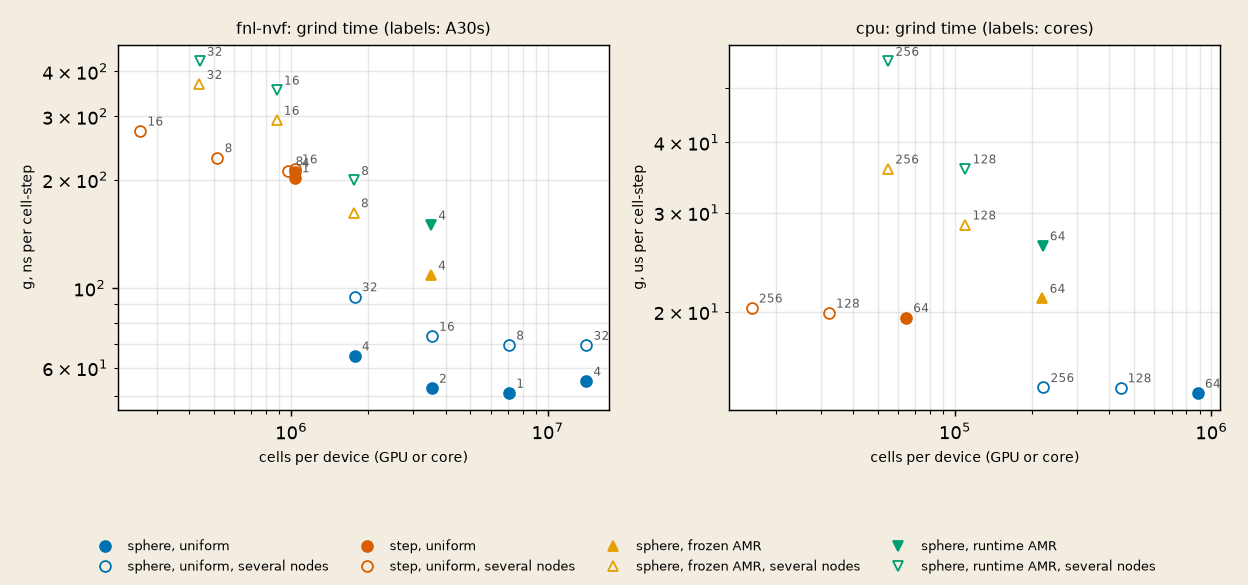
Timings of these paths on more nodes (baselines; step cost in s on 4 / 8 / 16 / 32 A30 and 64 / 128 / 256 cores):
| Case | GPU nodes 1 / 2 / 4 / 8 | CPU nodes 1 / 2 / 4 |
|---|---|---|
| 1a step uniform (2-D) | 0.216 / 0.119 / 0.070 / – | 1.26 / 0.642 / 0.328 |
| 1b step frozen | 0.154 / 0.089 / 0.057 / – | 0.887 / 0.544 / 0.334 |
| 1c step runtime | 0.207 / 0.119 / 0.076 / – | 1.19 / 1.18 / 1.18 |
| 2b sphere runtime | 0.526 / 0.350 / 0.312 / 0.188 | 5.76 / 3.95 / 3.06 |
| 2c sphere frozen | 0.381 / 0.284 / 0.257 / 0.161 | 4.64 / 3.13 / 1.97 |
What the measurements say about the hypotheses of the plan
The plan of #133 stated four hypotheses before the runs, three of them on the accuracy-first paths:
| Hypothesis | Verdict | The measurement |
|---|---|---|
| H1: on the step, runtime AMR falls well short of its ideal on GPUs (launch floor), and comes close on CPUs | reformulated | short of the ideal on both nodes (1.04 and 1.06 of 1.59); no launch floor (the step scales to 0.26 M cells per A30); the losses are the AMR grid and the host regrid on the GPU node, the runtime layout on the CPU node |
| H2: a 2-D cell costs more than two thirds of a 3-D cell at the same order, by the null-axis ghosts | confirmed | at the same order and 1.03 M cells per A30 a 2-D cell costs 1.60 3-D cells (202 against 126 ns); the boundary-condition kernel, which refills the null axis's ghost layers every stage, takes 59 % of the 2-D step's kernel time against 10 % in 3-D |
| H3: on the sphere, the GPU runtime overhead is the regrid's host round trip; on the CPU it stays a few percent | confirmed | 38 % on 4 A30, all outside the steps, paid at every regrid step (1.4 s) whether or not the grid changes; 1.3 % on the CPU node, whose runtime overhead is inside the steps (half of it the runtime layout) |
| H4: on the channel, T(runtime) ≈ T(frozen) + regrid, the gain from the core alone | confirmed on the GPU node, refuted on the CPU node | 4 A30: 0.1432 + 0.0414 = 0.1846 s against 0.1842; the grid coarsens the core only. 64 cores: the runtime layout leaves the busiest rank with the uniform grid's load (gain 1.03) |
Limits
- Two machines: the full matrix on medooza (A30, Xeon Gold 6338), the uniform sphere only on ESA SpaceHPC (H100, no CPU node measured there); the AMD MI300X node of the plan is not measured yet.
- The matrix and its multi-node runs use 24³ blocks; the grid study shows 38³–48³ blocks are ~16 % cheaper per cell on one A30, so the multi-node numbers are not the best this hardware gives.
- Up to 8 nodes on both machines (32 A30, the most medooza schedules; 32 H100).
- The windows are short (110 steps); two residual biases were measured and are not in these numbers: printing the progress lines on every rank costs nothing measurable, and computing the conservation integrals every step costs 0.9 % on 4 A30.
Open issues found
| Cost | Where it shows | Proposal |
|---|---|---|
| The regrid runs on the host at every regrid step | 22–27 % of a runtime step on 4 A30, also when the grid does not change | per-phase timers, then marking on the device |
| The runtime layout keeps sibling sets whole and splits every realm from rank 0 | the CPU runtime step stops at 64 ranks; legs 1 and 3 gain nothing from runtime AMR on the CPU node | offset or joint split of the realms, weighted by cells; split sibling sets between regrids |
| A cell of the sphere's AMR grid costs twice a uniform cell on the A30 | grid efficiency 0.51 on 4 A30 | #157: the density guard once per fine ghost, applied (the 2:1 fill 20–43 % faster on the H100 benchmark, 3–50 % on the A30; the sphere's frozen AMR step 14 % cheaper on 4 A30, grid efficiency 0.51 → 0.59); one kernel per kind of row, measured, not applied (slower on the H100); the copy rows packed and sorted with the receiving block fastest in their own launch, applied (C4, bitwise: the copies 3.5–4x faster, the tricubic 2:1 fill −37 % on the H100 and −34 % on the A30 benchmark; ghost-fill benchmark; the step 2.3–4.6 % cheaper on the sphere and the channel on 4 H100 and 2.4–3.8 % on 4 A30, the launch-bound step unchanged), the guard once per ghost in the inter-realm seam pack too (B4: at the ~1000 rows of a pack of the step its second launch costs more than it saves, the seam fills +0.2 ms per step, the step unchanged); a cooperative prolongation planned (D) |
| A 2-D block stores ghost layers along its null axis; realms share the device equally | the step fits ~1.7 M cells per A30 | no ghosts on a null axis; device share in proportion to stored cells |
| The FNL job's free-memory check sees the batch node only | multi-node jobs | check every node |
Measured: ADAM 0bcdf870 + the night-2026-11-22 tree (since committed, 6f5e57a1..b06f02d3), CPU gfortran 16.2.0 + Open MPI 5.0.11 (iac_gnu) on medooza (Intel Xeon Gold 6338, 64 ranks per node), FNL nvfortran 26.9, CUDA 12.9, LTO (iac_nvf) on NVIDIA A30 (4 per node): the matrix 2026-11-23 (jobs 1369400-1369597, 1369616), the grid study and the rank placement 2026-11-24 (jobs 1369668-1369679, 1369687-1369691), the CPU weak pairs (1369694-1369698); speedup/run.sh windows, analyze.py, matrix_plot.py and grid_study_plot.py. H100: ESA SpaceHPC, nvfortran 26.3, CUDA 12.9, LTO (spacehpc_nvf), NVIDIA H100 (4 per node), the 2026-11-24 tree (2a67b16c), jobs 183592-183633; #156 lever 2: d68d5f97, 4a029436 and the second part, jobs 184501-184691; the re-measure after lever 2 (HEAD 0984b5f5): jobs 184703-184706 and 184730, results/2026-11-26-remeasure-l2/spacehpc/.