

Appearance
Verification
PRISM's regression suite (src/tests/prism/regression/) pins every case to a golden digest (regression reference). The pages below document the cases that also carry an oracle: a check.sh that asserts a physical or structural property of the run (an invariant, an agreement between two discretisations of the same problem, a refusal) instead of a stored number.
Each page has the same sections: case and scope, models and numerics with references to the code, initial and boundary conditions, input files, results, findings.
The tag on each card says what its page verifies:
- physics: a run against an exact or reference solution, an order of accuracy or a conservation law;
- contract: a bitwise identity, rank or decomposition invariance, a structural invariant, an input refusal.
A page without a figure reports its results as a table of bounds and measured values.
Fields on uniform and refined grids
The source-free Maxwell system and its discrete invariants on a uniform grid, then the 2:1 faces of static AMR on octrees and quadtrees: the reflux on the finite-volume path and the divergence source the faces inject.
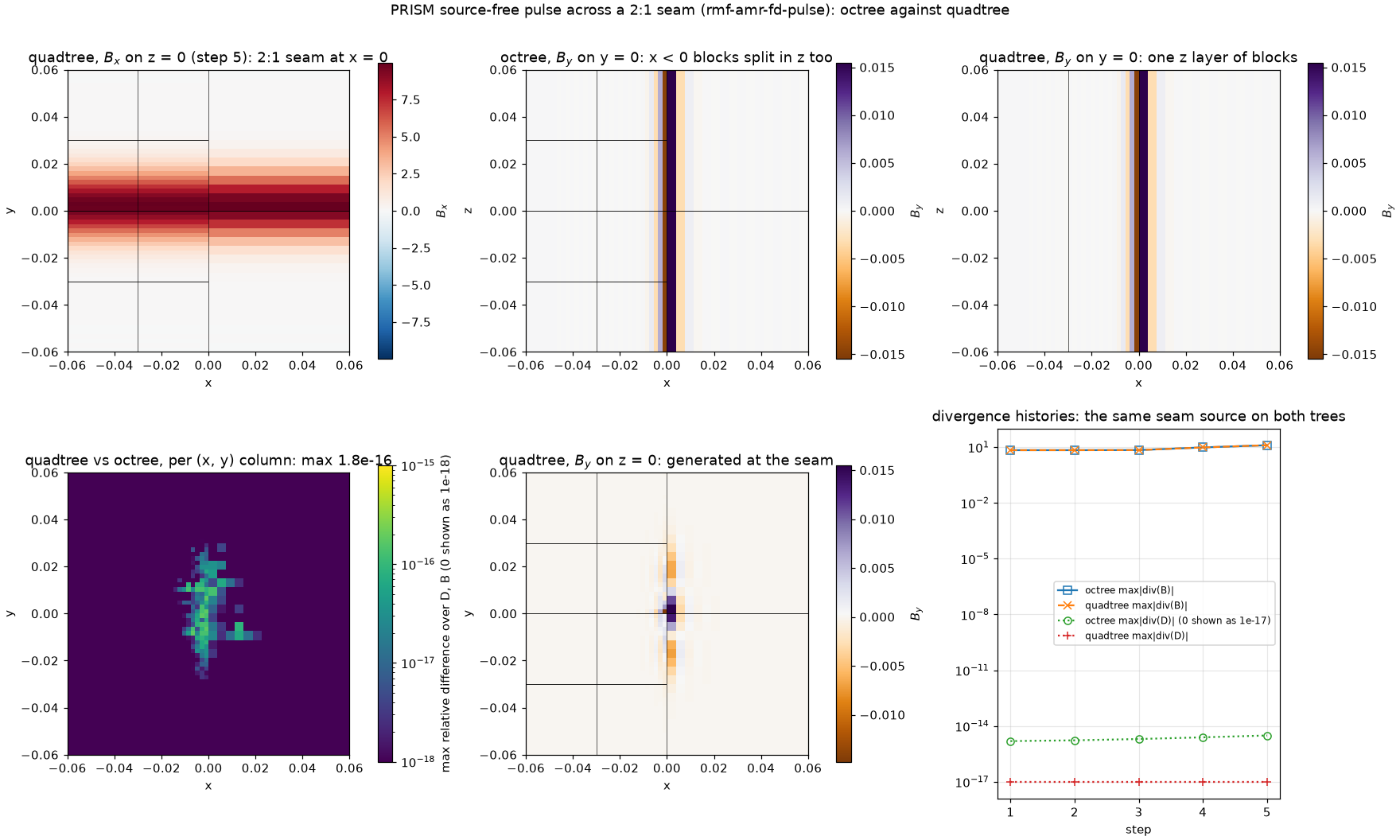 Quadtree 2:1 seams
Forests of realms
Realms glued by inter-realm seams run as one domain: 1:1 seams, seams between misaligned blocks and a 2:1 seam, each against the single-realm run.
Absorbing layers
The far-wave layer and the perfectly matched layer, on uniform and refined grids.
Elliptic solves and particles
The
Input and output
The inputs PRISM refuses, and the slices it writes.
How it was built
The pages in the order the capabilities were implemented, with the issues that built them.
| Built under | Page | Cases / legs |
|---|---|---|
| — (base) | Uniform grid: energy and divergence | periodic-pulse-blocks (digest) |
| #13 (M1–M3), #23, #24, #28 | Static AMR and the FV reflux register | rmf-amr/check.sh: structural, control, register parity |
| #21, #25, #26, #29 | 2:1 seam div(B): truncation order | rmf-amr-fd/check.sh; rmf-amr-fd-pulse/check.sh (control, uniform, seam, RK legs, --convergence) |
| #46 | Quadtree 2:1 seams | rmf-amr-fd-pulse/check.sh, quadtree leg |
| #16, #18, #31 | Inter-realm 1:1 seams: α and β cadence | rmf-2realm, rmf-2realm-asymK, rmf-2realm-stagesync (digests); rmf-2realm-fd-pulse/check.sh |
| #51, #54 | Inter-realm seams between misaligned blocks | rmf-2realm-fv-pulse-blocks/check.sh: small1, small2, one1, one2 |
| #52 | Inter-realm 2:1 seam | rmf-2realm-fd-pulse-refined/check.sh |
| #38 | FV reflux on a capped last step | rmf-amr-fv-pulse-timed/check.sh |
| #31, #58, #95 (P5.1) | Absorbing layers on AMR | rmf-fwl, rmf-fwl-amr, rmf-pml-amr (digests) |
| #11, #55, #56, #57, #61, #84, #111 | Input validation and refusals | refusals.sh (24 legs); rmf-hyperbolic (digest, nv = 11) |
| #84 (E3b, E3c) | t0 elliptic solves on FLAIL | rmf-pec-t0, rmf-open-t0, pic-pec-t0, pic-open-t0 (check.sh each) |
| #111, #112 | PIC: periodic faces and the Fresnel slab | pic-periodic, pic-slab-pulse (pic_check.sh legs) |
| — | Slices output | slices/check.sh (oracle, decomposition, adimensional, --convergence, input) |
Running a case
Every check.sh runs the CPU executable exe/adam_prism_cpu by default; PRISM_EXE selects another one. The PIC cases take the backend as their first argument. mpirun must be on PATH, and the scripts read the Python venv exe/.regression-venv (h5py, numpy) that run.sh creates on its first run.
bash
cd src/tests/prism/regression/rmf-amr-fd-pulse && ./check.sh       # CPU backend
PRISM_EXE=$PWD/../../../../../exe/adam_prism_fnl ./check.sh        # FNL backend (GPU)
./check.sh --convergence                                           # adds the opt-in refinement leg
cd ../pic-periodic && ./check.sh cpu                               # PIC cases: the backend is an argument
cd .. && PRISM_EXE=$PWD/../../../../exe/adam_prism_fnl ./refusals.sh # the init refusals, FNL| Script | Ranks | Options |
|---|---|---|
rmf-amr/check.sh | 1 and 2 | --build |
rmf-amr-fd/check.sh | 1 | --build |
rmf-amr-fd-pulse/check.sh | 1 | --build, --convergence, --keep (keeps the quadtree checkpoints for the figure) |
rmf-2realm-fd-pulse/check.sh | 1 | --build |
rmf-2realm-fv-pulse-blocks/check.sh, rmf-2realm-fd-pulse-refined/check.sh | 2 | --build, --np N |
rmf-amr-fv-pulse-timed/check.sh | 2 | --np N |
{rmf,pic}-{pec,open}-t0/check.sh | 1 and 2 | --build; PRISM_PY selects the Python |
pic-{periodic,slab-pulse}/check.sh <cpu|fnl> | CPU 1; FNL 1 and 2 | --capture; FNL_NP, PIC_CHECK_LAUNCH, PRISM_PY |
slices/check.sh | 1, 2, 4 | --build, --np "N ...", --convergence |
refusals.sh | 1 | none |
--build always builds prism-cpu-gnu, never the PRISM_EXE override. The FNL runs need the NVHPC toolchain on PATH; on the WSL box they also need the UCX settings of run-fnl-local.sh (WSL caveats). The goldened cases are checked by run.sh (running the suite); the oracles are not part of that sweep and are run by hand.
run_verification_legs.sh runs every oracle of this section and logs each case to <outdir>/<case>.log:
bash
src/tests/prism/regression/run_verification_legs.sh $PWD $PWD/exe/adam_prism_cpu /tmp/prism-verif          # CPU
src/tests/prism/regression/run_verification_legs.sh --fnl $PWD $PWD/exe/adam_prism_fnl /tmp/prism-verif    # FNL
The values in the result tables of this section come from these logs (2026-11-08, code at e3da0473): the CPU legs on a medooza node (gfortran 16.2.0, Open MPI 5.0.11), the FNL legs on A30 GPUs (nvfortran 26.9, CUDA 12.9), and slices on the WSL2 workstation (the same compilers, its two GPUs for FNL).
Not done
Analytic oracles for the physics are tracked and not yet implemented:
- #106: plane-wave and Gaussian-pulse convergence, PEC image, cavity mode, PML reflection against the angle of incidence, the infinite wire against Biot–Savart, the Larmor orbit, the plasma frequency;
- #105: the Fresnel slab against its exact spectral solution. The plane-mean agreement with the exact cold slab is already measured on
pic-slab-pulse(PIC page).