Appearance
Lax problem
| ID | Group | Milestone | Backends | Figure | Regression |
|---|---|---|---|---|---|
RV-3 (lax leg) | Euler | M3 (#47) | CPU (all schemes), FNL (weno-riemann HLLC) | yes | — |
Case and scope
The Riemann problem of Lax (1954):
What the case catches:
- a dissipative Riemann solver or a degraded flux correction of
scheme_space = weno-riemann:must stay within the splitting scheme's (owner decision, 2026-09-30); - direction-dependent defects: the problem runs along
, and , and the three runs must be equal bit for bit after the permutation of the axes; - broken 1-D consistency: every transverse copy of the solution, in every block, must be bitwise identical;
- an oracle that ignores the velocity: unlike Sod, the left state moves, so the exact solution must read the normal velocity of the input.
Models and numerics
| Item | Choice | Code |
|---|---|---|
| Equations | compressible Euler, ideal gas, | models |
Space, weno (baseline) | WENO5 (weno-u-5) flux splitting on characteristic variables | compute_residuals_weno, adam_flume_cpu_object.F90; compute_face_split_fluxes, adam_flume_euler_library.F90 |
Space, weno-riemann | WENO5 interpolation of the face states (characteristic), an LLF, HLL or HLLC Riemann flux, the 6th-order flux correction with the WENO-weight sensor | compute_residuals_riemann, adam_flume_cpu_object.F90; compute_riemann_face_fluxes, adam_flume_cpu_riemann_face_kernels_agnostic.INC; compute_riemann_llf, compute_riemann_hll, compute_riemann_hllc, adam_flume_euler_library.F90 |
| Time | SSP Runge–Kutta, 3 stages (runge-kutta-ssp-33), CFL 0.5 | adam_rk_object.F90 |
| Boundaries | zeroth-order extrapolation | set_boundary_conditions, adam_flume_cpu_object.F90 |
| FNL backend | the same kernels on the device | adam_flume_fnl_object.F90 |
The two schemes are described in numerics and numerics.
Initial and boundary conditions
The case is the Sod input with the two region states and the final time rewritten by riemann-flux/check.sh (set_lax).
| Item | Value |
|---|---|
| Domain | |
| Grid | 200 cells: 64 blocks of ngc = 3 |
| Ranks | 2 |
| Left state, | |
| Right state, | |
| Initial condition | riemann-problem, two regions |
| Boundaries | extrapolation on all six faces |
| Final time |
Input files
| File | Role |
|---|---|
src/tests/flume/verification/sod/sod-{x,y,z}.ini | the base inputs, rewritten into the Lax problem |
src/tests/flume/verification/riemann-flux/check.sh --legs lax | rewrites the inputs (set_lax, set_numerics), runs the three directions; --solver split|llf|hll|hllc, --correction, --sensor, --lax-l1-max |
src/tests/flume/verification/sod/sod_oracle.py | the exact solution (normal velocity read from the input), the |
src/tests/flume/verification/make_doc_figures.py (fig_lax) | the figure, from the split, llf and hllc work directories of riemann-flux/ |
bash
cd src/tests/flume/verification/riemann-flux
./check.sh --legs lax                                   # HLLC (default), bound 1.12e-2
./check.sh --legs lax --solver split                    # the splitting baseline
./check.sh --legs lax --solver llf --lax-l1-max X       # LLF needs an explicit bound X
FLUME_EXE=$PWD/../../../../../exe/adam_flume_fnl ./check.sh --legs lax  # FNL
Results
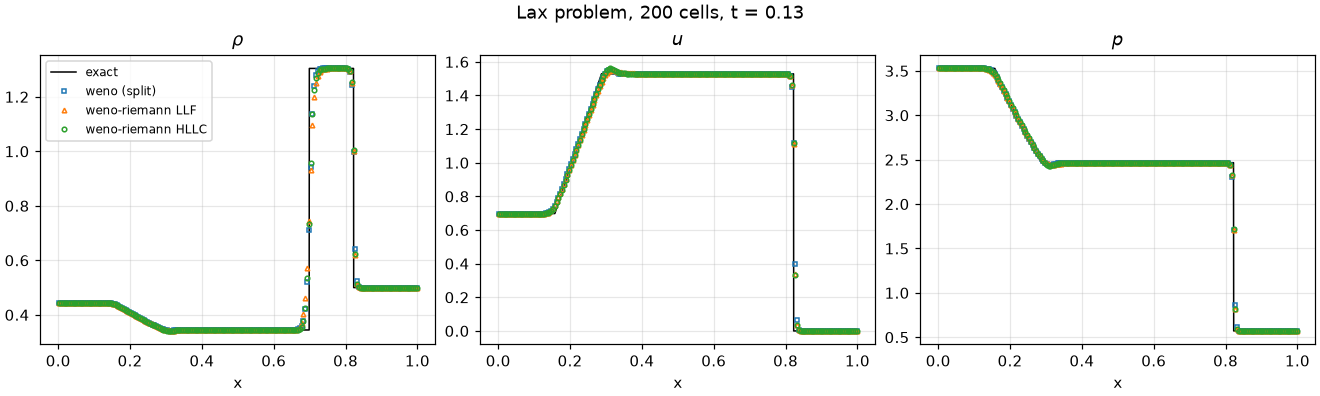
Density at weno-riemann LLF and HLLC against the exact solution.
| Scheme | Bound on | CPU | FNL |
|---|---|---|---|
weno (split) | — | not run | |
weno-riemann LLF | explicit (exceeds the default) | not run | |
weno-riemann HLL | — | not run | |
weno-riemann HLLC (default) | the same | ||
| bitwise | bitwise | bitwise |
HLLC by flux correction (CPU):
| Correction | |
|---|---|
| 6th, WENO-weight sensor (default) | |
| 6th, no sensor | |
| 4th | |
| none |
Related cases: Sod and Shu–Osher compare the same solvers; the scheme study behind the defaults is in src/tests/flume/verification/riemann-flux/README.md.
Findings
- Lax is the one problem where the splitting scheme beats every Riemann solver: HLLC is 1.6% worse. The correction is not the cause (1.8% worse without it). The gap belongs to interpolating the face states and solving the Riemann problem, on a problem measured almost entirely at its discontinuities.
- The WENO-weight sensor is needed: without it HLLC is 6% worse.
- LLF exceeds the default bound and is run with an explicit one.
- The first Lax measurement was wrong:
sod_oracle.pytook both velocities as zero (Sod only). It now reads the normal velocity of the input; the Sod results are unchanged. - Only the default HLLC run exists on FNL; the other schemes were run on the CPU only.