
Appearance
The hybrid central/WENO scheme
| ID | Milestone | Type | Legs | Backends | Figure |
|---|---|---|---|---|---|
| HY | #119 · T2.1–T2.7 | P+C | hy1–hy13 | CPU, FNL | yes |
Case and scope
scheme_space = hybrid-kep-weno (turbulence) uses a 6th-order kinetic-energy- and pressure-equilibrium-preserving central flux at the faces away from shocks and keeps WENO where a Ducros-type sensor flags a cell (T2.1–T2.3). WENO is kept on the skin of 2:1 seams and physical faces by default (hybrid_skin, T2.4). The legs check the central flux, pressure equilibrium (T2.5), the model masked to central cells (T2.6), conservation on every grid path and robustness at shocks (T2.7). The campaign reruns the ILES baseline cases and compares every scheme with the 512³ DNS.
Legs
src/tests/flume/verification/turbulence/check.sh, CPU and FNL.
| Leg | Phase | What it verifies | Measured |
|---|---|---|---|
| hy1 | T2.7 | inviscid Taylor-Green: dissipated | 47 times less on FNL |
| hy2 | T2.3 | one rank against 2 with the hybrid scheme on the random field, where the sensor fires | not recorded |
| hy3 | T2.2 | the central flux (test_kep): order, kinetic energy identity, pressure equilibrium | order 5.96–5.99; |
| hy4 | T2.1 | contact of density ratio 8 and 100 | |
| hy5 | T2.4 | 2:1 box, conservation; passes with any skin | mass |
| hy6 | T2.4 | Sod against WENO | L1 |
| hy7 | T2.4 | runtime regridding; a forest with open ends | |
| hy8 | T2.5 | density wave, amplitude 0.2; WENO holds it too, so this does not separate them | |
| hy9 | T2.6 | model only off flagged cells; one rank against 2; conservation (does not prove the mask on ghost cells) | |
| hy10 | T2.4 | the skin relaxed on 2:1 seams (the hy5 case, central-seams): what conservation does, the last history rows | a measure with no bound: printed, never fails the script |
| hy11 | T2.4 | relaxing the skin changes the density: seams, open ends (does not catch a shifted band) | |
| hy12 | T2.4 | restart on a refined grid, every cell | 0 |
| hy13 | T2.7 | against WENO, L1: a vortex through a shock (2-D), Shu-Osher and a shock through 2:1 seams (1-D, no vorticity, so the Ducros ratio flags any varying flow): robustness, no accuracy claim |
Taylor-Green vortex and isotropic turbulence
| Setup | |
|---|---|
| cases | the ILES baseline inputs with scheme_space = hybrid-kep-weno |
| sensor | thresholds 0.2 and 0.1 and the floor at their defaults (not calibrated) |
| model | none, or Vreman acting off flagged cells only (T2.6) |
| run | turbulence/tgv_campaign.sh, 4 ranks on A30 |
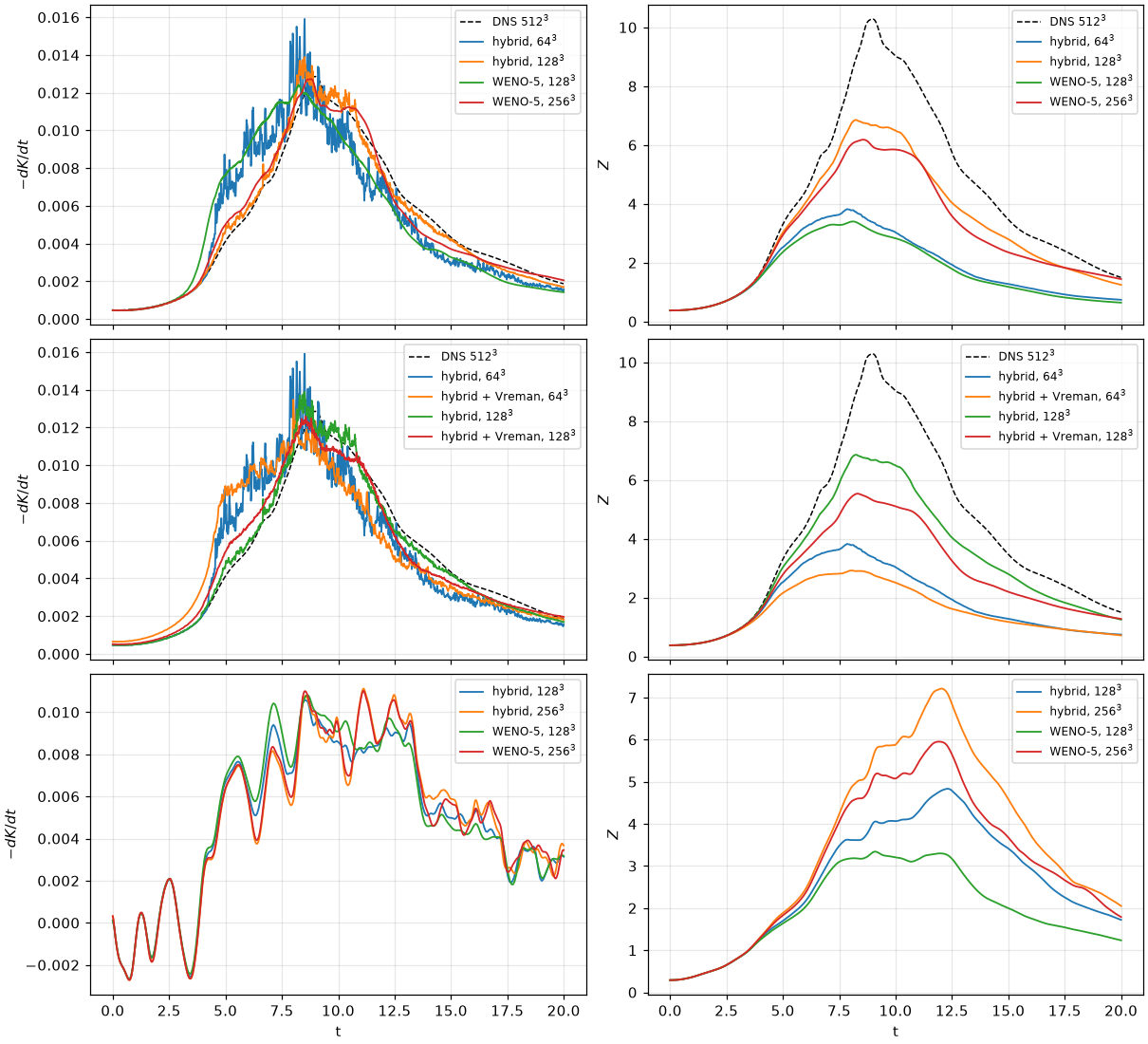
Top: M 0.1, the hybrid against WENO-5; middle: with Vreman; bottom:
| Case, M 0.1 | Peak | Over | at | Flicker, | Peak | Numerical share to the peak |
|---|---|---|---|---|---|---|
| WENO-5, | 0.01377 | 0.01357 | 5.09 | 0.3 % | 1.71 | 77 % |
| hybrid, | 0.01591 | 0.01334 | 8.09 | 7.2 % | 3.82 | 50 % |
| hybrid + Vreman, | 0.01347 | 0.01173 | 8.21 | 3.5 % | 2.92 | |
| WENO-5, | 0.01242 | 0.01216 | 8.29 | 0.5 % | 3.40 | 58 % |
| hybrid, | 0.01389 | 0.01317 | 8.48 | 2.0 % | 6.86 | 18 % |
| hybrid + Vreman, | 0.01258 | 0.01226 | 8.58 | 0.8 % | 5.53 | |
| WENO-5, | 0.01272 | 0.01261 | 8.72 | 0.7 % | 6.18 | 27 % |
The flicker is the rms of
| Case, | Peak | Peak | Numerical share |
|---|---|---|---|
| WENO-5, | 0.01383 / 0.01081 / 0.01101 | 1.81 / 3.34 / 5.95 | 80 % / 46 % / 20 % |
| hybrid, | 0.01266 / 0.01057 / 0.01112 | 2.20 / 4.83 / 7.21 | 73 % / 36 % / 10 % |
| Isotropic turbulence | Peak | |
|---|---|---|
| WENO-5 | 34.5 / 51.0 (60.5 at | 0.303 / 0.384 (0.413 at |
| hybrid | 41.0 / 57.4 | 0.367 / 0.408 |
| hybrid + Vreman | 37.8 / 54.1 |
What it shows.
- At M 0.1 the hybrid at
reaches a higher enstrophy peak than WENO-5 at , and at more than WENO-5 at , with the dissipation peak where the finer runs have it. is still below the DNS's 10.3. - At
the gain is smaller: the sensor keeps WENO around the shocklets. - The raw peak of
is not a measure on the hybrid. It flickers, 7 % at , 2 % at . The source is not established; the sensor switching on and off is the first candidate. Smoothed, the hybrid is 4–6 % above WENO-5 at . - Vreman on the hybrid removes half of the flicker and lowers
by 20 %. At it lands below the finer runs (0.0117). Against the DNS it makes the hybrid worse at both resolutions (below).
On a 2:1 box, and what the skin costs
| Setup | |
|---|---|
| grid | M 0.1, base |
| skin | hybrid_skin = weno (default) or central-seams |
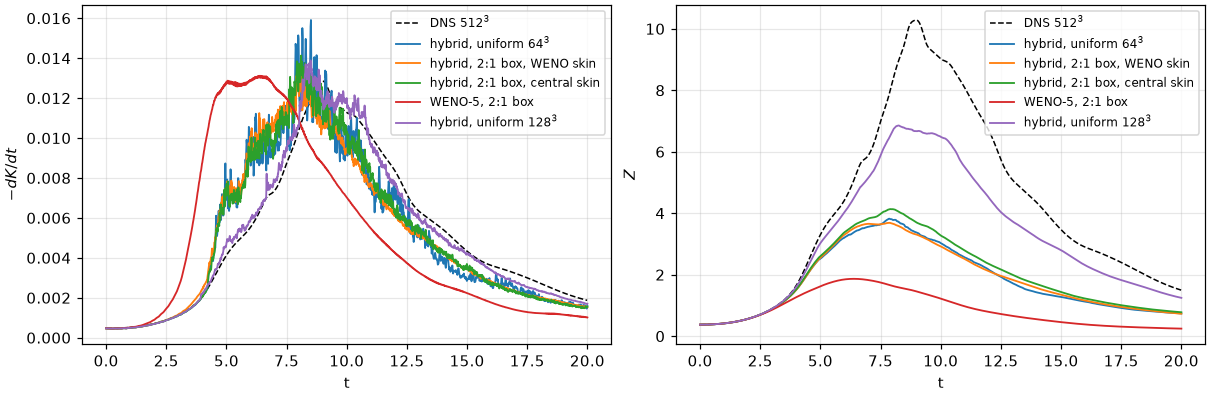
M 0.1, a box of half the side refined once on
| Case | Smoothed peak | Peak |
|---|---|---|
| WENO-5, box | 0.01304 | 1.87 |
| hybrid, box, WENO skin (default) | 0.01239 | 3.69 |
| hybrid, box, central skin | 0.01319 | 4.13 |
| hybrid, uniform | 0.01333 | 3.82 |
What it shows.
- With the WENO skin the box ends below the uniform run in
: the skin takes more than the extra cells give. - The central skin is stable to
and above the uniform run. Against the DNS it is the closer one (table below), on this smooth flow; the case with a shock has no reference. - A shock through the seams runs with the central skin. A vortex after Jiang & Shu (the code's profile, same strength and radius, unit square) through a Mach 1.1 shock crossing the box seams differs from the WENO skin by at most
in density at .
Against the DNS
M 0.1 against the 512³ DNS, from turbulence/tgv_dns.py. Peak
| Case | Peak | at | Peak | at | L2 | L2 | L2 |
|---|---|---|---|---|---|---|---|
| DNS | 0.01286 | 8.97 | 10.29 | 8.97 | |||
| WENO-5, | 0.01357 | 5.09 | 1.709 | 6.25 | 0.660 | 0.844 | 0.187 |
| WENO-5, | 0.01216 | 8.29 | 3.400 | 8.11 | 0.278 | 0.643 | 0.083 |
| WENO-5, | 0.01260 | 8.72 | 6.182 | 8.56 | 0.090 | 0.331 | 0.020 |
| HLLC, | 0.01235 | 8.32 | 3.585 | 8.11 | 0.260 | 0.623 | 0.070 |
| WENO-7, | 0.01215 | 8.11 | 3.171 | 8.14 | 0.291 | 0.688 | 0.101 |
| WENO-9, | 0.01274 | 8.27 | 4.454 | 8.03 | 0.177 | 0.539 | 0.037 |
| Vreman, | 0.01373 | 5.11 | 1.591 | 6.23 | 0.671 | 0.854 | 0.200 |
| Vreman, | 0.01193 | 8.28 | 3.177 | 8.15 | 0.295 | 0.662 | 0.092 |
| WALE, | 0.01183 | 8.26 | 3.164 | 8.16 | 0.296 | 0.660 | 0.091 |
| Sigma, | 0.01192 | 8.29 | 3.184 | 8.14 | 0.293 | 0.660 | 0.091 |
| WENO-5, 2:1 box | 0.01304 | 6.41 | 1.865 | 6.39 | 0.617 | 0.829 | 0.178 |
| hybrid, | 0.01333 | 8.09 | 3.822 | 7.86 | 0.237 | 0.615 | 0.057 |
| hybrid, | 0.01317 | 8.47 | 6.856 | 8.25 | 0.067 | 0.271 | 0.014 |
| hybrid + Vreman, | 0.01173 | 8.21 | 2.917 | 8.09 | 0.283 | 0.678 | 0.086 |
| hybrid + Vreman, | 0.01226 | 8.58 | 5.529 | 8.33 | 0.114 | 0.400 | 0.029 |
| hybrid, 2:1 box, WENO skin | 0.01239 | 8.14 | 3.688 | 7.88 | 0.269 | 0.618 | 0.063 |
| hybrid, 2:1 box, central skin | 0.01319 | 8.11 | 4.134 | 7.91 | 0.236 | 0.580 | 0.059 |
What it shows.
- The hybrid at
is closer than WENO-5 at on all three errors, with one eighth of the cells. At it is closer than WENO-5 at . - Its peak of
is 2.4 % above the DNS and comes at rather than 8.97; at reaches two thirds of the DNS peak, so the gradients are not converged. - A model makes it worse. Vreman takes the
error from 0.067 to 0.114 and the error from 0.27 to 0.40 at . All three models also worsen WENO-5. At Re 1600 the subgrid scales are not far from resolved, and the constants were not tuned; on these integrals no model is recommended. - WENO-9 at
(0.177) is much closer than WENO-5 (0.278); WENO-7 is further (0.291), see the ILES baseline. - The skin. On the 2:1 box the WENO skin (0.269) is further than uniform
(0.237); the central skin ties it on (0.236) and beats it on (0.580 against 0.615). Smooth flow only.
The flow
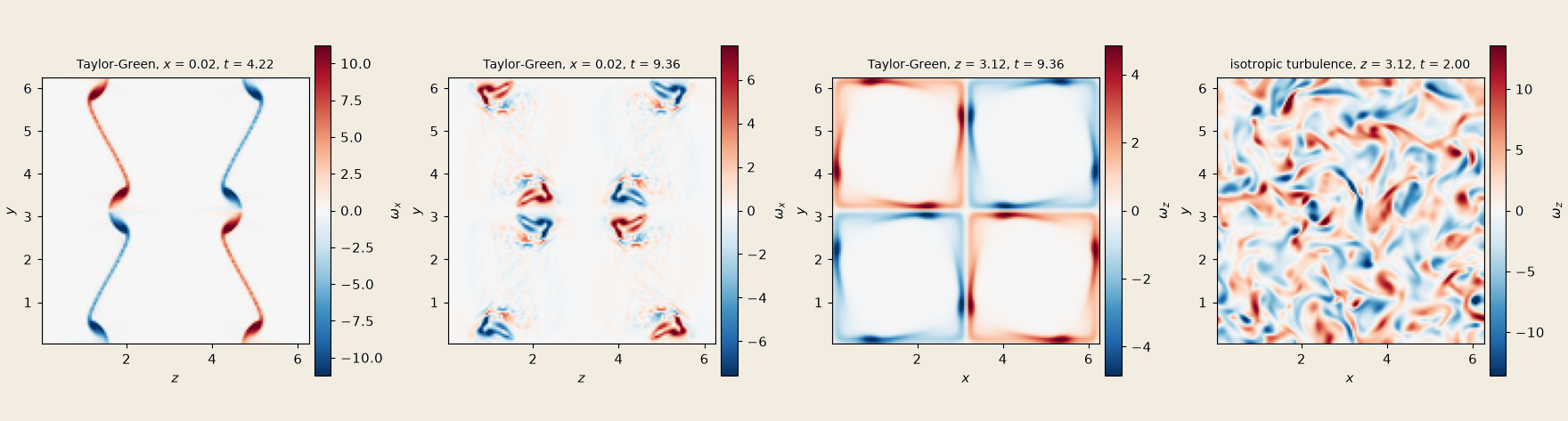
hybrid-kep-weno at tgv_cases_vis.txt). Taylor-Green, Re 1600, Mach 0.1: turbulence/field_slices.py --time; make_doc_figures.py --only tgv-fields.
- At
the vorticity is still in sheets; by they have rolled up and broken into the small structures of the transition. - The flow's mirror symmetries survive the breakdown. On the face
, is antisymmetric about and about to of its maximum at (0 at ), as the initial condition is. - On
the flow is still large-scale at : four counter-rotating cells with thin layers at their edges. - The isotropic field shows no visible imprint of the blocks (
per direction). One plane, one time: a description, not a measurement.
Cost
200 steps on
| Case | Wall time |
|---|---|
| WENO | 24.1–24.6 s |
| hybrid, every cell flagged | 24.2–24.7 s |
| hybrid, every cell central | 26.7–26.9 s |
The sensor costs under 1 %, the central flux about 10 % on top of WENO, startup included. The scheme runs both flux kernels; a single kernel with a mask was not tried, so what skipping WENO would save is not measured.
Not done
- Calibration of the sensor thresholds and floor.
- The source of the flicker of
. - A model masked by face rather than by cell; the mask on ghost cells at an interface.
central-bcson a forest seam (the sensor ghost is computed locally there).- A shock case with a reference for the relaxed skin.
- A single flux kernel with a mask.