Appearance
MHD blast symmetry on the flux-splitting path
| ID | Group | Milestone | Backends | Figure | Regression |
|---|---|---|---|---|---|
| #77 study, bounded by av3c | Runtime AMR (M5) | M5 (#74), #77 | CPU, FNL | yes | blast-limiter |
Case and scope
The Balsara–Spicer blast of blast-limiter and av3b starts exactly point-symmetric. Ideal MHD maps it onto itself under the rotation by π about the centre composed with
What the study would catch: an asymmetric defect of the scheme (an operator that is not invariant under the rotation), a grid-scale instability, or a backend divergence hidden behind a symmetric initial condition.
Models and numerics
| Item | Choice | Code |
|---|---|---|
| Equations | ideal MHD, | models, EGLM |
Space, weno | WENO5 flux splitting, characteristic reconstruction; one Lax–Friedrichs speed per MHD wave | compute_residuals_weno, adam_flume_cpu_object.F90; mhd_eglm_face_split_fluxes, mhd_eglm_eigenvectors, adam_flume_mhd_library.F90; numerics |
Space, weno-riemann | HLLD with and without the 6th-order correction, LLF, HLLD with primitive interpolation | compute_residuals_riemann, adam_flume_cpu_object.F90; adam_flume_cpu_mhd_eglm_hlld_kernels.F90; numerics |
| Positivity limiter | positivity_limiter = cell | limit_positivity, adam_flume_cpu_object.F90; numerics |
| Time | runge-kutta-ssp-54, CFL 0.4 | adam_rk_object.F90 |
| FNL backend | the same scheme on the device | compute_residuals_weno_dev, limit_positivity_dev, adam_flume_fnl_object.F90 |
Initial and boundary conditions
| Item | Value |
|---|---|
| Domain | periodic on the |
| Grid | the uniform blast of av3b: quadtree, |
| Ranks | 2 |
| Initial condition | riemann-problem regions: |
| Final time | |
| Asymmetry of a field |
Input files
| File | Role |
|---|---|
src/tests/flume/regression/blast-limiter/input.ini | the blast (written by verification/mhd/positivity-probe/make_blast.py --cells 64 --eglm); its golden is per backend |
src/tests/flume/verification/mhd/positivity-probe/make_blast.py | the blast generator (--b0 for the β probe) |
src/tests/flume/verification/regrid/make_regrid.py (blast-av) | the av3b and av3c inputs |
src/tests/flume/verification/regrid/accuracy.sh --legs av3c | the symmetry bound on the Riemann-flux path |
src/tests/flume/verification/regrid/av_oracle.py (blast) | the point-symmetry measure, bound |
src/tests/flume/verification/make_doc_runs.sh <runs> blast77 (FNL), make_doc_figures.py --only mhd-blast-symmetry | re-runs the uniform blast on the splitting scheme and on HLLD with a checkpoint every 20 steps |
bash
cd src/tests/flume/verification/regrid && ./accuracy.sh --legs av3c         # CPU
FLUME_EXE=$PWD/../../../../../exe/adam_flume_fnl ./accuracy.sh --legs av3c  # FNL
The probes of the table below are investigation runs, not legs of a script.
Results
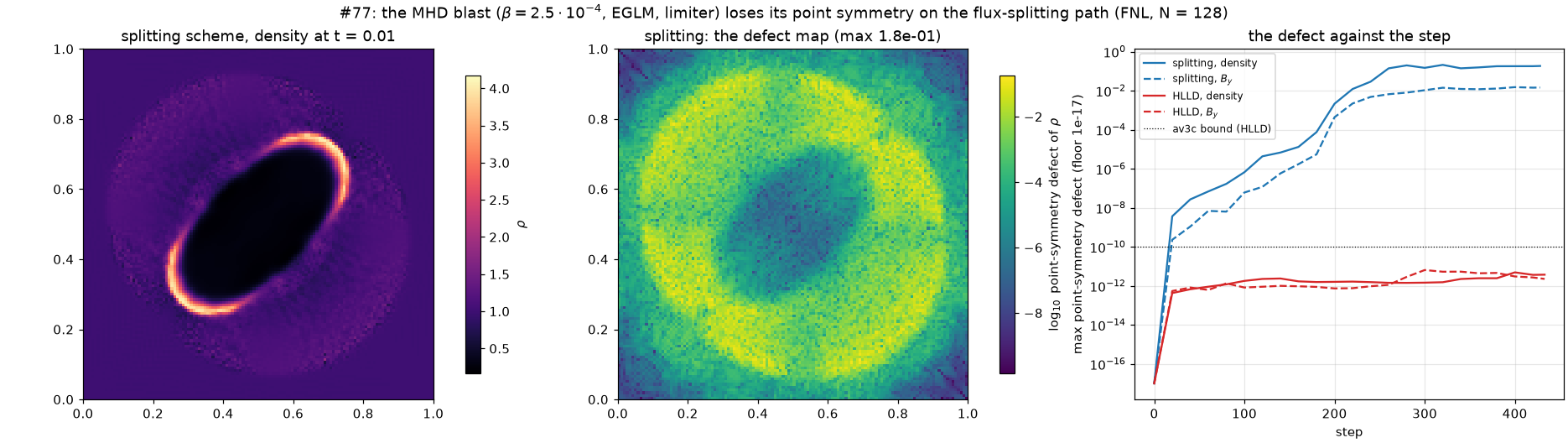
The uniform weno-riemann HLLD it stays near
| Probe | Result |
|---|---|
| HEAD, after the #79 fix (CPU) | ρ 0.16 pointwise; in L1 only 2.3·10⁻²: the pointwise figure is a shock shifted by a few cells. CPU against FNL 0.16 |
| first steps | 1.2·10⁻¹⁰ after one step, at the front cells in the low-β gas; exponential growth from step 60 (e-folding in 10–15 steps), saturation at O(0.1) by step 220 |
| N = 64 / 128 / 256 | the asymmetry reaches 10⁻² at t = 0.0094 / 0.0047 / 0.0024: the growth rate scales as 1/Δx, a grid-scale instability, not a physical one (whose rate would converge) |
| CFL 0.4 → 0.2 | 10⁻² at t = 0.0047 / 0.0041: the spatial operator, not the time integrator |
| β × 10 / × 100 (B / √10, B / 10) | 6.8·10⁻⁸ at t = 0.01, still growing / 2·10⁻¹⁰, flat: a low-β effect |
| conservative reconstruction | the same growth, about 100 steps later |
| limiter off (floors 0.01), EGLM or GLM | NaN at step 8: the limiter keeps the run alive |
weno-riemann: HLLD with and without the 6th-order correction, LLF, HLLD with primitive interpolation | symmetric to 10⁻¹² – 10⁻¹⁰ through t = 0.01 |
| positivity limiter activity | flux splitting: faces limited at every step (428 of 428; β × 100: 46 of 384); weno-riemann: only in the first 17–27 steps. The backbone flux the limiter falls back to is the same on both paths |
The bound that closes the study (av3c, weno-riemann with riemann_solver = hlld):
| Check | Bound | CPU | FNL |
|---|---|---|---|
| point symmetry, uniform | |||
| point symmetry, tracked (3 regrids) | |||
| shock radius on the four half-axes | — | the same on both runs | — |
Related cases: the regridded blast is av3b and av3c of AV; the limiter itself is the positivity limiter case; the Riemann-flux path is MHD on weno-riemann.
Findings
- Diagnosis. At β ≈ 2.5·10⁻⁴ the
wenoflux splitting keeps producing nearly inadmissible states at the blast front, the positivity limiter clips them at every step, and the round-off asymmetry of the arithmetic grows at the grid scale from 10⁻¹⁰ to O(0.1). The Riemann-flux path does not produce those states past the first steps and stays symmetric. The limiter's part rests on correlation and elimination (it acts at every step exactly where the scheme is unstable, and the scheme cannot run without it), not on a direct measurement of its amplification. - A fix tried and not kept. One Lax–Friedrichs speed for the seven MHD waves (the stencil's fast bound) instead of one per wave, the cleaning pair unchanged, delays the growth (N = 128: 5.8·10⁻⁵ at t = 0.01; N = 256 saturates at 4·10⁻³ instead of 0.17) but does not stop it, keeps the limiter acting at every step, and raises the MV-5 errors 2 to 4 times on smooth waves (orders kept, every fixed bound failed).
- Resolution (accept and bound). On the flux-splitting path at β ≲ 10⁻³ the point symmetry, and the agreement of the two backends, hold only to the grid-scale instability above: the shock positions agree within a few cells, the pointwise fields do not. That path keeps its golden (
blast-limiter: each backend is compared with its own golden, which a deterministic run reproduces; symmetry is not asserted). For low-β problems where symmetry or backend agreement matter, usescheme_space = weno-riemannwithriemann_solver = hlld; av3c bounds that path.