Appearance
Shock generator and regular reflection
| ID | Milestone | Type | Legs | Backends | Figure |
|---|---|---|---|---|---|
| SG | #121 · S3, S4a | P | sg1–sg4 (boundary) | CPU, FNL | yes |
Case and scope
[bc_y_max] type = shock-generator (boundary conditions) brings an oblique shock in through the top face. The legs measure the shock it makes against the oblique-shock relations (S3) and its regular reflection off a slip wall (S4a), with shockgen_oracle.py, which solves the relations on its own. These sg legs belong to src/tests/flume/verification/boundary/check.sh, not to the subgrid-scale models.
Setup
| Setup | |
|---|---|
| box, cells | |
| gas | Euler, |
| boundary | inflow at extrapolation at wall-inviscid for sg4); shock-generator at shock_x = 0.5 ( |
| scheme | WENO-U-5 characteristic, SSP-54, CFL 0.5, 2 ranks, to |
| script | src/tests/flume/verification/boundary/check.sh |
Results
| Leg | Case | Oracle | Measured (CPU; FNL the same to the digits shown) |
|---|---|---|---|
| sg1 | the shock by its deflection | the uniform region behind it (16 cells off the shock, 4 below the streamline from its foot, above | |
| sg2 | the same shock by its angle (shock_angle 39.313932) | as sg1 | the same digits |
| sg3 | a shock entering beyond the box (shock_x 3) | equal to an extrapolated top bit for bit | 0 of 64 datasets differ |
| sg4 | the regular reflection off a slip wall (S4a): wall-inviscid at shock_x = 0.1 (the shock meets the wall at | behind the reflected shock (8 cells off it and off the wall) |
The incident shock
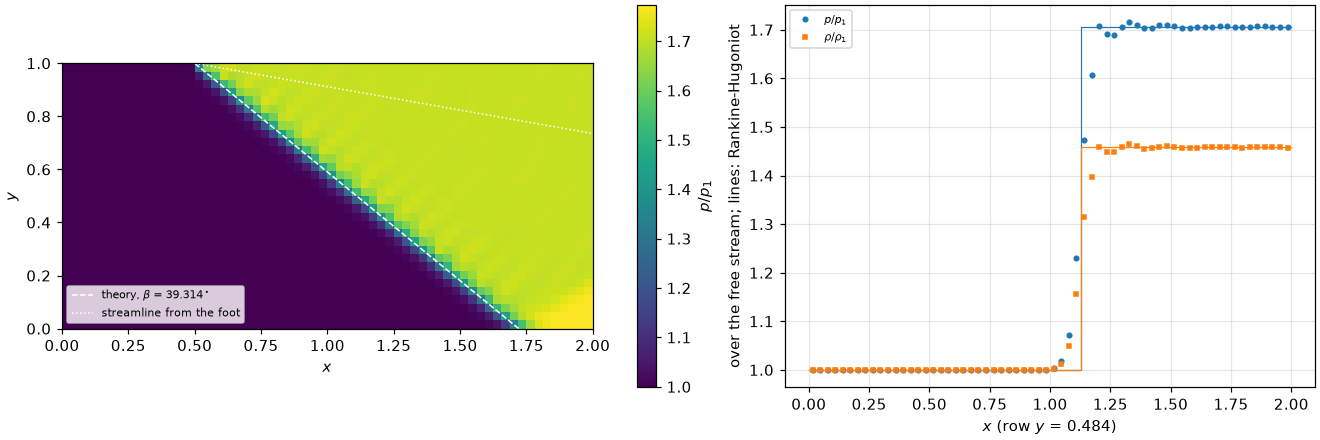
Left:
What it shows.
- The shock is where the relations put it. Its angle is within
of , and it meets the top within a cell of shock_x; behind it the state is Rankine–Hugoniot's within. - What the oracle leaves out, and why. The captured shock leaves oscillations of a few
that decay over 16 cells behind it (the staircase of an oblique shock on a Cartesian grid). The jump of the ghost state at shock_xleaves an entropy streak along the streamline from the foot (7e-3 off, the pressure continuous). Where the shock leaves through the extrapolated bottom, the corner downstream sits up to 4 % high: an extrapolated face crossed by an oblique shock is not clean. In a shock/boundary-layer interaction the shock meets the wall instead.
Regular reflection off a slip wall
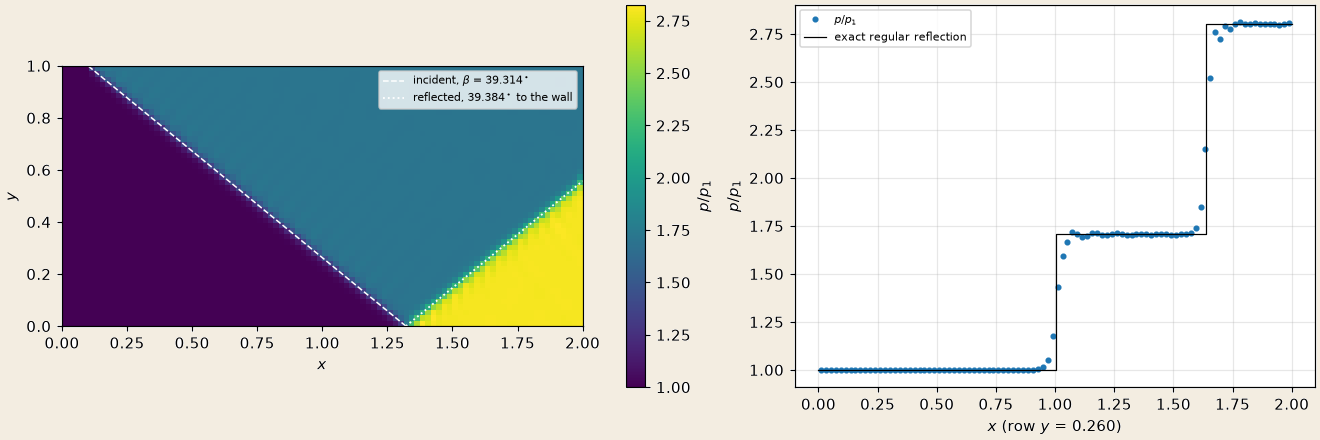
Leg sg4. Left:
What it shows.
- The reflection is the exact one. Behind the reflected shock the state is within
of , the flow parallel to the wall within , and the reflected shock lies within of its angle, its foot within a cell of where the incident shock meets the wall. - It needs the steady state. At
the region behind the reflected shock is still 6 % low near the outflow: the reflected shock forms at the wall and straightens outward, so the leg runs to .
The viscous interaction with a turbulent boundary layer is S4b.