Appearance
Shock crossing a static 2:1 face
| ID | Group | Milestone | Backends | Figure | Regression |
|---|---|---|---|---|---|
| AS (A3, C3, C3b, C3c) | Seam accuracy and divergence | M6 (#68) | CPU, FNL (Sod); FNL only (RJ2a, C3, C3c) | yes | — |
Case and scope
The Sod problem (V1) and RJ2a (MV-4) run on the V1 grid with one 2:1 face at
The committed shock-across-a-seam checks (the multirealm legs, the sod-amr goldens) compare FLUME runs with each other, so an error common to all of them passes. AS compares with the exact solution. A seam can fail a shock in three ways a run-to-run comparison does not see.
What the case catches:
- a conservation defect: the mass integral against the exact one, and the shock landing in the wrong place;
- a reflection: acoustic waves left in the plateau behind the shock (velocity and pressure);
- an entropy glitch: a density and entropy defect at constant pressure, advected away from the face by the flow;
- a transverse dependence of the 1-D solution (the spread among the transverse copies must stay at round-off).
AS is the shock baseline of the seam remedies of #68 C, D and E (D2's "no worse than tricubic"). C3 reruns it under the 6-point restriction, C3b profiles the FNL cost, C3c adds the WENO restriction.
Models and numerics
| Item | Choice | Code |
|---|---|---|
| Equations, Sod | compressible Euler, ideal gas, | models |
| Equations, RJ2a | ideal MHD, divergence_control = none; in 1-D | models |
| Space | WENO5 (weno-u-5) flux splitting on characteristic variables | compute_residuals_weno, adam_flume_cpu_object.F90; compute_face_split_fluxes, adam_flume_euler_library.F90; mhd_face_split_fluxes, adam_flume_mhd_library.F90 |
| Time | SSP Runge–Kutta, 3 stages (runge-kutta-ssp-33), CFL 0.5 | adam_rk_object.F90 |
| Fine-to-coarse ghosts | mean (A3); lagrange6 and weno6 (C3, C3c) | update_ghost_local, restrict_seam_high_order, adam_field_object.F90; seam_restriction_weno6, seam_weno6_core, seam_restriction_meta_pack, adam_seam_interpolation_library.F90 |
| Coarse-to-fine ghosts | tricubic | interp_seam_ghost, adam_field_object.F90 |
| Reflux | Berger–Colella, on; off only as a measurement (--no-reflux) | accumulate_seam_fluxes, apply_reflux_to_stage_forest, adam_flume_cpu_object.F90 |
| Boundaries | extrapolation on all six faces | boundary conditions |
| FNL ghost kernel | the local ghost update, its map loops collapsed (C3b) | update_ghost_local_gpu_dev, adam_fnl_field_kernels.F90 |
C3c, the WENO restriction ([amr] seam_restriction = weno6, #68 C3). Per direction, the WENO-Z combination (Borges et al. 2008, test_seam_interpolation (src/tests/amr/test_seam_interpolation.F90) checks it: exact on cubics at any scale and offset, design orders on smooth data, the fine pair's own state across a jump elsewhere and the mean of a jump inside the pair, mirror-symmetric on random data.
Initial and boundary conditions
| Item | Sod | RJ2a |
|---|---|---|
| Domain | the same | |
| Base grid | octree (ratio = 8), the V1 grid: four blocks along ngc = 3; | the same, |
Refined side, c2f | the same | |
Refined side, f2c | the same | |
| Refinement | one 2:1 level at initialisation (primitive-box marker, max_level = 3, no regridding); the octree refines the null | the same |
| Uniform controls | c2f is f2c | the same |
--long | adds the refined runs at | the same |
| Initial condition | riemann-problem, | riemann-problem, the RJ2a states of MV-4, discontinuity at |
| Boundaries | extrapolation on all faces | the same |
| Final time | ||
| Ranks | 2 | 2 |
| C3 variant | --seam-restriction R: the null | the same |
Cost, 2 ranks: Sod about 7 min on the CPU and 8 min on FNL; RJ2a about 25 min on FNL and hours on the CPU (the octree refinement holds 88 and 200 blocks per rank against 32), so the RJ2a leg runs on FNL; the refined RJ2a runs alone take 5 to 14 minutes there.
Input files
| File | Role |
|---|---|
src/tests/flume/verification/amr-shock/make_amr_shock.py | writes the inputs from sod/sod-x.ini (Sod) or mhd/rj2a/make_rj2a.py (RJ2a); --side c2f or f2c, --uniform, --no-reflux, --seam-restriction, --reflux-policy, --it-save |
src/tests/flume/verification/mhd/amr_box.py | refine_box: the refined side, one 2:1 level at initialisation |
src/tests/flume/verification/amr-shock/amr_shock_oracle.py | mass, shock position, plateau, band and spread against the exact solution |
src/tests/flume/verification/make_doc_runs.sh <runs> seams, make_doc_figures.py --only shock-crossing | re-runs the Sod crossings as-c2f, as-f2c and the uniform controls with checkpoints kept (CPU); rj2a-shock (FNL) the RJ2a crossings as-rj2a-{c2f,f2c,uniform} |
src/tests/flume/verification/amr-shock/check.sh | runs the legs (--legs sod,rj2a, --long, --np N, --keep) |
src/tests/flume/verification/mhd/positivity/check.sh | the PV-5 blast across 2:1 seams (C3; --legs pv5, not a default leg) |
src/tests/amr/test_seam_interpolation.F90 | the unit test of the seam interpolants and restrictions (C3c) |
bash
cd src/tests/flume/verification/amr-shock && ./check.sh --legs sod   # CPU
FLUME_EXE=$PWD/../../../../../exe/adam_flume_fnl ./check.sh          # FNL, both legs
FLUME_EXE=$PWD/../../../../../exe/adam_flume_fnl ./check.sh --long   # adds the refined runs at 2N
The C3 and C3c runs reuse make_amr_shock.py --seam-restriction R; the C3 PV-5 runs are the positivity PV-5 blast with nk widened to 8.
Oracle (amr_shock_oracle.py):
- mass: the relative defect of the mass integral against the initial mass plus
times the net inflow at the ends (their states never change by ); - shock: the mass-equivalent shock position (the step holding the mass of the cells within
of the exact shock, so a smeared profile counts as its integral) minus the exact one, in local cells; - plateau: between the left wave (Sod: the contact; RJ2a: the rotational discontinuity) and the shock,
away from both: for , and ( ahead of the shock, behind it), and of and its mean; - band: the same maxima over the cells within
ngcof their own spacing from the face; - spread: the largest relative difference among the transverse copies of a column.
| Bound | Value |
|---|---|
| mass defect | |
| spread | |
| every plateau and band metric | at most the baseline ( |
Results
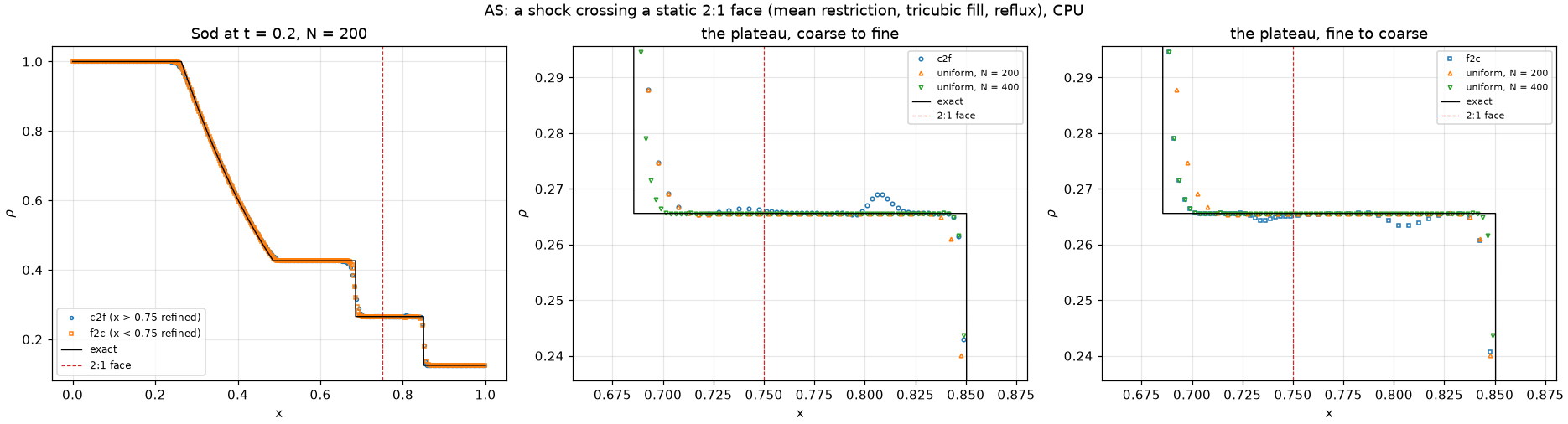
Sod at
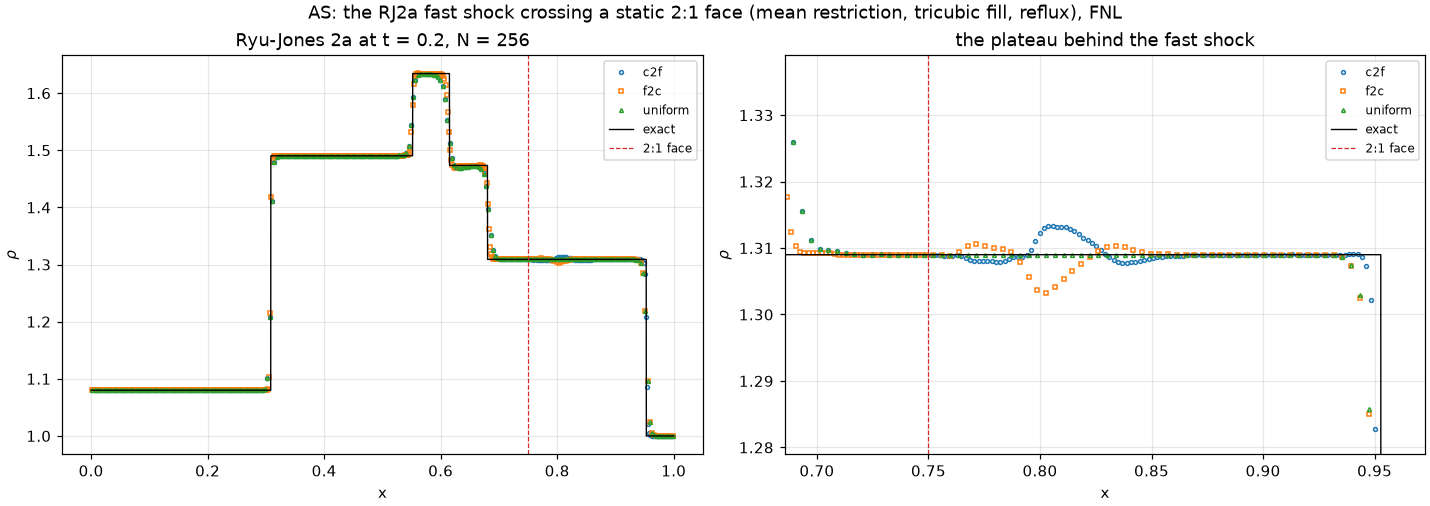
RJ2a at make_doc_runs.sh <runs> rj2a-shock): the density against the exact solution and the plateau behind the fast shock with the uniform control; the same signature as on Sod, a bump behind the face after c2f and a dip after f2c, which the uniform run does not have.
A3 (2 ranks; Sod: CPU and FNL agree to every printed digit; RJ2a: FNL). Plateau maxima of the refined run and, in brackets, of its uniform control at the spacing of the side that holds the shock:
| Case | Shock (cells) | ||||
|---|---|---|---|---|---|
| Sod c2f, N = 200 | 0.16 (0.17) | ||||
| Sod c2f, N = 400 | 0.16 (0.17) | ||||
| Sod f2c, N = 200 | 0.18 (0.17) | ||||
| Sod f2c, N = 400 | 0.18 (0.17) | ||||
| RJ2a c2f, N = 256 | 0.11 (0.11) | ||||
| RJ2a f2c, N = 256 | 0.11 (0.11) |
With the reflux turned off (make_amr_shock.py --no-reflux, a measurement only): mass defect
C3: the 6-point restriction at shocks
lagrange6 is linear and unlimited, so it could overshoot where a shock lies in its footprint (#68 C3). The AS cases rerun under either restriction on the widened grid (the mean run on it reproduces the AS baseline to every printed digit). FNL, 2 ranks:
| Case | Plateau | Plateau | Plateau | Band | Band | Shock (cells) |
|---|---|---|---|---|---|---|
| Sod c2f, mean / lagrange6 | 0.158 / 0.158 | |||||
| Sod f2c, mean / lagrange6 | 0.177 / 0.177 | |||||
| RJ2a c2f, mean / lagrange6 | 0.109 / 0.109 |
The PV-5 blast (the limited Balsara–Spicer blast across 2:1 seams, nk widened to 8) passes under both restrictions and both schemes:
C3b: the cost was the ghost kernel
Profiled with Nsight Systems (40 PV-5 steps, one rank), the local ghost update was 98 % of the FNL GPU time even with the mean: 0.70 s per call. nvfortran parallelised its loop over the variables only (9 threads) and ran the map rows in sequence (a "loop carried dependence" through the indirect writes): the schedule #27 specifies the fix for, and that #53 measured as the dominant FNL cost. With the two loops collapsed, as the other map kernels are:
| Run | Before | After |
|---|---|---|
local ghost kernel over 444 calls, mean | 310 s | 0.84 s |
local ghost kernel over 444 calls, lagrange6 | 815 s | 1.39 s |
full PV-5 split run, mean | 1955 s | 276 s |
full PV-5 split run, lagrange6 | 4900 s | 288 s (premium 4 %, with 5 % more steps) |
The results are bitwise identical. WSL timings: #27 asks for the benchmark on a real node.
C3c: the WENO restriction
| Check (FNL, 2 ranks) | mean | lagrange6 | weno6 |
|---|---|---|---|
| AO euler, reflux off, N = 256: L1 all / band, Linf | — | ||
| AO orders L1 / Linf (128 → 256) | — | 5.33 / 5.53 | 5.34 / 5.53 |
| Sod c2f plateau | |||
| Sod f2c plateau | |||
| RJ2a c2f plateau | |||
| PV-5 split / HLLD: most faces limited in a stage | 48512 / 17920 | 46336 / 17920 | 48064 / 17920 |
| PV-5 split wall (WSL, after C3b) | 276 s | 288 s | 278 s |
The AO rows are the legs euler-l6 and euler-w6 of AO, which CPU and FNL reproduce to every printed digit.
Related cases: AO is the smooth baseline of the same operators; the seam studies D1, D2, E0 and E2 rerun these crossings; the uniform references are Sod and Ryu–Jones 2a; the blast is the positivity limiter case PV-5.
Findings
- The reflux does what it is for. Mass is exact (to the floor the uniform RJ2a run shares), and the shock lands where the uniform run puts it. Without the reflux the mass drifts by
and the shock moves by a fraction of a cell. - A shock crossing a 2:1 face leaves an
error behind it. The plateau carries a density and entropy defect of 0.6 to 2.5 % of the shock jump and acoustic waves of 0.08 to 1 % in velocity and pressure: 4 to 4800 times the uniform level. This error does not converge: from to 400 the maxima stay the same while the uniform level falls up to 14 times; only the width of the defect shrinks (the mean entropy error halves). - It is not the reflux. Without the reflux the plateau defect changes by at most 30 %. A3 placed its source in the coarse-fine transfer of a discontinuity, the mean restriction and the prolongation of the ghosts, which Phases C and D replace; E0 later showed that no seam operator controls it: it is a capturing error.
- The entropy defect leaves the face. It moves with the flow,
downstream of the face by , so the band entropy maxima are 100 to 1900 times below the plateau ones; the acoustic maxima of Sod c2f still sit at the face. - C3: the 6-point restriction does not worsen a shock crossing. Every plateau and band defect is within 2 % of the mean's (the RJ2a band density 2 % above, the others equal or below), and the shock lands in the same place with the mass exact. The defect behind a crossing shock does not come from the restriction's order.
- C3: it does not worsen positivity. The limited blast passes as with the mean, with no more faces limited.
- C3: on FNL it was slow on an octree, 2.4 to 2.5 times the mean's wall time: a restricted ghost reads 216 fine cells, one after the other, in the loop that copies the other ghosts. The nonlinear
weno6followed as an option, not as a fix. - C3b: the cost was the ghost kernel, for every regime. Collapsing its two loops cut the full PV-5 run from 1955 s to 276 s (mean) and from 4900 s to 288 s (
lagrange6), bitwise identical. - C3c: on the smooth vortex
weno6equalslagrange6(the band L1 13 % lower): no jump is detected, and the fourth-order rows at the donor block's edge do not show at these resolutions. The AO legeuler-w6asserts it. - C3c: at shocks it is as neutral as
lagrange6: shock positions identical, mass exact, every defect within 1.5 % of the mean's; PV-5 passes under both schemes with no inadmissible stage. Neither 6-point restriction makes a shock crossing worse, so the default staysmeanuntil Phase D/E evidence;weno6is the option for data with jumps inside the restriction footprint that these cases do not produce. - Multirealm leg 6 runs both regimes (bitwise unions), and GP probes
weno6onbox3d,channel2dandrefined3d.