Appearance
Quadtree AMR
| ID | Group | Milestone | Backends | Figure | Regression |
|---|---|---|---|---|---|
| MV-15 | Ideal MHD | #46 (no milestone, after M3) | CPU, FNL | yes | — |
Case and scope
A quadtree (ratio = 4) refines nk = 4.
MV-15 runs the same 2-D problem on three trees, keys the cells by
- the octree with null
, nk = 4: the reference, the layout of every AMR verification before #46; - a quadtree with
nk = 1: true 2-D, 4 times fewer cells per block; - a quadtree with an active
axis, nk = 4(Orszag–Tang only): thefluxes are computed, and the solution must stay -invariant.
What the case catches: a seam operator that mixes cells of different
Models and numerics
| Item | Choice | Code |
|---|---|---|
| Equations | ideal MHD; GLM (Orszag–Tang), EGLM (blast) | models |
| Space | WENO5 flux splitting on characteristic variables; the blast with the positivity limiter | compute_residuals_weno, limit_positivity, adam_flume_cpu_object.F90 |
| Time | SSP Runge–Kutta, 5 stages, CFL 0.4 | adam_rk_object.F90 |
| Seam ghosts | fine→coarse restriction (mean of 8 fine cells on an octree, 4 on a quadtree), coarse→fine tricubic fill | interp_seam_ghost, update_ghost_local, update_ghost_mpi, adam_field_object.F90; seam_interpolate_tricubic, adam_seam_interpolation_library.F90; boundary conditions |
| Reflux | fine face flux restricted per axis (2×1 fine faces per coarse face cell on a quadtree) | restrict_fine_face_to_quadrant, face_tangential_ratios, adam_flux_register_object.F90 |
| Limiter seam synchronisation (blast) | per stage | seam_sync_fluxes, adam_flume_cpu_object.F90; seam_fine_to_coarse, adam_flume_seam_sync_object.F90 |
| Boundaries | periodic in | boundary conditions |
| FNL backend | the same kernels on the device | adam_flume_fnl_object.F90 |
Initial and boundary conditions
| Leg | Problem | Grid | Trees | Final time |
|---|---|---|---|---|
ot | Orszag–Tang (orszag-tang), GLM, | octree nk = 4; quadtree nk = 1; quadtree nk = 4 | 0.2 | |
blast | Balsara–Spicer blast (positivity limiter PV-1), EGLM, limiter on | the same | octree nk = 4; quadtree nk = 1 | 0.006 (the outer shock crosses the seams) |
Both legs: 2 ranks.
Input files
| File | Role |
|---|---|
src/tests/flume/verification/mhd/orszag-tang/make_orszag_tang.py | writes the ot inputs (--cells 32 --time-max 0.2 --refine-box 0.25 0.25 0.75 0.75 --ratio 8|4 [--nk 4]) |
src/tests/flume/verification/mhd/positivity-probe/make_blast.py | writes the blast inputs (--eglm --cells 32 --time-max 0.006 --refine-box ... --ratio 8|4) |
src/tests/flume/verification/mhd/amr_box.py | the one-level box refinement on either tree |
src/tests/flume/verification/mhd/quadtree/check.sh | runs the legs (--legs ot,blast, --np N, --keep) |
src/tests/flume/verification/make_doc_runs.sh <runs> quadtree, make_doc_figures.py --only quadtree | re-runs the ot leg on the octree and the quadtree with checkpoints kept (2 runs, about 3 min) |
src/tests/flume/verification/mhd/quadtree/quadtree_oracle.py | the per-variable |
src/tests/amr/test_quadtree_seam_ghost.F90 | the unit test of the seam exchange on a linear field |
bash
cd src/tests/flume/verification/mhd
quadtree/check.sh                                                     # CPU (about 6 min)
FLUME_EXE=$PWD/../../../../../exe/adam_flume_fnl quadtree/check.sh    # FNL (about 9 min on WSL)
Results
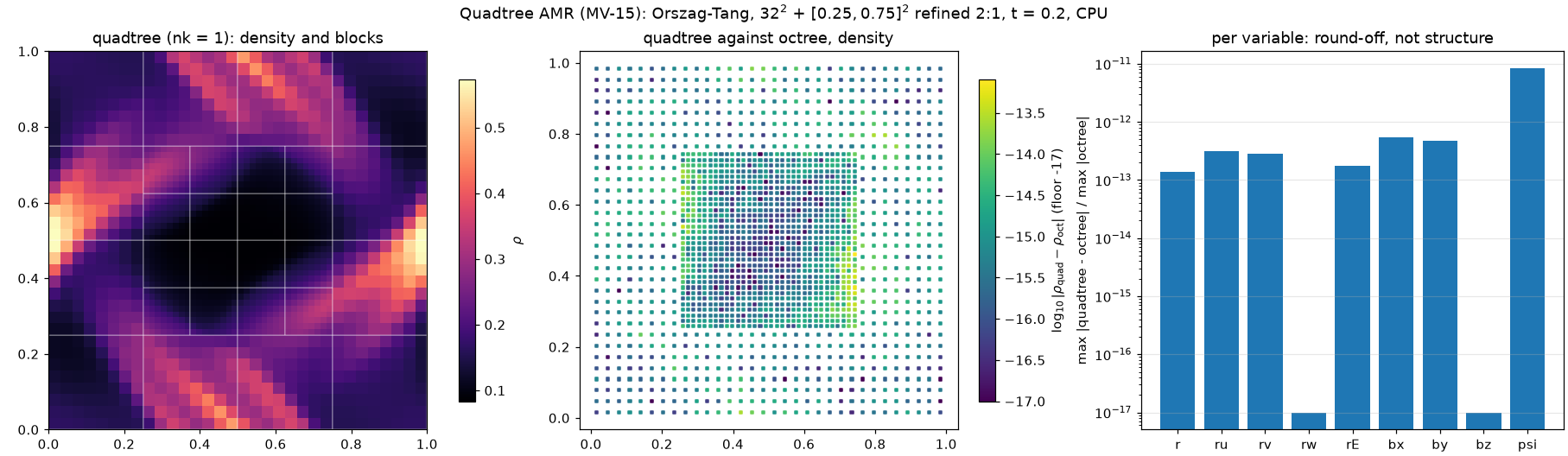
Orszag–Tang,
| Leg | Quadtree nk = 1 against the octree | Octree z spread | Quadtree nk = 4 z spread |
|---|---|---|---|
| Orszag–Tang, | 0 | ||
| Balsara–Spicer blast, limiter on, | — |
| Check | Bound | CPU | FNL |
|---|---|---|---|
ot: quadtree nk = 1 against the octree, relative | |||
ot: octree | pass | ||
ot: quadtree nk = 4 | 0 (bitwise) | 0 | 0 |
blast: octree | pass | ||
blast: quadtree against the octree, per variable | ratio 0.40 to 0.80 | ratio 0.87 to 1.02 | |
blast: limited stages | reported | 579 | 579 |
Related cases: Orszag–Tang is the --amr problem of MV-12; positivity limiter PV-5 runs the limited blast across octree seams; forward-facing step runs a forest on quadtrees; ghost probe checks every seam ghost on a linear field.
Findings
- The runs agree to round-off, not bit for bit: an octree restriction averages 8 fine cells (two identical
layers), a quadtree 4, and even the octree's identical layers differ at round-off, its tricubic weights depending on the sub-position. - In the blast the limiter's switches amplify that round-off: the octree's own layers drift apart by
, and the quadtree differs from the octree by no more than that spread (the same 579 limited stages on both backends). The leg therefore bounds the agreement by twice the reference spread, not by a fixed tolerance. - FNL gives the same picture on Orszag–Tang (
against the octree, spread 0 with nk = 4). - The
nk = 4quadtree computes thefluxes and keeps the solution -invariant bit for bit. Its cells enter the time step, so its step sequence differs and it is compared with itself only. - The unit test
test_quadtree_seam_ghostpins the seam exchange on the linear field(octree, quadtree nk = 4andnk = 1, 1 to 3 ranks): every face, edge and corner ghost inside the domain must holdat its own centre. Its FNL build also asserts the device exchange equal to the CPU one, bit for bit.