Appearance
The multigrid Poisson solver on AMR grids
| ID | Group | Milestone | Backends | Figure | Regression |
|---|---|---|---|---|---|
| SV-9, SV-12, SV-13 | Self-gravity | M8 (#81), P5a; #87, P1, P2 | CPU only | yes | — |
Case and scope
On an AMR grid the exact
The case has two parts:
- the operator study (
seam_operators.py): three couplings of a coarse cell C and the fine cellson its face, measured in a 2-D model, to choose the one the solver uses; - the solver leg (
test_poisson_mg): the multigrid solver on that operator, on uniform grids against the FFT solver (SV-9a) and on box-refined grids against the exact potential (SV-9b); - the Dirichlet legs (
test_poisson_mg, #87 P1): the same solver with Dirichlet domain faces, the ground the isolated solve on AMR is built on: on a uniform grid the coarsest-level solve (the FFT solver's Dirichlet mode) is the whole solve (SV-12a); on box-refined grids against the exact potential (SV-12b); - the isolated legs (
test_poisson_mg --isolated, #87 P2): free-space boundaries on AMR by a symmetric James step, SV-6's stars: on uniform grids against the FFT solver's isolated mode (SV-13a), on grids with the star refined against the exact potentials (SV-13b), the symmetry of the solution map measured in situ.
What the case catches:
- a non-symmetric assembled operator (the symmetry defect of the assembled rows, which the assembly does not symmetrise);
- an inconsistent seam coupling: a truncation error that grows as
under refinement; - a multigrid that is not the FFT solve on a uniform grid, a ghost the fill leaves empty, a stalled FCG;
- mixed periodic and non-periodic boundaries accepted;
- an isolated solve that is not the free-space solution on a uniform grid, or not a symmetric map (
: would not be conserved); - an isolated solve accepted with a refined leaf on the domain boundary.
Models and numerics
The three couplings (the operator study):
- B, Tomida and Stone's flux matching: the fine ghost interpolated from C and its tangential neighbours, the coarse flux the sum of the fine ones. Consistent, not symmetric.
- S1
, the symmetrisation the P5-0 design proposed. The transposed tangential terms land in the coarse rows with no matching Taylor terms. - M, the mimetic mean flux (
adam_poisson_mg_object): every fine face carries, the mean of the face's fine cells and the fine face area over the fine spacing; C gets their sum. It is the hybrid mimetic finite-difference flux of the coarse cell, seen as a polygon with hanging nodes, with its face unknowns eliminated: consistency makes the coarse cell's sub-face block rank one (it sees only the mean of its face unknowns), and the elimination gives . Exact for linear face by face, and symmetric by construction.
| Item | Choice | Code |
|---|---|---|
| Operator | the composite Laplacian of the leaves, | initialize (assemble_a), a_row, face_cells, face_weight, adam_poisson_mg_object.F90 |
| 2:1 ghosts | the first ghost layer across a 2:1 face is the value whose one-sided difference equals M's face gradient | initialize (assemble_ghost_fill), adam_poisson_mg_object.F90 |
| Iteration | flexible conjugate gradients (Notay's FCG(1)) on | solve, solve_packed, adam_poisson_mg_object.F90 |
| Preconditioner | one V-cycle. Levels: each holds its leaves plus a shadow block for every refined node (ADAM keeps leaves only). Smoothing: red-black Gauss–Seidel, 2 sweeps down and 2 up. Transfers: restriction by sum, piecewise-constant prolongation | vcycle, smooth, adam_poisson_mg_object.F90 |
| Coarsest level | the minimum leaf level, which covers the domain, solved exactly by the FFT solver | solve_blocks, adam_poisson_fft_object.F90 |
| Dirichlet faces (#87 P1) | no active direction periodic: a domain face keeps | a_row, assemble_ghost_fill, solve(..., ghost), apply_b, apply_bt, adam_poisson_mg_object.F90 |
| Isolated, the James step (#87 P2) | initialize(..., isolated=.true.): the zero-ghost solve | solve_packed, ghost_green, solve_fcg, adam_poisson_mg_object.F90; solve_blocks (isolated), adam_poisson_fft_object.F90 |
| Scope | every active direction periodic, or none (mixed is fatal); isolated: 3-D, cubic cells, and every leaf on the domain boundary at the coarsest level (D-87-2; the ghost cells then form the coarse lattice | initialize (boundaries), assemble_ghost_fill (the boundary layer), classify (2:1 balance), adam_poisson_mg_object.F90 |
| Verification hooks | the symmetry defect | symmetry_defect, apply_a, adam_poisson_mg_object.F90 |
The operator on AMR grids is described in models.
Initial and boundary conditions
| Leg | Domain and source | Grid | Ranks |
|---|---|---|---|
Operator study (seam_operators.py) | the doubly periodic unit square; | coarse ( | — (NumPy) |
| SV-9a | SV-2's: | uniform, octree and quadtree at level 2 | 1, 2, 3 |
| SV-9b | the same | the central box | 1, 2, 3 |
| SV-12a | the same source and box without periodic boundaries, the exact potential as the ghost values (Dirichlet at the centres of the first ghost layer): | uniform octree at levels 1 and 2 | 1, 2, 3 |
| SV-12b | the same | SV-9b's box-refined grids, octree and quadtree | 1, 2, 3 |
| SV-13a | SV-6's: the cube | uniform octree at levels 1 and 2 ( | 1, 2, 3 |
| SV-13b | the same polytrope, and the uniform sphere ( | base levels 2 and 3 with the star's box | 1, 2, 3 |
| Refusals | --mixed: one uniform grid periodic along --refuse-boundary-refined: the isolated cube at level 1 with the octant | — | 2 |
The FNL path comes with FLUME on AMR (P5b, P5c: SV-10, SV-11).
Input files
| File | Role |
|---|---|
src/tests/flume/verification/selfgravity/seam_operators.py | the operator study ([N ...], default 8 16 32 48) |
src/tests/poisson/test_poisson_mg.F90 | the unit test (mode test-poisson-mg-gnu), SV-9a, SV-9b, SV-12a, SV-12b; --isolated SV-13a, SV-13b; --mixed and --refuse-boundary-refined the refusals |
src/tests/flume/verification/selfgravity/poisson.sh | legs sv9 and sv13: the test on every rank count of --np-list, and the refusals; POISSON_MG_EXE selects the build |
src/tests/flume/verification/make_doc_runs.sh, group amr | sv9-poisson and sv13-poisson: the test (and --isolated) with its log |
src/tests/flume/verification/make_doc_figures.py, fig_selfgravity_amr, fig_selfgravity_amr_isolated | draws the figures (--only selfgravity-amr selfgravity-amr-isolated), the first running seam_operators.py |
bash
python3 src/tests/flume/verification/selfgravity/seam_operators.py      # the three couplings
cd src/tests/flume/verification/selfgravity && ./poisson.sh --legs "sv9 sv13"   # the solver, np 1, 2, 3
Results
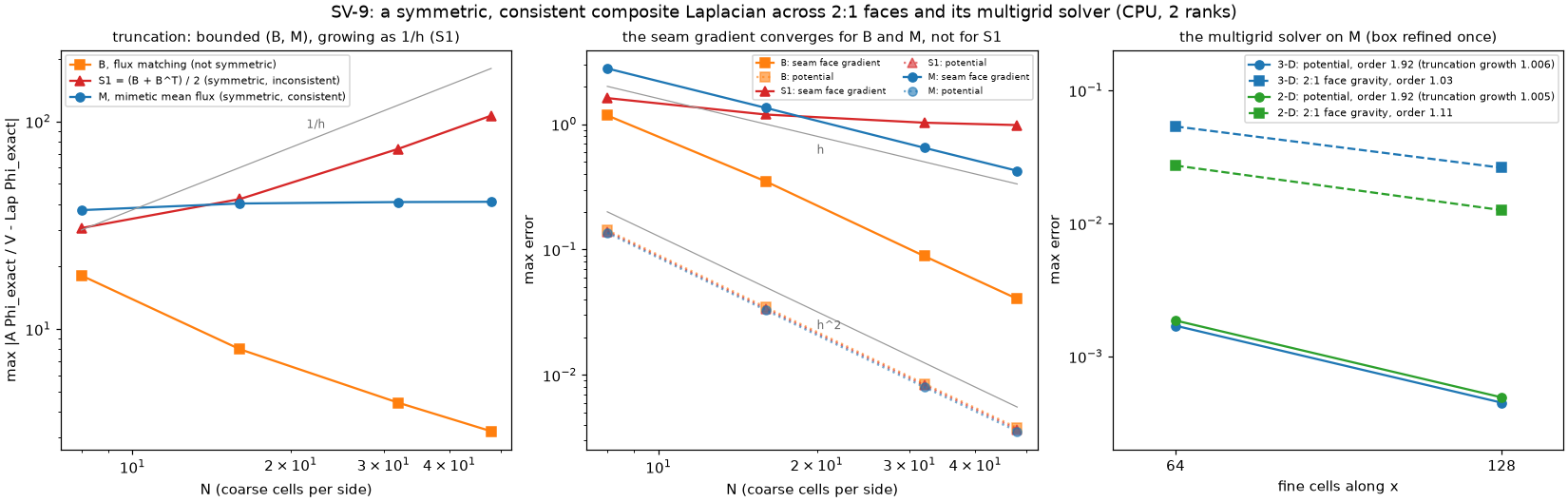
Left: the truncation error of S1 grows as
The operator study (measured, no bounds):
| Coupling, | seam face gradient error, order (32 → 48) | |||
|---|---|---|---|---|
| B | 18.1 → 3.2 | 1.99 | ||
| S1 | 0 | 30.7 → 107, growing as | 0.98 at | 1.99 |
| M | 0 | 37.4 → 41.0, bounded | 0.42 at | 2.00 |
The solver (CPU only):
| Asserted | Bound | CPU |
|---|---|---|
| SV-9a: multigrid against the FFT solver, | ||
| SV-9b: FCG residual, relative max norm | below it | |
| symmetry defect of the assembled rows (not symmetrised by the assembly) | ||
| ghost cells left unfilled | 0 | 0 |
| order of | 1.92 (3-D), 1.92 (2-D) | |
| growth of | 1.006 (3-D), 1.005 (2-D) | |
| SV-12a (Dirichlet, uniform): FCG iterations; order of | 1; 1.95 | |
| SV-12a: growth of | 0.27 (it falls at second order, 0.64 → 0.17) | |
| SV-12b (Dirichlet, AMR): FCG residual; symmetry defect of the Dirichlet rows; ghosts unfilled | below it; | |
| SV-12b: order of | 1.91 (3-D), 1.93 (2-D); 1.006, 1.005 | |
| SV-13a (isolated, uniform): | ||
| SV-13a: order of | 2.14 | |
| SV-13b (isolated, AMR): FCG residual (tolerance | below it; 0 | below it; 0 |
| SV-13b: order of | 2.01, 1.86 | |
| SV-13: symmetry of the solution map in situ, | ||
| mixed periodic and non-periodic directions | refused, exit 1 | refused |
| isolated, a leaf above the coarsest level on the boundary | refused, exit 1 | refused |
Reported, not bounded:
- 2:1 face gravity order: 1.03 (3-D) and 1.11 (2-D).
- FCG iterations: 36–39 in 3-D (mean factor 0.52–0.54) and 24–25 in 2-D (0.37–0.40); with Dirichlet faces 35–36 (3-D) and 22–23 (2-D); isolated (SV-13b, tolerance
) 24–25 for the zero-ghost solve and 23 for the second. - The James ghost values against the exact potential at the ghost centres:
(SV-13a), (SV-13b polytrope), (sphere). - AMR against the uniform grid at the same base level (
, polytrope): against .
Every printed number is the same on 1, 2 and 3 ranks, up to round-off. The bound on the potential's order is 1.7, not 1.9, because two grids give a single pair.
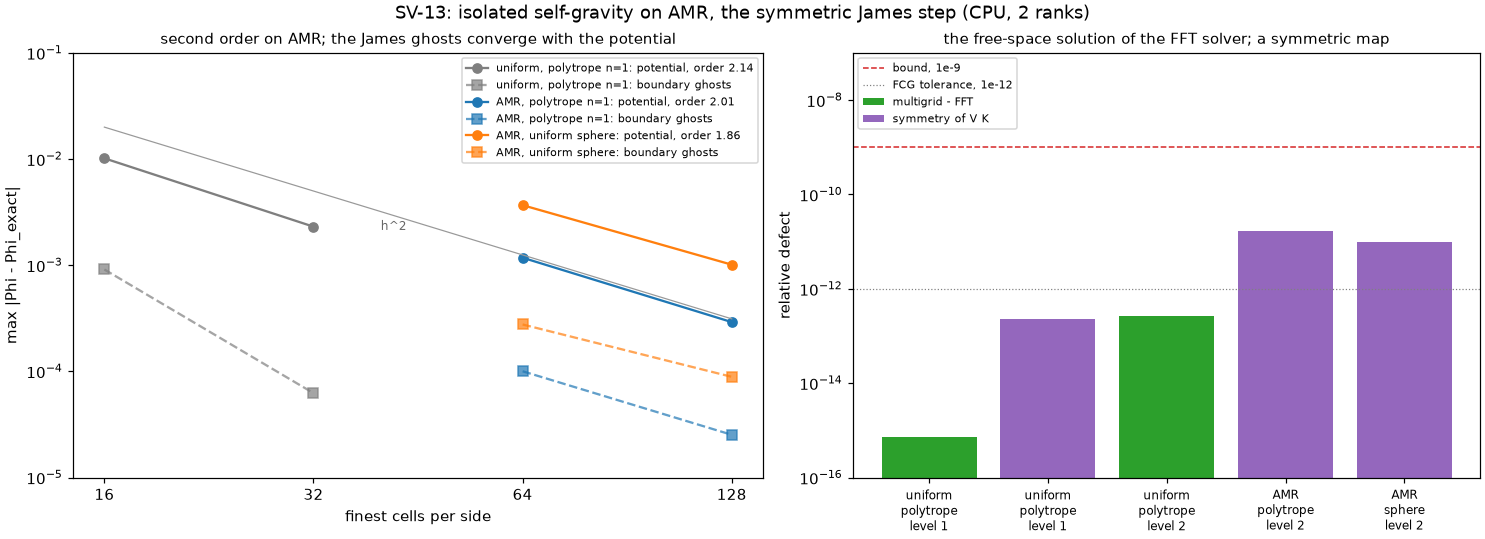
Left: the potential (solid) and the James ghost values (dashed) against the exact potential, uniform and with the star refined: second order, the ghost values converging with the potential. Right: the multigrid against the FFT solver's isolated mode on uniform grids (the same discrete free-space solution, to
Related cases: the FFT solver the coarsest level uses is SV-2, its isolated mode SV-6; the solver coupled to FLUME on a static AMR grid is SV-10, under runtime AMR SV-11.
Findings
- S1 is refuted. The P5-0 design comment claimed the symmetrisation costs nothing. Its potential is second order like the others, but its truncation grows as
and the gravity at the seam does not converge. The potential's max-norm hides the defect; the gravity, the quantity the scheme uses, shows it. - M pays for symmetry with one order of seam gravity. Its seam face gradient is first order (B's is second order in this model), and 10 times B's at
. The error sits on the one layer of seam faces; the potential stays second order. - M's truncation is
at the seam but consistent: bounded under refinement, the classical supra-convergence of cell-centred schemes. - The multigrid runs on the host only (CPU); the FNL backend calls it with its coarsest level on cuFFT (SV-10).
- Dirichlet boundaries cost nothing in symmetry or order (SV-12): a boundary face adds
to its row and moves to the right-hand side, so the rows stay symmetric ( ) and consistent (the uniform truncation falls at second order). The coarsest level's odd extension is exact: one iteration on a uniform grid. Mixed boundaries are refused; the periodic legs are unchanged to every printed digit. - The James step is symmetric and second order on AMR (SV-13), the P0 prototype's result in the library: on a uniform grid it is the discrete free-space solution (the FFT solver's, to
), on AMR the potential is second order (2.01 for the polytrope) and the solution map is symmetric to the solve tolerance, which the exact exchange needs. The cost is two composite solves and one padded FFT of the coarsest box per Poisson solve. The price is D-87-2: every leaf on the domain boundary at the coarsest level, fatal otherwise; the FLUME coupling (P3) lifts the run-time refusals.