Appearance
Dual energy: the advected entropy of euler-de
| ID | Group | Milestone | Backends | Figure | Regression |
|---|---|---|---|---|---|
| DE (de1 to de4) | Euler | M9 (#91), P2, P3, P4 | CPU, FNL | yes | noh-de |
Case and scope
In a cold supersonic flow the internal energy physical_model = euler-de carries the advected entropy
What the case catches:
- a model that perturbs a warm flow: where no cell is cold the floor never acts, and the Euler fields must be those of
eulerbitwise; - a floor that removes shock heat: the entropy does not see a shock, so a scheme that resets the energy of a cold shocked cell from it loses the shock (the first form of D-M9-1 did, on this very case);
- a silent input: a switch outside
; - a backend that disagrees: the FNL kernels (
adam_flume_fnl_euler_de_kernels,sync_dual_energy_dev) against the CPU ones on the same run.
Models and numerics
| Item | Choice | Code |
|---|---|---|
| Model | euler-de: the Euler equations plus nv = 6 | models; adam_flume_euler_de_library, adam_flume_euler_library_body.INC |
| Space, time | as Sod (V1): WENO5 characteristic flux splitting, SSP-33, CFL 0.5; the entropy is the sixth characteristic field (eigenvalue | adam_flume_cpu_euler_de_kernels.F90 |
| Synchronisation | once per step: in a cold cell ([physics] dual_energy_eta, default 0.05) | sync_dual_energy, adam_flume_cpu_object.F90; FNL: sync_dual_energy_dev, adam_flume_fnl_euler_de_kernels.F90 |
Initial and boundary conditions
| Leg | Setup |
|---|---|
| de1 | the sod-x regression input (Sod), 50 cells on euler and with euler-de |
| de2 | the planar Noh problem in a cold gas: sod-x grid and numerics, extrapolation boundaries, |
| de3 | the de1 input with dual_energy_eta = 0 and 1 |
| de4 | the de2 euler-de runs of CPU and FNL |
Input files
| File | Role |
|---|---|
src/tests/flume/verification/dualenergy/make_de.py | sod and noh write the inputs (--model, --eta) |
src/tests/flume/verification/dualenergy/check.sh | runs the legs (--legs de1,de2,de3,de4, default all but de4; FLUME_EXE selects the backend; de4 compares the work directories of both) |
src/tests/flume/verification/dualenergy/de_oracle.py | the bitwise comparison (de1) and the Noh bounds (de2) |
make_doc_runs.sh <runs> dualenergy, make_doc_figures.py --only dual-energy | the figure (2 runs, a minute) |
bash
cd src/tests/flume/verification/dualenergy && ./check.sh                              # CPU
FLUME_EXE=$PWD/../../../../../exe/adam_flume_fnl ./check.sh                         # FNL
./check.sh --legs de4                                                                 # CPU against FNL
Results
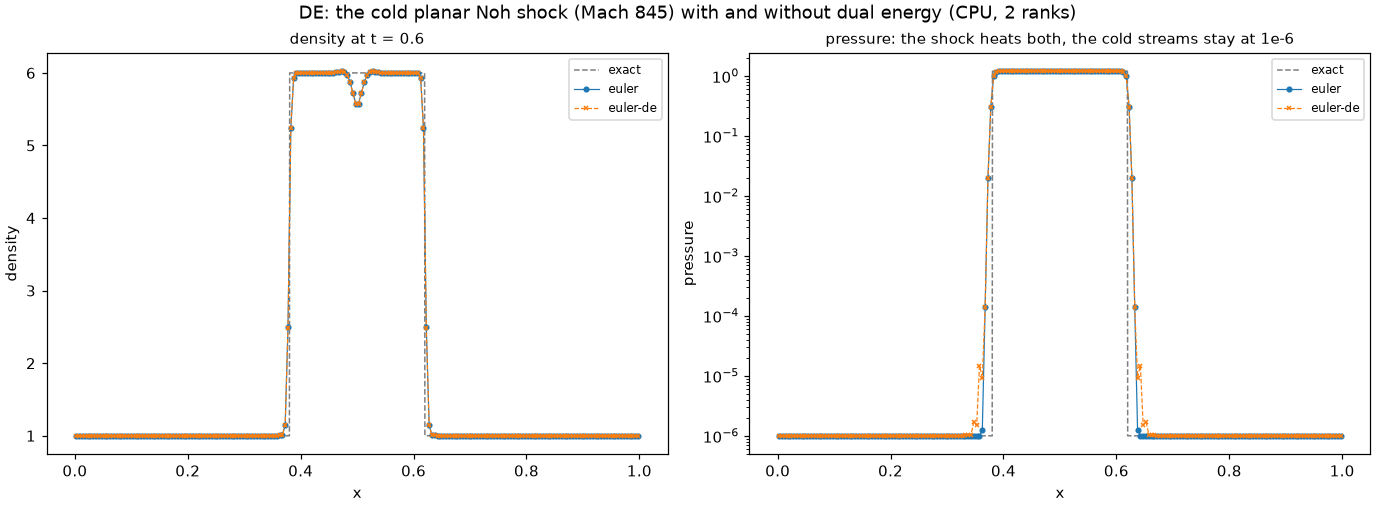
The cold planar Noh shock at euler-de lifts the two cells at each shock foot to
| Leg | Asserted | Bound | CPU | FNL |
|---|---|---|---|---|
| de1 | r, ru, rv, rw, rE of euler-de against euler | bitwise | bitwise equal | bitwise equal |
| de2 | post-shock pressure (median within 0.08 of the centre), euler / euler-de | 2 % of 1.2 | ||
| de2 | cold-stream pressure (beyond 0.2 of the centre), largest relative error, euler / euler-de | |||
| de2 | largest density difference of the two models | |||
| de3 | dual_energy_eta = 0, 1 | refused | refused | refused |
| de4 | per field, FNL against CPU relative to its largest magnitude, euler-de against the euler pair (rs against their largest) | euler pair's, or | ru euler rs | (the same comparison) |
Related cases: Sod is the warm baseline of de1; the collapse dual energy rescues is SV-17.
Findings
- Where no cell is cold,
euler-deiseuler. In Sod every cell has, the floor never acts, and the entropy only follows the energy: the five Euler fields are bitwise those of euler. - A floor, not a reset. The first form of the synchronisation (D-M9-1 as approved: the energy of a cold cell reset from its entropy) took the shock's heat away in the first steps of this case, when every cell is cold, and the run went non-finite at step 3. Numerical dissipation only raises the entropy, so the drained cells are the ones below their adiabat: lifting only those keeps every shock heated (the post-shock pressure of the two models agrees to
), and the energy the floor adds is the only change to the total energy. - The price is a little preheating at a cold shock's foot. The advected entropy diffuses forward across the foot, so the floor lifts the one or two cold cells there, to
in a stream ahead of a 1.2 shock. A switch at Enzo's would lift the same cells (their is below it as well): it is the floor, not the switch. - The FNL port runs the same rule. On a Mach 845 shock the two backends already differ by
with euler(the device arithmetic);euler-dediffers by at most 1.5 times that, and its entropy by half of it (de4, the relative-to-baseline rule of AV av8: an absolutebound fails euleritself). - The switch is 0.05, not Enzo's
(D-M9-3, revised): in the #88 collapse the coldest cells sit at two steps before they go negative, so never acts; 0.05 (Cholla uses 0.035) rescues the collapse (SV-17).