

Appearance
Ghost fill on the GPU: a microbenchmark
A standalone measurement of how fast ADAM fills the ghost cells of its blocks on a GPU, against what the same GPU can copy, and against the alternatives an AMR redesign could take. It is the first piece of evidence for that redesign (2026-11-25): today's fill moves its data at 10–16 % of the GPU's copy rate, and structured slab copies, with no per-cell index map, reach 43–57 % and are 3.0–5.5 times faster, bit for bit identical. On a 2:1 AMR grid the picture changes (AMR neighbourhoods): the cost moves to the prolongation rows, under 10 % of the rows and 54–85 % of the fill, and most of that is the density guard of the seam fill. The code, the job scripts and the raw results are in src/tests/perf/ghost-fill/ (uniform) and its amr/ (2:1 neighbourhoods).
Why it was done
The scaling campaigns of #133 timed a FLUME step phase by phase on A30 and H100 nodes (performance). Three findings set the question:
- The arithmetic dominates. The face-flux kernel takes 60–85 % of a step; a cell's cost depends weakly on the block size (on one H100, blocks of 32³ cost 8 % more per cell than 64³; AthenaK, with a lighter cell update, loses 1.7× over the same range). FLUME's high-order cell update is heavy, by design.
- The face kernel is not yet compute-bound. On the H100 it runs at roughly 3–7 % of the FP64 peak, held back by local memory and latency (its private stencil arrays spill; profile in
speedup/profile-couette3d/README.md). Making it faster is the first track of the next optimisation round. - Everything around the ghost cells is data movement. Without an immersed body, the local fill, the boundary conditions and the MPI exchange take up to ~20 % of a step on the H100 (~30 % with the body). With a faster face kernel that share grows (Amdahl): at a face kernel twice as fast the ghost work of the body case passes a third of the step. So the ghost machinery has to reach its own floor: the second track.
Before redesigning the AMR data structures for the second track, the question is how far today's fill is from that floor, and why. A whole FLUME step mixes too many effects to answer it; a microbenchmark isolates the fill.
What it measures
ghost_fill_bench.F90 (plain OpenACC, no ADAM dependency) builds a uniform periodic brick of blocks of b³ cells with ngc ghost layers and 5 variables, and fills every ghost cell (faces, edges and corners) from its same-level neighbour: the rows that ADAM's local ghost map holds. Each variant changes one thing:
| Variant | Kernel | Isolates |
|---|---|---|
| V0 | ADAM's update_ghost_local_gpu_dev (adam_fnl_field_kernels.F90) replicated: one row per ghost cell, 10 integer(I8P) columns of which 9 are read, collapse(2) with the variable loop outermost, the branch on the row's kind, layout q(b,i,j,k,v) (block index fastest), rows in the order adam_maps_object builds them | today |
| V1 | V0 with integer(int32) columns | the bytes of the indices |
| V2 | one linear offset for the donor and one for the receiver per row, the variables inside the row | the index traffic and the map read once per variable |
| V3 | structured slabs: no per-cell map; one kernel per neighbour direction (26) over (variable, k, j, i, block), the donor block from a per-block neighbour table, the donor cell by a constant shift; layout q(b,i,j,k,v) | the per-cell map |
| V4 | V3 on the layout q(i,j,k,v,b), cell index fastest | the layout |
| V5 | V3 fused into one launch: the ghost cells of a block numbered direction by direction, the direction and cell decoded from a 26-entry table | the launch count |
| V6 | V5 on the layout q(i,j,k,v,b) | the layout, one launch |
| ref | a contiguous copy of as many values | the floor the GPU reaches |
Method. Median of 50 fills after a warm-up, each followed by a device wait. Sizes: ~7 M cells per GPU in blocks of 16³, 24³, 32³, 38³ and 48³ (the load of the 7 M-cell weak pairs of #133), ~56 M in 24³, 38³ and 48³, and 38³ with ngc 4 (WENO-7). The bandwidth counts 16 bytes per ghost value (one read, one write); the index reads of the map variants are not counted, so their figure is what the data alone would need. Every variant, at every size, on both GPUs, is compared bit for bit with a fill on the host and is identical: a copy is exact, so any difference would be a bug.
Machines. ESA SpaceHPC, one NVIDIA H100 (nvfortran 26.3, -gpu=cc90,cuda12.9, PBS job 184030), the reference; and medooza, one NVIDIA A30 (nvfortran 26.9, -gpu=cc80,cuda12.9, Slurm job 1369794), for comparison. Each run printed the GPU's clock and throttle bits before and after: no throttling.
The benchmark reproduces ADAM's fill
V0 against the local ghost fill timed inside FLUME steps by the phase timer, at the same load and block size (per call: the step does 3 fills without the body, 12 with it):
| V0 | FLUME, phase timer | |
|---|---|---|
| H100, 56 M cells per GPU, 38³ | 9.09 ms | 9.5 ms |
| H100, 7 M cells per GPU, 38³ | 1.10 ms | 1.12 ms |
| A30, 7 M cells per GPU, 38³ | 3.27 ms | 3.1 ms |
Within 5 %: what the benchmark says about V0 is what ADAM does.
Results
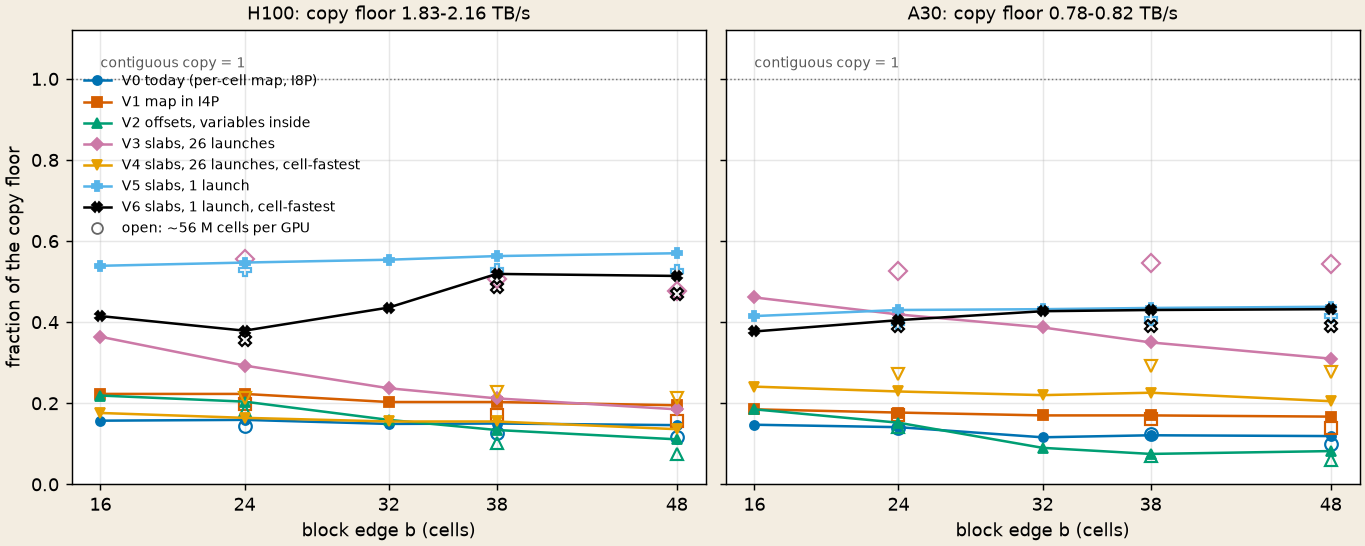
Today's fill (V0) moves its data at 10–16 % of what the GPU copies, on both GPUs, at every block size and both loads. Structured slabs (V3, V5) reach 43–57 %. Narrowing the map to 32-bit indices (V1) helps a little; precomputed offsets with the variables inside the row (V2) are worse than today, because each thread then walks five addresses a whole variable apart.
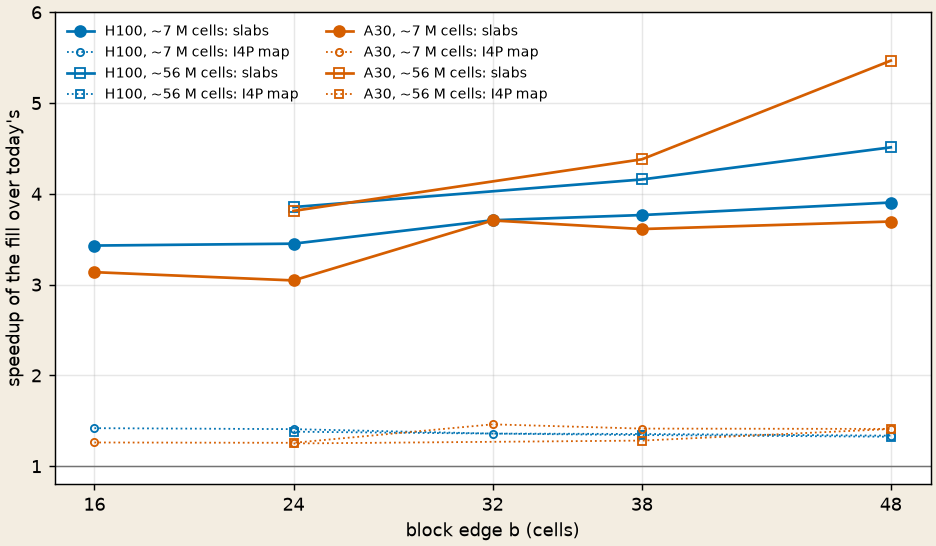
The structured fill is 3.0–5.5 times faster than today's, more at larger blocks and loads (H100: 3.4× at 16³, 7 M cells, to 4.5× at 48³, 56 M; A30: up to 5.5×). The 32-bit map gives 1.3–1.4× at every point.
Time of one fill, the reference sizes (all in src/tests/perf/ghost-fill/README.md):
| copy floor | V0 today | V1 I4P | best slabs | speedup | |
|---|---|---|---|---|---|
| H100, 7 M cells, 38³ | 0.164 ms | 1.096 ms (15 %) | 0.809 ms | 0.291 ms (56 %, V5) | 3.8× |
| H100, 56 M cells, 38³ | 1.156 ms | 9.094 ms (13 %) | 6.773 ms | 2.187 ms (53 %, V5) | 4.2× |
| A30, 7 M cells, 38³ | 0.394 ms | 3.269 ms (12 %) | 2.312 ms | 0.905 ms (44 %, V5) | 3.6× |
| A30, 56 M cells, 38³ | 3.031 ms | 24.35 ms (12 %) | 19.00 ms | 5.559 ms (55 %, V3) | 4.4× |
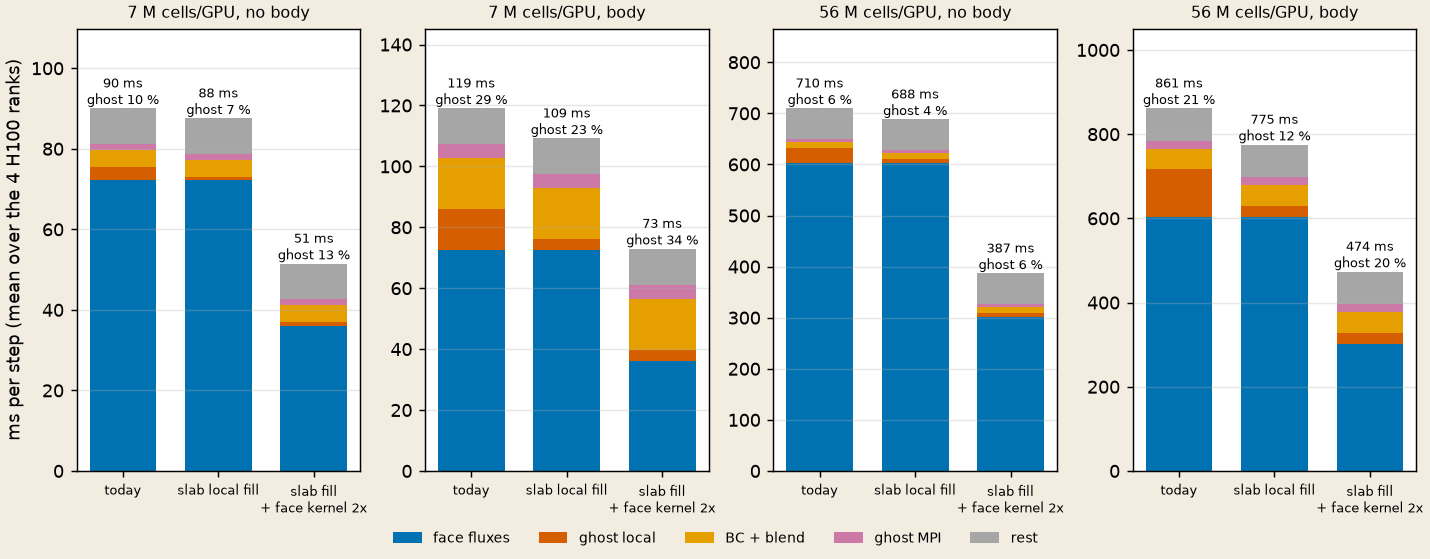
What it means for a FLUME step (4 H100, the uniform sphere in 38³ blocks, phase timer; the local fill scaled by the measured slab/V0 ratio; the right-hand bar of each group also halves the face fluxes, a scenario for the first track, not a measurement). Today the slab fill alone would take 2.8 % (7 M cells, no body) to 10 % (56 M cells, with the body) off a step. With a face kernel twice as fast, the ghost work, at today's boundary-condition and exchange cost, is 13 % (no body) and 34 % (body) of the step at 7 M cells: the ghost machinery would again be a third of the step where the immersed boundary is present.
What it proves
- The cost of today's fill is the per-cell index map, not the data. Every copied value carries a row of nine 8-byte indices; the copies are gathers and scatters through them. The data alone would move 6–10 times faster.
- Removing the map is worth three times more than shrinking it. 32-bit indices gain 1.3–1.4×; computing the indices from a per-block neighbour table and the slab geometry gains 3.0–5.5×. A map rewrite does not reach the floor; a structural change does.
- ADAM's block-fastest layout costs the ghost machinery nothing. The cell-fastest layout is never faster (V6 against V5, V4 against V3). The layout chosen for the face kernel's coalescing can stay; the first track is free to keep it.
- The launch strategy depends on the GPU and the load. One fused launch wins on the H100 nearly everywhere; on the A30, 26 per-direction launches win at 56 M cells and at 16³. The design should allow both.
- The structured fill is about a factor 2 from the copy floor: thin slabs (3–4 cells) gathered from 26 neighbours. That factor is the fill's own floor, not a defect.
AMR neighbourhoods (2:1 seams)
The second benchmark, src/tests/perf/ghost-fill/amr/, measures the fill where the rows are not copies. It is linked to ADAM: the grid is built by ADAM's own tree, grid and maps objects (the unit cube, an octree of blocks of b³ cells refined to a base level, then one more level inside the box [0,s]³, so 2:1 faces, edges and corners around the box); the values come from ADAM's own seam operators, every high-order regime of [amr] seam_ghost_fill and seam_restriction; FLUME's density guard of the seam fill (#101) is on.
ADAM describes a fill with a descriptor table (maps%local_map_ghost, one entry per receiver block, donor block and region, with its ranges, shifts and refinement relation), expands it into one row per ghost cell with its seam metadata (maps%local_map_ghost_cell, deduplicated so the last descriptor covering a ghost wins), and runs every row in one launch, a branch per row (V0). The variants:
| Variant | Kernel | Isolates |
|---|---|---|
| V0 | update_ghost_local_gpu_dev on ADAM's rows | today |
| V0s | the same kernel on the rows split by kind (copy, restriction, prolongation), one launch each | branch divergence; the cost of each kind |
| D1 | one kernel per kind over the descriptors, the seam metadata computed on the device by ADAM's routines | the per-cell map, on AMR |
| D2 | D1 batched in shape classes, the member blocks innermost | D1 with the uniform benchmark's coalescing |
| V0ng | V0 with the density guard off | the guard's cost |
| D3 | prolongation per coarse anchor (tricubic, guard off): the 8 children's footprints gathered once, each child by ADAM's seam_interpolate_tricubic | the reads the children share |
| V0p, V0png | since #157: the kernel of b8641a59 (its guard function copied verbatim into the harness), guard on and off | the before of #157 in the same run |
| V0k, V0kng | since #157: ADAM's kernel on the rows sorted by kind, guard on and off | grouping the rows by kind |
An owner mask (one integer per stored cell) reproduces the last-writer rule for the descriptor kernels. Every variant, every regime pair, both GPUs: bit for bit identical to its reference (V0, and V0ng for D3).
The production-like grid has blocks of 24³ at levels 2–3, 253 blocks, 3.5 M cells and 2.87 M rows (88.1 % copy, 2.3 % restriction, 9.7 % prolongation): the row count per GPU of the frozen AMR sphere of #133 on 4 A30.
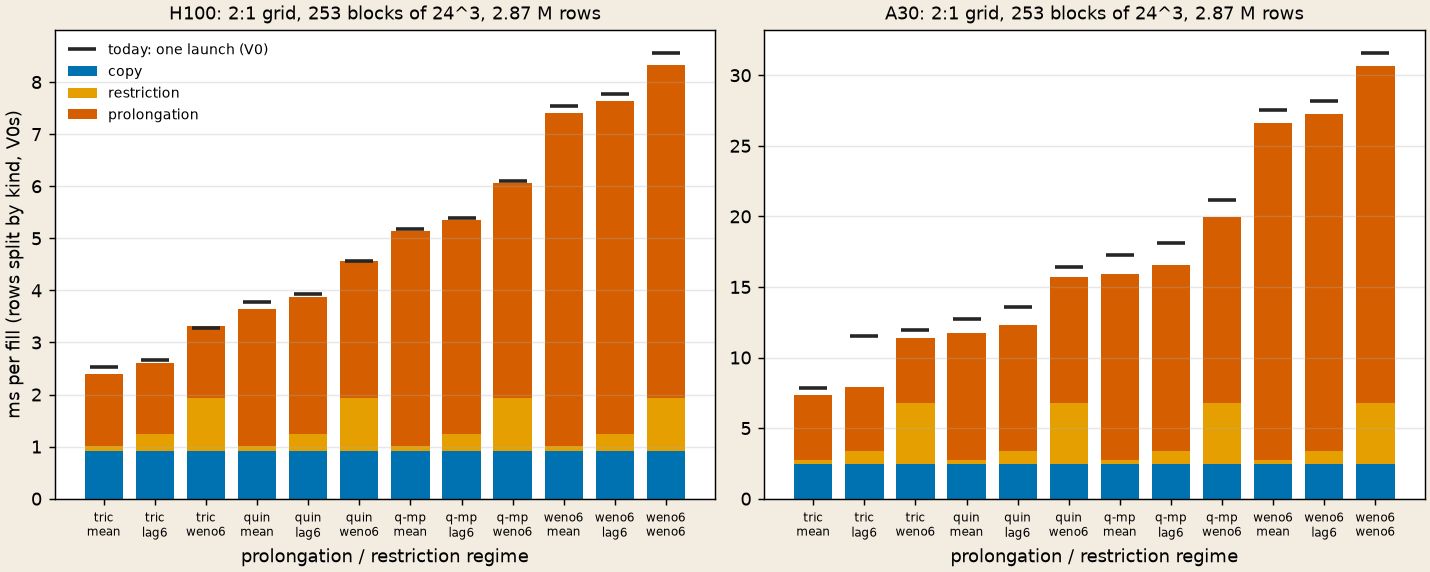
The 2:1 cost is the prolongation. Under 10 % of the rows, the prolongation takes 54 % (tricubic) to 85 % (weno6) of the fill on the H100; the copies cost what they cost on a uniform grid; a weno6 restriction costs as much as all the copies.
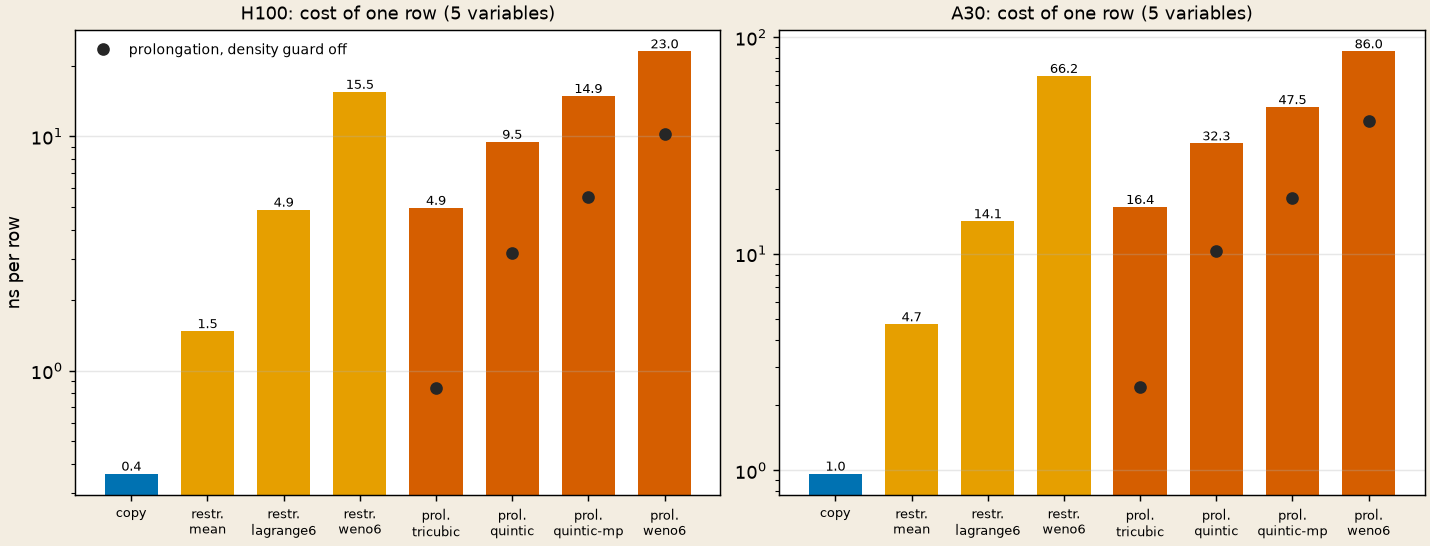
One row (5 variables, H100): a copy 0.36 ns; a restriction 1.5 (mean) to 15.5 ns (weno6); a prolongation 5.0 (tricubic) to 23.0 ns (weno6): 14 to 64 copy rows. The A30 is 2.6–4.3 times slower per row, with the same proportions. The density guard is most of the prolongation: without it a tricubic row costs 0.84 ns instead of 5.0 (83 % of the row is the guard; 85 % on the A30), a weno6 row 10 instead of 23. The guard re-interpolates the density, and re-gathers its footprint, for each of the other four variables of every fine ghost: the same density work five times.
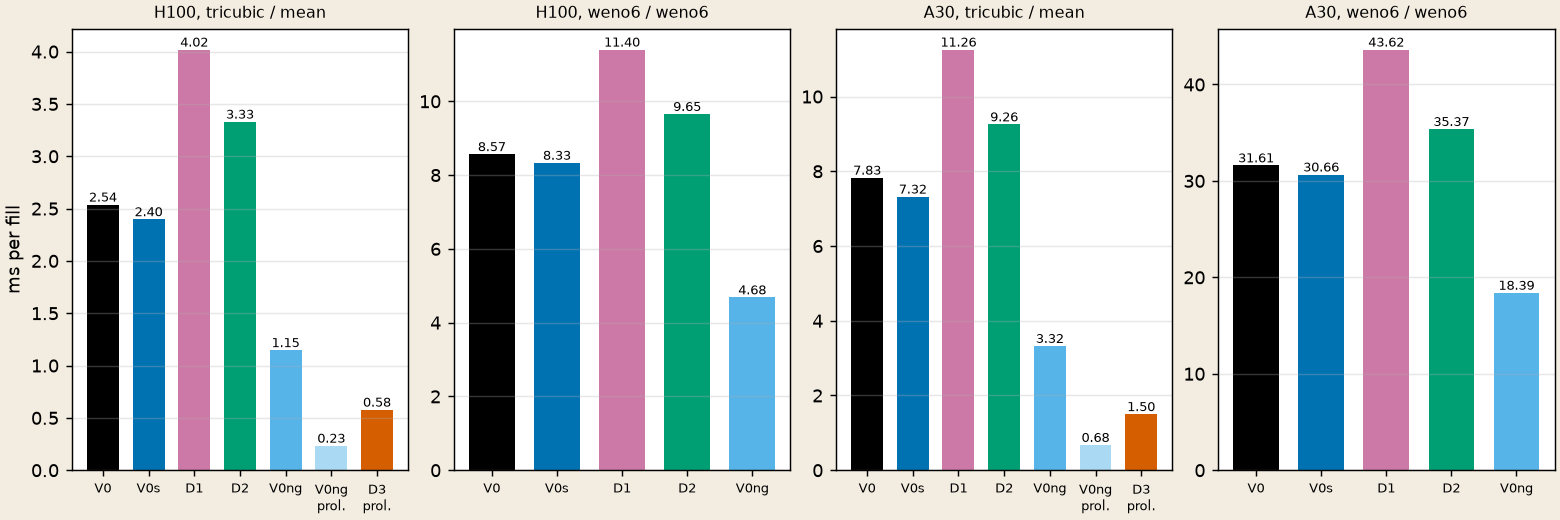
- Branch divergence is minor on the H100 (V0s: −10 % to +7 %), larger on the A30 (up to −38 % where both passes agree).
- The descriptor kernels do not carry the uniform gain to AMR. D2 makes the copies only 18 % faster (5,310 small, irregular descriptors in 154 shape classes; the owner mask and the search paid per cell) and the prolongation 1.2–2.1 times slower than V0 (the seam metadata the rows carry precomputed is recomputed per cell).
- Sharing a footprint per anchor in one thread loses: D3 is 2.5 times slower than V0ng's prolongation on the H100, 2.2 times on the A30; eight children computed serially with a 2.7 KB private footprint lose more parallelism than the shared reads save.
- At four times the load (960 blocks, 13.3 M cells, 11.3 M rows) the per-row costs and the guard's share are the same.
Production check. On the A30 the copy rows cost 2.44 ms for 2.53 M rows, FLUME's uniform launch 2.6 ms for a similar count: the copies reproduce FLUME. FLUME's AMR launch on the frozen sphere costs 14.6 ms against 7.8 ms here at the same total row count; with the per-row costs above that implies about 26 % prolongation rows in the sphere's grid (three levels hugging the body), against 9.7 % in the box. The sphere's row mix itself was not measured.
What it says for the 2:1 fill.
- The density guard is the first target, before any change of data structure: compute the density, its bound and the guard decision once per fine ghost and reuse them for the other variables (the same operations, done once: bitwise). It is worth up to half of the 2:1 fill. Applied (below).
- The prolongation operators are arithmetic (5–23 ns per row): they belong to the first track. Sharing the children's footprints has to be cooperative (threads of a block through shared memory); the serial per-anchor thread is ruled out.
- Group the rows by kind: free with today's maps, bitwise, up to 38 % on the A30. Measured with the guard once: slower on the H100, not applied (below).
- Descriptors need structure, not only compression: few, regular, non-overlapping by construction (no owner mask), member blocks contiguous, the seam metadata precomputed per class. Superseded for the copies by C4 (below): the rows themselves, packed and sorted with the receiving block fastest, give the copies their 4x without descriptors.
Applied: the density guard once per ghost
#157 B2 (2026-11-25) splits the device guard as the CPU's: a first kernel over the coarse-to-fine rows computes each fine ghost's clamped density once (seam_guard_density_gpu_dev) into a scratch value per row, and the fill applies it to each variable (seam_guard_value_gpu_dev); with the guard off the fill runs a kernel without the guard's code. The benchmark checks it in every run: bit for bit against the b8641a59 kernel (V0p) on every regime pair and both GPUs, and against the CPU fill.
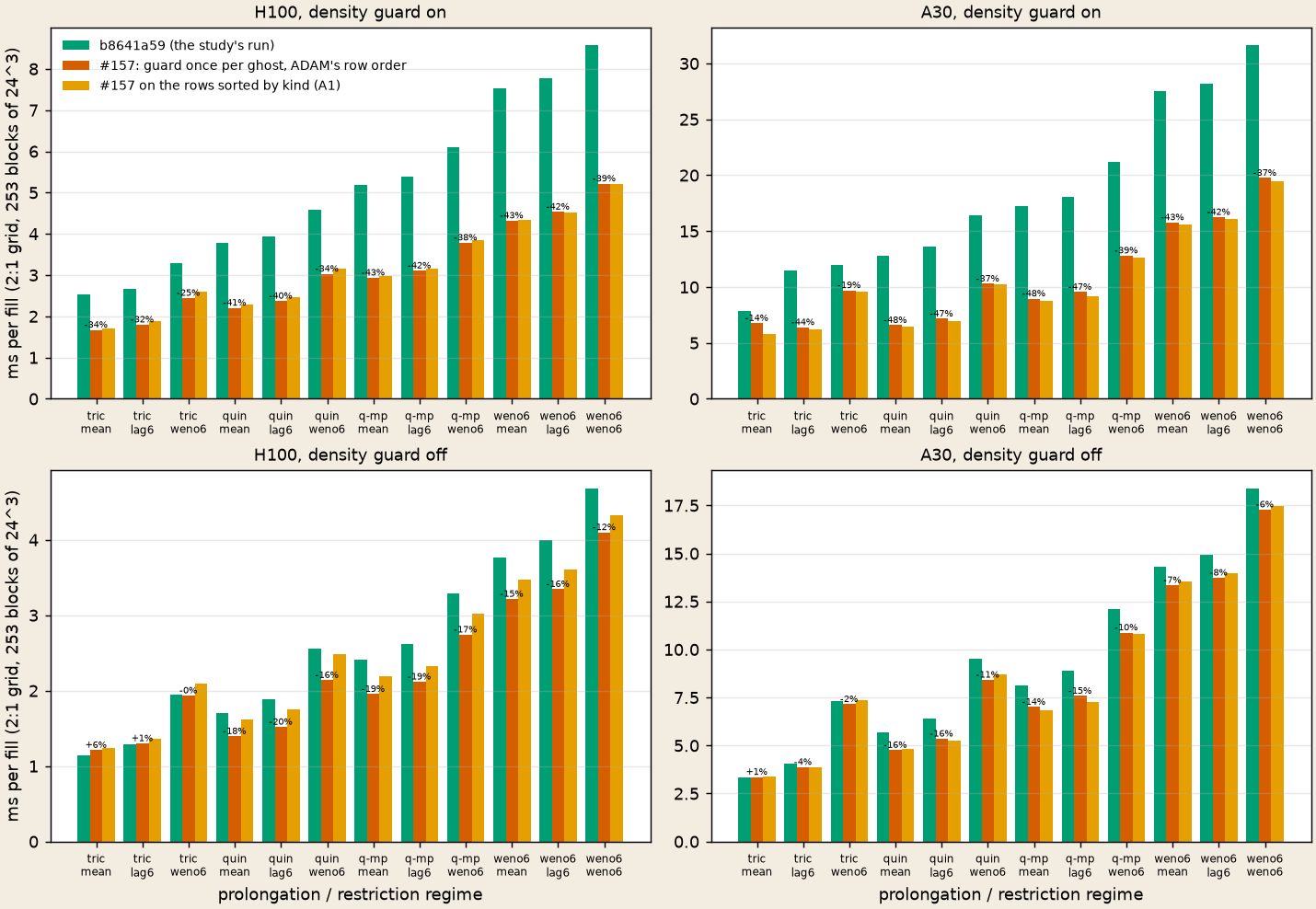
| Production-like grid (ms) | H100 before | H100 #157 | A30 before | A30 #157 |
|---|---|---|---|---|
| tricubic / mean (the defaults) | 2.54 | 1.67 (−34 %) | 7.83 | 6.77 (−14 %) |
| quintic / lagrange6 | 3.94 | 2.37 (−40 %) | 13.58 | 7.16 (−47 %) |
| quintic-mp / mean | 5.18 | 2.94 (−43 %) | 17.26 | 8.96 (−48 %) |
| weno6 / weno6 | 8.57 | 5.22 (−39 %) | 31.61 | 19.76 (−37 %) |
- Every grid and regime pair is faster: 20–43 % on the H100, 3–50 % on the A30. The tricubic fill on the H100 is now 0.46 ms above its guard-off floor, against 1.39 ms before.
- With the guard off (PRISM, and FLUME's non-state fields), against the b8641a59 kernel in the same run, the 6-point regimes gain 8–20 % on the H100 and 5–19 % on the A30; tricubic moves by −0.3 to +6.3 % on the H100 (−12 to +2 % on the A30): the b8641a59 kernel carried the guard's code unused, and that compiled shape happened to suit the copy-dominated tricubic fill on the H100.
- Grouping the rows by kind does not pay with the guard once. The same kernel on the rows sorted by kind is slower on the H100 in 18 of 22 runs (guard off up to +16 %): the heavy prolongation threads become the tail of the launch, while in ADAM's order they run beside the copies. The A30 still prefers the sorted rows (up to −33 %). The H100 is the reference, and the guard-once kernel does not depend on the order, so the rows keep ADAM's order.
Per-case numbers, the nvfortran hazards met on the way and the repeatability notes are in the benchmark's README (src/tests/perf/ghost-fill/amr/README.md, "#157").
Applied: the copy rows in their own launch
#157 C (2026-11-26). The plan proposed structured descriptors for the copy rows; the benchmark found a shorter way. What gave the uniform benchmark its 3–5x is the receiving block running fastest (consecutive threads write consecutive memory of the block-fastest field), not the absence of a map. New variants, every one bitwise against V0:
| Variant | What it runs | A30, production-like grid, tricubic / mean |
|---|---|---|
| K0 | the copy rows alone, ADAM's kernel and order | 2.64 ms |
| Ka | the copy rows as int32 donor and receiver offsets, ADAM's order | 1.54 |
| Kb / Kd | the same sorted by receiver / donor offset (the block fastest) | 0.53 / 0.51 |
| Kp | the copy rows packed as [block, i j k] int32 pairs, sorted as Kb, the field indexed directly | 0.65 |
| Ca–Cg | every kind of row in one compact launch, in ADAM's order or sorted (by receiver, by kind, heavy rows first or last) | 5.2–12.6 |
| Ci / Cj | ADAM's kernel on the restriction and prolongation rows in ADAM's order, then Kb / Kp | 3.71 / 3.84 |
- Sorting the copies gains 4x, compressing them alone 1.7x. Sorting the prolongation rows loses: the children of a coarse anchor stop being neighbours and their shared footprints leave the caches (Cb, every row sorted by receiver, is twice V0).
- Mixing the kinds in one launch wastes the gain, whatever the order: the copies need their own launch.
- The dedupe never removes a row on any FLUME or PRISM regression case nor on the #133 grids (its message never appears in the logs): the rows are non-overlapping already, so any split and order is bitwise.
Applied as Cj (C4): maps_fnl_object%copy_cpu_gpu derives, from the same CPU map, the heavy rows (restriction and prolongation, the map's order, int64) and the copy rows (four int32 [b_send, ijk_send, b_recv, ijk_recv], ijk packed 10 bits each, sorted by receiver cell then block); the local fill runs update_ghost_local_gpu_dev on the first and update_ghost_local_copy_gpu_dev on the second. Bitwise against the b8641a59 kernel on the full map in every run, and on every FLUME and PRISM regression case (A/B), on both GPUs.
| Production-like grid (ms) | A30 before C4 | A30 C4 | H100 before C4 | H100 C4 |
|---|---|---|---|---|
| tricubic / mean | 5.86 | 3.88 (−34 %) | 1.67 | 1.04 (−37 %) |
| weno6 / weno6 | 22.3 | 20.5 (−8 %) | 5.18 | 4.56 (−12 %) |
| guard off, tricubic | 3.52 (b8641a59) | 1.65 | 1.21 | 0.58 (−53 %) |
On the H100 (SpaceHPC job 184729, HEAD 80582712 against C4 alternated on one GPU) every case gains, the split launch costs nothing there: quintic / lagrange6 2.37 → 1.88 ms (−21 %), tricubic on 16³ blocks 0.396 → 0.277 (−30 %), at 4 times the load (960 blocks) 4.58 → 2.32 (−49 %); the copies alone 0.90 → 0.26 ms (3.5x). The A30 figures of the C4 fill are its two launches timed apart and the fill timed again at the end of the run (3.24 + 0.65 = 3.88 ms): the first variant a run times is not warm (V0, 5.37 ms in the same run). The harness now fills for a second before V0; the figures of the earlier sections, each run's first, are biased high by up to that much, so the gains reported against V0 there were conservative.
After C4 the 2:1 fill is the prolongation and its guard: on the A30 the copies are 0.65 of 3.88 ms; the guard alone (3.88 against 1.65 guard-off) is 2.2 ms. That is where the cooperative prolongation (#157 D) and the rest of the guard have to act. Reading the guard's density footprint only when the MP bound needs it (bitwise) gains 2 % on the A30 and nothing on the H100 (measured, not applied): the guard's cost is not its reads but, most likely, the divergence of its MP path, which a few per cent of the ghosts enter while every warp holding one of them waits.
What it does not cover
- Real AMR layouts. The 2:1 benchmark refines a box; the row mix of a grid that hugs a body (the sphere) is inferred, not measured, and three-level grids are not built.
- The boundary-condition rows, the blend and the MPI pack/unpack. They use the same per-row maps; they are expected to carry a similar factor and are the next measurements.
- Several realms, empty ranks, an immersed body. The fill here is the same-level local fill only.
- Other vendors. Plain OpenACC on NVIDIA here; the AMD path (FUNDAL's OpenMP offload) was measured by Giacomo Rossi on an MI300X (#157): there an array constructor with variable elements in device code was a device
malloc, which made the 2:1 fill 7.8 times the H100's; fixed (element assignments, bitwise; nvfortran's quintic-mp fill gained 14 % on the A30 too), andsrc/tests/lint/check-device-array-constructors.shkeeps it out.
Future paths it indicates
- Ghost exchange by slabs, not by cells. The maps should describe (receiver block, donor block, direction, ranges, shift) per neighbour pair, a few dozen descriptors per block instead of thousands of rows, and the kernels compute the cell indices. For a uniform same-level neighbourhood this is V3/V5. The AMR redesign has to give every block this kind of description of its neighbourhood, including the 2:1 faces.
- 2:1 seams: the guard and the operators first. The 2:1 benchmark shows the seam rows are arithmetic (the prolongation operators and, above all, the density guard), not data movement: once the guard runs once per ghost (#157 B2) and the copies have their own sorted launch (#157 C4), what is left is the guard's velocity bound and the footprint reads that the cooperative prolongation (#157 D) would share.
- One pass per refresh. Local fill, boundary conditions and the blend run as three passes over three maps today; with slab descriptors they can be one fused pass per ghost refresh, which matters most where the refreshes are many (12 per step with the immersed body).
- MPI pack and unpack by slabs. The send and receive buffers are filled through the same kind of per-row maps; slab descriptors per neighbour rank give contiguous pack kernels.
- A selectable launch strategy (fused or per direction), chosen once per GPU and load.
- The first track keeps the layout. With the ghost machinery near its floor, the face kernel (local memory, register pressure, shared-memory stencils) is free to be rewritten for its own sake, without a layout change imposed by the ghosts.
Reproduce
bash
cd src/tests/perf/ghost-fill
./run.sh cc90,cuda12.9 results/h100-<id>.txt     # one GPU; nvfortran on PATH (inside jobs/spacehpc.pbs on SpaceHPC)
./run.sh cc80,cuda12.9 results/a30-<id>.txt      # jobs/medooza.slurm on medooza
cd ../../../..   # the repository root
exe/.regression-venv/bin/python src/tests/perf/ghost-fill/plot.py --out docs/public/developer --theme both
plot.py reads the newest results/h100-*.txt and results/a30-*.txt and the H100 phase reports of #133 (src/tests/flume/speedup/results/2026-11-25-spacehpc/phase/reports/), and writes the first three figures of this page with their dark twins.
The 2:1 benchmark builds through FoBiS (mode test-amr-ghost-bench-fnl-nvf) inside its run script:
bash
cd src/tests/perf/ghost-fill/amr
./run.sh spacehpc_nvf results/h100-<id>.txt      # jobs/spacehpc.pbs (RUN_ONLY=large: the larger load only)
./run.sh iac_nvf results/a30-<id>.txt            # jobs/medooza.slurm
cd ../../../../..   # the repository root
exe/.regression-venv/bin/python src/tests/perf/ghost-fill/amr/plot.py --out docs/public/developer --theme both