

Appearance
Subgrid-scale models
| ID | Milestone | Type | Legs | Backends | Figure |
|---|---|---|---|---|---|
| SG | #119 · T1 | P+C | sg1–sg4 | CPU, FNL | yes |
Case and scope
T1 adds the algebraic eddy-viscosity models Vreman, WALE and Sigma ([turbulence] sgs_model, turbulence) and asks the go/no-go question of #119: does a model improve on the ILES baseline? The legs check the formulas, the energy budget with the model and rank invariance; the campaign reruns the Taylor-Green vortex of T0.3 with each model.
Legs
src/tests/flume/verification/turbulence/check.sh, CPU and FNL.
| Leg | What it verifies | Measured |
|---|---|---|
| sg1 | the formulas against numpy on 200 tensors (test_sgs); the zeros of each model | |
| sg2 | budget with the model, M 0.4: Vreman 36 %, 5.7 %, 0.27 % left at | at |
| sg3 | no viscosity with each model | |
| sg4 | one rank against 2 with a model |
Taylor-Green vortex with a model
| Setup | |
|---|---|
| flow, scheme, run | as the ILES baseline: Re 1600, M 0.1, WENO-5, runge-kutta-ssp-54, CFL 0.5, 4 ranks on A30 |
| models | Vreman, WALE, Sigma, default constants (not tuned) |
| grids |
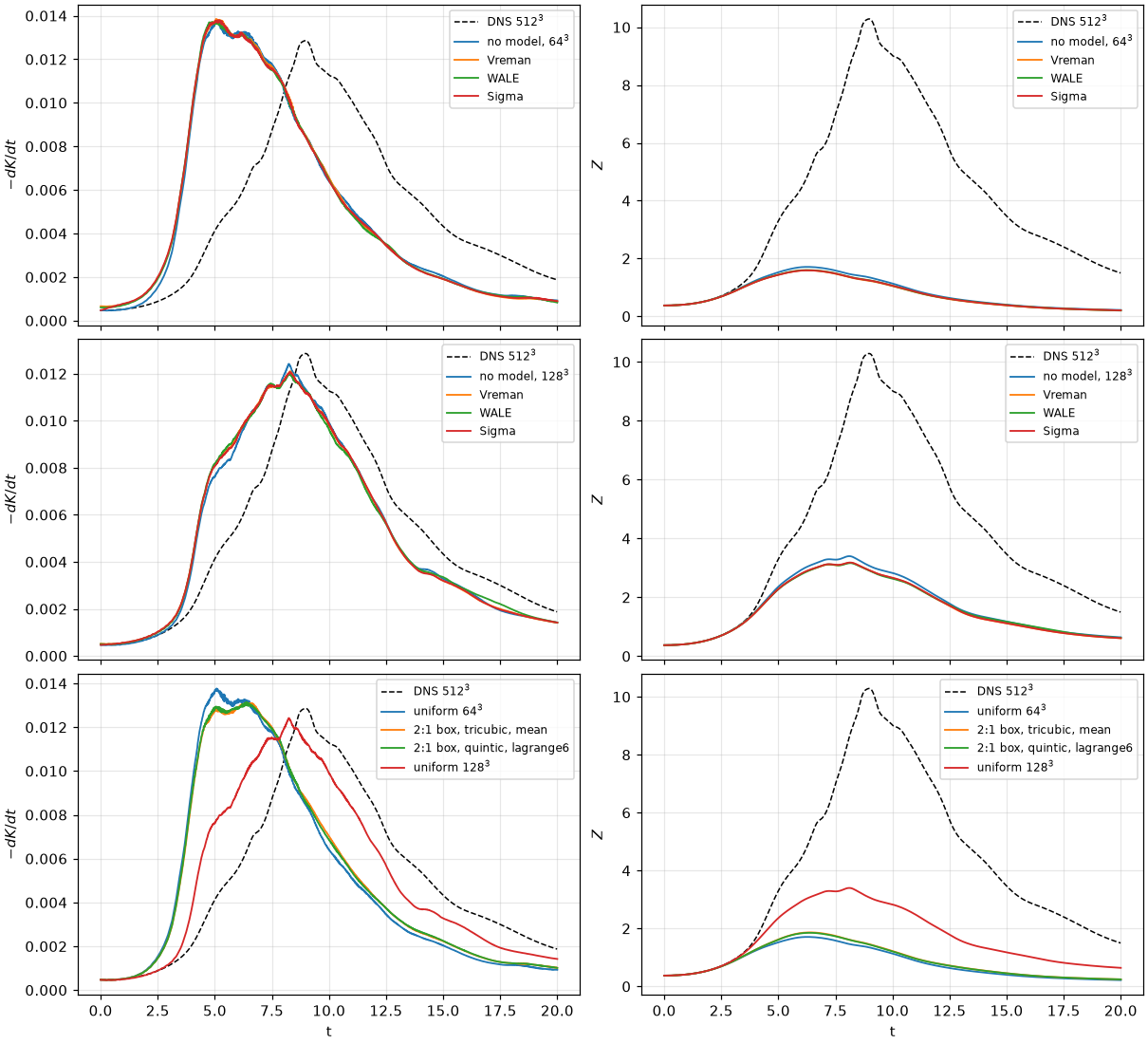
Top: M 0.1 at
| Case, M 0.1 | Peak | at | Peak | Share to the peak | |
|---|---|---|---|---|---|
| no model, | 0.01377 | 5.08 | 1.71 | 77 % | 0.0245 |
| Vreman, | 0.01385 | 5.05 | 1.59 | 79 % | 0.0236 |
| WALE, | 0.01374 | 5.04 | 1.60 | 79 % | 0.0239 |
| Sigma, | 0.01380 | 5.17 | 1.59 | 79 % | 0.0237 |
| no model, | 0.01242 | 8.24 | 3.40 | 58 % | 0.0219 |
| Vreman, | 0.01210 | 8.29 | 3.18 | 61 % | 0.0213 |
| WALE, | 0.01199 | 8.29 | 3.16 | 61 % | 0.0210 |
| Sigma, | 0.01206 | 8.30 | 3.18 | 60 % | 0.0213 |
The share leaves
Against the 512³ DNS (L2 errors over
| Case | L2 | L2 | L2 |
|---|---|---|---|
| WENO-5, | 0.660 | 0.844 | 0.187 |
| Vreman, | 0.671 | 0.854 | 0.200 |
| WENO-5, | 0.278 | 0.643 | 0.083 |
| Vreman, | 0.295 | 0.662 | 0.092 |
| WALE, | 0.296 | 0.660 | 0.091 |
| Sigma, | 0.293 | 0.660 | 0.091 |
What it shows.
- No model beats no model. On a dissipative scheme each one lowers the enstrophy peak further from the reference (1.59 against 1.71 at
, 3.18 against 3.40 at ), and all three worsen every L2 error. - The three models are nearly the same.
- The eddy viscosity adds to a numerical dissipation that already dominates. In the laminar phase, to
at M 0.4, it takes 21–53 % of the energy lost. - Go/no-go: no-go for a model on WENO. Under the rule of #119 this makes the hybrid central/WENO scheme (T2) necessary before any model is recommended.
The constants come from other discretizations. The same models in decaying isotropic turbulence are in the ILES baseline; on the hybrid scheme in T2.
Not done
- A spectral comparison with filtered DNS, which could rank the models differently.
- Tuned constants.
- A model on 2:1 grids beyond conservation (hy9); a model with runtime AMR.