Appearance
MHD on weno-riemann
| ID | Group | Milestone | Backends | Figure | Regression |
|---|---|---|---|---|---|
| RV-5, RV-6, RV-7 | Ideal MHD | M3 (#47, M3-P3c) | CPU, FNL | yes | rj2a-hlld |
Case and scope
The MHD verifications of M2 were built on the WENO flux splitting. The weno-riemann scheme (WENO interpolation of the face states, an LLF, HLL or HLLD Riemann solver, a high-order flux correction) reuses their inputs and oracles through the shared --numerics option, which rewrites the [numerics] block of the generated inputs:
--numerics SOLVER[:RECON[:CORRECTION[:SENSOR]]]with SOLVER = llf | hll | hlld, RECON = primitive | characteristic (default characteristic, the MHD default), CORRECTION = none | 4th | 6th (default 6th), SENSOR = weno | none (default weno). Seven scripts take it: linear-wave, cpaw, riemann, rj2a, orszag-tang, rotor and field-loop.
What the case catches:
- a Riemann-solver path that loses accuracy: the specs
hlld:primitiveandhlld:characteristic(6th, weno) assert bounds measured on them inrj2a,linear-wave,cpawandfield-loop; HLLD must be at least as accurate as HLL on Ryu–Jones 2a (RV-6); - a scheme-dependent defect: every spec runs the scheme-independent checks (order, bitwise x/y/z and left/right, symmetry, conservation, positivity); the other specs are measurements.
Models and numerics
| Item | Choice | Code |
|---|---|---|
| Equations | ideal MHD, no cleaning, GLM or EGLM, as in each verification | models |
| Space | scheme_space = weno-riemann: WENO interpolation of the face states (primitive or characteristic variables) | compute_residuals_riemann, adam_flume_cpu_object.F90; mhd_face_interpolation_fields, mhd_face_states, adam_flume_mhd_riemann_library.F90; numerics |
| Riemann solvers | LLF, HLL, HLLD (with a fallback to HLL, reported in the log); GLM and EGLM variants | mhd_riemann_llf, mhd_riemann_hll, mhd_riemann_hlld, mhd_glm_riemann_hlld, mhd_eglm_riemann_hlld, adam_flume_mhd_riemann_library.F90; adam_flume_cpu_mhd_hlld_kernels.F90 (and the _llf, _hll, _glm_*, _eglm_* twins) |
| Flux correction | 6th with the WENO sensor (default) | numerics |
| Time, boundaries, grids | as in each verification | — |
| FNL backend | the same kernels on the device | compute_residuals_riemann_dev, adam_flume_fnl_object.F90 |
Initial and boundary conditions
The inputs are those of the verifications, unchanged except for the [numerics] block:
| Problem | Setup |
|---|---|
| Ryu–Jones 2a | 256 and 512 cells, |
| linear waves, CPAW | the MV-5 and MV-6 ladders |
| Brio–Wu, Ryu–Jones 4d | 512 cells, floors armed at |
| field loop | the uniform 64/128 ladder |
| Orszag–Tang, rotor | as in MV-12, MV-13 |
Input files
| File | Role |
|---|---|
src/tests/flume/verification/mhd/numerics.sh | numerics_check, numerics_tag, numerics_apply: validates the spec and rewrites [numerics] |
src/tests/flume/verification/make_doc_runs.sh <runs> rj2a mhd, make_doc_figures.py --only weno-riemann | rj2a re-runs the splitting and HLLD-characteristic runs, mhd the HLLD-primitive run rj2a-hlld-prim |
src/tests/flume/verification/mhd/{rj2a,linear-wave,cpaw,riemann,orszag-tang,rotor,field-loop}/check.sh | the seven scripts that take --numerics |
bash
cd src/tests/flume/verification/mhd
rj2a/check.sh --numerics hlld                     # HLLD, characteristic interpolation
rotor/check.sh --numerics hlld:primitive          # HLLD, primitive interpolation
Results
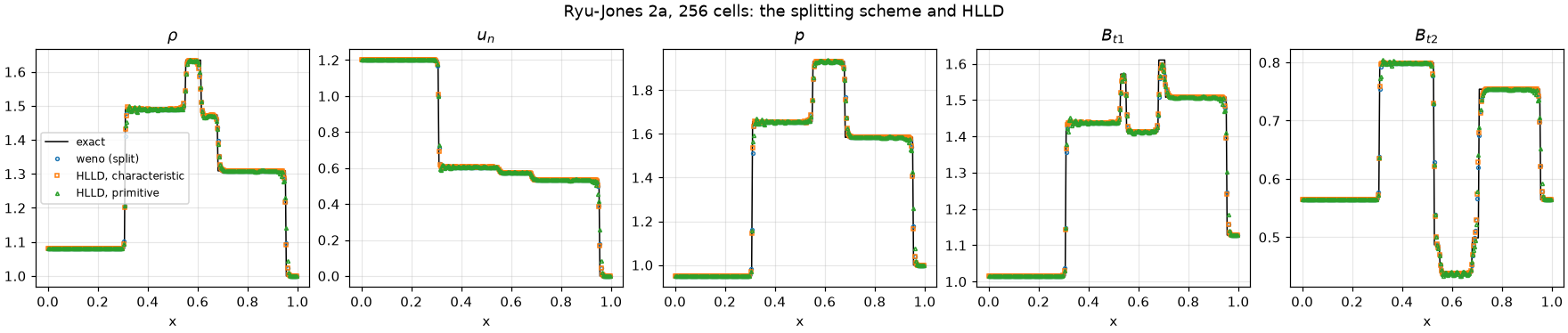
Ryu–Jones 2a at 256 cells, CPU, over the exact solution: the splitting scheme and weno-riemann with HLLD on characteristic and on primitive interpolation. The three agree at this scale; the primitive interpolation has the largest
Measured in issue #47, M3-P3c; CPU and FNL agree to the printed digits:
| Problem | Splitting | HLLD primitive | HLLD characteristic |
|---|---|---|---|
| Ryu–Jones 2a, | |||
| linear waves, CPAW: observed order | 4.96–5.02 | 4.96–5.00 | 4.96–4.99 |
| Brio–Wu, Ryu–Jones 4d: floored cells, HLLD fallbacks | 0 | 0, 0 | 0, 0 |
| field loop, magnetic energy kept at 64 / 128 cells | 0.872 / 0.937 | 0.869 / 0.936 | 0.887 / 0.944 |
Bounds asserted under the two HLLD specs (CPU M3-P3c + 2%; energies − 0.2%):
| Check | HLLD primitive | HLLD characteristic |
|---|---|---|
| Ryu–Jones 2a, | ||
| CPAW | ||
| linear waves, CPAW: observed order | ||
| field loop | ||
| field loop | ||
| Ryu–Jones 2a, GLM against no cleaning | ||
| rotor symmetry at step 100 / at the end |
The linear-wave bounds are per run, the larger of the two interpolations (linear-wave/check.sh).
Related cases: Sod, Lax and Shu–Osher compare the Euler Riemann solvers; EGLM cleaning runs on HLLD characteristic; positivity limiter runs HLLD and HLLC with the limiter.
Findings
- On Ryu–Jones 2a HLLD is more accurate than HLL (
and ): RV-6 asserts the HLLD sum at most the HLL one. - HLLD with characteristic interpolation matches the splitting scheme on Ryu–Jones 2a; primitive interpolation is about 35% less accurate there. On the smooth waves the two interpolations agree to 3 digits (linear WENO weights).
- The GLM run differs from the run without cleaning by round-off (
; bitwise with the splitting), because the interpolated uniform seeds . - The rotor's symmetry defect is round-off amplified by the flow and grows as the dissipation decreases (final
to depending on the interpolation and the backend), so under --numericsit is checked at step 100 withinand at the end within (rotor). - The scripts
glm-pulse,divb-peak,vortexandrotated-shock-tubedo not take--numerics: MV-3, MV-7, MV-8 and MV-10 run on the splitting scheme only.