Appearance
Ghost probe: every face and edge ghost on a linear field
| ID | Group | Milestone | Backends | Figure | Regression |
|---|---|---|---|---|---|
| GP | Infrastructure | M4 (#65 P0, P1), M6 (#68 C2, D1) | CPU, FNL | yes | — |
Case and scope
The directional WENO stencils read only the face ghosts: the cells outside a block along one axis. The dissipative terms of M4 take cross derivatives, such as the tangential derivatives of the viscous stress or of the current at a face. Those read the edge ghosts too: the cells outside a block along two axes, in the rows next to a block edge. Before M4 nothing checked what an edge ghost held. GP checks every one, on every path that fills it: the same-level copy and the MPI exchange, the 2:1 restriction and tricubic fill, the inter-realm seams (1:1 mirror, misaligned, 2:1 refined), and the physical boundary conditions.
Oracle. Each case holds a linear field, CFL = 1e-30, which moves the field by ghost_probe.py compares every ghost with the value a stencil must read:
- the field at the ghost's own centre, inside the realm or across a seam;
- along an axis where the ghost lies beyond a physical face, that face's condition applied to the value of its donor: the coordinate mirrored with the normal momentum negated for an inviscid wall (and the normal field on MHD); mirrored with the velocity reflected about the wall velocity for a no-slip wall (and the temperature
for an isothermal one); the first interior cell for extrapolation; the inflow state for inflow; the wrapped coordinate for periodic. Beyond two faces the conditions compose in the backends' order (inflow first, else the first face in axis order acts on a donor valued the same way).
The no-slip walls are not linear in the state; the probe evaluates them with an independent implementation of the rule of Boundary conditions, so walls3d checks the plumbing (which donor, which face, which wall parameters, in which order), not the physics of the wall. The physics comes with the viscous fluxes (VV-3, Couette).
The poison. The negligible step leaves a stale ghost equal to a fresh one, so the oracle alone cannot see a ghost read before its donor is written. Every case therefore runs with [diagnostics] ghost_poison = .true.: each ghost is set to NaN before the fill, and a ghost that reads an unfilled donor is written as NaN, which the probe reports as an infinite error. Its negative control is the defect it found (see Findings).
The polynomial probe (#68 D1). check.sh --degree N starts from the field tricubic 3, lagrange6 and quintic 5), so at
Models and numerics
| Item | Choice | Code |
|---|---|---|
| Models | Euler; ideal MHD with GLM (box3d) and with EGLM (walls3d), | models |
| Step | one step at CFL = 1e-30 (WENO5 splitting, SSP-33; the update is negligible) | compute_residuals_weno, adam_flume_cpu_object.F90 |
| Poison | every ghost NaN before the fill of a field write | poison_ghosts, adam_flume_cpu_object.F90; poison_ghosts_dev, adam_flume_fnl_kernels.F90 |
| Intra-realm exchange | same-level copy, MPI exchange, 2:1 restriction and fill (tricubic default; lagrange6, quintic options) | update_ghost, adam_flume_cpu_object.F90; update_ghost_local, update_ghost_mpi, interp_seam_ghost, restrict_seam_high_order, adam_field_object.F90; boundary conditions |
| Inter-realm seams | 1:1 mirror, misaligned, 2:1 refined | fill_seam_from_peer_forest, adam_flume_cpu_object.F90; seam_fill, adam_seam_exchange.F90; boundary conditions |
| Physical boundaries | inflow, extrapolation, periodic, inviscid, no-slip and isothermal walls; edges compose the conditions of their faces | set_boundary_conditions, adam_flume_cpu_object.F90; realm_edge_face, realm_edge_donor, wall_noslip_ghost, adam_flume_bc_object.F90; set_boundary_conditions_dev, adam_flume_fnl_kernels.F90; boundary conditions |
| Field write | post-step save, ghosts refilled in Runge–Kutta stage order (seams first) | post_step_forest, save_simulation_data, adam_flume_cpu_object.F90 |
Initial and boundary conditions
Common to every case: linear initial condition with ngc = 3; it_max = 0, time_max = 0, CFL = 1e-30; ghost_poison = .true.; MHD cleaning glm_ch = 3, glm_alpha = 0.18.
Case (make_probe.py) | Grid | Boundaries | Paths |
|---|---|---|---|
box3d (Euler and MHD) | 2:1 seams meeting an inflow face and two walls in 3-D | ||
channel2d | nk = 1), blocks of | the 2:1 seam crossing the periodic boundary at the wall | |
mirror3d | two realms | 1:1 mirror seam at | seam edges in every plane |
refined3d | as mirror3d, the second realm one level finer | a coupling = refined (2:1) seam | the 2:1 inter-realm seam |
walls3d (Euler and MHD with EGLM) | as box3d | wall-noslip (wall_u = 0.2, wall_w = -0.1), wall-noslip, wall-isothermal (wall_v = 0.15, wall_temperature = 0.9), | the no-slip walls of #65 P1 around a refined corner |
step | the Woodward–Colella forest at | inflow, outflow, walls | misaligned mirror seams, a re-entrant corner |
| Run | Ranks |
|---|---|
| every case, CPU | 1, 2, 3 |
| every case, FNL | 1, 2 |
Faces and edges must hold the expected value to solid, inside the step).
Input files
| File | Role |
|---|---|
src/tests/flume/verification/ghosts/make_probe.py | writes the cases; --linearize rewrites the step forest into a probe run |
src/tests/flume/verification/step/make_step.py | the step forest (--cells 80 --refine) |
src/tests/flume/verification/ghosts/check.sh | runs the cases (--np "1 2 3", --legs LIST: a leg is a case, box3d, box3d-mhd, channel2d, mirror3d, refined3d, walls3d, walls3d-mhd, step, default all; --keep, --seam-restriction R, --seam-ghost-fill F, --degree N) |
src/tests/flume/verification/ghosts/ghost_probe.py | the expected value of every ghost, the report by class (face, edge, corner) and by what lies beyond, the bound (--tol 1e-12) |
src/tests/flume/verification/make_doc_figures.py (fig_ghosts) | the figure, from ghosts/check.sh --legs step --np 2 --keep and the before-P0 run kept as ghosts/work-before-p0-np2-step (built from 3f51451d) |
bash
cd src/tests/flume/verification/ghosts && ./check.sh                    # CPU, np 1 2 3, every case
FLUME_EXE=$PWD/../../../../../exe/adam_flume_fnl ./check.sh --np "1 2"  # FNL
./check.sh --legs box3d,channel2d,refined3d --degree 5 --seam-restriction lagrange6 --seam-ghost-fill quintic
Results
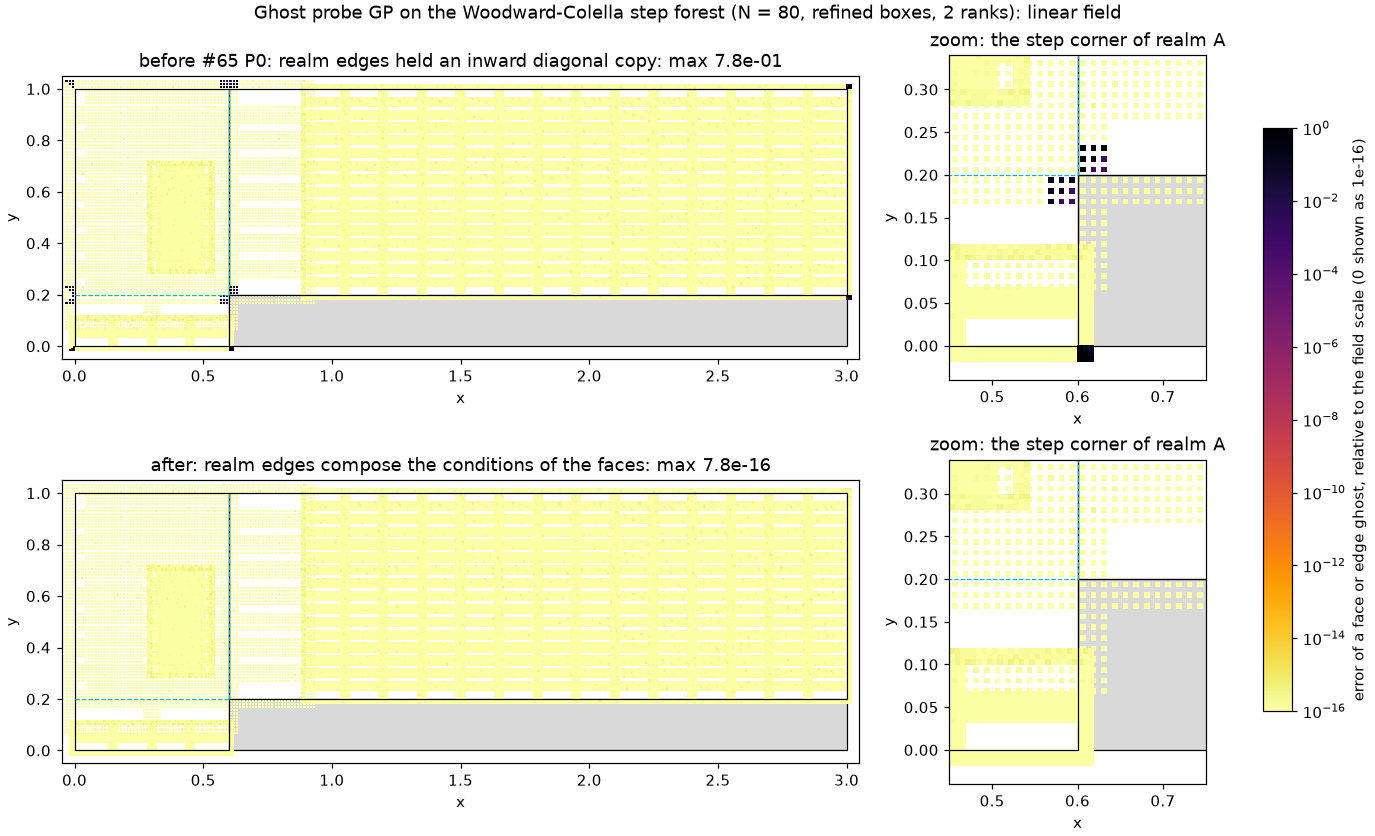
Each point is a face or edge ghost of the step forest (
| Probe | Bound | CPU (np 1–3) | FNL (np 1–2) |
|---|---|---|---|
| linear field, every case, every face and edge group | |||
linear field, --seam-restriction lagrange6 (box3d, channel2d, refined3d) | |||
degree 5, lagrange6 + quintic (box3d, channel2d, refined3d) | |||
degree 5, tricubic (negative control) | must fail | misses by | |
| degree 2, mean restriction (negative control) | must fail | misses by | |
| the step forest before P0 | — | realm edges off by up to 0.78 |
Related cases: Forward-facing step and Multi-realm runs run the seams this probe inspects; D1, quintic fill uses the polynomial probe.
Findings
- What it found (P0). Before P0, a ghost beyond two realm faces held a copy of its inward diagonal cell. That covers wall plus wall at the step corner, wall plus seam where the step face meets the A–B seam, inflow plus wall, and the like. On the step forest those ghosts were off by up to 0.78 of the field scale: the wrong position, and the wrong sign of the normal momentum. They now compose the conditions of the faces, as Boundary conditions describes. The face ghosts, and the edges with another block beyond one of their faces, were already right.
- What the poison found (P1, after P0 had been committed). An extrapolation ghost copied the previous ghost of its chain along the normal. When the ghost also lies beyond a block interface along another axis, deeper than along the normal, that previous ghost is in the same crown, so in the same device launch: on FNL the rows raced. Two identical FNL runs of
sod-xwrote different edge and corner ghosts (the interior identical), and with the poison GP failed theblock+extrapolationedges on every case (NaN read). The CPU walks each row outward and read its donors fresh, by the row order alone. The P0 probe could not see it: without the poison the stale value equalled the fresh one. An extrapolation ghost now copies the first interior cell along its normal directly (the same value, and a donor the exchange has filled), on both backends; with the poison every case passes and two FNL runs are bit for bit equal. - A gap in its own instrument. The step-0 file is written while each realm initialises, before the forest connects the realms, so its seam ghosts are unfilled. GP therefore reads the file written after the negligible step, whose write refills the seams first.
- The negative controls of the polynomial probe are not part of
check.sh; they are run by hand with--seam-ghost-fill tricubic --degree 5and--seam-restriction mean --degree 2.