Appearance
Positivity limiter
| ID | Group | Milestone | Backends | Figure | Regression |
|---|---|---|---|---|---|
| PV-1 to PV-5 | Ideal MHD | M3 (#47, M3-P5); PV-5 #50 | CPU, FNL (PV-1 as a sphere: FNL only) | yes | blast-limiter, blast3d-limiter, blast-amr-limiter |
Case and scope
The limiter (positivity_limiter = cell) blends every face flux with the first-order Lax–Friedrichs backbone so that each stage keeps the density and the pressure positive. It must make the hard problems run without floors and leave the smooth ones untouched. All legs run with the floors disabled, on the splitting scheme and on weno-riemann (HLLD for MHD, HLLC for Euler, characteristic interpolation).
A leg passes when the run reaches its final time and no stage meets an inadmissible backbone (the log line positivity limiter: N faces limited, M inadmissible backbones has
What the case catches:
- loss of positivity on strongly magnetised blasts (PV-1, PV-2) and near vacuum (PV-3);
- a limiter that acts on smooth flow (PV-4): with the limiter on, smooth runs must be bitwise equal to the runs without it;
- positivity lost at 2:1 seams (PV-5): the end-of-step reflux and the seam ghost fill must not undo the limiter; the mass must stay constant and the coarse seam flux must equal the mean of the fine ones at every stage.
Models and numerics
| Item | Choice | Code |
|---|---|---|
| Limiter | cell-based parametrised flux limiter: each face flux blended with the first-order backbone; the relative floor keeps | limit_positivity, adam_flume_cpu_object.F90; compute_positivity_factors, compute_backbone_fluxes, blend_positivity_fluxes, adam_flume_cpu_positivity_kernels_agnostic.INC; POSITIVITY_LIMITER_KAPPA, adam_flume_parameters.F90; numerics |
| MHD backbone | Lax–Friedrichs flux with the Wu speed (no-cleaning and EGLM variants) | mhd_backbone_flux, mhd_eglm_backbone_flux, adam_flume_mhd_riemann_library.F90 |
| EGLM sources under the limiter | sources taken with the limited arithmetic; unlimited where | add_eglm_sources_limited, adam_flume_cpu_mhd_eglm_kernels.F90 |
| Seams (PV-5) | per-stage seam flux synchronisation; ghost positivity blend of the tricubic seam ghosts | seam_sync_fluxes, seam_sync_factors, adam_flume_cpu_object.F90; blend_inadmissible_ghosts, adam_flume_cpu_ghost_kernels_agnostic.INC |
| Equations | ideal MHD with EGLM (PV-1, PV-2, PV-5), | models |
| Space | WENO5 flux splitting; weno-riemann HLLD (MHD) or HLLC (Euler), characteristic, 6th, weno sensor | compute_residuals_weno, compute_residuals_riemann, adam_flume_cpu_object.F90 |
| Time | MHD: SSP Runge–Kutta 5 stages, CFL 0.4 (the Orszag–Tang setup); Euler: SSP-33, CFL 0.5 (the Sod setup) | adam_rk_object.F90 |
| Floors | disabled | models |
| FNL backend | the same limiter on the device | limit_positivity_dev, seam_sync_fluxes_dev, adam_flume_fnl_object.F90 |
Initial and boundary conditions
| Leg | Problem | Grid | Final time |
|---|---|---|---|
| PV-1 | Balsara–Spicer blast: | 0.01 | |
| PV-1, sphere | the same blast as a sphere | 0.01 | |
| PV-2 | Wu & Shu (2018, Example 4.4): | 0.001 | |
| PV-3, LeBlanc | 400 cells (4 blocks of 100), the Sod grid, extrapolation | 6 | |
| PV-3, double rarefaction | 400 cells ( | 0.6 | |
| PV-3, planar Sedov | 800 cells ( | 0.001 | |
| PV-4 | the isentropic vortex (V2, Euler, | their verification grids | theirs |
| PV-5 | PV-1 at | amr_box.py | 0.01 |
All legs: 2 ranks. Initial conditions: the blasts and the near-vacuum problems use riemann-problem regions (one strip region per cell row for the disc). PV-3 setups as Zhang & Shu (2010) and Guo et al. (arXiv:1402.5618, Examples 8–10).
Input files
| File | Role |
|---|---|
src/tests/flume/verification/mhd/positivity-probe/make_blast.py | writes the blasts (--cells, --eglm, --3d, --b-axis x, --p-in, --b0, --time-max, --glm-ch, --refine-box, --ratio) |
src/tests/flume/verification/mhd/positivity/make_vacuum.py | writes the PV-3 inputs from sod/sod-x.ini (--problem leblanc|double-rarefaction|sedov) |
src/tests/flume/verification/mhd/positivity/check.sh | runs the legs (--legs pv1,pv1-3d,pv2,pv3,pv4,pv5; default pv1,pv2,pv3,pv4) and the verdicts |
src/tests/flume/verification/make_doc_runs.sh groups blast, vacuum | re-run PV-1, PV-2 (4 runs) and PV-3 (6 runs) with checkpoints kept |
src/tests/flume/verification/make_doc_figures.py fig_blast, fig_vacuum | draw blast.png, blast-wushu.png and near-vacuum.png (--only blast near-vacuum) |
bash
cd src/tests/flume/verification/mhd/positivity
./check.sh                       # PV-1, PV-2, PV-3, PV-4 (about 70 min on the CPU, PV-3 takes 55)
./check.sh --legs pv1-3d         # the blast as a sphere on 64^3 (about 1 h per scheme on the CPU)
./check.sh --legs pv5            # the blast across 2:1 AMR seams (about 14 min per scheme on the CPU, 19 on FNL)
Results
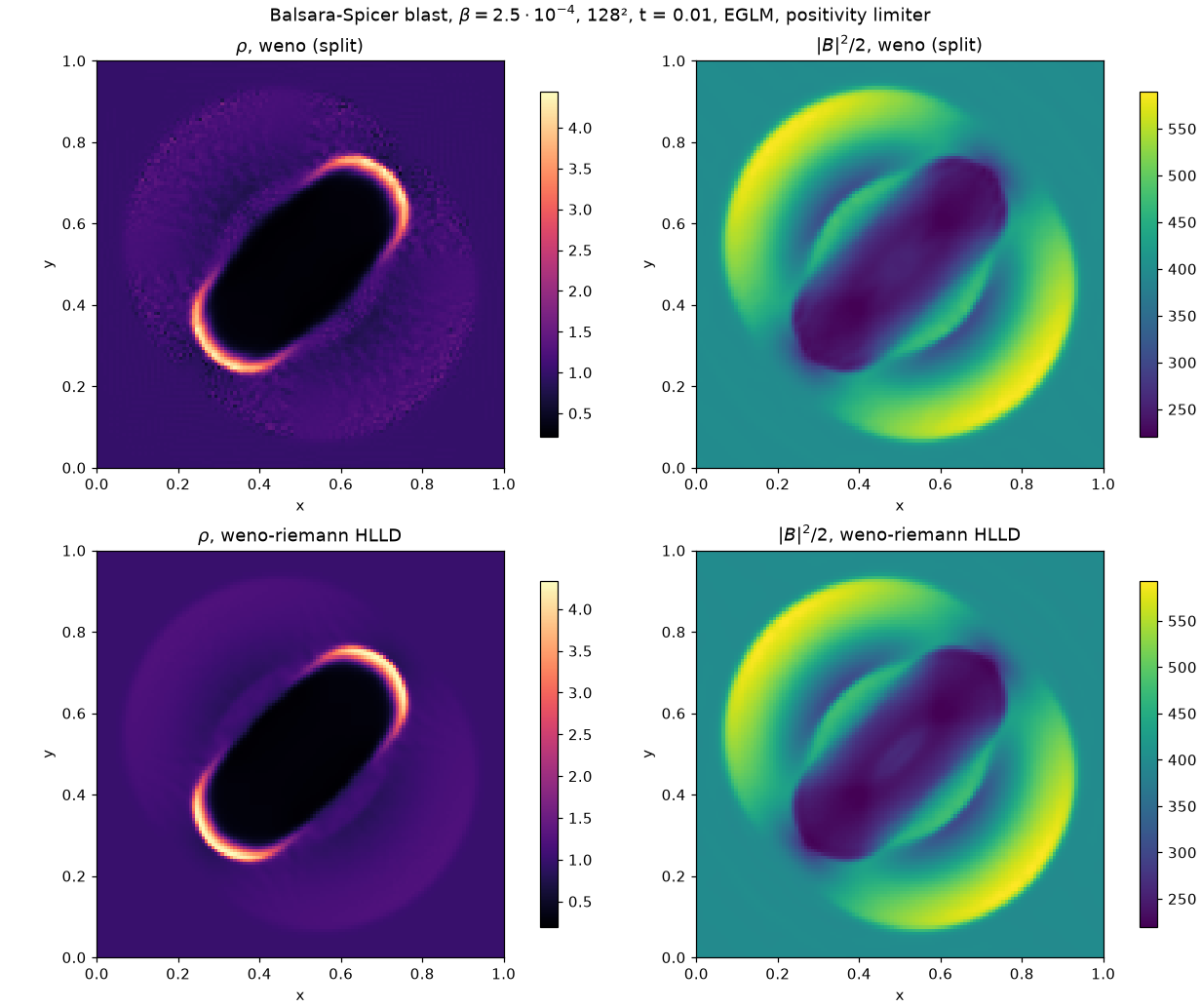
Balsara–Spicer blast, weno-riemann HLLD (bottom).
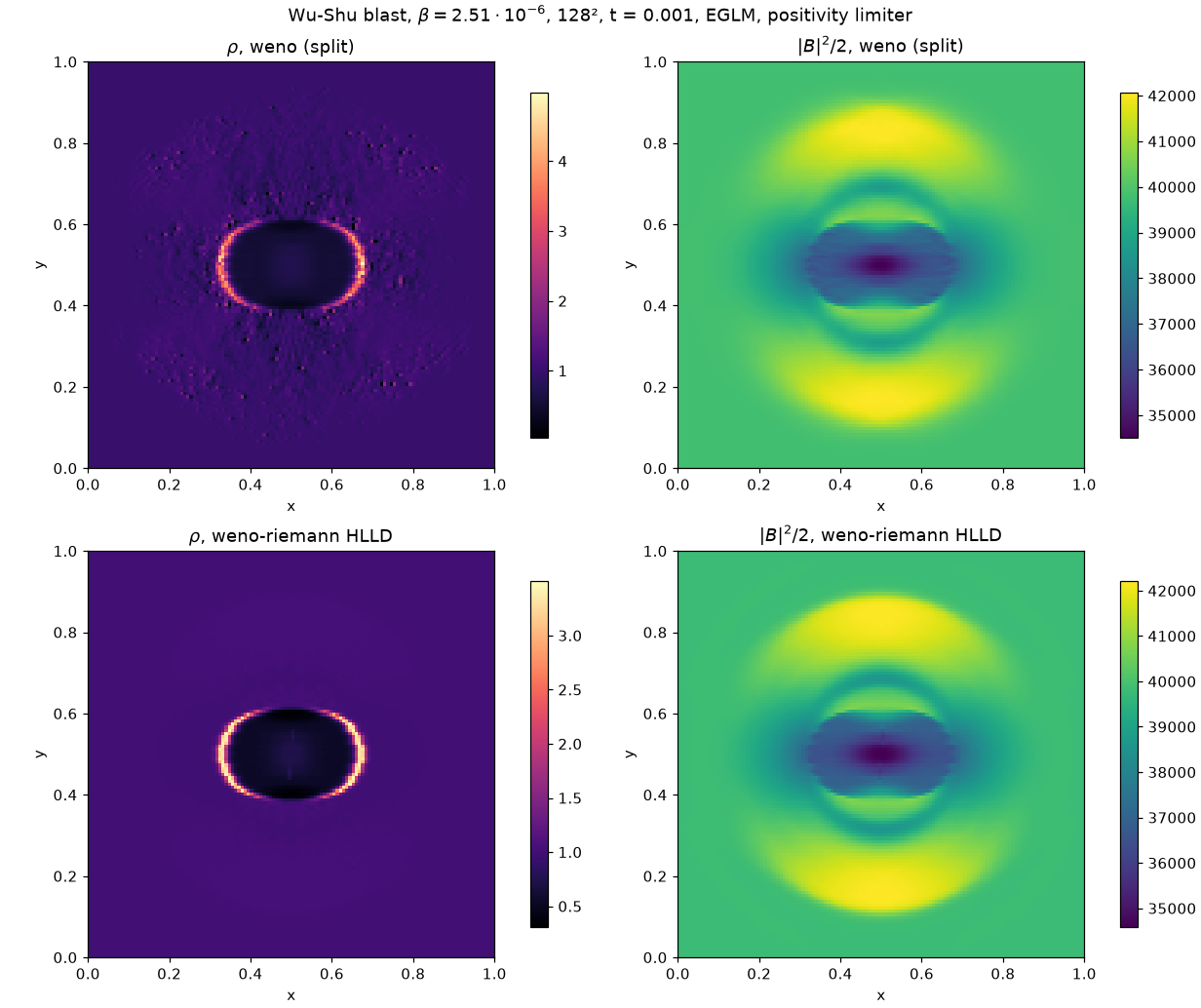
Wu–Shu blast,
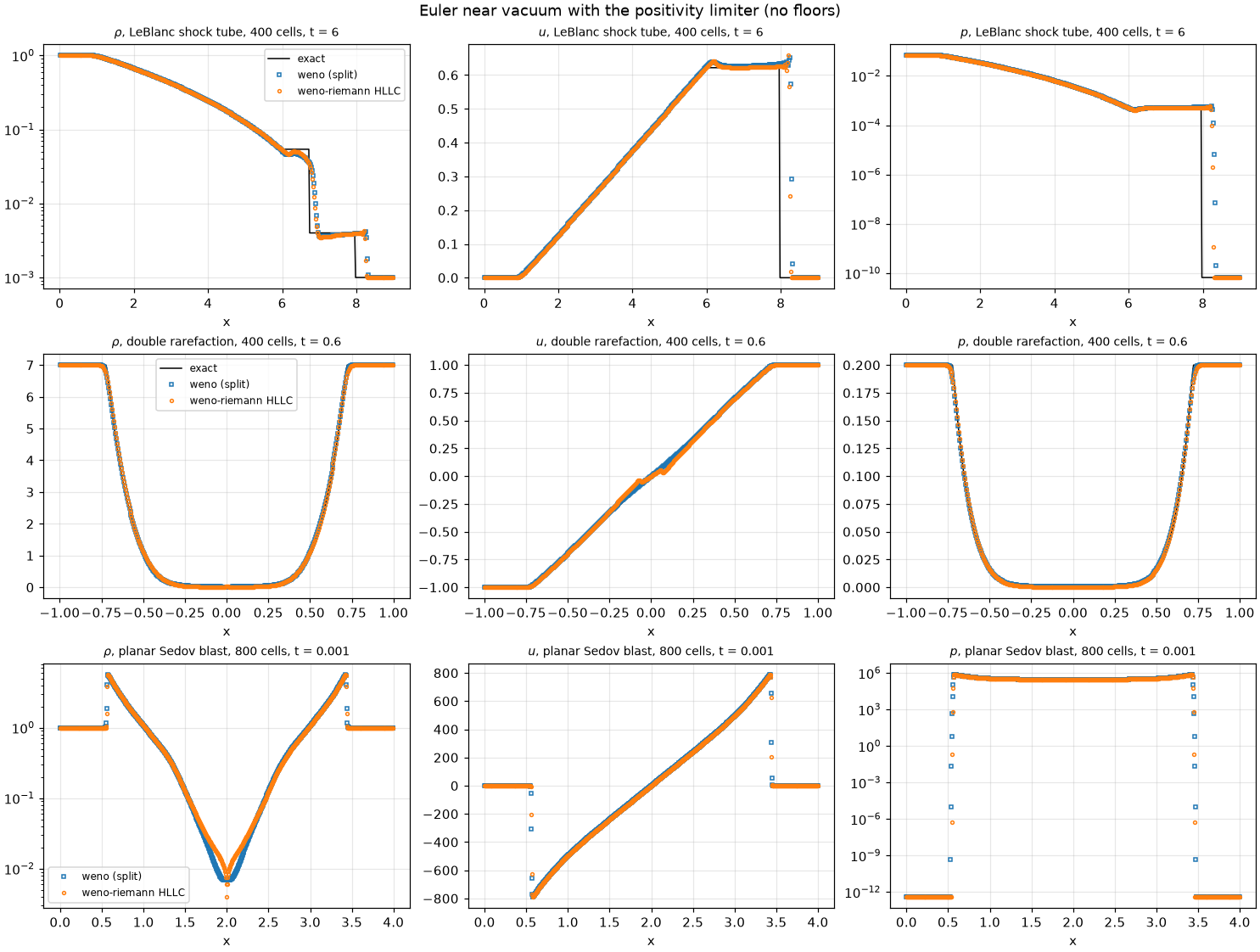
LeBlanc, the double rarefaction and the planar Sedov blast with the limiter, splitting scheme and weno-riemann HLLC, with the exact solutions of LeBlanc and of the double rarefaction.
| Problem | Without the limiter | Splitting + limiter | Riemann + limiter |
|---|---|---|---|
| PV-1, Balsara–Spicer blast, | splitting fails at step 3; HLLD runs | passes, up to 1540 faces limited per stage | passes, up to 280 |
| PV-1 as a sphere, | not run | passes, up to 51566 | passes, up to 2976 |
| PV-2, Wu–Shu blast, | splitting fails at step 1, HLLD at step 41 | passes, up to 10333 | passes, up to 352 |
| PV-3, LeBlanc shock tube, 400 cells | both run | passes, never limited | passes, up to 512 |
| PV-3, double rarefaction, 400 cells | splitting runs; HLLC fails at step 79 | passes, never limited | passes, up to 1024 |
| PV-3, planar Sedov blast, 800 cells | splitting runs; HLLC fails at step 69 | passes, never limited | passes, up to 768 |
| PV-4, isentropic vortex ( | — | bitwise equal to the run without the limiter | — |
| PV-5, PV-1 at | not run (uniform: splitting fails at step 3) | passes; mass to round-off, seam flux mismatch | passes; the same |
The face counts include the copies along the null directions (256 per 1-D face). They are those of the CPU; the device ones differ in the splitting blasts (1468 and 10955), whose limited runs are not bitwise reproducible across backends, and agree elsewhere. The 3-D blast was run with the relative floor on the device only.
| Assertion | Bound | CPU | FNL |
|---|---|---|---|
| final time reached, inadmissible backbones, non-finite fluxes (every leg) | pass | pass | |
| PV-3: final | pass | ||
| PV-4: interior of the last checkpoint, limiter on against off | bitwise | bitwise | bitwise |
| PV-5: relative mass drift | round-off | round-off | |
| PV-5: forest | the same |
Related cases: EGLM cleaning shows the blast failing without the limiter; quadtree AMR runs the limited blast on a quadtree; the MHD blast symmetry studies the blast under runtime AMR; Sod and Lax are the Euler Riemann problems the HLLC path is checked on.
Findings
- Both schemes reach the final time, but not with the same quality: the density of the splitting scheme carries grid-scale noise around the blast, mild at
and plain at , where HLLD stays clean. The limiter guarantees positivity, not accuracy: on strongly magnetised blasts weno-riemannwith HLLD is the scheme to use. - The Euler splitting scheme needs no limiting on any of the three near-vacuum problems at these resolutions: the limiter matters for
weno-riemann. - On LeBlanc both schemes put the shock ahead of its exact position
: by 0.33 at 400 cells and by 0.19 at 800 (measured on the splitting scheme). The error converges slowly under refinement, as reported for this problem in the literature, and the limiter does not cause it (the splitting scheme never limits here). On the double rarefaction the velocity is ill-defined where the density nearly vanishes, hence the kink at . On Sedov HLLC reaches a lower centre density than the splitting scheme ( against ), and the ambient pressure stays at its initial . - Sedov on HLLC set the limiter's relative floor. With the absolute floor alone the run stopped at step 10, at every CFL from 0.2 to 0.5: one stage drained the centre cell to
with its energy kept (the sound speed grew by ), and the next stage, whose time step is that of the step's first state, had no admissible backbone. With the relative floor ( ) the limiter acts in 15 stages and the run completes; the smooth cases of PV-4 stay bitwise. - The splitting scheme takes 614 steps on PV-2 against 284 for HLLD (779 with the absolute floor alone): its limited states keep low-density cells with large Alfvén speeds, which cost time steps but not admissibility.
- PV-4 is bitwise because a face whose two cells keep
is not touched, and the EGLM sources with take the unlimited arithmetic. - Before issue #50 neither scheme reached the end of PV-5. The splitting scheme stopped at step 184: the end-of-step reflux drove coarse cells beside the seam to
(it replaced the limited coarse flux with the restricted fine one, a correction no cell factor bounds). HLLD stopped at step 261, after the tricubic seam ghost fill had produced inadmissible fine ghosts. With the ghost positivity blend and the per-stage seam flux synchronisation both schemes reach on the CPU and on FNL; the coarse seam flux is the mean of the fine ones at every stage, so the end-of-step reflux corrects round-off only.