Appearance
Order across static 2:1 seams
| ID | Group | Milestone | Backends | Figure | Regression |
|---|---|---|---|---|---|
| AO (A1, C1) | Seam accuracy and divergence | M6 (#68) | CPU, FNL | yes | — |
Case and scope
A smooth vortex starts centred on the corner of a refined quadrant, so its core straddles an
Every smooth order test (V2, MV-5 to MV-7 in order of accuracy) runs on a uniform grid; VV-8 measures a seam with dissipative waves. No test measured the inviscid order of a smooth feature crossing a seam, where the #68 audit (F1) predicts that the mean restriction of the coarse ghosts and the Berger–Colella reflux of point-value fluxes each cap the order at 2.
What the case catches:
- a loss of order at the seams, in the band and in the regions the flow reaches after crossing a seam;
- a degradation of the seam operators: the finest refined errors are bounded by the CPU baseline plus 2 %, so an improvement of the transfers or of the reflux passes and a degradation fails;
- a broken instrument: the uniform control (no refined quadrant) must reach design order.
Phases C (high-order restriction), D (quintic prolongation) and E (reflux policy) of #68 are measured against these baselines; the legs euler-l6, euler-w6, euler-q6, euler-ww, euler-mp and euler-tq are their entries in the same ladder.
Models and numerics
| Item | Choice | Code |
|---|---|---|
Equations, euler | compressible Euler, ideal gas, | models |
Equations, mhd | ideal MHD with mixed GLM cleaning, glm_ch 3.0, glm_alpha 0.18, glm_damping_length 1.0 | models; mhd_glm_face_split_fluxes, adam_flume_mhd_library.F90 |
| Space | WENO5 (weno-u-5) flux splitting on characteristic variables | compute_residuals_weno, adam_flume_cpu_object.F90; compute_face_split_fluxes, adam_flume_euler_library.F90 |
| Time | SSP Runge–Kutta, 5 stages (runge-kutta-ssp-54), CFL 0.4 | adam_rk_object.F90 |
| Fine-to-coarse ghosts | [amr] seam_restriction: mean (default, the 2:1 mean), lagrange6 (C1), weno6 (C3) | update_ghost_local, restrict_seam_high_order, adam_field_object.F90; seam_restriction_code, SEAM_W_LAGRANGE6, adam_seam_interpolation_library.F90; key read in initialize, adam_adam_object.F90 |
| Coarse-to-fine ghosts | [amr] seam_ghost_fill: tricubic (default), quintic (D1), weno6, quintic-mp (D2) | interp_seam_ghost, adam_field_object.F90; seam_interpolate_tricubic, seam_interpolate_quintic, adam_seam_interpolation_library.F90 |
| Reflux | Berger–Colella, [numerics] reflux = .true.; reflux_policy = always (default) or troubled (euler-tq) | accumulate_seam_fluxes, apply_reflux_to_stage_forest, flag_troubled_seam_cells, adam_flume_cpu_object.F90; reduce_fine_sums, adam_flux_register_object.F90 |
| Boundaries | periodic in extrapolation on the null | boundary conditions |
| FNL backend | the same kernels on the device; the restriction rows in the local ghost kernel (C2) | adam_flume_fnl_object.F90; update_ghost_local_gpu_dev, adam_fnl_field_kernels.F90 |
The seam operators are described in numerics.
C1, the 6-point restriction ([amr] seam_restriction = lagrange6, #68 C1, C2). The coarse seam ghosts take the tensor 6-point Lagrange interpolation of the fine cells to the coarse centre instead of their mean: exact 1-D weights
Initial and boundary conditions
| Item | euler | mhd |
|---|---|---|
| Domain | ||
| Initial condition | V2 isentropic vortex: radius 0.07, strength 5, centre | MV-7 magnetised vortex: radius 1, |
| Base grid | quadtree (ratio = 4), ngc = 3; | the same |
| Refined region | quadrant primitive-box marker, max_level = 3, no regridding) | quadrant |
| Uniform control | the same case without the box (max_level = 2), the coarse spacing | the same |
| Boundaries | periodic in extrapolation in | the same |
| Final time | ||
| Ranks | 2 | 2 |
euler-octree (on request) | the euler leg on an octree (ratio = 8, nk = 4), | — |
Legs of the euler ladder (each: refined and uniform runs,
| Leg | seam_restriction | seam_ghost_fill | Reflux | Phase |
|---|---|---|---|---|
euler | mean | tricubic | on, always | A1 |
euler-l6 | lagrange6 | tricubic | off | C1 |
euler-w6 | weno6 | tricubic | off | C3, C3c |
euler-q6 | lagrange6 | quintic | off | D1 |
euler-ww | weno6 | weno6 | off | D2 |
euler-mp | lagrange6 | quintic-mp | off | D2 |
euler-tq | lagrange6 | quintic | on, troubled | E2 |
Input files
| File | Role |
|---|---|
src/tests/flume/verification/amr-order/make_amr_order.py | writes the inputs from the V2 input vortex/vortex-n{064,128,256}.ini (euler) or mhd/vortex/make_mhd_vortex.py (mhd); --ratio, --uniform, --no-reflux, --seam-restriction, --seam-ghost-fill, --reflux-policy, --time-max, --it-save |
src/tests/flume/verification/mhd/amr_box.py | refine_box: the refined quadrant, one 2:1 level at initialisation |
src/tests/flume/verification/amr-order/amr_order_oracle.py | the per-region errors against the exact vortex, the orders, the bounds |
src/tests/flume/verification/make_doc_figures.py --only order-across-seams | the figure, from the kept work directories of amr-order/check.sh --keep (CPU) |
src/tests/flume/verification/amr-order/check.sh | runs the legs (--legs euler,mhd,euler-octree,euler-l6,euler-w6,euler-q6,euler-ww,euler-mp,euler-tq, default all but euler-octree; --np N, --keep; FLUME_EXE selects the backend) |
bash
cd src/tests/flume/verification/amr-order && ./check.sh             # CPU, default legs (all but euler-octree)
FLUME_EXE=$PWD/../../../../../exe/adam_flume_fnl ./check.sh         # FNL
./check.sh --legs euler-octree                                      # the octree leg, on request
Oracle (amr_order_oracle.py). Each cell of the last checkpoint is compared with the exact convected vortex: the density for Euler; for MHD the eight conservative variables, combined as MV-7 does (ngc of their own spacing from the boundary of the refined quadrant (periodic images included), and the interior, the rest; a uniform run is all interior. For each region: L1 (the volume-weighted mean of
| Bound | Leg | Value |
|---|---|---|
| finest refined L1 (all, band) and L∞ (all) | every leg but euler-octree | at most the CPU baseline plus 2 % |
| uniform control, interior L1 order | every leg | |
| refined L1 / L∞ order, finest pair | euler-l6, euler-w6, euler-ww | |
| refined L1 / L∞ order, finest pair | euler-q6, euler-mp, euler-tq |
Cost of euler-l6: about 10 min on the CPU, 2 on FNL.
Results
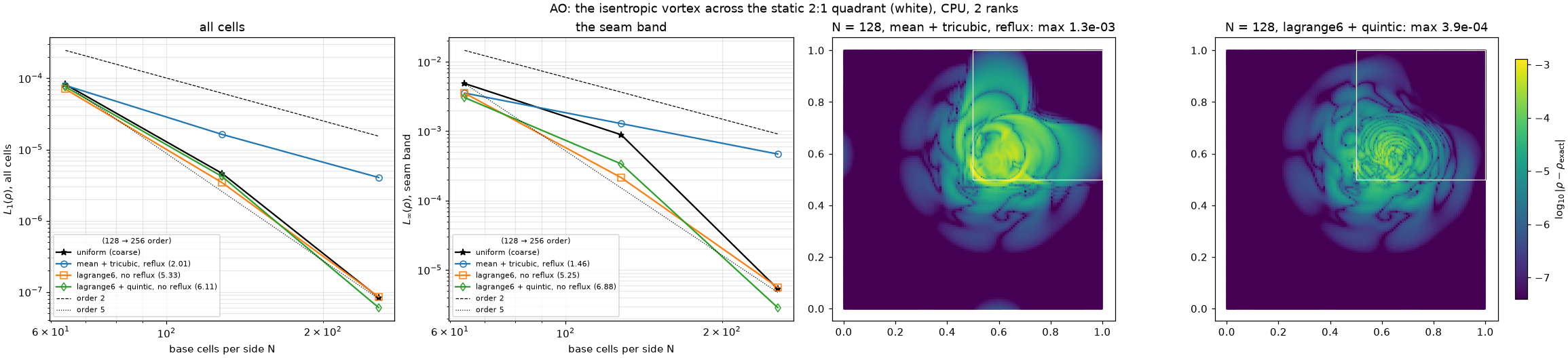
CPU, from the work directories amr-order/check.sh --legs euler,euler-l6,euler-q6 --keep leaves:
Baselines (A1). CPU and FNL identical to every printed digit, 2 ranks; orders of the finest pair,
| Leg | Refined L1 at N = 256 | Uniform L1 at N = 256 | L1 order: all / band / interior | L∞ order | Uniform L1 order |
|---|---|---|---|---|---|
| euler | 2.01 / 1.71 / 1.91 | 1.46 | 5.79 | ||
| mhd | 2.07 / 1.85 / 1.92 | 1.89 | 5.34 |
C1, the 6-point restriction (euler-l6). CPU and FNL (the device twin of C2) agree to every printed digit, and on the same run to
| N = 256 | L1 all | L∞ all | Orders 128 → 256, L1 / L∞ |
|---|---|---|---|
| euler (mean, reflux on, today) | – | 2.01 / 1.46 | |
| euler-l6 (lagrange6, reflux off) | 5.33 / 5.53 | ||
| uniform at the coarse spacing | 5.79 / 7.38 |
The other legs of the ladder report on their study pages: euler-w6 in C3c, euler-q6 in D1, euler-ww and euler-mp in D2, euler-tq in E2.
Related cases: AS is the shock baseline of the same seam operators; AL logs the drift of this vortex without the reflux; B1 reproduces the caps in a 2-D prototype; the uniform-grid orders are V2 and MV-5 to MV-7.
Findings
- The seams cap the whole solution at second order, not only the band. The error made at a seam is carried into the interior by the flow, so every region a feature reaches after crossing a seam is second order. The plan's expectation of "design order in the interior" holds only for regions the flow does not reach from a seam.
- On this smooth flow the refinement makes the solution worse. At
the refined composite error is 48 times (Euler) and 70 times (MHD) the error of the uniform run at the coarse spacing, which reaches design order. - Euler's L∞ order is 1.46, below the 2 of the 1-D prototype in #68 (Appendix A). The vortex crosses the seam corner, where the two seam directions meet; the 2-D prototype of Phase B was to check whether the corner explains it (B1 and B2 found it does not).
- C1: the restriction was the seam error. With the 6-point restriction and without the reflux the refined composite error equals the uniform coarse run's, 47 times below today's: at these resolutions the restriction was the seam error, and the tricubic prolongation's
term has not shown yet. - C1: the reflux caps the order by itself. With the reflux on, the restriction changes nothing (band L∞ order 1.43 against 1.46 at
= 64 → 128), as B1 predicts. Reaching the high order with the reflux kept at the shocks is Phase E's job (E2). - No restriction row fell back to the mean: every fine pair lies inside its donor block.
- C1 cost on FNL: about 16 % of the wall time of this run (
, reflux off: 56 s against 48 s with the mean; WSL, indicative only): the restriction rows read 36 cells instead of 4 on this quadtree, in the same kernels as the copies.