Appearance
Shu–Osher shock / entropy-wave interaction
| ID | Group | Milestone | Backends | Figure | Regression |
|---|---|---|---|---|---|
RV-3 (shu-osher leg) | Euler | M3 (#47) | CPU (all schemes), FNL (weno-riemann HLLC) | yes | — |
Case and scope
A Mach 3 shock runs into a sinusoidal density field (Shu & Osher 1989, J. Comput. Phys. 83, example 8). Behind the shock the density wave is compressed into high-frequency entropy waves, which a dissipative scheme smears. The problem has no closed-form solution; the reference is a much finer run.
What the case catches:
- excess dissipation of the
weno-riemannscheme at the entropy waves:against the reference must stay within the splitting scheme's (owner decision, 2026-09-30); - a flux-correction sensor that trips on smooth waves: a jump sensor switches the correction off in the entropy waves and does worse than splitting;
- loss of positivity behind the strong shock: density and pressure must stay positive;
- direction-dependent defects: the
, and runs must be bitwise equal after the permutation of the axes, and every transverse copy bitwise identical.
Models and numerics
| Item | Choice | Code |
|---|---|---|
| Equations | compressible Euler, ideal gas, | models |
Space, weno (baseline) | WENO5 (weno-u-5) flux splitting on characteristic variables | compute_residuals_weno, adam_flume_cpu_object.F90; compute_face_split_fluxes, adam_flume_euler_library.F90 |
Space, weno-riemann | WENO5 interpolation of the face states (characteristic), LLF, HLL or HLLC, the 6th-order flux correction with the WENO-weight sensor | compute_residuals_riemann, adam_flume_cpu_object.F90; compute_riemann_llf, compute_riemann_hll, compute_riemann_hllc, adam_flume_euler_library.F90 |
| Time | SSP Runge–Kutta, 3 stages (runge-kutta-ssp-33), CFL 0.5 | adam_rk_object.F90 |
| Initial condition | the shu-osher kind | set_initial_conditions, adam_flume_ic_object.F90 |
| Boundaries | zeroth-order extrapolation | set_boundary_conditions, adam_flume_cpu_object.F90 |
| Reference | the splitting scheme in NumPy (hybrid_proto.py, FLUME's weno scheme) on 16× finer cells, averaged to the grid | reference_density, src/tests/flume/verification/riemann-flux/shu_osher_oracle.py |
Initial and boundary conditions
The case is the Sod input rewritten by riemann-flux/check.sh (set_shu_osher).
| Item | Value |
|---|---|
| Domain | |
| Grid | 400 cells: 64 blocks of ngc = 3 |
| Ranks | 2 |
| Left state, | |
| Right state, | |
| Initial condition | shu-osher (interface = -4, rho_amplitude = 0.2, rho_wavenumber = 5) |
| Boundaries | extrapolation on all six faces |
| Final time | |
| Reference | 6400 cells, averaged to the 400 cells of the run; max |
Input files
| File | Role |
|---|---|
src/tests/flume/verification/sod/sod-{x,y,z}.ini | the base inputs, rewritten into the Shu–Osher problem |
src/tests/flume/verification/riemann-flux/check.sh --legs shu-osher | rewrites the inputs (set_shu_osher, set_numerics), runs the three directions; --solver, --so-l1-max |
src/tests/flume/verification/riemann-flux/shu_osher_oracle.py | the reference (computed once, a few minutes, cached in the temporary directory), the |
src/tests/flume/verification/riemann-flux/hybrid_proto.py | the NumPy splitting scheme that computes the reference |
src/tests/flume/verification/make_doc_figures.py (fig_shu_osher) | the figure, from the split and hllc work directories and the cached reference |
bash
cd src/tests/flume/verification/riemann-flux
./check.sh --legs shu-osher                                        # HLLC (default), bound 0.274
./check.sh --legs shu-osher --solver split                         # the splitting baseline
FLUME_EXE=$PWD/../../../../../exe/adam_flume_fnl ./check.sh --legs shu-osher  # FNL
Results
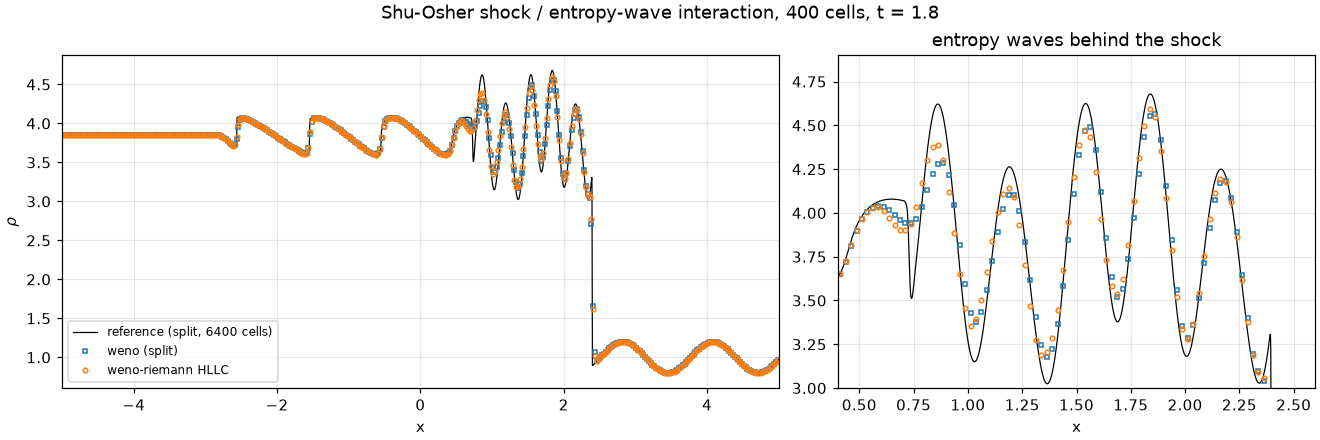
Density at weno-riemann HLLC against the 6400-cell reference; right, the entropy waves behind the shock.
| Scheme | Bound on | max | FNL | |
|---|---|---|---|---|
weno (split) | — | 0.2605 | 4.563 | not run |
weno-riemann LLF | explicit (exceeds the default) | 0.3009 | 4.550 | not run |
weno-riemann HLL | — | 0.2490 | 4.590 | not run |
weno-riemann HLLC (default) | 0.274 ( | 0.2425 | 4.592 | the same |
| bitwise | bitwise | bitwise |
Related cases: Sod and Lax compare the same solvers on simpler Riemann problems.
Findings
- HLLC resolves the entropy waves best: 7% below the splitting scheme's
, and the highest density peak. LLF is the most dissipative and exceeds the default bound. - The reference is the splitting scheme itself, so the comparison is biased toward it by the reference's own error, about 1/16 of the coarse error at the shocks. HLLC wins despite that bias.
- In the NumPy prototype study (
riemann-flux/README.md) the jump sensor switched the correction off in the entropy waves and did worse than splitting; the WENO-weight sensor is the default for that reason. - Only the default HLLC run exists on FNL.