

Appearance
PML reflection at normal incidence
| Cases | Issues | Type | Backends | Figure | Regression |
|---|---|---|---|---|---|
pml-reflection sweep (16 runs) | #145 (item 3), #106 (open: oblique incidence) | P | CPU, FNL (one point) | yes | no (measurement, not a leg) |
Case and scope
A plane Gaussian pulse travels along
the same for every frequency, so the reflected pulse is the incident one scaled by
The sweep measures:
- the thickness
cells at s , (the paper's absorbing-layer test is the point); from to s at ; at one design value, ( fixed): what is left is the grading reflection; - the CFS layer at
, with , (the classical layer through the CFS path) and with the , s of rmf-pml-amr; - the boundaries without a layer: the first-order Silver–Müller condition, Neumann, PEC;
- the noise floor of the measurement: a wall 0.40 m away, beyond reach in the measured time.
The reflection against the angle of incidence is not measured here (#106).
Models and numerics
| Item | Choice | Code |
|---|---|---|
| Equations | Maxwell, SI, no source | models |
| Space, time | centred finite differences of order 6; SSP Runge–Kutta (5,4), CFL 0.5 | numerics |
| PML | classic (CFS, on both | adam_prism_pml_object.F90; absorbing layers |
| Silver–Müller | first-order impedance ghosts, normal components solved for zero divergence | boundary conditions |
| Neumann | mirror ghosts of every component | adam_prism_cpu_object.F90 |
Initial and boundary conditions
| Item | Value |
|---|---|
| Domain | interior |
| Grid | one block, ni = |
| Initial condition | Gaussian pulse along |
| Time | until the pulse reflected by the wall behind the layer has its centre at |
| Ranks | 1 |
Measurement (pml_reflection.py).
Input files
| File | Role |
|---|---|
src/tests/prism/verification/pml-reflection/make_pml_reflection.py | writes one input (--boundary pml|cfs|silver-muller|neumann|pec|far, --cells, --gamma-max, --exponent, --alfa-max, --k-max) |
src/tests/prism/verification/pml-reflection/pml_reflection.py | the measurement; --profiles keeps |
src/tests/prism/verification/pml-reflection/sweep.sh | runs the 16 cases (--jobs, --cases), writes results.txt, results.json |
src/tests/prism/verification/make_paper_figures.py | the figures from the sweep |
bash
src/tests/prism/verification/pml-reflection/sweep.sh /tmp/pml --jobs 16                     # CPU, about 15 min on 16 cores
PRISM_EXE=$PWD/exe/adam_prism_fnl src/tests/prism/verification/pml-reflection/sweep.sh /tmp/pml-fnl --cases "pml-n20 silver-muller far"
PRISM allocates its block pool from the free memory of the node; set ADAM_MEMORY_FRACTION (e.g. 0.02) when the runs share a node, or they are killed for memory.
Results
| Boundary | |||||||
|---|---|---|---|---|---|---|---|
| classical PML | 10 | ||||||
| classical PML | 20 | ||||||
| classical PML | 40 | ||||||
| classical PML | 80 | ||||||
| classical PML | 20 | ||||||
| classical PML | 20 | ||||||
| classical PML | 20 | ||||||
| classical PML | 20 | ||||||
| classical PML | 10 | ||||||
| classical PML | 40 | ||||||
| CFS, | 20 | ||||||
| CFS, | 20 | — | — | ||||
| Silver–Müller (first order) | — | — | — | — | |||
| Neumann | — | — | — | — | |||
| PEC | — | — | 1 | 1 | |||
| none within reach (floor) | — | — | — | — |
Measured: ADAM 0bcdf870 + the night-2026-11-22 tree (HEAD 95ffd728 with the working tree of 2026-11-23), CPU gfortran 16.2.0 + Open MPI 5.0.11 (iac_gnu) on medooza (gnode25), FNL nvfortran 26.9, CUDA 12.9 (iac_nvf) on NVIDIA A30 (gnode23), 2026-11-23 (pml-reflection/sweep.sh, jobs 1369621 CPU, 1369626 FNL). FNL reproduces the three CPU values to every printed digit, both measures.
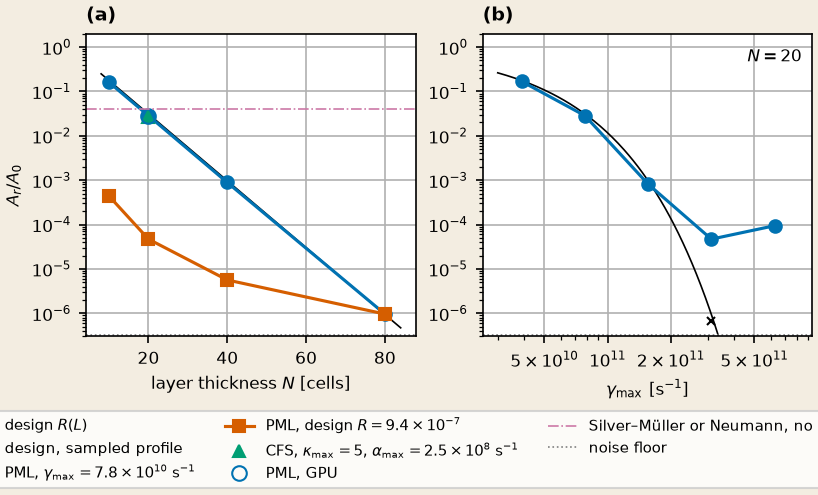
Reflected amplitude against the thickness at
Findings
- The layer reflects what its design says, as long as the grading is resolved. Up to
the measured amplitude is the sampled design value to 1 % ( at s ; and s at ), and the reflected pulse is a scaled copy of the incident one (the amplitude and the energy measures agree to 0.1 %). The paper's 20-cell layer reflects of the incident amplitude: the sampled profile integrates to 2.6 % more damping than the continuum one, whose is . - Beyond, the grading sets the floor. A steeper profile (larger
at fixed ) stops paying at for : from to s the reflection doubles while the design value falls by six decades, and it arrives first (the inner part of the layer), with the opposite sign and a distorted shape (the energy measure 1.45 times the amplitude one). At a fixed design the grading reflection falls from ( ) to (20), (40) and (80, the design value): about , the order of a quadratic profile. The best measured values are with 20 cells and with 40. - CFS. With
, the CFS path reproduces the classical layer to every printed digit. With the rmf-pml-amrparameters it reflects: the stretching delays the reflection (the pulse crosses the layer at ) and leaves the amplitude near the classical one. - Silver–Müller is not exact at normal incidence on this grid. The continuum condition reflects nothing at normal incidence; the discrete one returns 0.36 % of the energy,
, as a grid-scale (odd–even) wave packet of peak of the incident one that travels back at 2.2 times the speed of light (the group velocity of the mode of the sixth-order centred derivative). In the energy measure the 20-cell classical layer at the paper's reflects 2.1 times less (4.5 times less energy), the 40-cell one 68 times less. - Neumann does not reflect the pulse. The mirror ghosts let 99.6 % of the energy leave through the face, and send back the same grid-scale packet as Silver–Müller (0.36 % of the energy; the window energy of the two runs agrees to four digits from step 360 to step 560). At the opposite Neumann face that packet turns into a smooth pulse of nearly the incident amplitude (
) travelling in : the energy in the domain grows from 0.36 % to 99.7 % of the initial one within 80 steps. A Neumann face is not energy-stable for the centred scheme; the "large reflection" of a Neumann boundary in a 1-D run is this re-emission at the opposite face, not a reflection. - The floor of the measurement,
, is the dispersive trail of the pulse (its high-wavenumber content, which the centred scheme carries backwards), not round-off.