Appearance
Passive scalars
| ID | Group | Milestone | Backends | Figure | Regression |
|---|---|---|---|---|---|
| PS (ps1 to ps4) | Euler | M10 (#92) | CPU, FNL | yes | sod-ps |
Case and scope
[physics] passive_scalars = N carries up to four scalars euler and on euler-de (numerics). A passive scalar must not act on the flow, must be conserved, and must follow the flow exactly where its specific value is uniform.
What the case catches:
- a scalar that acts on the flow: the flow fields of a run with scalars must be those of the same run without them, bitwise;
- a scalar flux inconsistent with the mass flux: a uniform specific value must stay uniform, through every regrid and reflux;
- a slot that leaks: the unused scalar slots must stay empty;
- a backend that disagrees, or a silent input.
Models and numerics
| Item | Choice | Code |
|---|---|---|
| Model | euler or euler-de with passive_scalars = N: four more conserved variables (nv 9 or 10), the first N used | adam_flume_euler_ps_library, adam_flume_euler_de_ps_library (the body adam_flume_euler_library_body.INC) |
| Space, time | as Sod (V1) and runtime regrids: WENO5 characteristic flux splitting; each scalar a characteristic field of eigenvalue | adam_flume_cpu_euler_ps_kernels.F90, FNL adam_flume_fnl_euler_ps_kernels.F90 |
| Initial values | s1..sN per region (the first region whose box holds the cell), and per inflow face | set_initial_conditions, adam_flume_ic_object.F90 |
Initial and boundary conditions
| Leg | Setup |
|---|---|
| ps1 | the sod-x input with two scalars, euler and on euler-de, each against the same run without scalars |
| ps2 | passive_scalars = 5; passive_scalars = 1 with mhd-ideal |
| ps3 | the ps1 runs of CPU and FNL |
| ps4 | the vortex-regrid input (the isentropic vortex on a periodic quadtree, levels 1–3, a regrid every 5 steps, reflux on, 100 steps) with one scalar, |
Input files
| File | Role |
|---|---|
src/tests/flume/verification/scalars/make_ps.py | writes the inputs (`--case sod |
src/tests/flume/verification/scalars/check.sh | runs the legs (--legs ps1,ps2,ps3,ps4, default all but ps3; FLUME_EXE selects the backend; ps3 compares the work directories of both) |
src/tests/flume/verification/scalars/ps_oracle.py | the bitwise comparison and the drift bound (ps1), the CPU–FNL rule (ps3), the uniform scalar (ps4) |
src/tests/flume/regression/sod-ps/input.ini | the frozen ps1 euler case |
make_doc_runs.sh <runs> scalars, make_doc_figures.py --only passive-scalars | the figure (2 runs, 2 minutes) |
bash
cd src/tests/flume/verification/scalars && ./check.sh                                  # CPU
FLUME_EXE=$PWD/../../../../../exe/adam_flume_fnl ./check.sh                           # FNL
./check.sh --legs ps3                                                                 # CPU against FNL
Results
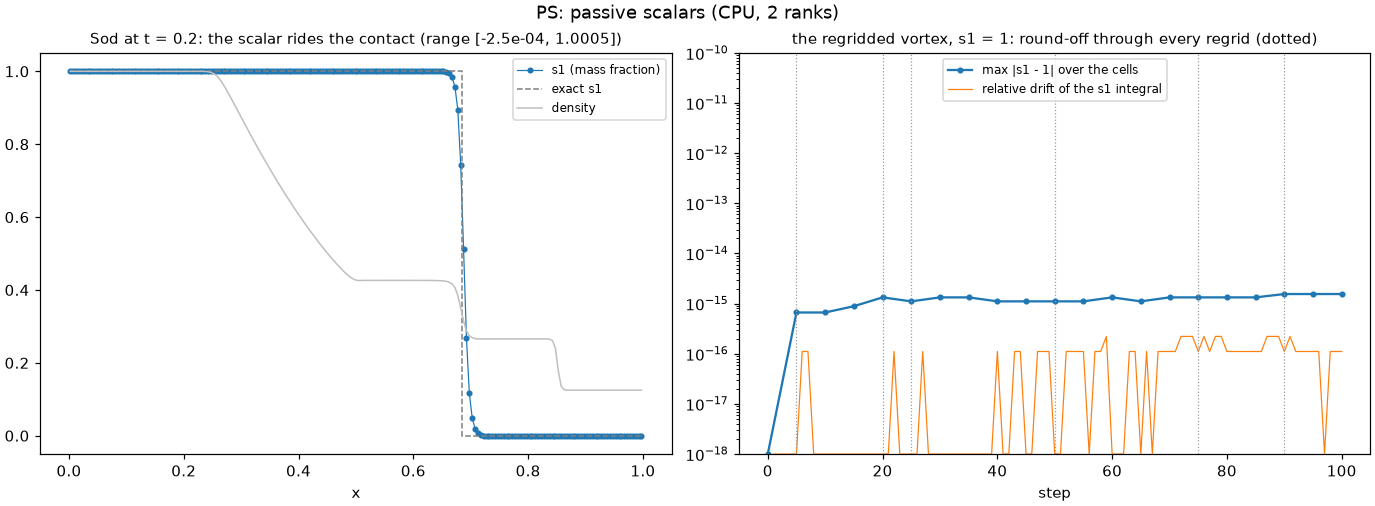
Left: Sod at
| Leg | Asserted | Bound | CPU | FNL |
|---|---|---|---|---|
| ps1 | the flow fields (and the entropy of euler-de) against the run without scalars | bitwise | bitwise equal | bitwise equal |
| ps1 | each scalar integral | 0 | ||
| ps1 | the unused slots 3 and 4 | zero | zero | zero |
| ps2 | passive_scalars = 5; with mhd-ideal | refused | refused | refused |
| ps3 | per field, FNL against CPU, relative to the runs without scalars | the flow fields as the base ( | (the same comparison) | |
| ps4 | the largest |
Related cases: Sod is the flow of ps1; runtime regrids the grid of ps4; the entropy of euler-de uses the same machinery (dual energy).
Findings
- A passive scalar is invisible to the flow. Each scalar is a characteristic field of its own, and the Euler waves' left eigenvectors have no component on it, so the flow fields of a run with scalars are bitwise those without.
- A uniform scalar stays uniform to round-off, through AMR. Its characteristic field
vanishes, so the scalar flux is times the mass flux whatever the reconstruction; the prolongation, the restriction and the reflux treat it like the density. - WENO bounds a scalar only to its own accuracy. A mass fraction across a contact over- and undershoots by
; a model that needs strictly (chemistry) would need a bound-preserving limiter on the scalars. - The fixed capacity costs width. The kernels carry four slots whatever
(D-M10-1): a scalar run projects the wider state, the unused slots stay exactly zero.