

Appearance
The ILES baseline
| ID | Milestone | Type | Legs | Backends | Figure |
|---|---|---|---|---|---|
| TT, HT | #119 · T0.1–T0.6 | P+C | tt1–tt6, ht1–ht2 | CPU, FNL | yes |
Case and scope
T0 measures what the scheme alone does to turbulence, with no model: the implicit LES (ILES) baseline. The cases are the Taylor-Green vortex at Mach 0.1 (T0.3) and at
Legs
src/tests/flume/verification/turbulence/check.sh, CPU and FNL.
| Leg | Phase | What it verifies | Measured |
|---|---|---|---|
| tt1 | T0.1, T0.2 | first history row of taylor-green against the exact integrals, M 0.1, 1.25 | K |
| tt2 | T0.1 | one rank against 2 | |
| tt3 | T0.3 | energy budget to | 70 %, 8.8 %, 0.28 % at |
| tt4 | T0.1 | spectra.py on the initial field: Parseval, the energy of the single-mode field in shell 2 | not recorded (bound |
| tt5 | T0.1 | (--agree TAG) this executable's tt2 history against the executable TAG: backends | not recorded (bound |
| tt6 | T0.1 | pressure work, M 0.8: the budget closes only with | 8.5 % left, 203 % without, 414 % flipped |
| ht1 | T0.5 | isotropic-turbulence field: every shell, | shells |
| ht2 | T0.5 | one rank against 2 on the random field |
Taylor-Green vortex
| Setup | |
|---|---|
| box | |
| flow | Re 1600; M 0.1 and |
| schemes | weno (flux splitting, WENO-5, 7, 9); HLLC: weno-riemann with the 6th-order correction and the WENO sensor |
| time | runge-kutta-ssp-54, CFL 0.5, weights = si |
| run | turbulence/tgv_campaign.sh, 4 ranks on A30; all values per unit volume |
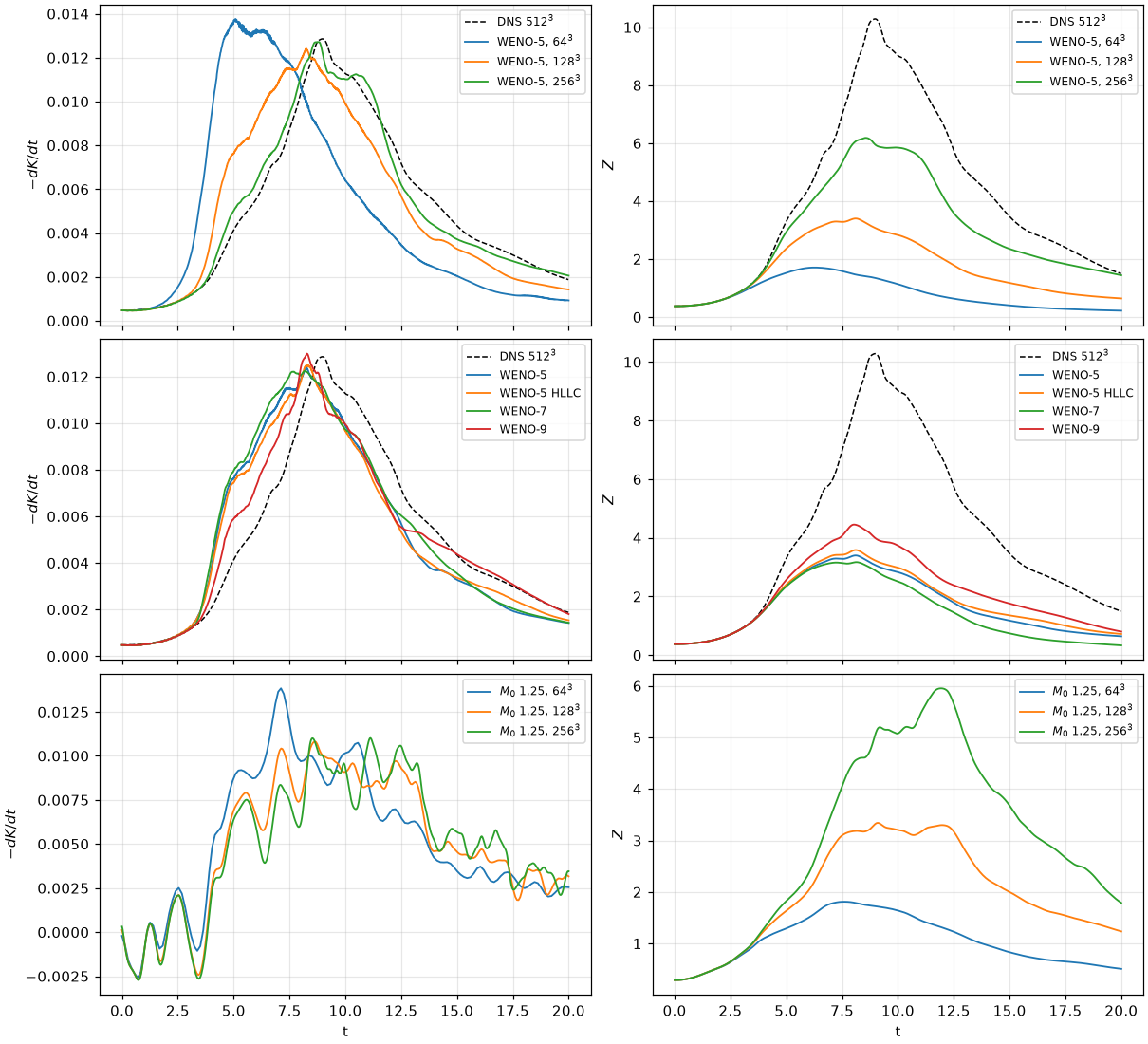
Top: M 0.1, WENO-5 by resolution; middle: M 0.1 at
| Case | Peak | at | Peak | at | Numerical share to the peak | |
|---|---|---|---|---|---|---|
| M 0.1, WENO-5, | 0.01377 | 5.08 | 1.71 | 6.25 | 77 % | 0.0245 |
| M 0.1, WENO-5, | 0.01242 | 8.24 | 3.40 | 8.11 | 58 % | 0.0219 |
| M 0.1, HLLC, | 0.01305 | 5.42 | 1.83 | 6.56 | 76 % | 0.0284 |
| M 0.1, HLLC, | 0.01249 | 8.28 | 3.59 | 8.11 | 55 % | 0.0227 |
| M 0.1, WENO-7, | 0.01224 | 8.19 | 3.17 | 8.14 | 60 % | 0.0181 |
| M 0.1, WENO-5, | 0.01272 | 8.75 | 6.18 | 8.56 | 27 % | 0.0223 |
| M 0.1, WENO-9, | 0.01299 | 8.28 | 4.45 | 8.03 | 43 % | 0.0213 |
| 0.01383 | 7.12 | 1.81 | 7.62 | 80 % | 0.0206 | |
| 0.01081 | 8.62 | 3.34 | 9.09 | 46 % | 0.0243 | |
| 0.01101 | 11.12 | 5.95 | 11.94 | 20 % | 0.0245 | |
| 0.01246 | 7.22 | 2.29 | 7.72 | 69 % | 0.0299 | |
| 0.01120 | 8.56 | 3.86 | 11.44 | 36 % | 0.0265 | |
| 0.01122 | 11.11 | 6.31 | 11.99 | 14 % | 0.0243 |
The share is that of the energy lost until the peak of
Reference. The 512³ pseudo-spectral DNS of the High-Order CFD Workshop (case C3.5, turbulence/reference/spectral_Re1600_512.gdiag), incompressible, so compared at M 0.1 only: peak
What it shows.
- Numerical dissipation dominates. Up to the peak of
it is 77 % of the energy lost at and 58 % at with WENO-5 at M 0.1. - The resolved gradients are far from converged. At
the enstrophy peak is a third of the reference, even where the total looks right. At the peak of comes at , against 9. - Resolution matters more than scheme and order at
. HLLC gains a few percent, WENO-9 reaches 4.45. WENO-7 is below WENO-5 ( 3.17 against 3.40); the cause is not established. - At
the numerical share falls with the resolution: 80 %, 46 %, 20 %.
A static 2:1 box
| Setup | |
|---|---|
| grid | base |
| flow, scheme | M 0.1, WENO-5, as above |
| seam operators | tricubic fill with mean restriction; quintic fill with lagrange6 restriction |
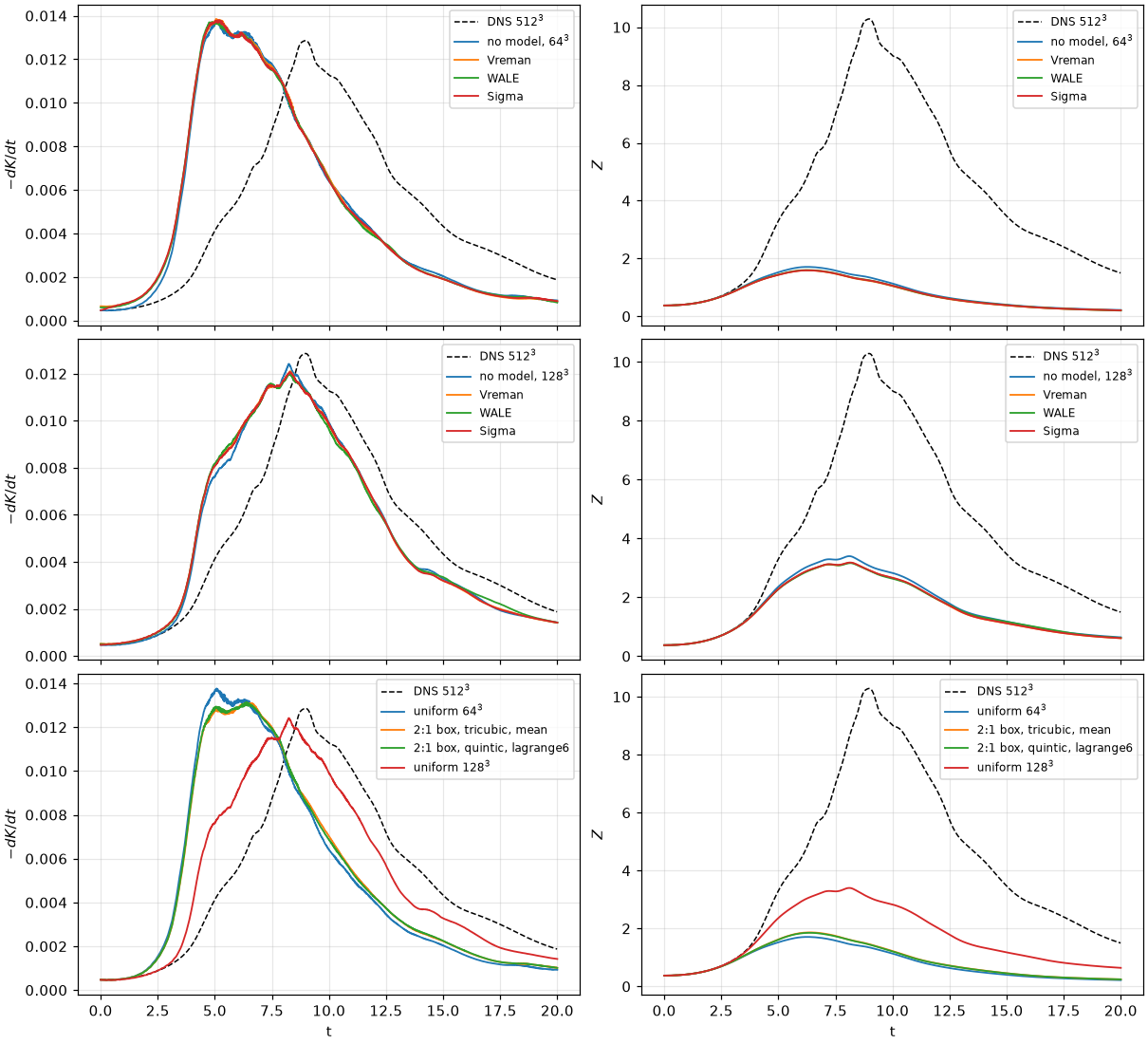
Bottom row: the 2:1 box on the centre of the
| Case | Peak | at | Peak | at | ||
|---|---|---|---|---|---|---|
| uniform | 0.01377 | 5.08 | 1.71 | 6.25 | 0.0245 | 0.00026 |
| box, tricubic fill, mean restriction | 0.01312 | 6.39 | 1.87 | 6.39 | 0.0233 | 0.0070 |
box, quintic fill, lagrange6 | 0.01314 | 6.39 | 1.85 | 6.38 | 0.0234 | 0.0115 |
| uniform | 0.01242 | 8.24 | 3.40 | 8.11 | 0.0219 | 0.00007 |
What it shows.
- The box delays and lowers the peak of
, from to . - The two seam operators give the same integrals:
and do not tell them apart. cannot be read on a 2:1 grid. It is 27 to 44 times the uniform value. A central difference across a 2:1 face does not telescope, so picks up the mean pressure ( at M 0.1) times a nonzero discrete . This explanation is untested. The budget and the numerical share are therefore not reported on a 2:1 grid.
Decaying compressible isotropic turbulence
| Setup | |
|---|---|
| field | isotropic-turbulence, |
| gas | power-law viscosity 0.76, Pr 0.7 |
| time scale | |
| reference | none: the DNS of Johnsen et al. (2010) is not available to this tree, so only self-convergence is measured |
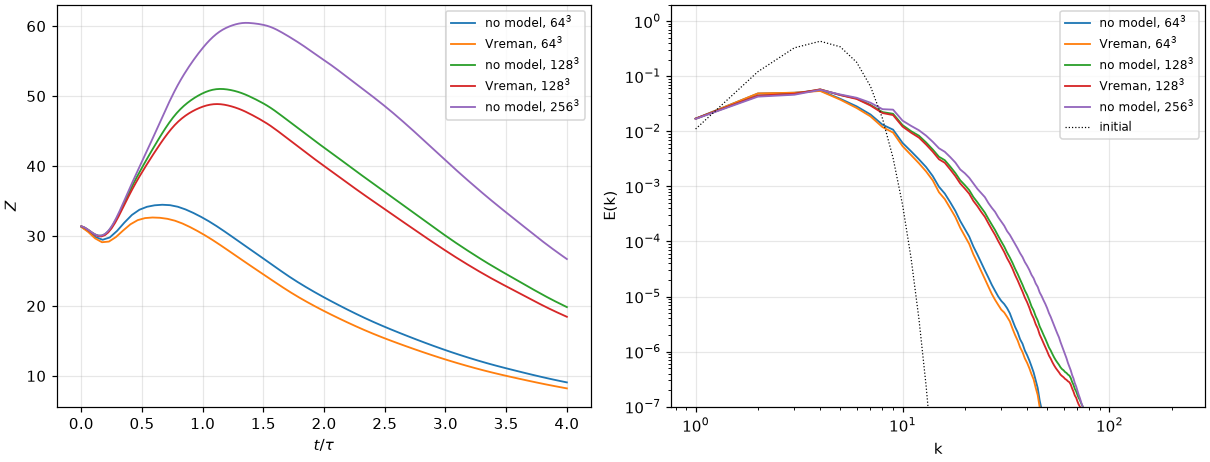
Left: the enstrophy against
| Case | Peak | at | |||
|---|---|---|---|---|---|
| no model, | 34.5 | 0.66 | 0.303 | ||
| Vreman, | 32.6 | 0.58 | 0.292 | ||
| no model, | 51.0 | 1.14 | 0.384 | ||
| Vreman, | 48.9 | 1.12 | 0.376 | ||
| no model, | 60.5 | 1.36 | 0.413 |
What it shows.
with WENO-5 is not converged. changes by 7 % from to . - Vreman moves away from the finer runs at each resolution, as on the Taylor-Green vortex (subgrid-scale models).
The vorticity of both flows on the hybrid scheme is in The flow.
Not done
- HLLC at
, M 0.1. - Spectra against the DNS: the Workshop file holds integrals only.
- The DNS of Johnsen et al. for the isotropic case.
- The pressure dilatation on a 2:1 grid: the non-telescoping explanation is not tested.