

Appearance
Seam design record
| ID | Group | Milestone | Type | Backends | Figure | Regression |
|---|---|---|---|---|---|---|
| B1, B2, B3, E0, G2 | Seam accuracy and divergence | M6 (#68) · B1–B3, E0, G2 | P | NumPy prototypes (B); FNL, CPU re-runs (E0, G2) | yes | — |
This appendix keeps the studies of M6 that chose a design or ruled one out without adding a key of their own. The verification cases that freeze the outcome are AO, AD, AS, AL, reflux policy and EGLM reflux.
| Study | Question | Conclusion |
|---|---|---|
| B1 | do the 1-D order caps of a 2:1 seam hold in 2-D, and do the corners explain AO's L∞ order? | yes; no |
| B2 | does a sensor-gated reflux recover the order and keep the shocks? | yes, near-conservatively: built as reflux_policy = troubled |
| B3 | shift-inward or two-pass footprint for the 6-point restriction? | shift-inward |
| E0 | does a seam operator cause the defect behind a crossing shock? | no: a capturing error |
| G2 | would a per-level GLM damping length matter on a seam? | no: not added |
The prototypes run from src/tests/flume/verification/amr-proto/check.sh (--legs b1,b2,b3, a leg runs only when the ones before it pass; --long for the finer ladders). They are NumPy models in proto2d.py, not FLUME runs: a 2:1 box mean or 6-point lag6 restriction, cubic or quintic prolongation, reflux on or off) reimplemented on it.
The caps in a 2-D prototype
Study B1. Tried. --long); the L∞ error split into corner, edge and interior regions (within 3 coarse cells of a box corner, of a box edge, the rest). check.sh asserts lower bounds only: uniform L∞ order lag6-quintic-off lag6-cubic-off
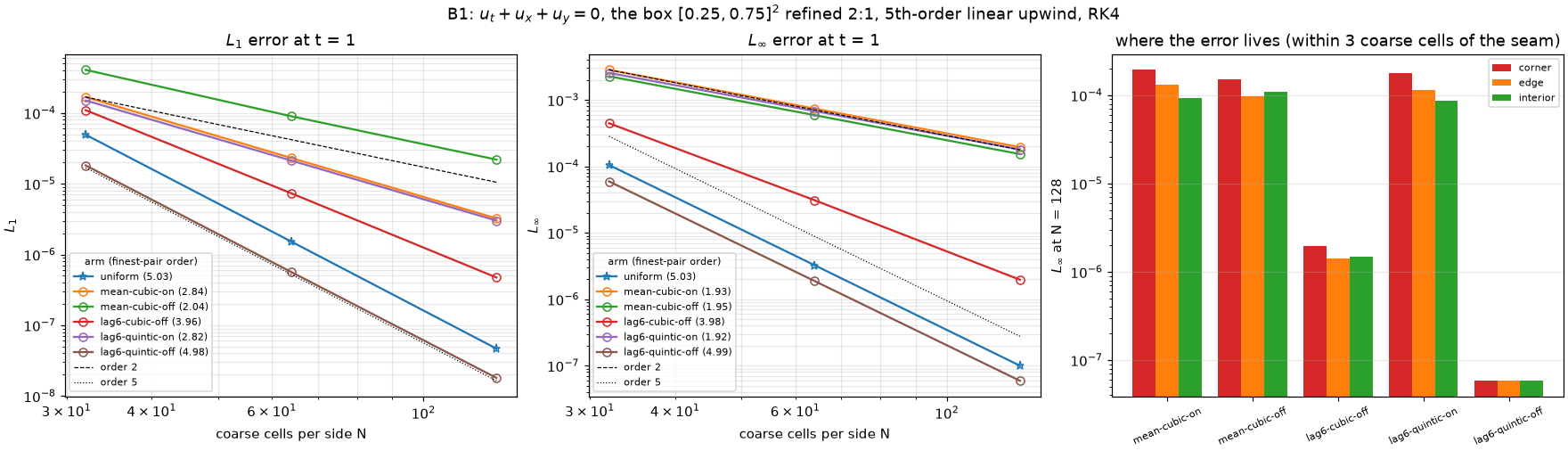
The check.sh ladder,
| Arm | L1 order | L∞ order | Mass drift at N = 256 |
|---|---|---|---|
| uniform (coarse) | 5.01 | 5.01 | |
| mean, cubic, reflux on (the default) | 2.85 | 1.93 | |
| mean, cubic, off | 2.01 | 1.95 | |
| lag6, cubic, on | 2.85 | 1.93 | |
| lag6, cubic, off | 3.98 | 4.01 | |
| lag6, quintic, on | 2.85 | 1.93 | |
| lag6, quintic, off | 4.99 | 4.99 |
Conclusion. The mean restriction caps the order at 2 whatever the prolongation; the reflux caps it at 2 whatever the transfers. The 6-point restriction with the quintic prolongation and no reflux recovers order 5 with the corners present. The corners hold the maximum error in every arm but converge at the same rate as edges and interior, so they do not explain the L∞ order 1.46 of AO's Euler vortex.
A sensor-gated reflux prototype
Study B2. Tried. The B1 grid with WENO5-JS and Lax–Friedrichs splitting (the weights of adam_weno_object). Three reflux policies on lag6/quintic: always, never, and troubled, a coarse box face refluxed only where the sensor c2f), fine to coarse (f2c), and a weak weak, the missed-detection control). --check asserts the smooth orders of troubledtroubled within 0.05 cells of always on the shocks with a mass defect never's mass defect
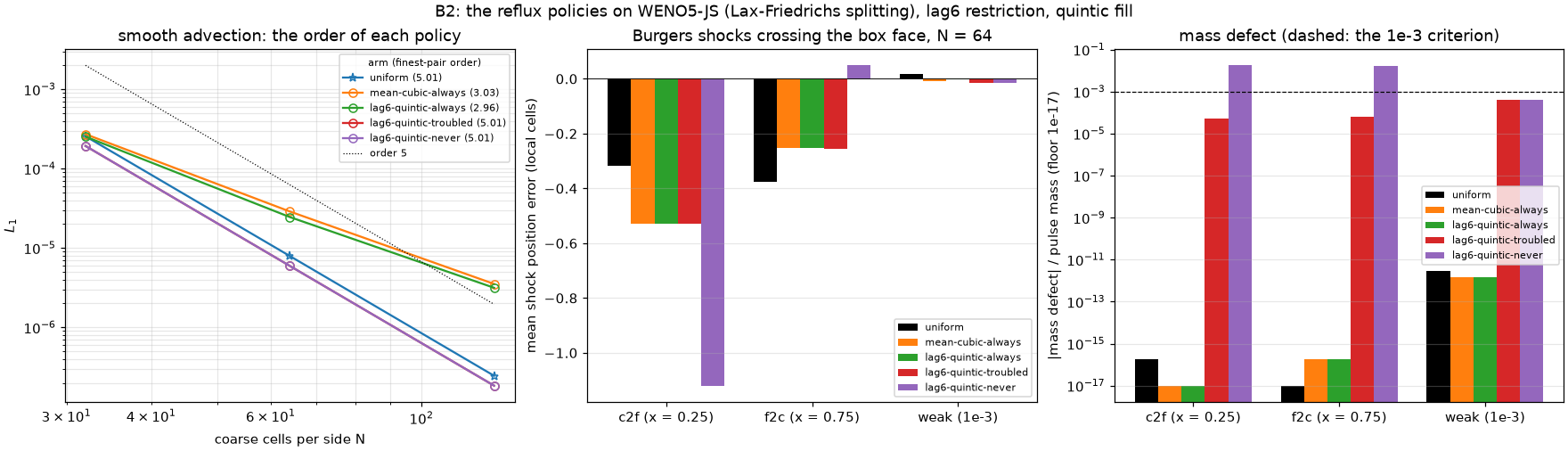
Left: the smooth leg, always is capped near order 3, troubled keeps the uniform order. Centre and right: the Burgers pulses at troubled places the strong shocks where always does with a mass defect below never misplaces the c2f shock by a cell and loses troubled equals never.
| Leg, N | always | troubled | never | Faces flagged |
|---|---|---|---|---|
| smooth, L1 / L∞ order 64 → 128 | 2.96 / 2.10 | 5.01 / 4.95 | 5.01 / 4.95 | 0 % |
| c2f, 128: shock (local cells), mass defect | −0.50, | −0.50, | −1.07, | 8 % |
| f2c, 128: shock, mass defect | −0.25, | −0.25, | +0.06, | 7 % |
| weak, 128: shock, mass defect | −0.015, | −0.022, | −0.022, | 0 % |
Conclusion. On smooth data the sensor flags no seam face, so troubled recovers order 5. On shocks it places them within 0.003 cells of always; the flagged faces (7 to 15 % of the seam-face evaluations) are what holds the shock. It is near-conservative, not conservative: a mass defect of reflux_policy = troubled.
Footprint of the 6-point restriction
Study B3. Tried. The 6-point restriction reaches 2 to 3 fine cells beyond the coarse cell, so near the edge of a fine block it needs data the block does not hold. Two footprints, on the B1 problem without reflux, with the fine box split into blocks of --long):
- shift-inward: the stencil shifts inside the donor block (one-sided, needs
); - two-pass: the fine ghosts are filled first and the stencil stays centred (any
, a second synchronisation).
check.sh asserts the L∞ orders of shift-inward (
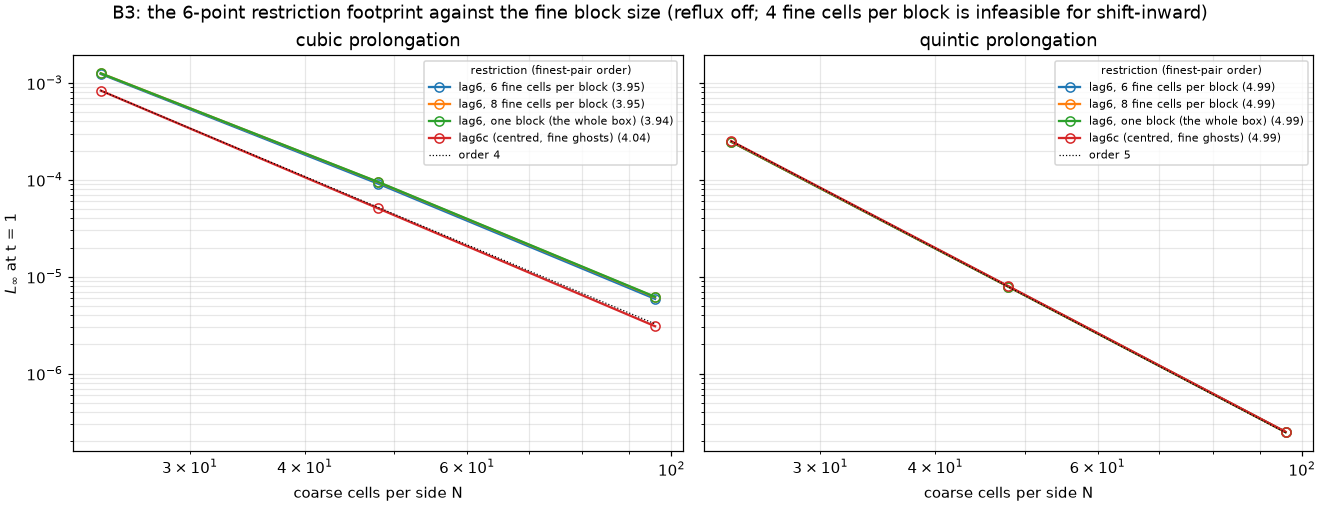
The check.sh ladder,
| Footprint, prolongation | Block size | L1 at N = 192 | Order L1 / L∞ |
|---|---|---|---|
| shift-inward, cubic | 6 / 8 / 16 / box | 3.98 / 4.00 | |
| two-pass, cubic | any | 4.14 / 4.03 | |
| shift-inward, quintic | 6 / 8 / 16 / box | 4.98 / 4.99 | |
| two-pass, quintic | any | 5.00 / 5.00 | |
| shift-inward | 4 | infeasible |
Conclusion. Shift-inward is insensitive to the block size from 6 cells up (2.5 % in L1) and, with the quintic prolongation, equivalent to two-pass. It keeps update_ghost_local a single pass and needs 6 fine cells per refined axis, which the #66 guard (seam_restriction_code, adam_seam_interpolation_library.F90).
The shock-crossing defect is a capturing error
Study E0. Tried. AS finds an c2f crossings (Sod restriction-compatible, the one fill with mean, and tricubic), restriction (mean, lagrange6) and reflux (on, off). No check.sh leg runs E0; the inputs come from amr-shock/make_amr_shock.py (--seam-ghost-fill, --seam-restriction, --no-reflux).
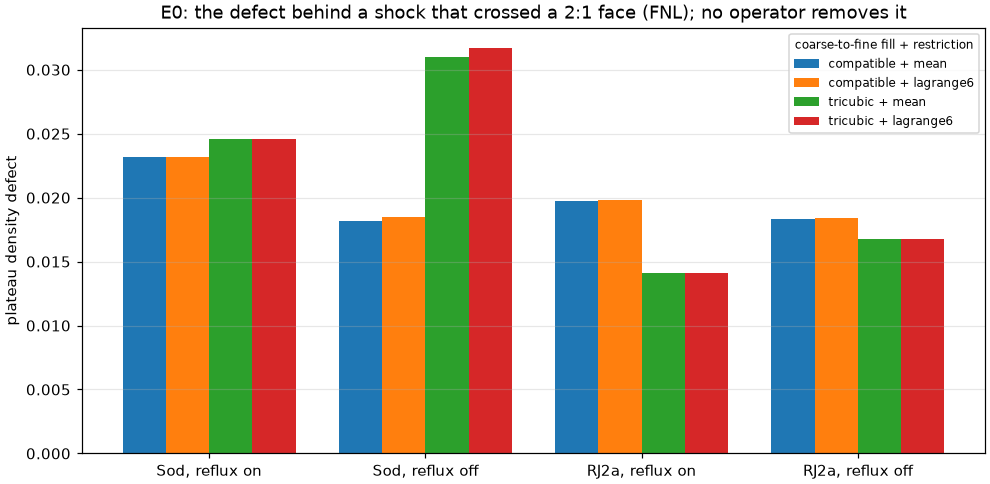
The table below as bars: no combination of fill, restriction and reflux removes the defect.
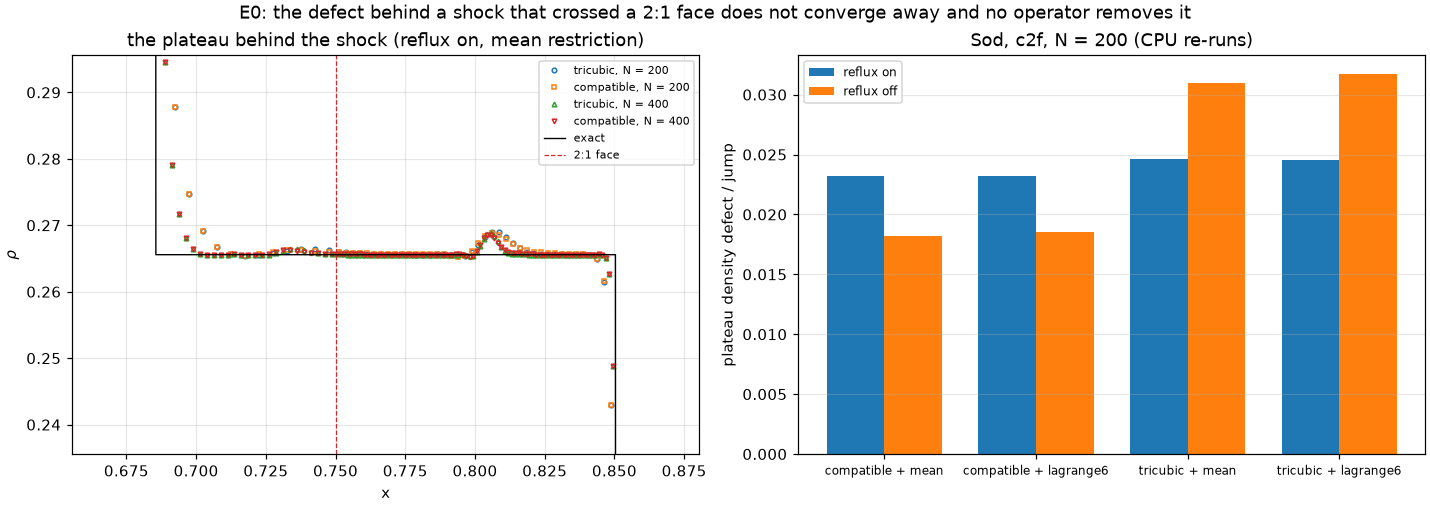
CPU re-runs (make_doc_runs.sh <runs> seams): left, the plateau after the c2f crossing with the tricubic and the compatible fills at
Plateau density defect behind the shock:
| Fill + restriction | Sod, reflux on | Sod, reflux off | RJ2a, reflux on | RJ2a, reflux off |
|---|---|---|---|---|
| compatible + mean ( | ||||
| compatible + lagrange6 | ||||
| tricubic + mean | ||||
| tricubic + lagrange6 |
Sod with the reflux on at
Conclusion. The restriction is irrelevant (within 0.5 %);
The GLM damping length on a seam
Study G2. Tried. The GLM damping rate is [mhd] glm_damping_length min-cell (the finest spacing; under runtime AMR frozen at the spacing of max_level). G2 brackets a per-level length between the coarse and the finest spacings on the source-free CPAW of AD (cpaw leg, glm_ch 2.0, glm_alpha 0.18, refined and uniform make_amr_divb.py cpaw --glm-damping-length, amr_divb_oracle.py growth).
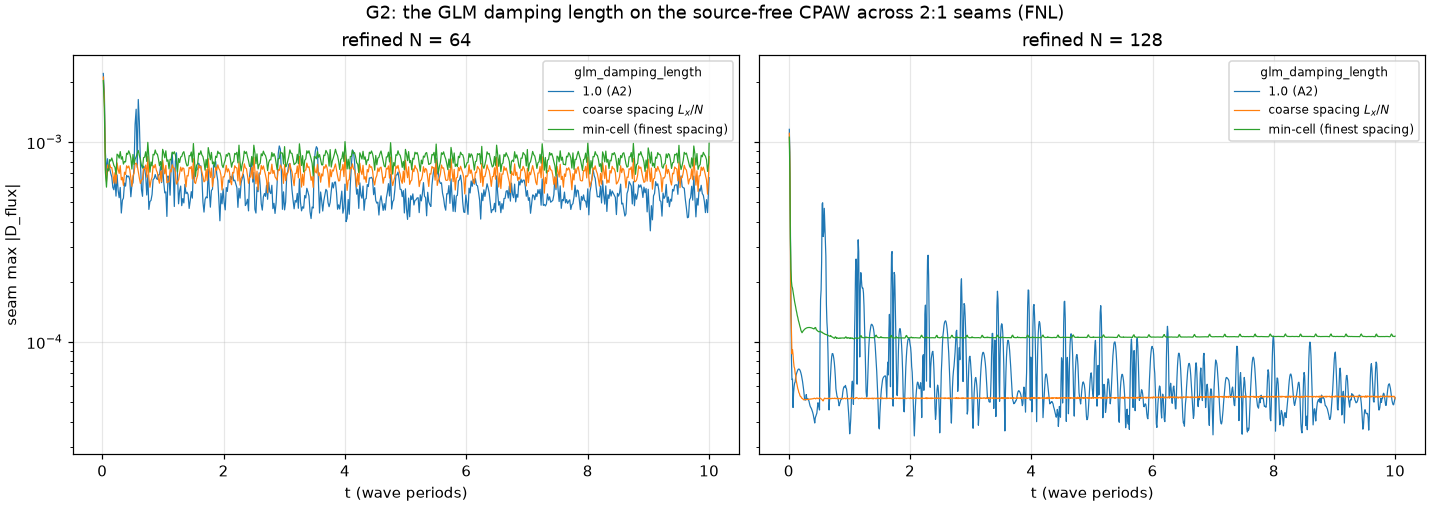
FNL: the seam maximum of D_flux on the source-free CPAW for the three damping lengths, refined min-cell doubling the floor at
glm_damping_length | rate | seam D_flux floor N = 64 / 128 | × uniform (N = 128) | growth N = 128 |
|---|---|---|---|---|
| 1.0 (A2) | 0.36 | 119 | 0.72 | |
| coarse spacing | 20.6 | 116 | 1.02 | |
min-cell (finest spacing) | 41.2 | 233 | 1.01 |
Conclusion. Every length keeps the seam divergence bounded (growth 0.72 to 1.02 over 10 periods). Strong damping raises the seam floor: min-cell doubles it at min-cell length costs at most that factor 2 and keeps the damping rate fixed through regrids. No per-level option exists.