Appearance
Ranks without blocks
| ID | Group | Milestone | Backends | Figure | Regression |
|---|---|---|---|---|---|
| DV-1 | Infrastructure | — (#82) | CPU, FNL | yes | — |
Case and scope
The tree never splits a family of sibling blocks across ranks. tree%mpi_redistribute cuts the Morton-ordered blocks into equal chunks, and when a cut falls inside a family it moves the whole family to one side. A grid with fewer families than ranks therefore leaves ranks with no block: four blocks at level 1 are one family, all on rank 0 at np 2. Every code path that sizes an array by the local blocks_number meets a zero there.
On FNL that is a zero-byte device allocation: acc_malloc(0) returns a null pointer (measured, nvhpc 25.5), and FUNDAL reports a null pointer as a failed allocation. Every MHD run therefore died at initialisation (#82): the div(B) history copied its seam-face flags, divb_seam(blocks_number, 6), to the device. The array is now sized by the block capacity nb, as every other block-indexed device array is. Small multi-rank tests rarely leave a rank empty, so this leg makes the empty rank the test.
What the leg catches: any block-indexed allocation, copy or reduction that fails, or changes the result, on a rank that owns no block, in every model and option that allocates block-indexed state; and a regrid that does not repopulate an empty rank.
Models and numerics
| Item | Choice | Code |
|---|---|---|
| Models | Euler; ideal MHD under none, glm and eglm; external gravity | models |
| Space | WENO5 flux splitting on characteristic variables; weno-riemann HLLD (6th-order correction, weno sensor) in one case | compute_residuals_weno, compute_residuals_riemann, adam_flume_cpu_object.F90 |
| Time | SSP Runge–Kutta, 3 stages (runge-kutta-ssp-33), CFL 0.4 | adam_rk_object.F90 |
| Distribution | sibling families kept on one rank | mpi_redistribute, adam_tree_object.F90 |
| div(B) history | seam-face flags sized by the block capacity nb | set_divb_seam, adam_flume_common_object.F90; compute_divb_history, adam_flume_fnl_object.F90 |
| Options | positivity limiter, equilibrium = atmosphere, runtime AMR with a Löhner marker | limit_positivity, regrid_forest, adam_flume_cpu_object.F90; mark_by_lohner, adam_flume_common_object.F90 |
Initial and boundary conditions
| Item | Value |
|---|---|
| Domain | |
| Grid | quadtree, four blocks of ngc = 4 |
| Ranks | 1 and |
| Steps | 20 at CFL 0.4 |
| Boundaries | hydrostatic (the atmospheres), wall-inviscid (repro) |
| Case | Input (gravity/make_atmosphere.py) |
|---|---|
repro | the issue's input: iso2d-mhd turned into a uniform EGLM state with |
| Euler | strat2d: the isothermal atmosphere under |
MHD, none / glm / eglm | strat2d-mhdx: strat2d with a field across gravity, |
| EGLM, positivity limiter | strat2d-mhdx with positivity_limiter = cell |
EGLM, equilibrium = atmosphere | strat2d-mhdx --balanced |
EGLM, weno-riemann + HLLD | strat2d-mhdx --riemann hlld |
| EGLM, runtime AMR | strat2d-mhdx with runtime regrids every 5 steps to level 2: a Löhner marker on the density (refine_tol = 0.1, derefine_tol = 0.02, buffer = 2), acting at the regrids only, so rank 1 starts empty and the first regrid repopulates it |
Asserted (ranks_oracle.py):
- ownership: in the np 2 run every rank but 0 owns no block at step 0, so the leg cannot become vacuous if the distribution changes; in the AMR case, every rank owns blocks at the end;
- identity: np 2 = np 1 bitwise, every field and every cell at the last checkpoint. With every block on rank 0 the arithmetic is the same, and the reductions add exact zeros.
Input files
| File | Role |
|---|---|
src/tests/flume/verification/gravity/make_atmosphere.py | writes the inputs |
src/tests/flume/verification/ranks/check.sh | rewrites them to one family, runs each case on 1 and --np N, --legs LIST: repro, euler, mhd-none, mhd-glm, mhd-eglm, limiter, balanced, hlld, amr, default all; --keep, --it-save N) |
src/tests/flume/verification/ranks/ranks_oracle.py | ownership (--empty-at-start, --filled-at-end) and same (bitwise) |
src/tests/flume/verification/make_doc_runs.sh (group ranks) | the AMR case on 1 and 2 ranks, a checkpoint every step |
src/tests/flume/verification/make_doc_figures.py (fig_ranks) | the figure |
bash
cd src/tests/flume/verification/ranks && ./check.sh                    # CPU, np 1 and 2
FLUME_EXE=$PWD/../../../../../exe/adam_flume_fnl ./check.sh            # FNL
cd .. && ./make_doc_runs.sh <dir> ranks && python3 make_doc_figures.py --out ../../../../docs/public/flume --runs <dir> --only ranks
Results
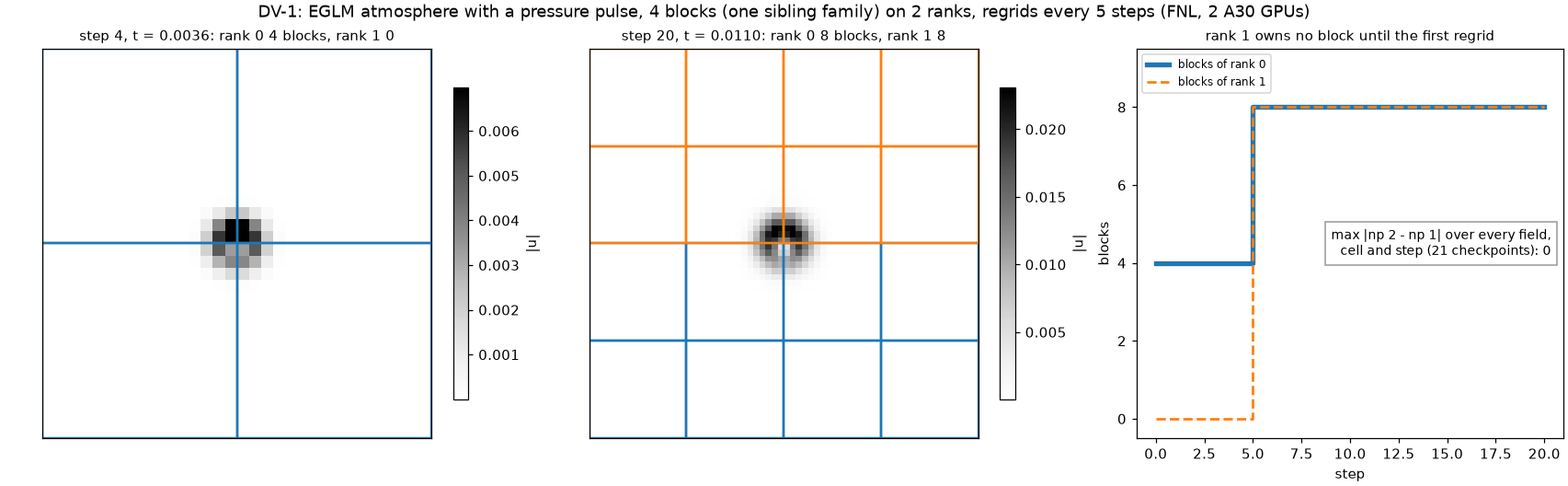
Left: the speed at step 4, before the first regrid, the block outlines coloured by owner: the four blocks are all rank 0's. Centre: step 20; the first regrid (step 5) refined the family into four, and the distribution gave each rank two families, 8 blocks. Right: the blocks of each rank against the step. Over all 21 checkpoints the largest difference between the np 2 and np 1 states, over every field and every cell, is 0.
| Case (FNL, 2 A30 GPUs, nvhpc 25.5) | blocks per rank, step 0 → 20 | before the fix, np 2 | after: np 2 vs np 1 |
|---|---|---|---|
repro | 4 / 0 → 4 / 0 | aborts at initialisation | bitwise |
| Euler | 4 / 0 → 4 / 0 | runs | bitwise |
MHD, none | 4 / 0 → 4 / 0 | aborts | bitwise |
MHD, glm | 4 / 0 → 4 / 0 | aborts | bitwise |
MHD, eglm | 4 / 0 → 4 / 0 | aborts | bitwise |
| EGLM, positivity limiter | 4 / 0 → 4 / 0 | aborts | bitwise |
EGLM, equilibrium = atmosphere | 4 / 0 → 4 / 0 | aborts | bitwise |
EGLM, weno-riemann + HLLD | 4 / 0 → 4 / 0 | aborts | bitwise |
| EGLM, runtime AMR | 4 / 0 → 8 / 8 | aborts | bitwise (4096 cells) |
| Backend | Bound | Result |
|---|---|---|
| FNL, after the fix | 9/9 bitwise, ownership as asserted | pass, 3.6 min |
| FNL, the pre-fix executable (negative control) | must fail | 8 of 9 cases abort; Euler, which never computes the div(B) history, runs |
| CPU | 9/9 bitwise | pass, 2.8 min |
Related cases: Scaling covariance (the other identity leg of this group); the atmospheres are the external-gravity inputs.
Findings
- The issue reported the CPU backend unaffected, since a zero-size host array is legal; it passes the leg as well.
divergence_control = nonefailed too, because the div(B) history is skipped only for Euler.- The failure was specific to FNL and invisible to every small multi-rank test that happened to give each rank a block.