Appearance
Isentropic vortex: order of accuracy
| ID | Group | Milestone | Backends | Figure | Regression |
|---|---|---|---|---|---|
| V2, RV-2 | Euler | M1 (#35), M3 (#47) | CPU (all schemes), FNL (weno, weno-riemann LLF and HLLC) | yes | vortex-periodic |
Case and scope
An exact smooth solution of the Euler equations: an isentropic vortex (Shu 1998, ICASE 97-65, §5.1) convected diagonally by the free stream through a doubly periodic box. Every run is compared cell by cell with the exact solution, and the observed order between successive resolutions,
What the case catches: a loss of design order on smooth flows, which Sod cannot see (WENO is first order at discontinuities):
- a wrong stencil weight or reconstruction table;
- a wrong ghost fill across periodic block faces, across blocks and across ranks;
- a first-order boundary treatment.
Models and numerics
| Item | Choice | Code |
|---|---|---|
| Equations | compressible Euler, ideal gas, | models |
Space, weno | WENO5 (weno-u-5) flux splitting on characteristic variables | compute_residuals_weno, adam_flume_cpu_object.F90; compute_face_split_fluxes, adam_flume_euler_library.F90 |
Space, weno-riemann (RV-2) | WENO5 interpolation (characteristic), LLF, HLL or HLLC, the 6th-order flux correction with the WENO-weight sensor | compute_residuals_riemann, adam_flume_cpu_object.F90; initialize_interpolation, adam_weno_object.F90 |
| Time | SSP Runge–Kutta, 5 stages, 4th order (runge-kutta-ssp-54), CFL 0.1 (small, so the space error dominates the time error) | adam_rk_object.F90 |
| Initial condition | the isentropic-vortex kind | isentropic_vortex, adam_flume_ic_object.F90 |
| Boundaries | library periodicity in | update_ghost, adam_flume_cpu_object.F90; boundary conditions |
| FNL backend | the same kernels on the device | adam_flume_fnl_object.F90 |
Initial and boundary conditions
| Item | Value |
|---|---|
| Domain | |
| Grid | quadtree (ratio = 4, nk = 1), 16 blocks (4 per side) of ngc = 3 |
| Ranks | 2 (8/8 blocks) |
| Free stream | |
| Vortex | centre |
| Initial condition | isentropic-vortex |
| Boundaries | periodic on extrapolation on the null |
| Final time |
Input files
| File | Role |
|---|---|
src/tests/flume/verification/vortex/vortex-n{064,128,256}.ini | the ladder |
src/tests/flume/verification/vortex/check.sh | V2: runs the ladder (--np N, --legs v2; FLUME_EXE selects the backend), order bound 4.5 |
src/tests/flume/verification/vortex/vortex_oracle.py | the exact density, |
src/tests/flume/verification/riemann-flux/check.sh --legs vortex | RV-2: the ladder on weno-riemann, order bound 4.8 |
src/tests/flume/verification/make_doc_figures.py (fig_vortex) | the figure, from the work directories of the two scripts |
bash
cd src/tests/flume/verification/vortex && ./check.sh                    # V2, CPU
FLUME_EXE=$PWD/../../../../../exe/adam_flume_fnl ./check.sh             # V2, FNL
cd ../riemann-flux && ./check.sh --legs vortex --solver hllc            # RV-2 (also llf, hll)
Results
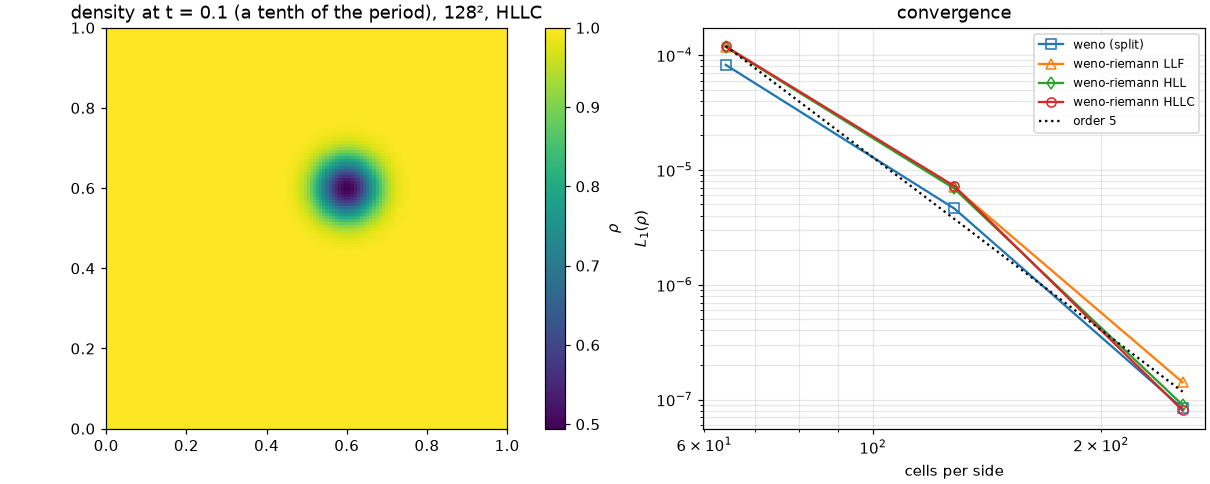
Left: density at weno-riemann HLLC. Right:
| Scheme | Bound (finest-pair order) | Order 128 → 256 | FNL | |
|---|---|---|---|---|
weno (split) | 4.5 (V2) | 5.79 | the same | |
weno-riemann LLF | 4.8 (RV-2) | 5.64 | the same | |
weno-riemann HLL | 4.8 (RV-2) | 6.26 | not run | |
weno-riemann HLLC | 4.8 (RV-2) | 6.49 | the same |
The full ladders on the CPU:
| Scheme | |
|---|---|
weno (split) | |
weno-riemann LLF, WENO-weight sensor | |
weno-riemann LLF, sensor none |
Related cases: Sod checks the same schemes at discontinuities; the MHD orders are in Order of accuracy.
Findings
- The order is asserted on the finest pair only. From
to it is lower (4.15 for the splitting scheme): at the vortex radius spans 4.5 cells and the WENO weights are still far from the linear ones. - At
the WENO-weight sensor of weno-riemannis inactive (the same digits with and without it); atit trips at the vortex extrema and costs a factor 1.5. The library weights use the exponent of , the NumPy prototype 2. - LLF is 1.7× more dissipative than the splitting scheme on the vortex; HLL and HLLC close the gap, and HLLC is the most accurate of the four.
- The quadtree layout is bitwise identical to the octree one with a null
axis, and 16 times cheaper. - The earlier verification page and the figure's panel title called the run "one period"; the input runs to
, one tenth of the period of the diagonal convection through the unit box (the title is corrected since #85 R1).