Appearance
Sod shock tube
| ID | Group | Milestone | Backends | Figure | Regression |
|---|---|---|---|---|---|
| V1, RV-3 | Euler | M1 (#35), M3 (#47) | CPU, FNL | yes | sod-x, sod-y, sod-z, sod-hllc |
Case and scope
The shock tube of Sod (1978): two gases at rest, separated by a diaphragm at
What the case catches:
- direction-dependent defects: the problem is run along
, and (the other two axes null). CHASE, the application FLUME replaced, only ever ran x-aligned problems, and its transposed characteristic projection and singular y/z eigenvectors went unnoticed. Here the three runs must be equal bit for bit after the permutation of the axes; - loss of accuracy of the shock-capturing scheme:
against the exact solution under a recorded bound; - broken 1-D consistency: every transverse copy of the solution, in every block, must be bitwise identical;
- wall boundaries (the
v1-wallleg): a double Sod in a closed box must stay mirror symmetric and keep its mass and energy.
Models and numerics
| Item | Choice | Code |
|---|---|---|
| Equations | compressible Euler, ideal gas, | models |
Space, weno | WENO5 (weno-u-5) flux splitting on characteristic variables (reconstruction_variables = characteristic) | compute_residuals_weno, adam_flume_cpu_object.F90; compute_face_split_fluxes, adam_flume_euler_library.F90 |
| Characteristic projection | left and right eigenvectors of the flux Jacobian in direction | compute_eigenvectors, adam_flume_euler_library.F90 |
Space, weno-riemann (RV-3) | WENO interpolation of the face states, then an LLF, HLL or HLLC Riemann solver | compute_residuals_riemann, adam_flume_cpu_object.F90; adam_flume_cpu_euler_hllc_kernels.F90 (and the _llf, _hll twins) |
| Time | SSP Runge–Kutta, 3 stages (runge-kutta-ssp-33), CFL 0.5 | adam_rk_object.F90 |
| Boundaries | zeroth-order extrapolation; reflecting inviscid walls in the v1-wall leg | set_boundary_conditions, adam_flume_cpu_object.F90; adam_flume_bc_object.F90 |
| FNL backend | the same kernels on the device | adam_flume_fnl_object.F90 |
The scheme options are described in numerics.
Initial and boundary conditions
| Item | Value |
|---|---|
| Domain | |
| Grid | 200 cells: 64 blocks of ngc = 3 |
| Ranks | 2 (the 8 sibling groups split 32/32) |
| Left state, | |
| Right state, | |
| Initial condition | riemann-problem, two regions |
| Boundaries | extrapolation on all six faces |
| Final time | |
v1-wall leg | walls at both ends, the high state in the middle, |
Input files
| File | Role |
|---|---|
src/tests/flume/verification/sod/sod-{x,y,z}.ini | the three directions |
src/tests/flume/verification/sod/sod-wall-{x,y,z}.ini | the reflecting-wall double Sod |
src/tests/flume/verification/sod/check.sh | runs the cases (--np N, --legs LIST: v1 (default) and v1-wall (--wall is its older spelling); FLUME_EXE selects the backend) |
src/tests/flume/verification/sod/sod_oracle.py | the exact solution, the |
src/tests/flume/verification/riemann-flux/check.sh --legs sod | the weno-riemann runs (RV-3) |
bash
cd src/tests/flume/verification/sod && ./check.sh             # CPU
FLUME_EXE=$PWD/../../../../../exe/adam_flume_fnl ./check.sh   # FNL
./check.sh --legs v1-wall                                     # the reflecting-wall variant
The figure is drawn by make_doc_figures.py (fig_sod) from the work directories of the two scripts.
Results
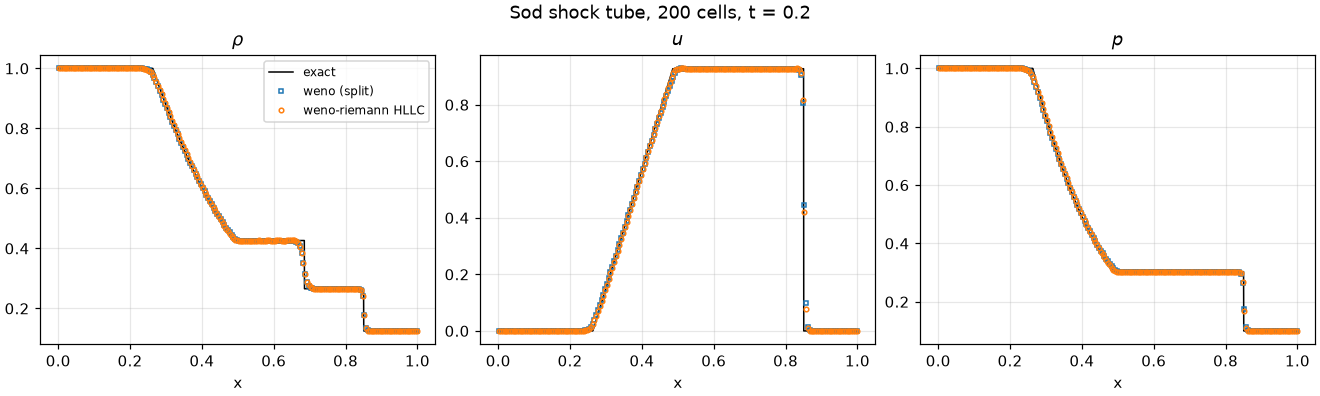
Density, velocity and pressure at weno-riemann HLLC against the exact solution.
| Check | Bound | CPU | FNL |
|---|---|---|---|
weno (split, characteristic) | |||
weno-riemann LLF / HLL / HLLC | — | the same | |
| bitwise | bitwise | bitwise | |
| transverse copies of the 1-D solution | bitwise | bitwise | bitwise |
v1-wall: mirror symmetry about the centre | pass | pass | |
v1-wall: relative drift of mass and energy | pass | pass |
Related cases: Lax and Shu–Osher compare the same Riemann solvers on harder problems; the MHD analogue is Ryu–Jones 2a.
Findings
- The three directions are the same arithmetic on permuted data (cyclic tangents), so they agree to the last bit: the direction-dependent eigenvector defects of CHASE cannot recur unnoticed.
- The CPU and FNL backends agree to
, not bitwise: the compilers contract differently into FMAs. They agree that closely because the host and device WENO weights share one exponent ( weno_weights_exponent). - HLLC is the most accurate of the Riemann solvers on the contact, and slightly more accurate than the splitting scheme.
- Symmetry alone does not prove that the walls reflect: extrapolation at both ends is symmetric too. The
v1-wallleg therefore also requires a closed box (extrapolated ends would leak about 10% of the mass).