Appearance
Verification gallery
PRISM's regression suite (src/tests/prism/regression/, PRISM regression) pins every case to a golden digest; this page shows the cases that also carry an oracle: a check.sh that asserts a physical or structural property of the run (an invariant, a symmetry, an agreement between two discretisations of the same problem) rather than a stored number. The figures are drawn from the runs by src/tests/prism/regression/make_doc_figures.py (each check run with --keep); the runs use the CPU backend unless stated, PRISM_EXE=exe/adam_prism_fnl runs a check on the GPU (FNL) backend.
bash
cd src/tests/prism/regression/rmf-amr-fd-pulse && ./check.sh       # CPU backend
PRISM_EXE=$PWD/../../../../../exe/adam_prism_fnl ./check.sh        # FNL backend (GPU)
AMR
Quadtree 2:1 seams: the source-free pulse
A quadtree ([amr] ratio = 4) refines x and y only: its blocks span the domain along z at every level, so a 2:1 seam is 2:1 in x and y and 1:1 in z. Until #46 the seam machinery (ghost restriction, coarse-fine interpolation, reflux) assumed an octree, and the coarse cells beside a quadtree seam picked up a spurious z dependence; quadtree AMR was refused at initialisation.
Case. rmf-amr-fd-pulse: the source-free Gaussian EM pulse (B0 = 10, σ = 0.01) travelling along +y across a 2:1 seam at x = 0 (the x < 0 half refined one level), fd_centered order 6, SSP-54, 5 steps, 1 rank. The pulse is uniform in x and z, so the seam is the only thing that can perturb it: it generates By, and the seam div(B) source of #29 (a truncation-order quantity the check pins to a baseline).
Oracle (the quadtree leg of check.sh, default-on). The same case runs on the octree of the regression case and on a quadtree with nk = 16 (z cells of 7.5·10⁻³ against the octree's finest 1.875·10⁻³). PRISM's time step is CFL · min(dx, dy, dz) / c, set on both trees by the finest x and y cells, so the two runs take the same steps; the pulse is uniform in z, so both stay z-invariant. quadtree_oracle.py (shared with FLUME's MV-15) keys the cells by their (x, y) centre and asserts, per field:
- the z spread of every (x, y) column of each run at most
1e-13; - the quadtree against the octree at the same (x, y) at most
1e-13.
Each field is measured against the largest magnitude of its vector (D, B, J): the pulse carries Dz and Bx, and the seam adds By; the other components are round-off on the octree (Dx, Dy ~ 3·10⁻¹⁸, Bz ~ 5·10⁻¹⁶ against |Bx| = 10) and exactly zero on the quadtree, and scaled by their own magnitude they would compare round-off with round-off. The leg also holds the quadtree's div(D) to the structural round-off invariant of the case.
Results (CPU; FNL in parentheses where it differs):
| Quantity | Octree | Quadtree |
|---|---|---|
| z spread of a column, max over D and B | 2.6·10⁻¹⁶ (FNL 3.6·10⁻¹⁶) | 0 |
| against the octree, per (x, y) column, max over D and B | — | 1.8·10⁻¹⁶ (FNL 3.6·10⁻¹⁶) |
| seam max|div(B)| at step 5 | 12.65004 | 12.65004 |
| max|div(D)| | 3.1·10⁻¹⁵ | 0 |
The quadtree reproduces the octree to round-off, including the seam's div(B) source to every printed digit: on a z-invariant field the per-axis seam formulas (restriction over 2×2 fine cells, coincident interpolation rows along z) give the same values as the octree's 2×2×2 ones on two identical z layers. The octree's own z spread and its non-zero div(D) are round-off of its z interpolation (its tricubic weights depend on the z sub-position); the quadtree has neither.
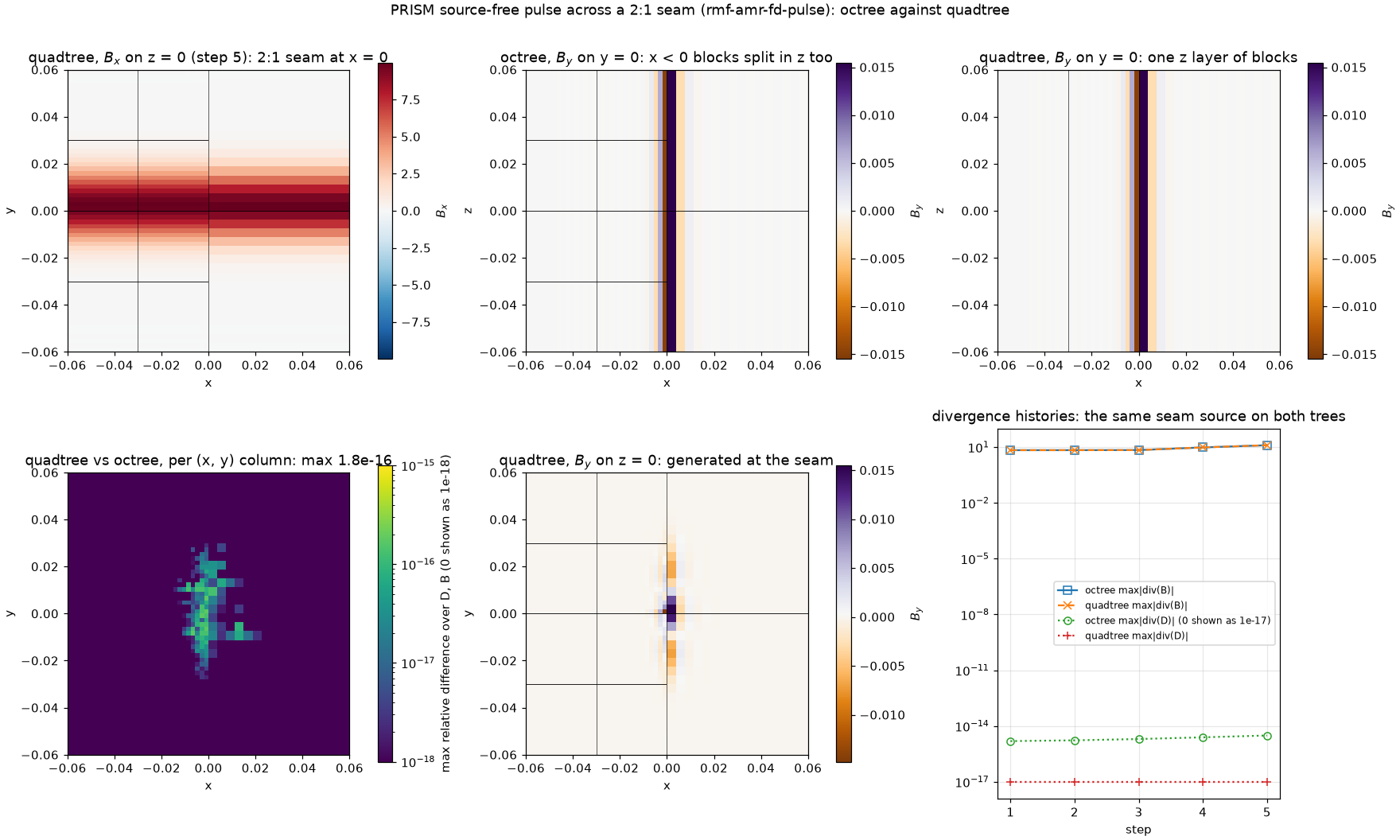
Top row: Bx on z = 0 (quadtree, blocks outlined: the refined half x < 0 and the seam at x = 0), and Bx on y = 0 for both trees: the octree refines its x < 0 blocks in z as well, the quadtree keeps one z layer of blocks. Bottom row: the quadtree against the octree per (x, y) column (relative to each vector's magnitude); By, the field the seam generates; and the divergence histories of the two runs, superposed.