Appearance
Shock-crossing defect is a capturing error
| ID | Group | Milestone | Backends | Figure | Regression |
|---|---|---|---|---|---|
| E0 | Seam studies | M6 (#68) | FNL; CPU re-runs agree to the printed digits | yes | — |
Case and scope
A3 found an restriction-compatible with the mean restriction has
Models and numerics
| Item | Choice | Code |
|---|---|---|
| Equations | Sod: compressible Euler, | models |
| Space, time | WENO5 flux splitting on characteristic variables; SSP Runge–Kutta 3 stages, CFL 0.5 | as in AS |
| Fill | restriction-compatible (order 2) or tricubic (order 4) | seam_interpolate_compatible, seam_interpolate_tricubic, adam_seam_interpolation_library.F90 |
| Restriction | mean or lagrange6 | restrict_seam_high_order, adam_field_object.F90 |
| Reflux | on or off | apply_reflux_to_stage_forest, adam_flume_cpu_object.F90 and adam_flume_fnl_object.F90 |
Initial and boundary conditions
| Item | Value |
|---|---|
| Cases | the AS c2f crossings: Sod extrapolation on all faces |
| Arms | every combination of fill (restriction-compatible, tricubic) × restriction (mean, lagrange6) × reflux (on, off) |
| Ranks | 2, FNL |
Input files
| File | Role |
|---|---|
src/tests/flume/verification/amr-shock/make_amr_shock.py | the crossings (--seam-ghost-fill, --seam-restriction, --no-reflux) |
src/tests/flume/verification/amr-shock/amr_shock_oracle.py | the plateau and band defects, the mass and the shock position |
No check.sh leg runs E0.
Results
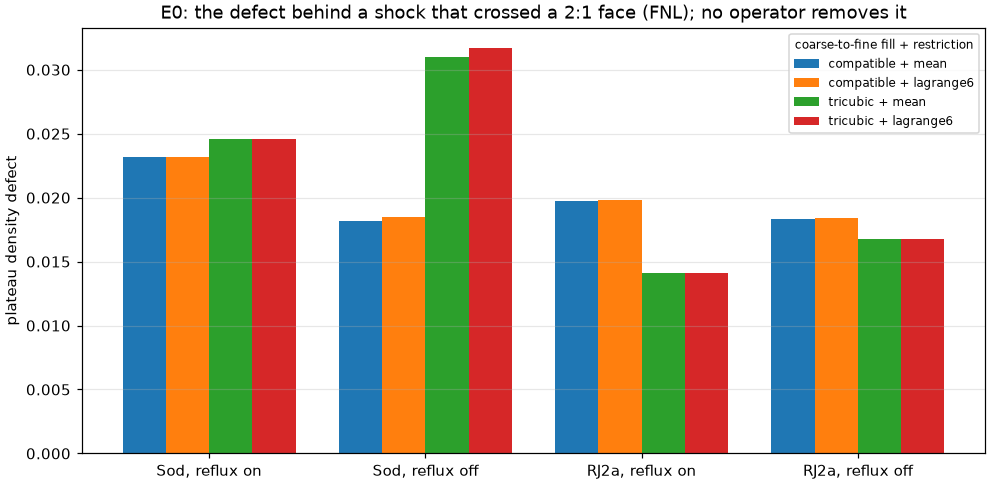
*The table below as bars (make_doc_figures.py --only capturing-error): no combination of coarse-to-fine fill, restriction and reflux removes the defect; the largest change is the reflux on Sod with the tricubic fill. *
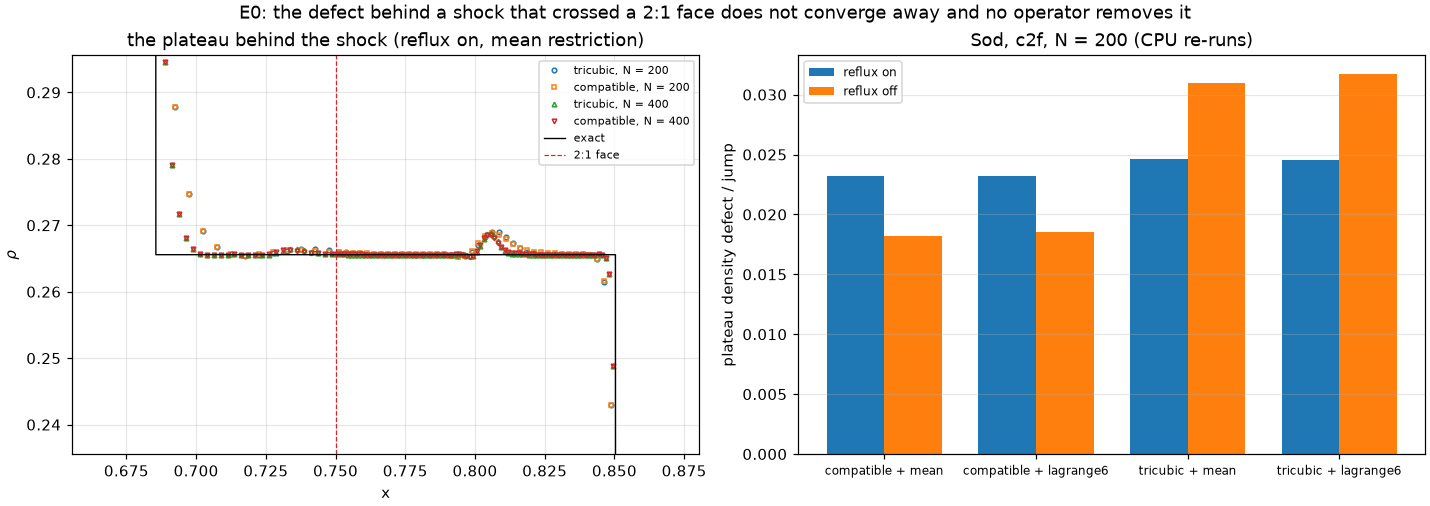
The CPU re-runs (make_doc_runs.sh <runs> seams): left, the plateau after the c2f crossing with the tricubic and the compatible fills at
Plateau density defect behind the shock:
| Fill + restriction | Sod, reflux on | Sod, reflux off | RJ2a, reflux on | RJ2a, reflux off |
|---|---|---|---|---|
| compatible + mean ( | ||||
| compatible + lagrange6 | ||||
| tricubic + mean | ||||
| tricubic + lagrange6 |
Sod with the reflux on at
Related cases: AS found the defect; D2 ruled out the fill's order; E2 proceeds with the reflux policy on its own merit.
Findings
- The restriction is irrelevant (
meanandlagrange6within 0.5 % in every case). - Consistency does not control it: the
pair is best on Sod and worse than tricubicon RJ2a. - The reflux does not cause it: off, it moves the defect by up to 30 % either way and costs conservation.
- It does not converge:
= 200 to 400 lowers it by 5 to 8 %. - So it is not a seam-operator defect. The evidence points to the start-up error of a captured shock whose numerical structure, a few cells wide, is squeezed into finer cells (an interpretation, not measured directly): the transition emits a spurious wave (the plateau entropy defect is about 1.8 %) whose amplitude scales with the shock's strength, not with the spacing.
- Remedy: keep shocks off the seams by refining ahead of them (a gradient or Löhner marker with a buffer and a short regrid frequency, M5), which numerics now recommends. Phase E (the reflux policy) proceeds on its own merit.