Appearance
Footprint of a high-order restriction
| ID | Group | Milestone | Backends | Figure | Regression |
|---|---|---|---|---|---|
| B3 | Seam studies | M6 (#68) | NumPy prototype (no ADAM run) | yes | — |
Case and scope
Phase C replaces the mean restriction with a 6-point one. Its stencil reaches 2 to 3 fine cells beyond the two cells of the coarse cell, so near the edge of a fine block it needs data the block does not hold. Two footprints are possible:
- shift-inward: the stencil shifts inside the donor block (one-sided, at least 6 fine cells per block);
- two-pass: the fine block's ghosts are filled first and the stencil stays centred (any block size, at the price of an ordering constraint).
B3 asks which one Phase C should implement: how accurate each is, how the block size matters, and what each costs in FLUME's ghost update.
Models and numerics
| Item | Choice | Code |
|---|---|---|
| Model | the B1 problem ( | Composite, run, proto2d.py |
| Fine blocks | the fine box split into blocks of | Composite, proto2d.py |
lag6 (shift-inward) | the 6-point restriction shifted inside its donor fine block (needs | Composite._restriction_stencils, proto2d.py |
lag6c (two-pass) | the centred 6-point restriction reading the fine ghosts (exact fine neighbours inside the box, the prolongation at its edge) | Composite._restriction_stencils, proto2d.py |
| Prolongation | cubic or quintic | Composite.pad_fine, proto2d.py |
| FLUME counterpart | shift-inward, adopted in C1: seam_restriction_code keeps the footprint inside the donor block | seam_restriction_code, adam_seam_interpolation_library.F90; update_ghost_local, adam_field_object.F90 |
Initial and boundary conditions
| Item | Value |
|---|---|
| Domain, initial condition | the periodic unit square, |
| Block sizes | proto2d.py default; check.sh runs 4, 6, 8 and the box) |
| Grids | check.sh --long); check.sh) |
| Reflux | off |
Input files
| File | Role |
|---|---|
src/tests/flume/verification/amr-proto/proto2d.py | b3 [--cells ...] [--blocks 4 6 8 16 0] [--assert ARM:NORM:MIN] (block 0: the whole box) |
src/tests/flume/verification/amr-proto/check.sh | runs B1, B2 and B3 (--legs b3 for B3 alone) |
src/tests/flume/verification/make_doc_figures.py --only seam-proto-b3 | draws the figure (fig_seam_proto_b3; NumPy only, about 20 s) |
bash
cd src/tests/flume/verification/amr-proto && ./check.sh --legs b3  # B3 at N = 24 / 48 / 96, about 20 s
./check.sh --legs b3 --long                                        # B3 at N = 48 / 96 / 192
Bounds asserted by check.sh: the L∞ orders of shift-inward (
Results
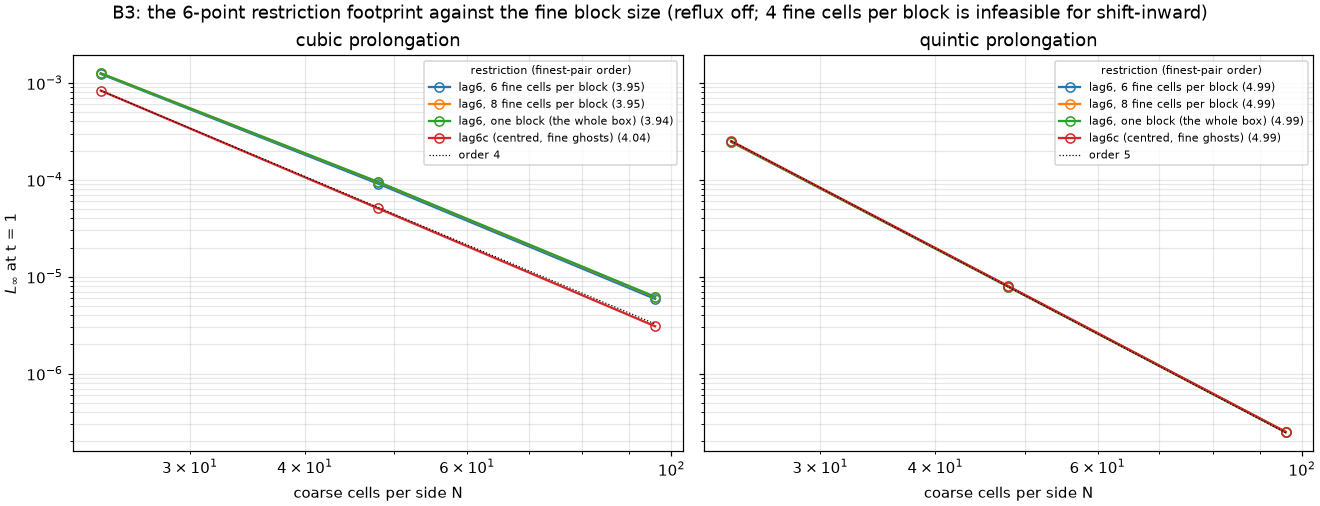
The check.sh ladder,
| Footprint, prolongation | Block size | L1 | L∞ | Order L1 / L∞ |
|---|---|---|---|---|
| shift-inward, cubic | 6 / 8 / 16 / box | 3.98 / 4.00 | ||
| two-pass, cubic | any | 4.14 / 4.03 | ||
| shift-inward, quintic | 6 / 8 / 16 / box | 4.98 / 4.99 | ||
| two-pass, quintic | any | 5.00 / 5.00 | ||
| shift-inward | 4 | infeasible |
Related cases: C1 implements the recommendation; B1 is the base model; D1 adds the quintic prolongation in FLUME.
Findings
- The block size does not matter for shift-inward. From 6 fine cells per block to the whole box the error changes by at most 2.5 % in L1 and 5 % in L∞, at the same order.
- With the quintic prolongation the two footprints are equivalent (within 1.5 %), both at order 5.
- With today's cubic prolongation, two-pass is 4 times more accurate in L1 (2 times in L∞), at the same order 4: the one-sided shift has a larger error constant than the centred stencil reading 4th-order ghosts.
- What each costs in FLUME.
update_ghost_localfills copies, coarse-to-fine interpolations and fine-to-coarse restrictions in one pass, in map order, the restriction reading only the donor block's interior cells. Shift-inward keeps that single pass and needs 6 fine cells per refined axis, which the #66 guard already requires (). Two-pass needs the fine ghosts complete before any restriction: a second local pass and, on several ranks, a second exchange round, because the sender must update its fine ghosts before it packs. - Recommendation for Phase C: shift-inward. It fits the current ghost update and block guard, and with the quintic prolongation of Phase D it is as accurate as two-pass. Two-pass would buy a constant factor only while the cubic prolongation stays, at the cost of a second synchronisation per ghost update.