10. Cut cells
A conservative cut-cell solver needs, for every cell the wall crosses, the fluid fraction of the cell, the fluid fraction of each face, and the separate fluid pieces when the wall splits a cell. FOSSIL computes them exactly from the geometry. This chapter does it in 2-D on the section of chapter 7 and in 3-D on the dragon.
f90
use fossil, only : surface_stl_object, curve_object, cut_cells_2d_t, cut_cells_3d_t, cut_cells_3d, STATUS_OK
use penf,   only : I4P, R8P

implicit none
type(curve_object)       :: section
type(surface_stl_object) :: surface
type(cut_cells_2d_t)     :: cut2
type(cut_cells_3d_t)     :: cut3
real(R8P)                :: x(49), h
integer(I4P)             :: i, k, c(3), p, status

call section%load_from_file(file_name='dragon-section.dat', status=status)
if (status /= STATUS_OK) error stop 'cannot load dragon-section.dat'
x = [(-0.6_R8P + 0.025_R8P * i, i = 0, 48)]                  ! cell edges: 48 cells per direction, h = 0.025
h = 0.025_R8P
call section%cut_cells(x=x, y=x, cut=cut2)
print '(A,I0,A,I0)', '2-D: cut cells ', count(cut2%alpha > 0._R8P .and. cut2%alpha < 1._R8P), &
                     ', cells with 2+ pieces ', count(cut2%pieces > 1)
print '(A,F10.6,A,F10.6)', '     solid area ', sum(1._R8P - cut2%alpha) * h**2, '  curve area ', section%get_area()
c(1:2) = maxloc(cut2%wet_length)
print '(A,I0,A,I0,A,F8.5,A,4F8.5)', '     cell (', c(1), ',', c(2), ') alpha ', cut2%alpha(c(1), c(2)), &
                                    '  apertures ', cut2%aperture(:, c(1), c(2))
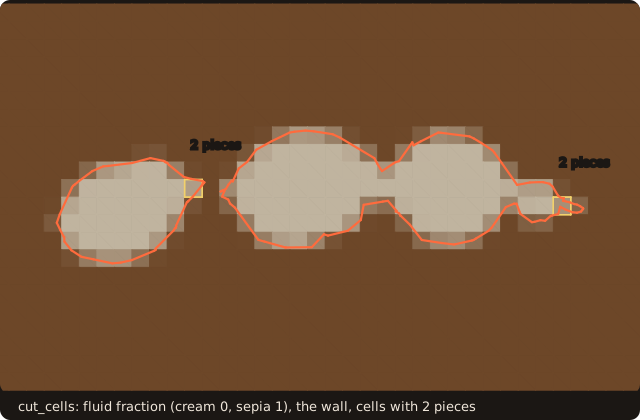
cut_cells(x=, y=, cut=)takes the cell edges of a block, strictly increasing in each direction, and fills acut_cells_2d_t. The fluid is outside the solid. Per cell (nx × ny arrays):alpha: the fluid area fraction, 1 in the fluid, 0 in the solid;aperture(4, :, :): the fluid fraction of the four edges, in the order -u, +u, -v, +v;centroid,wet_length,wet_centroid,wet_normal: the fluid centroid and the wetted wall;pieces: the number of separate fluid pieces of the cell, with their measures inpiece_area,piece_centroid, ... from indexfirst_piece.
- The topology is exact (the crossings are decided with the exact
orient2d, a point on a grid line belongs to the low cell), the measures exact to round-off. A cell whose boundary does not close (an open loop) is flagged inclosed, withalpha = -1.
f90
call surface%load_from_file(file_name='dragon-placed.stl', guess_format=.true.)
call cut_cells_3d(surface=surface, x=x(1:49:2), y=x(1:49:2), z=x(1:49:2), cut=cut3)    ! 24^3 cells, h = 0.05
print '(A,I0,A,I0,A,I0)', '3-D: cut cells ', count(cut3%alpha > 0._R8P .and. cut3%alpha < 1._R8P), &
                          ', flagged ', count(cut3%pieces < 0), ', cells with 2+ pieces ', count(cut3%pieces > 1)
c = findloc(cut3%pieces, 2)                                   ! the first cell with two fluid pieces
p = cut3%first_piece(c(1), c(2), c(3))
print '(A,I0,A,I0,A,I0,A,F8.5,A,2F8.5)', '     cell (', c(1), ',', c(2), ',', c(3), ') alpha ', &
   cut3%alpha(c(1), c(2), c(3)), '  pieces ', (cut3%piece_volume(p + k) / 0.05_R8P**3, k = 0, 1)
cut_cells_3d(surface=, x=, y=, z=, cut=)is a free routine (fromuse fossil), with acut_cells_3d_tresult:alpha(volume fraction),face_x,face_y,face_z(face fractions), the wetted area, centroid and normal, and the fluid pieces:pieces(i, j, k), numbered fromfirst_piece(i, j, k), each withpiece_volume,piece_centroid, its wall terms andpiece_face(6, :), the fluid fraction of its six faces.pieces = -1flags a cell that cannot be trusted: a boundary edge of the mesh crosses it, or its faces do not close. Such a cell has no measures.
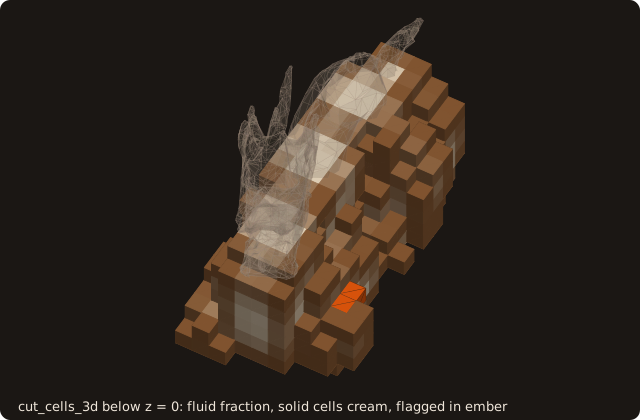
The top of the cubes is the plane of the 2-D section: the solid inside, the cut cells around it. The ember cells are flagged, where an open edge of the dragon crosses them.
Running it
$ tut10_cut_cells
2-D: cut cells 91, cells with 2+ pieces 2
     solid area   0.072609  curve area   0.072609
     cell (23,41) alpha  0.33034  apertures  0.61695 0.85409 0.00000 0.49297
3-D: cut cells 895, flagged 17, cells with 2+ pieces 75
cell (13,7,6) alpha 0.06856 pieces 0.06533 0.00323- 2-D: 91 cells are cut, 2 of them hold two fluid pieces. Summed over the block, the solid area equals the area of the curve to the printed digits. The cell with the longest wall, (23, 41), is 33 % fluid; its -v edge is entirely solid.
- 3-D: 895 cells are cut and 75 have two or more fluid pieces. 17 are flagged: the dragon is open (chapter 2), and the cells at its open edges get no measures.
- In cell (13, 7, 6) the fluid is 6.856 % of the cell, in two pieces of 6.533 % and 0.323 %: their volumes add up to the cell's.
What you learned
curve%cut_cells and cut_cells_3d give exact fluid fractions, apertures and fluid pieces per cell, and flag the cells an open surface makes untrustworthy. Reference: Cut-cell geometry.
Next: 11. Moving bodies.