
3. Placing the body
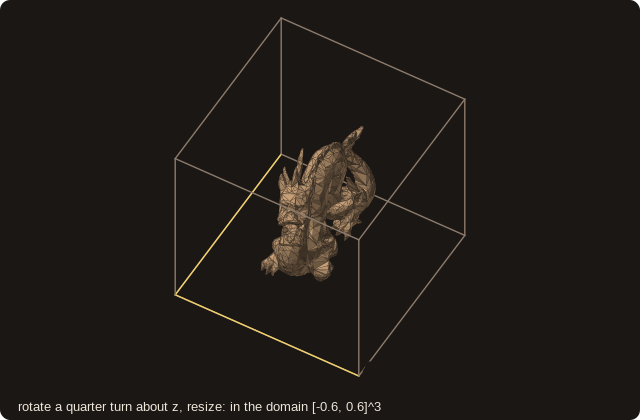
The repaired dragon is in its own CAD units, about 20 long, floating 12 units above the origin. The simulation domain of the next chapters is the cube [-0.6, 0.6]³, so the dragon is centred, turned and scaled to a longest side of 1, then saved for the chapters that follow. A second program splits it by a box, mirrors one half and merges the two.
Centring, turning, scaling
use fossil, only : surface_stl_object
use penf,   only : I4P, R8P
use vecfor, only : vector_R8P, ez_R8P

implicit none
real(R8P), parameter     :: pi = 4._R8P * atan(1._R8P)
type(surface_stl_object) :: surface
type(vector_R8P)         :: bmin, bmax
real(R8P)                :: scale

call surface%load_from_file(file_name='dragon-clean.stl', guess_format=.true.)
bmin = surface%get_bmin() ; bmax = surface%get_bmax()
print '(A,3F9.4)', 'CAD box min ', bmin%x, bmin%y, bmin%z
print '(A,3F9.4)', 'CAD box max ', bmax%x, bmax%y, bmax%z
call surface%translate(delta=-0.5_R8P * (bmin + bmax))             ! box centre to the origin
call surface%rotate(axis=ez_R8P, angle=pi / 2._R8P)                 ! a quarter turn about z
call surface%analyze                                                ! rebuild box, volume, tree
bmin = surface%get_bmin() ; bmax = surface%get_bmax()
scale = 1._R8P / maxval([bmax%x - bmin%x, bmax%y - bmin%y, bmax%z - bmin%z])
print '(A,F9.6)', 'scale       ', scale
call surface%resize(x=scale, y=scale, z=scale)                     ! longest side 1, about the origin
call surface%analyze
bmin = surface%get_bmin() ; bmax = surface%get_bmax()
print '(A,3F9.4)', 'box min     ', bmin%x, bmin%y, bmin%z
print '(A,3F9.4)', 'box max     ', bmax%x, bmax%y, bmax%z
print '(A,F9.6)',  'volume      ', surface%get_volume()
call surface%save_into_file(file_name='dragon-placed.stl')translate(delta=)moves every facet by a vector;x=,y=,z=give the components one by one. Passing both forms is ambiguous:statusis thenSTATUS_AMBIGUOUS_ARGS(withoutstatusthe program stops). The centre of the bounding box is used here, notget_centroid(): the centroid is a volume integral, meaningful only on a closed surface.rotate(axis=, angle=)turns the facets byangleradians aboutaxis, through the origin;center=pivots about another point.rotate(matrix=)takes a rotation matrix instead.resize(x=, y=, z=)(orfactor=, a vector) scales about the origin, or about the centroid withrespect_centroid=.true..- The transformations move the facets and nothing else: bounding box, volume and AABB tree are stale until
analyzeruns. Hereanalyzeruns after the turn, because the scale needs the new box, and after the last transformation, before any query. save_into_filewritesdragon-placed.stl, the body of the chapters that follow.
$ tut03_a_place
CAD box min  -10.8287  -4.1883   5.2821
CAD box max    9.6461   4.9512  19.7413
scale        0.048841
box min       -0.2232  -0.5000  -0.3531
box max        0.2232   0.5000   0.3531
volume       0.054283
Every transformation acts about the fixed world origin, so the order matters: the box centre goes to the origin first, and the turn and the scale then leave it there. The animation applies the calls of the program one at a time, in CAD units, with the world x and y axes drawn through the origin.
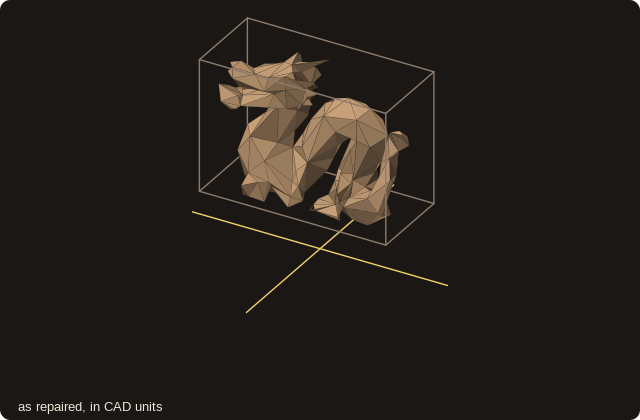
The last frame is the dragon of the rest of the tutorial, too small to see at the CAD scale. In domain units it spans [-0.2232, 0.2232] × [-0.5, 0.5] × [-0.3531, 0.3531], with volume 0.054283: the volume of chapter 2 times the cube of the scale.
Clipping
use fossil, only : surface_stl_object
use penf,   only : I4P, R8P
use vecfor, only : vector_R8P, ex_R8P, ey_R8P, ez_R8P

implicit none
type(surface_stl_object) :: surface, half, rest, twin
type(vector_R8P)         :: bmin, bmax

call surface%load_from_file(file_name='dragon-placed.stl', guess_format=.true.)
bmin = surface%get_bmin() ; bmax = surface%get_bmax()
half = surface
call half%clip(bmin=bmin, bmax=bmax%x * ex_R8P + 0._R8P * ey_R8P + bmax%z * ez_R8P, remainder=rest)  ! the box y <= 0
print '(A,I0,A,I0,A,I0)', 'clip y<=0 ', half%get_facets_number(), ' facets, remainder ', rest%get_facets_number(), &
                          ', sum ', half%get_facets_number() + rest%get_facets_number()
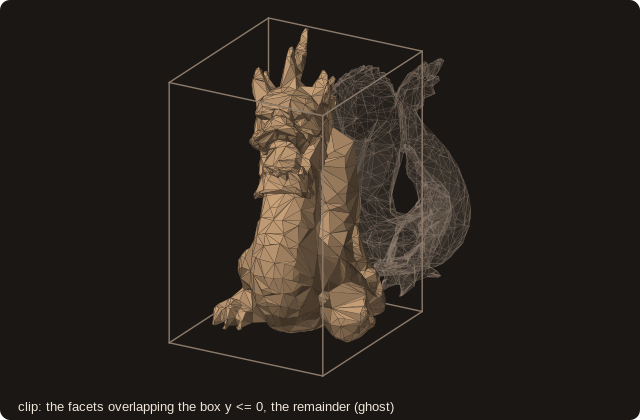
clip(bmin=, bmax=)keeps the facets that overlap the box and drops the others, whole: no facet is cut. Withremainder=the dropped facets go into a second surface, so the two parts add up to the original. Both are analyzed.
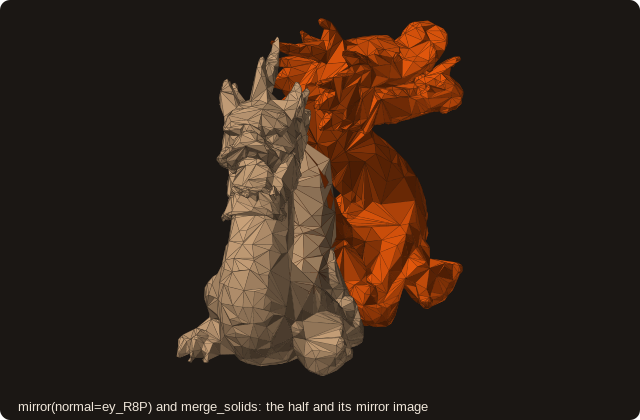
Mirroring and merging
twin = half
call twin%mirror(normal=ey_R8P)                                     ! reflect through the plane y = 0
call twin%analyze
call half%merge_solids(other=twin)                                  ! merge_solids analyzes
print '(A,I0,A)', 'merged    ', half%get_facets_number(), ' facets (half + mirrored half)'
bmin = half%get_bmin() ; bmax = half%get_bmax()
print '(A,3F9.4)', 'box min   ', bmin%x, bmin%y, bmin%z
print '(A,3F9.4)', 'box max ', bmax%x, bmax%y, bmax%zmirror(normal=)reflects the facets through the plane through the origin with that normal (mirror(matrix=)takes the matrix). The facet winding is kept outward.merge_solids(other=)appends the facets ofotherand analyzes the result.
$ tut03_b_clip
clip y<=0 3738 facets, remainder 2848, sum 6586
merged    7476 facets (half + mirrored half)
box min     -0.1886  -0.5000  -0.3530
box max      0.2232   0.5000   0.3531
The clip keeps 3738 facets, the remainder has 2848: together the 6586 facets of chapter 2. The merged surface has twice the half, 7476 facets, and its box is symmetric in y.
What you learned
translate, rotate, resize and mirror move facets about the world origin; analyze brings the derived data up to date; clip and merge_solids split and join surfaces. Reference: surface_stl_object.
Next: 4. Signed distance.