

Per-vertex Gaussian + mean curvature
What it does
Two TBPs that return scalar curvature fields, one value per vertex of the surface:
gaussian_curvature(K, status)— Gaussian curvatureK_icomputed from the angle defect at vertexi.K > 0on convex caps (sphere, ellipsoid),K < 0on saddles,K = 0on developable surfaces (cylinder, cone, flat plane).mean_curvature(H, status)— signed mean curvatureH_ifrom the mean-curvature normal identityH_i n_i = (1/2) M⁻¹ (L V)_i, with sign disambiguated by projection onto the per-vertex pseudo-normal.H > 0on outward-convex regions (sphere surface, cube corners),H < 0on saddles / concave-outward regions,H ≈ 0on flat regions.jet_curvature(H, K, status)(issue #42) — both, by a local polynomial fit: in the frame of the vertex pseudo-normal, a cubic height function is fitted to the 2-ring (Cazals & Pouget 2005), and H and K are those of the fitted graph.- The error is O(h²) pointwise on any sampling: on icospheres the maximum relative error falls 0.183 → 0.043 → 0.012 per subdivision.
- The two operators above stall near 15 % at the valence-5 vertices.
- Use it when pointwise values matter, as for the wall curvature at a foot point (
query_many(curvatures=)).
The first two build on cotangent Laplacian + barycentric mass. The mean variant in particular is a one-liner on top of (L, M): L V is the per-vertex mean-curvature normal scaled by 2 M_ii; inverting the diagonal mass and halving gives H n.
A correction worth surfacing
The feat(curvature,surface): per-vertex Gaussian curvature commit message claimed that the mean variant required a sparse linear solver. That was wrong. The mass matrix M is diagonal (barycentric per §2.1), so M⁻¹ is per-row scalar division — no factorisation needed. The mean variant shipped without any external dependency in the same release as Gaussian. The mean-curvature TBP docstring carries the retraction inline; this page records it once and moves on.
Pipeline
Gaussian — angle defect
For each interior vertex i:
where θ_i^T is the angle at vertex i inside triangle T, the sum runs over all triangles incident to i, and A_i = (1/3) Σ_{T ∋ i} A_T is the same barycentric vertex-area used in §2.1's mass matrix.
For boundary vertices the formula is (π − Σ θ) / A_i — half the angle defect, reflecting the fact that the surface doesn't wrap around i on the open side. FOSSIL detects boundary vertices automatically via the half-edge incidence pool.
The integrated angle defect Σ_i K_i A_i = 4π χ (Gauss–Bonnet) for any closed orientable manifold of Euler characteristic χ — χ = 2 for a topological sphere, χ = 0 for a torus. This is a standard regression oracle for the implementation.
Mean — mean-curvature normal
For each vertex i, compute the action of the cotangent Laplacian on the coordinate field V:
then form
The magnitude is H_i = ||H_i n_i||; the sign is decided by projecting onto the angle-weighted pseudo-normal computed by analyze (this is the same per-vertex pseudo-normal used by SIGN_PSEUDO_NORMAL for signed-distance queries). Outward-convex projection gives H > 0, inward-concave gives H < 0.
Both computations reuse the §2.1 per-triangle cotangent and area assembly. They run in a single pass over the facet array with O(N) storage; no sparse matrix is materialised by either TBP — the assembly is "on the fly" into the output vector.
API
Gaussian
call surface%gaussian_curvature(K, status)
   class(surface_stl_object),  intent(in)            :: self
   real(R8P), allocatable,     intent(out)           :: K(:)
   integer(I4P),               intent(out), optional :: status   ! CURV_STATUS_*
Output:
K(1:n_vertices)— per-vertex Gaussian curvature. Indexed by pool vertex id (pool%get_vertex_count()givesn_vertices). Boundary vertices use the half-defect formula; interior vertices the full formula.
Mean
call surface%mean_curvature(H, status)
   class(surface_stl_object),  intent(in)            :: self
   real(R8P), allocatable,     intent(out)           :: H(:)
   integer(I4P),               intent(out), optional :: status   ! CURV_STATUS_*
Output:
H(1:n_vertices)— per-vertex signed mean curvature. Positive on outward-convex regions, negative on saddle / inward-concave, ≈ 0 on flat regions.
Shared status codes:
CURV_STATUS_OK— operator built successfully.CURV_STATUS_BAD_INPUT— empty surface or uninitialised pool.CURV_STATUS_DEGENERATE_TRIANGLE— at least one triangle had area below tolerance and was skipped. The curvature field is still returned; degenerate vertices receive 0.
Pre-condition. analyze must have run (pseudo-normals populated). Every public construction path on surface_stl_object ensures this — load_from_file, adopt_facets, and sanitize all call analyze internally. The mean_curvature sign-disambiguation step is the only direct consumer of pseudo-normals among the curvature TBPs; Gaussian does not depend on them.
Examples
Gaussian curvature on a sphere
program ex_gaussian_curvature
use fossil
use fossil_facet_object, only : facet_object
use penf,                only : I4P, R8P
use vecfor,              only : vector_R8P
implicit none

type(surface_stl_object)        :: sphere
type(facet_object), allocatable :: facets(:)
real(R8P),          allocatable :: values(:,:,:), curv_k(:)
real(R8P)                       :: x, y, z, dx
integer(I4P), parameter         :: ng = 32_I4P
integer(I4P)                    :: ix, iy, iz, status

! Build a unit-sphere surface: sample the analytic SDF on a 32^3 grid
! spanning [-2, 2]^3, then marching-cubes the iso=0 level set.
allocate(values(ng, ng, ng))
dx = 4._R8P / real(ng - 1_I4P, R8P)
do iz = 1_I4P, ng
   z = -2._R8P + (iz - 1_I4P) * dx
   do iy = 1_I4P, ng
      y = -2._R8P + (iy - 1_I4P) * dx
      do ix = 1_I4P, ng
         x = -2._R8P + (ix - 1_I4P) * dx
         values(ix, iy, iz) = sqrt(x*x + y*y + z*z) - 1._R8P
      enddo
   enddo
enddo
call extract_isosurface(values=values, bmin=vector_R8P(-2._R8P, -2._R8P, -2._R8P), &
                        bmax=vector_R8P(2._R8P, 2._R8P, 2._R8P), iso=0._R8P,       &
                        surface=facets, status=status)
call sphere%adopt_facets(facets=facets)

call sphere%gaussian_curvature(K=curv_k, status=status)
print '(A,I0)',      'curv status = ', status
print '(A,I0)',      'n_vertices  = ', size(curv_k, kind=I4P)
print '(A,ES12.5)',  'mean K      = ', sum(curv_k) / real(size(curv_k, kind=I4P), R8P)
! A unit sphere has K = 1 everywhere: this extraction (watertight since
! issue #48; with slits before, it printed -31.8) prints a mean of 0.971.
! The per-vertex values scatter (see Known limitations); on the remeshed
! sphere of the Visual reference the mean is 1.009.
endprogram ex_gaussian_curvature
Mean curvature on a unit sphere
program ex_mean_curvature_sphere
use fossil
use fossil_facet_object, only : facet_object
use penf,                only : I4P, R8P
use vecfor,              only : vector_R8P
implicit none

type(surface_stl_object)        :: sphere
type(facet_object), allocatable :: facets(:)
real(R8P),          allocatable :: values(:,:,:), h_curv(:)
real(R8P)                       :: x, y, z, dx
integer(I4P), parameter         :: ng = 32_I4P
integer(I4P)                    :: ix, iy, iz, n_pos, n_total, status

! Same unit-sphere construction as the Gaussian example above.
allocate(values(ng, ng, ng))
dx = 4._R8P / real(ng - 1_I4P, R8P)
do iz = 1_I4P, ng
   z = -2._R8P + (iz - 1_I4P) * dx
   do iy = 1_I4P, ng
      y = -2._R8P + (iy - 1_I4P) * dx
      do ix = 1_I4P, ng
         x = -2._R8P + (ix - 1_I4P) * dx
         values(ix, iy, iz) = sqrt(x*x + y*y + z*z) - 1._R8P
      enddo
   enddo
enddo
call extract_isosurface(values=values, bmin=vector_R8P(-2._R8P, -2._R8P, -2._R8P), &
                        bmax=vector_R8P(2._R8P, 2._R8P, 2._R8P), iso=0._R8P,       &
                        surface=facets, status=status)
call sphere%adopt_facets(facets=facets)

call sphere%mean_curvature(H=h_curv, status=status)
n_total = size(h_curv, kind=I4P)
n_pos   = count(h_curv > 0._R8P)
print '(A,ES12.5,A)', 'mean H = ', sum(h_curv) / real(n_total, R8P), &
                      '   (analytic value for a unit sphere = 1.0)'
print '(A,I0,A,I0,A)', 'sign: ', n_pos, ' / ', n_total, ' vertices have H > 0'
! Expected: ~100% positive — the sphere surface is convex outward everywhere.
endprogram ex_mean_curvature_sphere
Combining both for principal curvature follow-up
The two scalars together carry the full second-fundamental-form trace + determinant:
! Both shipped today:
call surface%gaussian_curvature(K=K, status=stat_K)
call surface%mean_curvature(H=H, status=stat_H)

! Principal curvatures (not yet a TBP — small follow-up):
!     kappa1 = H + sqrt(max(0, H^2 - K))
!     kappa2 = H - sqrt(max(0, H^2 - K))
! Pointwise on every vertex. Discriminant clamp guards floating-point
! noise on near-umbilical (kappa1 = kappa2) points.
A principal_curvatures TBP is a documented follow-up — small wrapper, no new infrastructure. Tracked under issue #18.
Visual reference
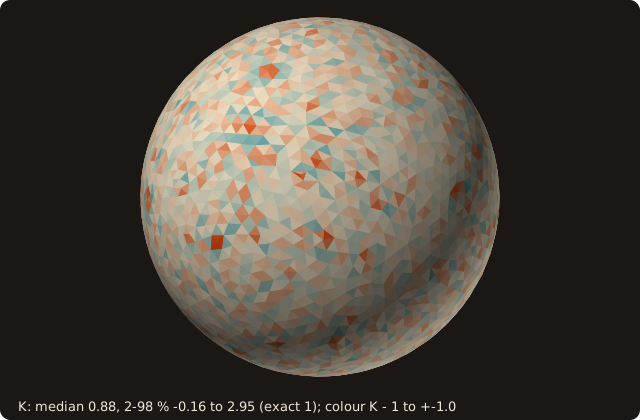
A unit sphere by marching cubes (the |x| - 1 field on 31³ samples of [-1.5, 1.5]³, cleaned by sanitize(fill_holes=.true.), which drops the slivers marching cubes leaves), then isotropically remeshed with the defaults (5436 facets). Each facet is coloured by the mean of its three vertex values minus the exact value 1 (teal below, ember above; the scale is in the caption). Gaussian curvature K by gaussian_curvature:
Signed mean curvature H on the same surface, by mean_curvature (left) and by jet_curvature (right), same colour scale:
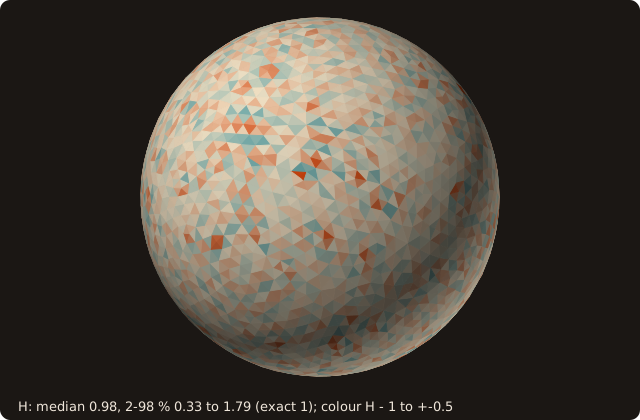
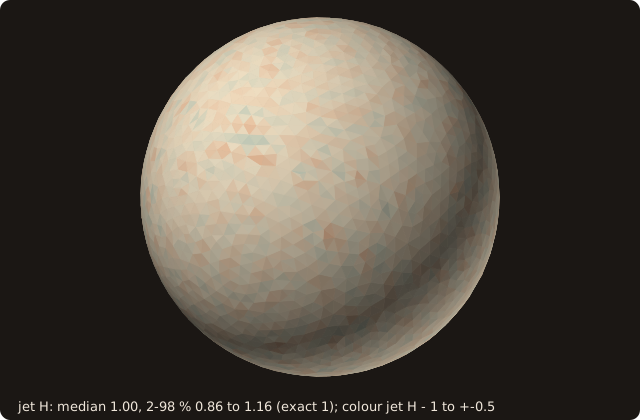
Read these figures honestly. The means are right (K and H average 1.009 and 1.005 over the vertices, the exact value is 1), but the per-vertex values of the angle-defect and cotangent operators are not: on this irregular triangulation they scatter over the whole surface, no cluster or region in particular (2nd-98th percentile: K from -0.16 to 2.95, H from 0.33 to 1.79). This is the non-convergence described in Known limitations below, not a rendering bug or a bug in the curvature TBPs: it is what the discrete formulae genuinely produce on a mesh whose vertex valences and triangle shapes vary from vertex to vertex. jet_curvature on the same mesh stays within 0.86 to 1.16. Use it when the pointwise value matters; on real CAD STL, run §1.7 isotropic remeshing first in any case. The figures are drawn by docs/examples/src/fig_ref_curvature.f90.
Known limitations
- The cotangent / angle-defect operators do not converge pointwise on irregular meshes. On icospheres the maximum relative error stays near 15 % (0.154, 0.148, 0.124 at 2, 3, 4 subdivisions) at the valence-5 vertices, although the RMS error decreases. They are exact on some structured meshes (a cylinder's rings).
jet_curvatureconverges at second order everywhere. - Discrete curvature is noisy on coarse triangulations. Both formulae carry an
O(h)discretisation error wherehis the local edge length; on very-coarse meshes (cube with 12 facets, low-res MC) the values are dominated by tessellation artefact rather than smooth curvature. This is why the §2.4 tests target sphere + bunny rather than the cube — sphere has well-behaved curvature, bunny has enough vertices to swamp tessellation noise. Use §1.7 isotropic remeshing or §1.3 decimation first if the input is pathological. - Mean-curvature sign relies on the pseudo-normal. If the surface has inconsistent normal orientation (one patch flipped), the per-vertex pseudo-normal may point inward at some vertices and the sign of
Hthere will flip. Runsanitize_normals(or fullsanitize) beforemean_curvatureif the input is dirty. The unsigned magnitude|H|is robust regardless. - Principal curvatures and directions are not yet a TBP — only the trace (
H) and determinant-shadow (K) are returned. Computing(κ₁, κ₂, d₁, d₂)requires either (a) the algebraic combination shown in the example above for the eigenvalues, or (b) Rusinkiewicz 2004 per-vertex 3×3 covariance +dsyevLAPACK eigen-decomposition for the directions. The follow-up TBP is small but not yet shipped. - Discrete curvature is per-vertex, not per-facet. If you want a per-facet curvature scalar (e.g. for face-based segmentation), the standard recipe is to average the three incident vertex values — the curvature TBPs do not provide a per-facet helper.
See also
- cotangent Laplacian + barycentric mass — the prerequisite operator. Mean curvature is a one-liner on top of
(L, M). - mesh smoothing — the shipped smoothing variants reduce high-frequency surface noise; running
mean_curvatureafter a few Taubin passes gives noticeably cleanerHfields without volume loss. sanitize_normals— ensures the pseudo-normals used by mean-curvature sign disambiguation are consistently outward-oriented.- Constants —
CURV_STATUS_*.
References
- Meyer, Desbrun, Schröder & Barr, Discrete differential-geometry operators for triangulated 2-manifolds, VisMath 2003. The reference formulation for both
K_i(angle defect) andH_i n_i(mean-curvature normal), including the mixed-area mass discussion that informs the §2.1 follow-up. - Rusinkiewicz, Estimating curvatures and their derivatives on triangle meshes, 3DPVT 2004. The per-vertex 3×3 covariance method for principal curvatures and directions — the documented follow-up.
- Crane, Discrete Differential Geometry: An Applied Introduction, SIGGRAPH course notes 2013–2023. The pedagogical reference covering both Gauss–Bonnet on triangle meshes and the
H n = (1/2) M⁻¹ L Videntity used by the FOSSIL mean-curvature TBP. - do Carmo, Differential Geometry of Curves and Surfaces, Prentice-Hall 1976. The smooth-surface theory the discrete formulae approximate — useful when you need to remember why
H = (κ₁ + κ₂)/2andK = κ₁ κ₂.