

Surface deviation (Hausdorff distance)
What it does
Measures how far one surface lies from another (issue #60, roadmap #58):
- the one-sided deviation
: how far the farthest point of A is from B; - the Hausdorff distance
; - the mean and rms of
over A, and at every vertex of A.
The two one-sided deviations differ in general: a small body inside a large one is close to it (
Remeshing, decimation, smoothing, hole filling, alpha wrapping and booleans all move a surface. The deviation measures by how much, so a test or a user can bound it instead of trusting it.
Method
distance_many): exact closest-point distances, bit-identical across tree kinds and thread counts.
Lower bound. A is sampled deterministically:
- every vertex;
- every edge midpoint;
- the centroids of the
sub-triangles of a regular subdivision of each facet f, with . The default density is 4 samples per mean facet area, about 4 per facet.
The largest sampled distance is a lower bound of
Mean and rms. The sub-triangle centroids, each weighted by
Certified upper bound
The samples can miss the maximum, which may lie anywhere inside a facet. The upper bound comes from three facts about
- Lipschitz.
for every k, since d is 1-Lipschitz. With the nearest corner, , where . - Convexity.
, because is a point of B. is convex in x, so its maximum over T is at a corner: . - One facet. If the three closest points lie on the same facet F of B, then for
the point lies in F (a triangle is convex), so , and .
The bound
ρ_T. For a triangle with no obtuse angle, the circumcentre lies in T and
Branch and bound.
- Every facet starts with its bound. A facet with
lower+toleranceis settled. - Each remaining one is split into four at its edge midpoints. The midpoints are evaluated in one batched query, and their distances raise
lower. upperis the largest bound left when no triangle remains, soand upper − lower ≤ tolerance. - When
max_trianglestriangles have been created first, the run stops withDEV_STATUS_NOT_CONVERGED. The bounds are still valid, only wider.
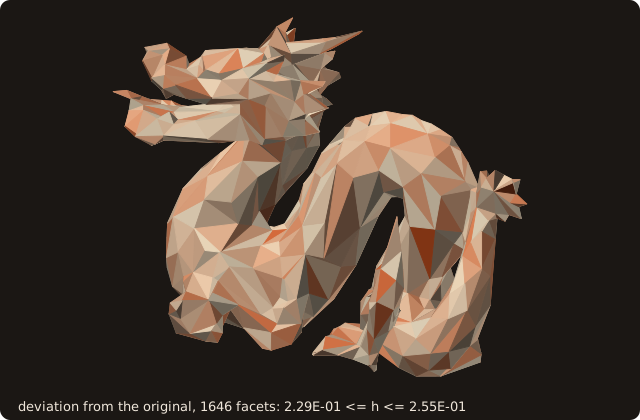
The dragon decimated to a quarter of its facets, each facet coloured by the distance of its centroid to the original (ember the largest). Quadric decimation keeps the vertices close to the surface, so the deviation peaks inside the facets that bridge concave parts. The certified bounds are in the caption.
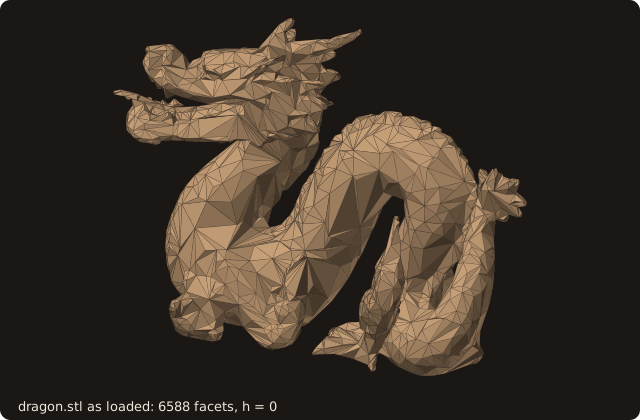
The animation repeats the decimation down to 204 facets, with the certified bounds of each level. Each bound converged to the default tolerance (1e-3 of the bounding-box diagonal) in at most 155 000 triangles; the whole sweep takes 1.5 s.
API
call surface%deviation(other, lower, upper, mean, rms, per_vertex, tolerance, samples_per_area, max_triangles, &
                       samples, triangles, device, status)
   class(surface_stl_object), intent(in)            :: self             ! A
   type(surface_stl_object),  intent(in)            :: other            ! B
   real(R8P),                 intent(out), optional :: lower            ! lower bound of h(A, B)
   real(R8P),                 intent(out), optional :: upper            ! certified upper bound (runs the branch and bound)
   real(R8P),                 intent(out), optional :: mean, rms        ! estimates of d over A
   real(R8P), allocatable,    intent(out), optional :: per_vertex(:)    ! d at the vertex-pool vertices of A
   real(R8P),                 intent(in),  optional :: tolerance        ! upper - lower target, default 1e-3 of the
                                                                        ! larger bounding-box diagonal
   real(R8P),                 intent(in),  optional :: samples_per_area ! default 4 / mean facet area of A
   integer(I4P),              intent(in),  optional :: max_triangles    ! work cap, default 2 000 000
   integer(I4P),              intent(out), optional :: samples          ! points sampled
   integer(I4P),              intent(out), optional :: triangles        ! triangles of the branch and bound
   logical,                   intent(in),  optional :: device           ! queries on the device (other entered)
   integer(I4P),              intent(out), optional :: status           ! DEV_STATUS_OK, _BAD_INPUT, _NOT_CONVERGED

call surface%hausdorff(other, lower, upper, tolerance, samples_per_area, max_triangles, device, status) ! H(A, B)device=.true.runs the queries on the device (below).status = DEV_STATUS_BAD_INPUTwhen either surface is empty (ordevicewithoutenter_device),DEV_STATUS_NOT_CONVERGEDwhen the work cap stopped the branch and bound (the bounds are valid).- Without
upperthe branch and bound does not run:lower,mean,rmsandper_vertexcost one batched query. - Neither surface needs to be closed: the deviation is defined for any triangle soup.
- The work is one batched closest-point query (
query_many) for the samples, plus one per round of the branch and bound. The result does not depend on the thread count: the queries are independent, and the maximum, the sums and the rounds run in a fixed order.
On the device
With device=.true., every batch of the sampling and of the branch and bound runs through query_many_device on other, which must be resident (other%enter_device); otherwise status = DEV_STATUS_BAD_INPUT. The device and the CPU use the same closest-point kernels, so lower, upper and per_vertex are bit-identical. The branch and bound itself (bounds, splits) stays on the host: the device does the queries, which are the cost.
call original%enter_device
call coarse%deviation(original, lower=lower, upper=upper, device=.true., status=status)
call original%exit_device
The GPU check (fossil_test_distance_bench) compares a copy of the bench surface, rotated by 2 degrees about its centre, against the surface on the device and on the CPU, and prints deviation device vs serial mismatches, which must be 0.
2-D: curves
curve%deviation and curve%hausdorff do the same for curves, open loops included:
call curve%deviation(other, lower, upper, mean, rms, per_vertex, tolerance, samples_per_length, max_segments, &
                     samples, created, device, status)
call curve%hausdorff(other, lower, upper, tolerance, samples_per_length, max_segments, device, status)- Sampling: every vertex, every segment midpoint, and the midpoints of sub-segments (
samples_per_length, default 4 per mean segment length). The same midpoints, length-weighted, givemeanandrms. - Bounds for a segment [a, b]:
when both closest points lie on one segment of B; - otherwise the smaller of
and over the two closest points.
- Refinement: segments above
lower+toleranceare halved. - Device:
device=.true.usescurve%query_many_device.
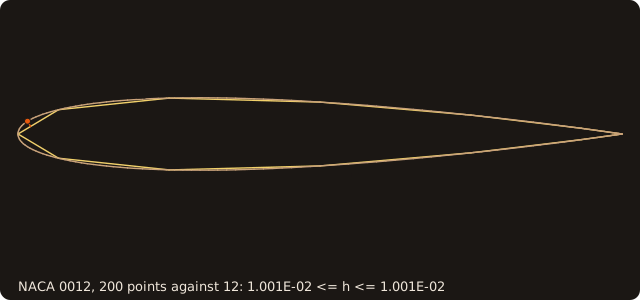
The figure shows a NACA 0012 section of 200 points against a coarse copy of 12. The deviation is largest at the nose, where the coarse copy cuts the curvature; there it is 1.001e-2. The marked vertex is the largest per_vertex, joined to its closest point on the coarse copy.
Example: how far did the repair move the dragon?
program ck_deviation
use fossil, only : surface_stl_object, DEV_STATUS_OK
use penf,   only : I4P, R8P
implicit none
type(surface_stl_object) :: original, repaired
real(R8P)                :: lower, upper, mean, rms
integer(I4P)             :: status

call original%load_from_file(file_name='dragon.stl', guess_format=.true.)
repaired = original
call repaired%sanitize(fill_holes=.true.)                       ! duplicates removed, 54 holes patched
call repaired%deviation(original, lower=lower, upper=upper, mean=mean, rms=rms, status=status)
if (status /= DEV_STATUS_OK) error stop 'deviation failed'
print '(A,ES10.3,A,ES10.3,A,ES10.3,A,ES10.3)', 'repaired -> original: ', lower, ' <= h <= ', upper, ', mean ', mean, &
                                               ', rms ', rms
call original%deviation(repaired, lower=lower, upper=upper, mean=mean, rms=rms, status=status)
print '(A,ES10.3,A,ES10.3,A,ES10.3,A,ES10.3)', 'original -> repaired: ', lower, ' <= h <= ', upper, ', mean ', mean, &
                                               ', rms ', rms
endprogram ck_deviation
$ ck_deviation
WARNING: sanitize: 54 hole(s) filled
WARNING: sanitize: 136 boundary edge(s) not forming a closed loop
WARNING: sanitize: 62 duplicate facet(s) removed
WARNING: sanitize: 188 facet(s) with 1 disconnected edge remain
WARNING: sanitize: 14 facet(s) with 2 disconnected edges remain
WARNING: sanitize: 54 non-manifold edge(s) (3+ incident facets) detected
repaired -> original: 9.439E-02 <= h <= 1.190E-01, mean 7.373E-06, rms 6.024E-04
original -> repaired: 3.009E-03 <= h <= 2.968E-02, mean 8.903E-10, rms 7.087E-07- Repaired against original: between 0.094 and 0.119. The 54 hole patches span the holes, and their middles are that far from the original surface. The samples alone gave 0.076: the maximum lies between them.
- Original against repaired: between 3.0e-3 and 0.030, at the facets
sanitizeremoved (degenerate and duplicate ones). The bracket is as wide as the default tolerance (1e-3 of the 26.7 diagonal); passtolerance=to narrow it. - The means are tiny: almost every point of either surface lies on the other.
Command line
fossilizer --compare other.stl [--tolerance τ] prints, for each input, both one-sided deviations and the Hausdorff distance as certified brackets, with the means and rms:
fossilizer -i repaired.stl --compare original.stl --tolerance 1e-4src/tests/fossil_test_deviation_cli.f90 reads the three brackets back for a cube against itself translated by 0.3.
Validation
src/tests/fossil_test_deviation.f90:
| Case | Checked | Measured |
|---|---|---|
cube-02 against itself | 0 at the vertices, round-off inside | 2.8e-17 |
cube-02 against itself translated by 0.3 along x | h = 0.3 both ways (attained at vertices) | exact |
| Marching-cubes unit sphere against itself scaled by 1.05 | 0.98 · 0.05 ≤ h ≤ 0.05 | 0.04995 |
| The cube [0.4, 0.6]³ inside the unit cube | h(small, unit) = 0.4, h(unit, small) = 0.4√3, H = 0.4√3 | exact |
| Two parallel unit squares 0.3 apart | lower, mean, rms = 0.3 | exact |
1 and 4 OpenMP threads (tests-gnu-openmp) | lower, mean, per-vertex bit for bit | identical |
| An empty surface | DEV_STATUS_BAD_INPUT | |
| Certified bounds on the translated cube, the nested cubes, the parallel squares (tolerance 1e-4) | lower ≤ h ≤ upper, upper − lower ≤ 1e-4 | 5.1e-5 (30 904 triangles; 208 256 without the one-facet bound), 1e-4, 2.5e-5 |
| Acute triangle against tiny triangles at its corners: the maximum at the circumcentre | sampled bound misses it by > 1e-3; certified bounds bracket R = 1.72413 | sampled 1.6008; 1.72403 ≤ h ≤ 1.72413 |
The same with max_triangles = 8 | DEV_STATUS_NOT_CONVERGED, valid bounds | 1.6008 ≤ h ≤ 2.3585 |
triangle_rho, 2000 random triangles | lattice maximum ≤ ρ, ≥ 0.98 ρ | |
device=.true. without enter_device; then entered (host build: device code, directives inert) | DEV_STATUS_BAD_INPUT; lower, upper, per_vertex = CPU | identical |
src/tests/fossil_test_curve_deviation.f90, the 2-D path:
| Case | Checked | Measured |
|---|---|---|
| Unit square against itself translated by 0.3 | h = 0.3 both ways, certified within 1e-4; hausdorff | 0.3 ≤ h ≤ 0.30003 |
| 64-gon on the unit circle against itself scaled by 1.05 | 0.98 · 0.05 ≤ h ≤ 0.05 | 0.049940 ≤ h ≤ 0.050034 |
| Open polyline (0,0)–(3,0) against tiny segments at x = 0 and 2.2: maximum 1.1 between the samples | sampled bound misses it; certified brackets it | sampled 1.075; 1.09991 ≤ h ≤ 1.10001 (29 segments) |
The same with max_segments = 3 | DEV_STATUS_NOT_CONVERGED, valid bounds | 1.075 ≤ h ≤ 1.45 |
| The 64-gons extruded to prisms | the 2-D and the 3-D brackets overlap | [0.049940, 0.050034] and [0.049940, 0.049997] |
device=.true.: refused before enter_device, then bit for bit | lower, upper, per_vertex | identical |
The curve bench (fossil_test_curve_bench, the GPU gate of tests-nvidia-curve) prints deviation device vs serial mismatches for the disc with a hole rotated by 2 degrees against itself.
A negative control: with
Where the library's tests use it
Six operations that move a surface now carry a certified deviation check against their input. Each bound is measured once and stated with a margin; no tolerance is loosened to make a test pass.
| Test | Operation | Certified result when written | Asserted |
|---|---|---|---|
fossil_test_isotropic_remesh | fine remesh of the cube, features preserved | h ≤ 1.0e-2 at tolerance 1e-2 (the true distance is ~0) | h ≤ 1.2e-2: a #42-style chamfer (~0.03) fails |
| marching-cubes sphere, 2 iterations | 5.61e-3 ≤ h ≤ 6.55e-3 at tolerance 1e-3 | h ≤ 7.5e-3 | |
fossil_test_decimate | sphere to 50 %, 25 %, 10 % | h ≤ 8.0e-3, 1.4e-2, 2.7e-2 | ≤ 1.5 × those; growing with the decimation |
fossil_test_smoothing | dragon, Taubin and explicit, 5 iterations | Taubin 0.307–0.333, explicit 0.565–0.589 | Taubin's upper below explicit's lower; Taubin ≤ 0.45 |
fossil_test_hole_fair | holed icosphere filled plain, refined, faired | plain 0.147–0.151, refined 0.161–0.164, faired 0.093–0.096 | faired's upper below plain's lower |
fossil_test_hole_refine | planar hole of the cube, plain and refined | H ≤ 1.6e-3 (default tolerance; true ~0) | H ≤ 2e-3 |
fossil_test_alpha_wrap | the cube wrapped with offset 0.033 | both directions 1.000–1.003 × offset | both bracket the offset within 1e-4 |
The smoothing and fairing checks compare two certified brackets: Taubin moves the dragon less than the explicit Laplacian, and the faired patch lies closer to the sphere than the plain fill. These were claims of the documentation; they are now certified.
Known limitations
- Coplanar surfaces whose facets cross. Where two surfaces coincide but are triangulated differently, the closest points of a triangle's corners can fall on different facets of B, so the one-facet bound does not apply. The branch and bound then refines along the crossing edges down to the tolerance, at a cost linear in 1 / tolerance. At the default tolerance this is cheap (the remeshed cube above: 1.7e-3 in well under a second). At 1e-4 on the same cube it reaches the work cap: the bounds stay valid but wider, with
DEV_STATUS_NOT_CONVERGED. - Surfaces that cross each other. Near a crossing curve d is close to 0, the convexity bound is only as good as the triangle size, and the branch and bound refines a strip around the curve down to the tolerance. Two triangulations of the same sphere (the remesh above) cost about 0.3 s at tolerance 1e-3 in an unoptimised build, and twice that at 5e-4.
- The mean and rms are estimates, from the centroid rule on the sub-triangles; only
lowerandupperare bounds. - The branch and bound runs on the host; with
device=.true.only the queries run on the device.
See also
- Mass properties, decimation, isotropic remeshing: operations whose result the deviation bounds.
surface_stl_object:distance_many, the query behind it.
References
- M. Tang, M. Lee, Y. J. Kim, Interactive Hausdorff distance computation for general polygonal models, ACM SIGGRAPH 2009.
- P. Cignoni, C. Rocchini, R. Scopigno, Metro: measuring error on simplified surfaces, Computer Graphics Forum 17(2), 1998.