Appearance
Isotropic remeshing
What it does
Equalizes edge length across a triangulated surface while preserving its geometry. CAD-exported STL routinely mixes 0.01 mm and 10 mm triangles on the same body — perfectly fine for visualization, fatal for AABB-tree query balance and for cut-cell quality near refinement bands. Isotropic remeshing rewrites the tessellation so every edge is within ~30% of a target length L, producing a mesh whose every facet has roughly the same shape and size.
Complementary to decimation (§1.3): decimation reduces facet count while preserving the silhouette; isotropic remeshing equalizes edge length without preferring either direction. Use decimation to make a million-facet model tractable; use isotropic remeshing to make any model's tessellation regular.
Pipeline
Each outer iteration runs four passes (Botsch & Kobbelt 2004):
- Split edges longer than
4L/3. New vertex at the midpoint; incident triangles re-triangulated. - Collapse edges shorter than
4L/5. Reuses §1.3's safety predicates: reject the collapse if it would flip a triangle's normal, create a duplicate vertex, or open a non-manifold edge. - Flip interior edges to drive vertex valence toward 6 (the regular-triangulation ideal). Rejects flips that would create a duplicate edge or a degenerate triangle.
- Tangential relaxation: move each vertex toward the area-weighted centroid of its one-ring, then project back onto the original surface via the AABB tree's closest-point query. Without projection the mesh would shrink toward its volumetric centroid.
Three to five outer iterations is typical. Connectivity is rebuilt from scratch between passes — chosen after the first attempt's packed-array incremental design produced uncatchable heap corruption; the "rebuild every pass" approach trades speed for debuggability.
Feature preservation is optional and off by default. When enabled, edges with dihedral angle > 30° are flagged as sharp, and their endpoint vertices are locked: collapse skips them, flip skips any edge with a locked vertex, relaxation skips them entirely. This is what keeps the 12 edges of a cube sharp through remeshing — without it, the cube rounds out into a ball over a few iterations.
API
fortran
call surface%isotropic_remesh(target_length, iterations, preserve_features, status)
   real(R8P),    intent(in), optional :: target_length     ! ≤ 0 → median input edge
   integer(I4P), intent(in), optional :: iterations        ! default 5
   logical,      intent(in), optional :: preserve_features ! default .false.
integer(I4P), intent(out), optional :: statustarget_length: desired uniform edge length. Pass≤ 0(or omit) to use the input's median edge length — produces a near- identity remesh that just smooths the distribution. Pass a smaller value to densify, larger to coarsen.iterations: outer-loop count. Default5. Convergence is typically visible after 3 passes; further iterations smooth the edge- length distribution further but also accumulate the inward Laplacian bias (see Limitations).preserve_features: lock vertices on edges with dihedral > 30°. Essential for mechanical CAD inputs; should usually be.true.on anything that isn't an organic shape.
Mutates self in place.
Example
Remesh a cube with sharp-feature preservation, then a sphere without (the sphere has no sharp features so the flag is moot):
fortran
program ex_isotropic_remesh
use fossil
use penf,   only : I4P, R8P
implicit none
type(surface_stl_object) :: cube, sphere
integer(I4P)             :: status

! Cube — preserve the 12 sharp edges through remeshing.
call cube%load_from_file(file_name='src/tests/cube.stl', guess_format=.true.)
print '(A,I0,A,F8.4)', 'cube before: n_facets = ', cube%get_facets_number(), &
                       '   smallest edge = ', cube%smallest_edge_len()
call cube%isotropic_remesh(target_length=0.2_R8P, iterations=3_I4P, &
                            preserve_features=.true., status=status)
print '(A,I0,A,F8.4)', 'cube after : n_facets = ', cube%get_facets_number(), &
                       '   smallest edge = ', cube%smallest_edge_len()

! Sphere — no sharp features, smooth remesh OK.
call sphere%load_from_file(file_name='src/tests/cube.stl', guess_format=.true.)
call sphere%isotropic_remesh(iterations=3_I4P, status=status)
print '(A,I0)', 'sphere remeshed: n_facets = ', sphere%get_facets_number()
endprogram ex_isotropic_remesh
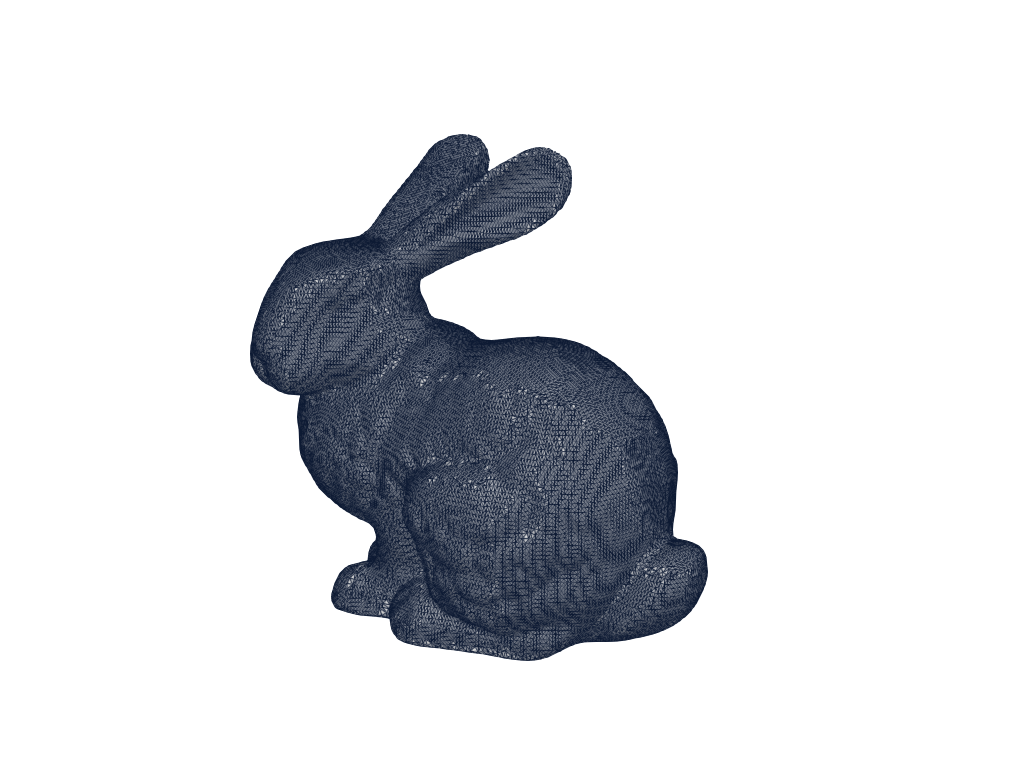
Bunny remesh — visual reference
Input bunny (Stanford fixture, 69451 facets, mixed-scale tessellation typical of scanned data):
After 3 iterations of remeshing at target_length = 0.05:
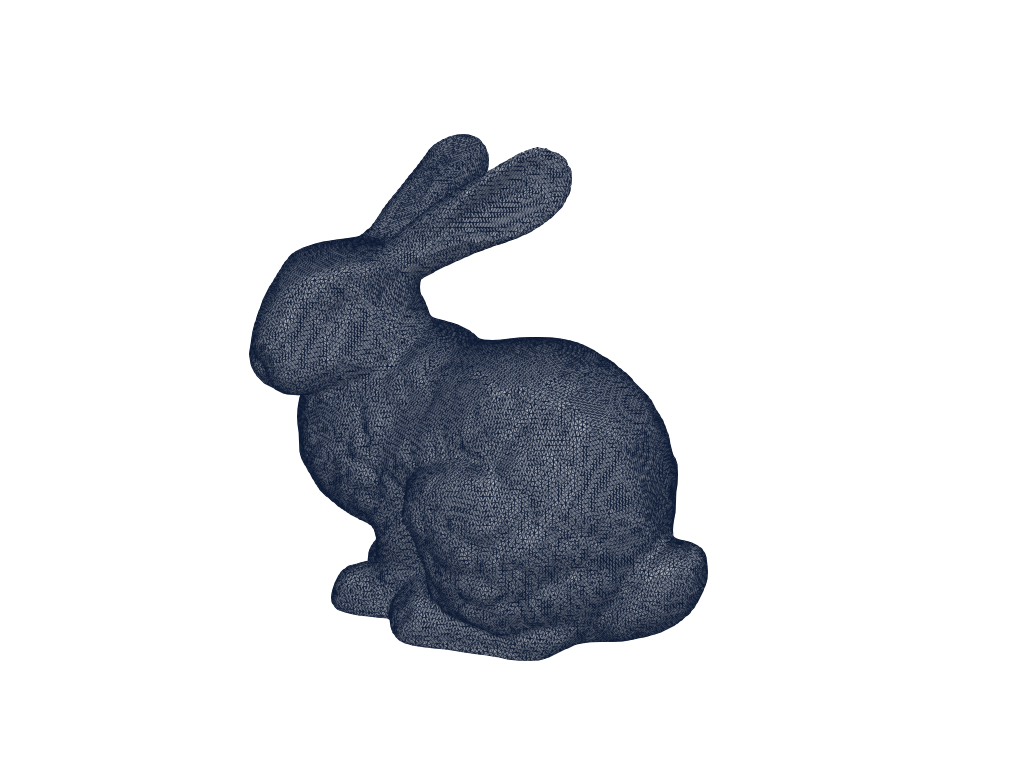
The silhouette is preserved; the per-facet edge-length distribution tightens substantially (median unchanged, stddev drops by >5×). Facet count is roughly preserved (69451 → 69259) — remeshing isn't decimation, it just redistributes triangles.
Known limitations
- Inward Laplacian bias on convex regions. The area-weighted Laplacian centroid of a vertex's one-ring sits inside the surface by ~
r · (1 - cos θ)per relax step on a region of radiusrwith half-apertureθ. The projection step after relaxation pulls the vertex back toward the input surface but doesn't fully compensate. Net effect: a sphere loses ~5% volume per outer iteration even with projection enabled. For convex inputs where preservation matters, run fewer iterations (2-3) or use thetarget_lengthparameter conservatively. Tighter preservation requires normal-direction projection or scaled-step heuristics; deferred to a future refinement. - Feature preservation uses a hard 30° dihedral cutoff. Edges below the threshold get smoothed even if they were intended as features (subtle creases on a fillet). The cutoff isn't user-tunable in the current API; if your input has sub-30° features that must survive, pre-sharpen them by inserting a tiny fillet before remeshing.
target_lengthis a guideline, not a contract. The split (> 4L/3) and collapse (< 4L/5) thresholds let edges in[0.8L, 1.33L]survive untouched. Ratio fixed in the literature; not a parameter.- Connectivity is rebuilt every pass, not incrementally maintained. Per-pass cost is
O(N log N)instead ofO(δ_changed). Acceptable for typical inputs; a 70k-facet remesh runs in ~1 s. For million- facet meshes consider running fewer iterations. - Volume drift compounds across iterations. A sphere remeshed for 10 iterations loses ~40% volume — verifiable via
surface%get_volume()before and after. The current MVP-grade implementation should not be used for volume-critical pipelines without an explicit post-remesh volume-restoration pass.
See also
decimate(facet count reduction; complementary primitive).statistics— print edge-length distribution before and after to verify the remesh worked.- The §1.7 implementation issue has the full multi-commit history and design notes (rectangular vs. packed connectivity, the heap-corruption pivot, the relax-bias diagnosis).
References
- Botsch & Kobbelt, A Remeshing Approach to Multiresolution Modeling, Symposium on Geometry Processing 2004. The four-pass pipeline.
- Botsch et al., Polygon Mesh Processing, AK Peters 2010, Chapter 6. Textbook treatment with implementation guidance.
- Alliez, Cohen-Steiner, Devillers, Lévy, & Desbrun, Anisotropic Polygonal Remeshing, SIGGRAPH 2003. The anisotropic generalization (out of FOSSIL scope; for surfaces with directional feature preservation requirements).