
Finite-difference wall closure
What it does
A high-order finite-difference solver on a Cartesian or rectilinear block treats an immersed wall with a sharp closure: image points, inverse Lax–Wendroff along grid lines, wall models. Every one of these closures starts from the same set: the ghost points, the solid points that a fluid point's stencil reaches. FOSSIL finds them from the geometry alone, on the solver's own point lines, with the exact inside/outside decisions of the cut cells, on the CPU or on the device.
| Query | 3-D (surface_stl_object) | 2-D (curve_object) |
|---|---|---|
| Ghost points of a block: indexes, coordinates, direction masks, steps to the fluid | ghost_points_3d(surface, x, y, z, reach, gp) | ghost_points_2d(curve, x, y, reach, gp) |
| The same on the device, bit for bit | ghost_points_3d(..., device=.true.) | ghost_points_2d(..., device=.true.) |
| Wall curvature at the feet: principal curvatures and directions (2-D: curvature, tangent), CPU or device | build_curvature, query_many(_device)(principal_curvatures=, principal_directions=), normal_curvature | same |
| The closure table in one call: ghosts, wall data, probes, curvature, wall velocity, ILW crossings | fd_closure_3d(surface, x, y, z, reach, table) | fd_closure_2d(curve, x, y, reach, table) |
| The same on the device, bit for bit, or left resident there | fd_closure_3d(..., device=.true.), resident=.true. | same |
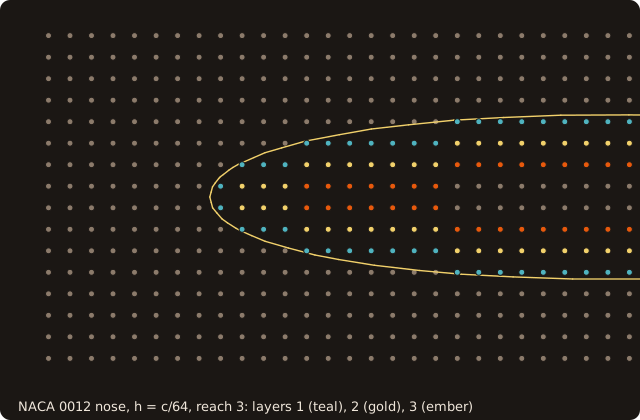
With a stencil half-width of 3 (the seven-point stencil of a sixth-order scheme) every solid point within three steps of the fluid along a grid line is a ghost: three layers along the wall, 304 of the 1280 cell centres around the section. The layers come from the steps to the first fluid point that every ghost carries:
$ fig_ref_fd_closure
NACA 0012, reach 3: ghosts 304, layers 122, 104, 78
unit square on its lines: solid points 16, ghosts (reach 1) 12
circle, reach 1: ghosts on node lines 16, on cell-centre lines 16
sphere, reach 2: ghosts 1788, lower half: layer 1 461, layer 2 381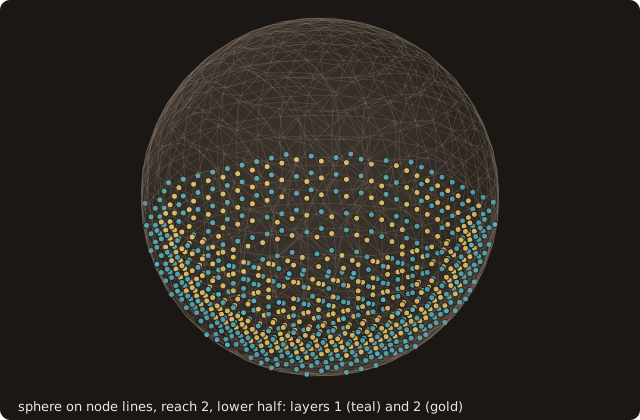
In 3-D the calls are the same with a third line z(:): on a sphere of radius 0.5 and node spacing 0.05, 1788 of the 15 625 points are ghosts for a half-width of 2, in two shells.
The wall curvature at the foot of each ghost point, for the curvature condition of a slip wall, comes from the principal curvatures and directions of the wall (Wall curvature). One call gathers everything per ghost point into the closure table of roadmap #109 (The closure table): foot point, normal, probes along the normal with their visibility and their cells, curvature, wall velocity and the grid-line crossings of inverse Lax–Wendroff, on the CPU or resident on the device. FOSSIL gives the geometry; the solver picks the closure and interpolates its own flow.
Definitions
- Point lines. The solver passes its point coordinates per axis,
x(:),y(:)and in 3-Dz(:): cell centres or nodes, uniform or stretched, strictly increasing, at least two per axis. The points are the tensor product. - Solid point. A point inside the body by the exact node states of the cut cells (next section).
- Reach.
reach(a) >= 1, the stencil half-width along axis a: the number of ghost layers the scheme needs. - Ghost point. A solid point with a fluid point within
reach(a)steps along the grid line of axis a through it, in either direction, inside the block. Solid points that are not ghosts are not listed. - Direction mask. Per ghost, a bit per direction: bit 2(a − 1) when the −a side sees fluid within reach, bit 2a − 1 for the +a side. The named constants are
GHOST_XM,GHOST_XP,GHOST_YM,GHOST_YP,GHOST_ZM,GHOST_ZP(1, 2, 4, 8, 16, 32); in 2-D x, y are the curve's (u, v). - Steps. Per ghost and direction,
steps(2a − 1, g)for −a andsteps(2a, g)for +a: the steps to the first fluid point that way, 1 .. reach(a), or 0 when there is none within reach. An inverse Lax–Wendroff closure reads the grid lines with a nonzero entry; the smallest nonzero entry is the ghost's layer. - Order. The ghosts are listed in lexicographic order of their indexes, i fastest:
gp%ijk(:, g),gp%points(:, g),gp%mask(g),gp%steps(:, g).
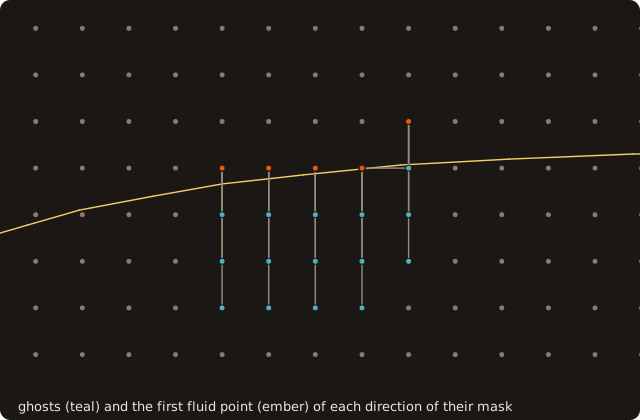
The ghosts of the upper side near x = −0.1 all see the fluid in +v, at 1, 2 or 3 steps. A ghost near the nose also sees it in −u, and its mask has both bits.
The low-side rule
The inside flags are the exact perturbed node states of the cut cells (issues #69 and #70): the point (x_i, y_j, z_k) is taken at (x_i + ε₁, y_j + ε₂, z_k + ε₃), and its flag is the parity of the exact crossings of its grid line before it (3-D: the z line, cut_cells_3d_nodes; 2-D: the row, node_flags). No tolerance enters, so a point exactly on the wall still gets one answer: the side the perturbation pushes it to. This is the rule of the cut cells, whose cells are (x_i, x_{i+1}]: a wall on the plane x = x_i bounds the cells above it, and the point x_i belongs with them.
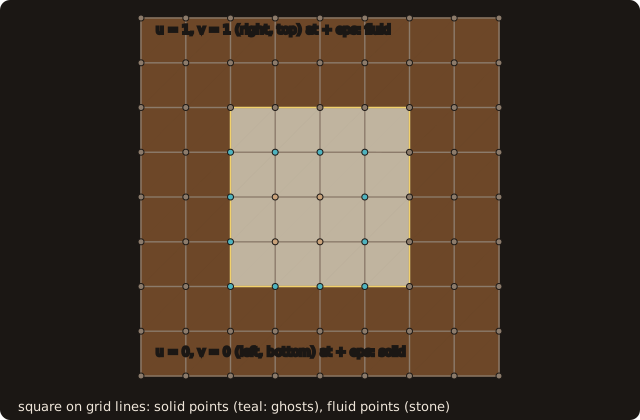
On lines through the sides of the unit square, the points on u = 0 and v = 0 are solid and the points on u = 1 and v = 1 fluid: 16 solid points, {0, 1/4, 1/2, 3/4}², of which the 12 on the border of that block are ghosts for a reach of 1. The cut cells see the same square: the cells (−1/4, 0] are fluid, the cells (3/4, 1] solid. When the solver's points are the nodes of its cut-cell grid, the flags are the cut's node_in bit for bit, so the ghost points, the cut cells and the device agree on every point, ties included.
The solver's own point lines
A finite-difference solver stores its unknowns at cell centres or at nodes, and its stencil runs along the lines of those points. The ghost set depends on that choice, so FOSSIL takes the points from the solver instead of deriving them from a cut-cell grid.
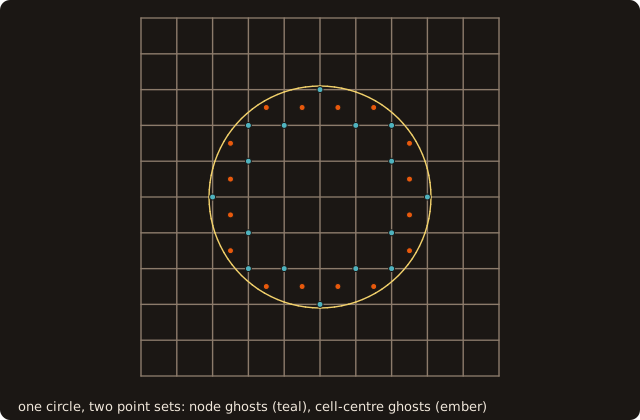
The same circle on node lines and on cell-centre lines of the same spacing gives 16 ghosts each for a reach of 1, at different places: a solver that reads the ghosts of the wrong lattice reads values at points it does not store.
Wall curvature
A slip wall carries no shear stress. With the velocity tangent to the wall (v·n = 0) and n the normal into the fluid, the tangential traction of a Newtonian fluid vanishes when
S the wall's shape operator (its Weingarten map: ∇_t n = S t). The term comes from ∇vᵀ n: along the wall v·n stays 0, so (∂_t v)·n = −v·∂_t n. In 2-D, or along a principal direction, it reads ∂ₙv_t = κ v_t: v_t / R on a circle of radius R, positive on a convex wall seen from the fluid. A rigid rotation satisfies it exactly, a flat-wall closure (∂ₙv_t = 0) does not.
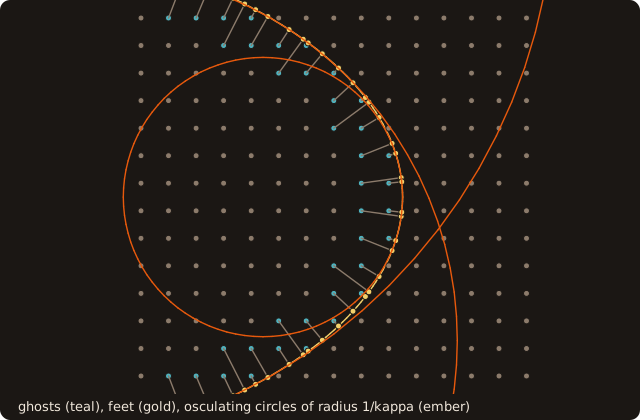
FOSSIL returns S at the foot of each ghost point as its principal curvatures and directions (k₁ ≥ k₂, d₁, d₂; see principal curvatures and directions), and in 2-D the curvature and the tangent. build_curvature stores them per vertex once per geometry (before enter_device for the device); query_many or query_many_device with principal_curvatures= and principal_directions= evaluates them at the feet, normal_curvature(k, d, t) gives κₙ = k₁ (t·d₁)² + k₂ (t·d₂)² along a tangent t. The solver applies the condition in the closure it uses: an image-point closure that extrapolates along the normal line through the foot, v_t(η) = v_t(0) (1 + κ η) + O(η²) (η the signed distance, positive in the fluid), sets each component along a principal direction from the image I to the ghost G as
with η_G < 0 and η_I > 0 the signed distances query_many returns; an inverse Lax–Wendroff closure uses ∂ₙv_t = S v_t as the boundary value of the normal derivative.
call ellipse%build_curvature                                      ! the vertex curvatures, once per geometry
call ghost_points_2d(ellipse, xc, yc, [2_I4P, 2_I4P], gp)         ! the ghost points of a stencil of half-width 2
allocate(d(gp%n), foot(2, gp%n), nrm(2, gp%n), kap(1, gp%n), dirs(2, 1, gp%n))
call ellipse%query_many(points=gp%points, distances=d, closest_points=foot, normals=nrm, principal_curvatures=kap, &
principal_directions=dirs) ! kap(1, g): the wall curvature at the foot of ghost gcall spheroid%build_curvature ! before enter_device: mapped with the surface
call spheroid%query_many(points=q, distances=d, closest_points=foot, principal_curvatures=kap, principal_directions=dirs)
do i = 1, gp%n
vt = [-foot(2, i), foot(1, i), 0._R8P] ! the wall velocity of a spin about z, Omega = 1
if (norm2(vt) > 0._R8P) kn = normal_curvature(kap(:, i), dirs(:, :, i), vt) ! then d_n v_t = kn v_t along v_t
enddo$ fig_ref_fd_closure_curvature
ellipse: ghosts 172, curvature at the feet from 1.251 to 9.860, max relative error 4.33E-04
osculating circle at the foot 0.3994 0.0110: radius 0.1014
osculating circle at the foot 0.3315 0.1119: radius 0.2701
osculating circle at the foot 0.2768 -0.1444: radius 0.4102
spheroid: facets 20480, ghosts 1340, max relative error of kappa_n along v_t 1.76E-03
device = host bit for bit: T- 2-D. At the feet of the 172 ghosts of the ellipse the curvature runs from 1.25 on the flanks to 9.86 at the ends (exact 1.25 and 10), within 4.3·10⁻⁴ of the exact value at each foot.
- 3-D. A spheroid of semi-axes 0.5, 0.5, 0.3 spinning about its axis: v = Ω × x is rigid, so stress-free, and along the parallels ∂ₙv_t / v_t = n_ρ / ρ (n_ρ the radial part of the normal, ρ the distance from the axis). At the feet of its 1340 ghost points
normal_curvaturealong v_t gives it within 0.18 %; the device query returns the same bits. - The spheroid is a unit icosphere of 5 subdivisions scaled, so its vertices lie on it: the jet fit wants vertices on the surface (a marching-cubes mesh of it gave 17 %: see the curvature limitations).
The closure table
fd_closure_3d(surface, x, y, z, reach, table) and fd_closure_2d(curve, x, y, reach, table) find the ghost points of the lines (as ghost_points_3d / _2d) and fill an ib_closure_t with, per ghost g:
| Field | Shape | Meaning |
|---|---|---|
ijk, points, mask, steps | [d, n], [d, n], [n], [2d, n] | The ghost, as in ghost_points_t |
distance | [n] | Signed distance to the wall, negative inside |
foot, normal | [d, n] | Closest point; pseudo-normal of the closest feature, outward (into the fluid) |
element, feature, body, patch | [n] | Closest facet (2-D segment, by its first vertex); 3-D FEATURE_FACE / _EDGE / _VERTEX, 2-D the closest vertex (0 inside a segment); body; patch |
lengths, probe, visible, probe_cell | [m], [d, m, n], [m, n], [d, m, n] | Probe k at foot + lengths(k) normal; the open segment foot–probe crosses no element; the enclosing cell per axis |
kappa, direction | [d-1, n], [d, d-1, n] | Principal curvatures and directions at the foot (2-D: curvature and tangent), when build_curvature ran |
velocity | [d, n] | Rigid wall velocity at the foot, when velocities are given |
ilw_t, ilw_element, ilw_normal, ilw_kappa, ilw_direction | [2d, n], ... | Per direction slot, the crossing of the grid line with the wall (ILW crossings) |
d is 3 or 2 (table%dims), m the number of probes (table%m). Arrays not asked for are allocated with a zero last extent, so a table always has every component.
- Probe lengths are absolute and signed (positive outward, along the normal from the foot), the same m lengths for every ghost: an image line of spacing l is
lengths = [l, 2 l, 3 l]. The mirror image of a ghost is at length −distance, ghost by ghost:2 foot − point. - Enclosing cell by the low-side rule on the solver's own lines: x(i) < p ≤ x(i+1) gives i; a probe outside the block, or on its first line, gives 0. The solver interpolates there with its own stencil; FOSSIL gives no weights.
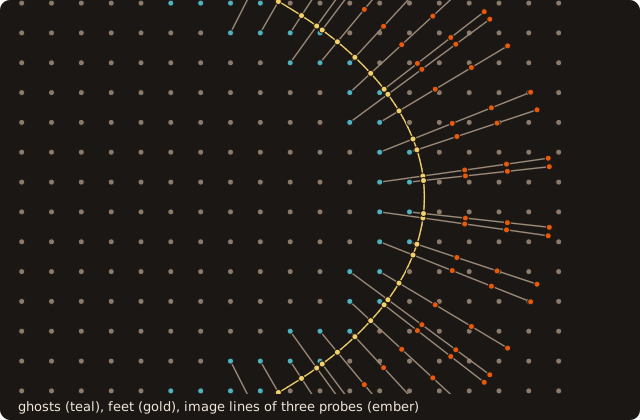
call ellipse%build_curvature                                      ! the wall curvature, once per geometry
h = 0.02_R8P
xc = [(-0.5_R8P + (i - 0.5_R8P) * h, i = 1, 50)] ; yc = [(-0.3_R8P + (j - 0.5_R8P) * h, j = 1, 30)]
pose = pose_2d(0.3_R8P, [0.05_R8P, 0._R8P])                       ! the body at its pose: turned, moved
call fd_closure_2d(ellipse, xc, yc, [2_I4P, 2_I4P], table, pose=pose, &
                   lengths=[(k * sqrt(2._R8P) * h, k = 1, 3)], &  ! an image line: 3 samples along the normal
                   linear_velocity=[0.5_R8P, 0._R8P], angular_velocity=2._R8P, & ! v = V + omega x (foot - c)
                   ilw=.true.)                                    ! the grid-line crossings of inverse Lax-Wendroff
print '(A,I0,A,I0,A,I0,A,I0)', 'ellipse: ghosts ', table%n, ', probes ', table%n * table%m, ', visible ', &
      count(table%visible), ', ILW crossings ', count(table%ilw_element > 0)
g = 1
print '(A,2I3,A,F9.5,A,2F9.5,A,2F8.4)', 'ghost 1: ij', table%ijk(:, g), '  distance', table%distance(g), &
      '  foot', table%foot(:, g), '  normal', table%normal(:, g)
print '(A,F8.4,A,2F8.4,A,3(2I3,:,","))', '  curvature', table%kappa(1, g), '  velocity', table%velocity(:, g), &
      '  probe cells', table%probe_cell(:, :, g)
do d = 1, 4                                                       ! its ILW slots: -u, +u, -v, +v
   if (table%ilw_element(d, g) > 0) print '(A,I0,A,F9.5,A,I0,A,2F8.4)', '  ILW slot ', d, ': crossing at ', &
      table%ilw_t(d, g), ' on segment ', table%ilw_element(d, g), ', normal', table%ilw_normal(:, d, g)
enddo
call ellipse%enter_device
call fd_closure_2d(ellipse, xc, yc, [2_I4P, 2_I4P], twin, pose=pose, lengths=[(k * sqrt(2._R8P) * h, k = 1, 3)], &
                   linear_velocity=[0.5_R8P, 0._R8P], angular_velocity=2._R8P, ilw=.true., device=.true.)
print '(A,I0)', 'device path vs host path: mismatches ', ib_closure_mismatches(table, twin)
call ellipse%exit_device
$ ref_fd_closure_table
ellipse: ghosts 168, probes 504, visible 504, ILW crossings 244
ghost 1: ij 15 5 distance -0.00198 foot -0.21049 -0.21192 normal -0.2481 -0.9687
curvature 3.1059 velocity 0.9238 -0.5210 probe cells 14 3, 14 2, 13 0
ILW slot 1: crossing at -0.21749 on segment 242, normal -0.2763 -0.9611
ILW slot 3: crossing at -0.21204 on segment 244, normal -0.2481 -0.9687
device path vs host path: mismatches 0
sphere: ghosts 1788, resident T
ILW crossings 3660, mismatches against the host path 0- The ellipse, turned by 0.3 rad and spinning at its pose, has 168 ghosts for a half-width of 2; all 504 probes of spacing √2 h are visible from their feet (a convex body).
- The third probe of the first ghost lies below the block (−0.3): its v cell is 0.
- The device path returns the same table (
ib_closure_mismatchescounts every differing entry, reals by bits).
ILW crossings
An inverse Lax–Wendroff closure works along the grid lines: it needs, for each ghost and each direction that reaches the fluid, the point where that grid line leaves the solid. With ilw=.true. every direction slot whose steps is s > 0 gets the crossing of the grid line with the wall between the last solid point (s − 1 steps away) and the first fluid point (s steps): ilw_t its coordinate along the axis, ilw_element the facet or segment, ilw_normal the pseudo-normal of the crossing point (a closest-point query of it) and, with the curvature built, ilw_kappa and ilw_direction there. Slots without a crossing hold zeros and element 0.
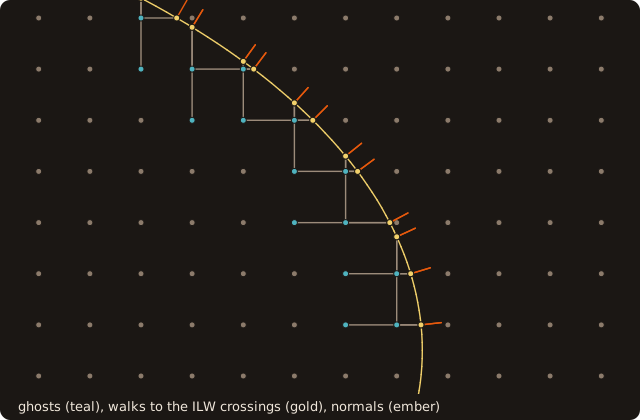
The crossings are the cut cells' own: the exact crossings of the line (line_crossings, its device kernel), placed against the perturbed points with the exact line_crossing_before. The node states being the parities of the same crossings, the segment between a solid and a fluid point holds an odd number of them on a watertight wall; the table takes the one nearest the fluid point (ties by element index). When the solver's points are the nodes of its cut-cell grid, the crossing lies on the cell edge the cut cells cut, and gives its fluid fraction of cut_cells_3d(edges=.true.) bit for bit (fossil_test_fd_closure_3d; 2-D, the apertures of curve%cut_cells).
Wall velocity
A moving body passes its pose (pose=: the body frame is the surface or curve as given) and, for the boundary condition of a no-slip or slip wall, its rigid velocity: linear_velocity V, angular_velocity ω and the centre c (default: the pose's translation, the body origin in the world; the world origin without a pose). At every foot
the exact velocity field of the rigid motion at that instant (in 2-D ω is a scalar, ω × r = ω (−r_v, r_u)).
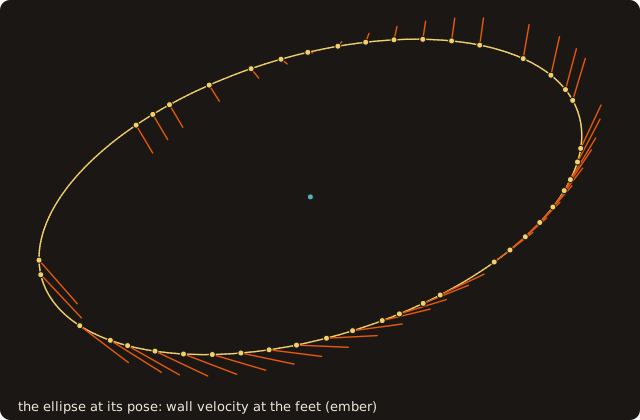
With a pose the ghosts and the ILW crossings are those of the body moved by the pose (the geometry the cut cells of the moved body see), and every query (foot, normal, probes, visibility, curvature, the ILW normals) runs in the body frame and is mapped back, as query_many(pose=). The surface is not moved: in 3-D the call places the facet vertices by to_world and refits a copy of the surface's SAH BVH to them, as move places and refits (on the device path both are built on the device, nothing is copied in); min and max are exact, so the node states and crossings are those of a moved copy bit for bit (fossil_test_fd_closure_3d). In 2-D the vertices are placed by to_world, as curve%move places them. A pure rotation about the centre is tangent to the wall up to the facet's tilt from the smooth normal (fossil_test_fd_closure_3d, _2d).
Resident use on the device
A GPU solver keeps its flow on the device; the table should stay there too. With device=.true. (the surface or curve mapped by enter_device, after build_curvature if it is built) every stage runs on the device in one pipeline: the node states, the ghost count, scan and fill, the body-frame points, the closest-point queries, the wall data, the probes and their visibility, the curvature, the ILW crossings and their queries. Nothing goes back to the host between the stages. With resident=.true. the table is left mapped (table%on_device): a device solver reads its arrays with present, through pointer aliases of the members.
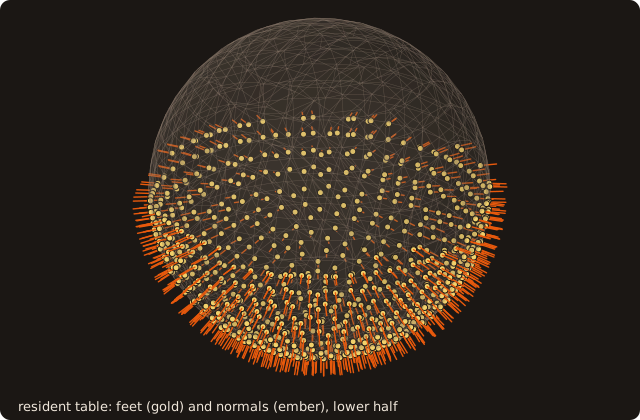
call sphere%enter_device                                          ! the surface on the device, once
call fd_closure_3d(sphere, xn, xn, xn, [2_I4P, 2_I4P, 2_I4P], table, lengths=[0.05_R8P, 0.1_R8P], ilw=.true., &
                   resident=.true.)                               ! the table stays on the device
print '(A,I0,A,L1)', 'sphere: ghosts ', table%n, ', resident ', table%on_device
call table%update_host                                            ! (a device solver would read it there)
call fd_closure_3d(sphere, xn, xn, xn, [2_I4P, 2_I4P, 2_I4P], twin, lengths=[0.05_R8P, 0.1_R8P], ilw=.true.)
print '(A,I0,A,I0)', '  ILW crossings ', count(table%ilw_element > 0), ', mismatches against the host path ', &
      ib_closure_mismatches(table, twin)
call ib_closure_reset(table)                                      ! releases the device copies
call sphere%exit_device
The resident pattern is the cut cells': update_host copies the table back (the arrays stay mapped), exit_device releases the device copies, enter_device maps a host table; ib_closure_reset releases and resets. Every call that writes a table takes it intent(inout) and releases it first. A copy b = a of a resident table is not mapped: device_key (the host address of points) tells, and update_host on the copy warns and drops the flag. Call exit_device (or ib_closure_reset) before a resident table goes out of scope.
How long a table takes (FOSSIL_CLOSURE_TIMING=N fossil_test_distance_bench, fossil_test_curve_bench; reach 3, three probes, curvature, ILW; best of 5 after a warm-up, each path timed in a row; nvfortran 26.9 -O2 -gpu=nofma, one RTX 4070 that no other job was using, one core of an i9-13900KF; indicative, one machine):
| Body, lines | Ghosts | CPU [s] | Device, copied back [s] | Device, resident [s] |
|---|---|---|---|---|
| dragon-fine (24k facets), 16³ | 535 | 0.026 | 0.030 (0.9×) | 0.027 (1.0×) |
| dragon-fine, 32³ | 3 969 | 0.142 | 0.034 (4.1×) | 0.034 (4.2×) |
| dragon-fine, 64³ | 23 039 | 0.645 | 0.072 (9.0×) | 0.069 (9.4×) |
| dragon-fine, 128³ | 112 001 | 2.56 | 0.217 (11.8×) | 0.184 (13.9×) |
| bunny, 128³ | 93 594 | 1.79 | 0.143 (12.5×) | 0.115 (15.6×) |
| NACA 0012 (2000 vertices), 1024² | 3 112 | 0.016 | 0.0061 (2.6×) | 0.0056 (2.8×) |
| disc with a hole (1100 vertices), 1024² | 7 524 | 0.035 | 0.0046 (7.6×) | 0.0039 (8.9×) |
In 3-D the resident call is bound by its kernels: at 128³ the probes and their visibility take 39 % of it, the two closest-point queries (ghosts and ILW crossings) 28 %, the ILW crossings 23 % and the node states 9 % (Nsight Systems); everything else, the refitted tree of a posed body included, under 1 % (a posed call costs 0-7 % more, with other ghosts). These are double-precision traversals with exact predicates, and the RTX 4070 runs FP64 at 1/64 of its FP32 rate (data-centre GPUs at 1/2). Copying the table back (122 MB at 128³) adds about 30 ms. At 16³ the GPU is not faster: 535 ghosts give too few threads, and each one walks the tree alone. In 2-D the kernels take under 1 ms of a 1024² call; the rest is host work and transfer latency, so the device wins from 256² lines (the disc, 2.6×) and is slower at 64².
Several bodies
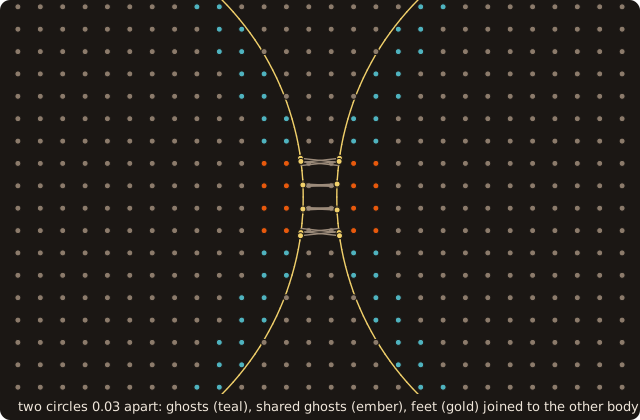
Two bodies in one block share its points: a ghost of one may sit in a gap narrower than the stencil, an image line may enter the other body, and moving bodies may touch or interpenetrate. fd_closure_3d_bodies(surfaces, x, y, z, reach, table) and fd_closure_2d_bodies(curves, x, y, reach, table) build one table for an array of bodies, body b at poses(b) with its own rigid velocity: linear_velocities(:, b), angular_velocities(:, b) (2-D the scalar angular_velocities(b)) and centres(:, b). The rule:
- Solid is inside any body. The node states of every body are computed exactly, as for one body, and a point is solid if one of them says so; the ghosts are those of the union.
- The owner is the nearest wall. Every body is queried at every ghost; the owner is the body of least |signed distance|, ties to the lower index. Its foot, normal, element, feature, patch, curvature, velocity and probes fill the table. For bodies that do not overlap, a ghost inside body A is nearer A's wall than any other wall, so the owner is the body it lies in.
body(g)is the index of the owner in the array,sub_body(g)itsfacet_body(a surface or curve holding several shells keeps them). - ILW crossings come from every body. Per slot, of the crossings of every body between the slot's two points, the one nearest the fluid point (
ilw_bodysays whose; ties to the lower index): in a gap narrower than h the last solid point of a walk can lie in another body than the ghost. - Visibility is against every body. A probe is visible when the segment foot–probe crosses no element of the owner (as for one body) and no element of any other body.
- Clearance, and shared ghosts.
clearance(g)is the unsigned distance from the owner's foot to the nearest other body (second_body,second_foot: its closest point); huge without one. A ghost issharedwhen its clearance is belowshared_distance(default: the largest reach(a) times the largest spacing along axis a): one stencil there sees two walls. FOSSIL reports it and decides nothing: the solver chooses a one-sided closure, a shorter image line, a merged condition. - Overlap is reported, not refused.
overlap(g)flags a ghost inside two or more bodies;overlap_pointscounts every point inside two or more. Its owner is still the nearest wall, which may be buried in the other body.
| Field | Shape | Meaning |
|---|---|---|
body, sub_body | [n] | The owner's index in the array; its facet_body |
clearance, second_body, second_foot | [n], [n], [d, n] | Distance from the foot to the nearest other body, that body, its closest point |
shared, overlap | [n] | clearance < shared_distance; the ghost lies inside two or more bodies |
ilw_body | [2d, n] | The body of the ILW crossing (0: none) |
with_bodies, bodies, shared_distance, overlap_points | scalars | A bodies table; the number of bodies; the threshold used; points inside two or more |
A single-body table has these arrays with a zero last extent. With one body the bodies table is the single-body table bit for bit in every other field, and for bodies farther apart than the stencil every ghost is the single-body table of its body bit for bit (fossil_test_fd_closure_bodies_3d, _2d).
h = 0.02_R8P
xc = [(-0.6_R8P + (i - 0.5_R8P) * h, i = 1, 60)] ; yc = [(-0.3_R8P + (j - 0.5_R8P) * h, j = 1, 30)]
poses = [pose_2d(0._R8P, [-0.265_R8P, 0._R8P]), pose_2d(0._R8P, [0.265_R8P, 0._R8P])] ! a gap of 0.03 = 1.5 h
call fd_closure_2d_bodies(discs, xc, yc, [2_I4P, 2_I4P], table, poses=poses, &
                          lengths=[(k * sqrt(2._R8P) * h, k = 1, 3)], &     ! an image line of 3 probes
                          linear_velocities=reshape([0.1_R8P, 0._R8P, -0.1_R8P, 0._R8P], [2, 2]))
print '(A,I0,A,I0,A,I0)', 'two discs: ghosts ', table%n, ', of body 1 ', count(table%body == 1), ', of body 2 ', &
      count(table%body == 2)
print '(A,F6.3,A,I0,A,F7.4)', '  shared distance ', table%shared_distance, ', shared ghosts ', count(table%shared), &
      ', least clearance ', minval(table%clearance)
call fd_closure_2d(discs(1), xc, yc, [2_I4P, 2_I4P], alone, pose=poses(1), lengths=[(k * sqrt(2._R8P) * h, k = 1, 3)])
print '(A,I0,A,I0)', '  probes blocked: ', count(.not. table%visible), ', disc 1 alone: ', count(.not. alone%visible)
g = minloc(abs(table%points(1, :) + 0.03_R8P) + abs(table%points(2, :) - 0.01_R8P), 1) ! a ghost of the gap
print '(A,2F8.4,A,I0,A,F8.4,A,2F8.4)', 'ghost at', table%points(:, g), ': body ', table%body(g), ', distance', &
      table%distance(g), ', foot', table%foot(:, g)
print '(A,F7.4,A,I0,A,2F8.4,A,L1,A,3L2)', '  clearance', table%clearance(g), ' to body ', table%second_body(g), &
' at', table%second_foot(:, g), ', shared ', table%shared(g), ', visible', table%visible(:, g)places(1) = pose_from_axis_angle([0._R8P, 0._R8P, 1._R8P], 0._R8P, [-0.3_R8P, 0._R8P, 0._R8P])
places(2) = pose_from_axis_angle([0._R8P, 0._R8P, 1._R8P], 0.4_R8P, [0.3_R8P, 0._R8P, 0._R8P]) ! they interpenetrate
call balls(1)%enter_device ; call balls(2)%enter_device ! map the array elements themselves
call fd_closure_3d_bodies(balls, xn, xn, xn, [2_I4P, 2_I4P, 2_I4P], table, poses=places, lengths=[0.05_R8P], &
ilw=.true., device=.true.)
print '(A,I0,A,I0,A,I0)', 'two balls: ghosts ', table%n, ', points inside both ', table%overlap_points, &
', overlapping ghosts ', count(table%overlap)
call fd_closure_3d_bodies(balls, xn, xn, xn, [2_I4P, 2_I4P, 2_I4P], twin, poses=places, lengths=[0.05_R8P], ilw=.true.)
print '(A,I0)', ' device path vs host path: mismatches ', ib_closure_mismatches(table, twin)
call balls(1)%exit_device ; call balls(2)%exit_device$ ref_fd_closure_bodies
two discs: ghosts 264, of body 1 132, of body 2 132
shared distance 0.040, shared ghosts 16, least clearance 0.0305
probes blocked: 56, disc 1 alone: 0
ghost at -0.0300 0.0100: body 1, distance -0.0148, foot -0.0153 0.0107
clearance 0.0305 to body 2 at 0.0152 0.0093, shared T, visible T F F
two balls: ghosts 2946, points inside both 853, overlapping ghosts 106
device path vs host path: mismatches 0- The two discs, 0.03 = 1.5 h apart, have 132 ghosts each. The default shared distance is 2 h = 0.04: the 16 ghosts whose feet face the gap see the other disc within it (least clearance 0.0305: the gap plus the sag of the polygons).
- 56 probes enter the other disc and are not visible; disc 1 alone has none blocked (a convex body).
- The ghost at (−0.03, 0.01) belongs to disc 1: its clearance to disc 2 is 0.0305, so its first probe (√2 h) stays in the gap and the next two cross the other wall.
- The two balls interpenetrate: 853 points lie inside both, 106 of them are ghosts (near the circle where the spheres meet), and the device path returns the same table.
The device path runs every stage of the single-body pipeline once per body (node states, then, at the union's ghosts, queries, wall data, probes, curvature, ILW crossings), each into a work table, and merges them in body order: the merges are copies and comparisons, the same kernels on both paths, so host and device agree bit for bit. The clearance is one query of the owners' feet per other body, the visibility one segment test per probe and other body. A body costs about one single-body table at the union's ghosts. The surfaces (curves) of the array are mapped themselves: a copy of a mapped surface is not mapped, so map the array's elements (call bodies(b)%enter_device), not the originals.
Validation. The validation program fossil_val_bodies (a geometry study, no flow solve; about 4 s at -O2, 0.1 GB) checks the rule on bodies far apart and across narrow gaps.
- Locality. An icosphere and an ellipsoid (3-D, h = 0.1), a NACA 0012 and an ellipse (2-D, h = 0.01), each at three pose pairs with their own rigid velocities, curvature, two probes and ILW crossings, farther apart than 2 × reach × h (least clearance 3.0–4.8 and 8.4–10.4 reach h): every ghost of the bodies table equals the ghost of its body's single-body table, field by field, bit for bit, and the ghosts are the union of the two (3-D 2 662–2 703 ghosts, 2-D 600–615; 0 mismatches).
- Narrow gap. Two spheres of radius 1 (5 120 facets, h = 0.1) and two circles of radius 0.5 (1 024 segments, h = 0.02) at gaps δ = 0.25 … 4 h, reach 2 (shared distance 2 h), probes h, 2 h, 3 h. The analytic clearance of a ghost is the distance from its foot f to the true other sphere, |f − c_B| − R. The other body is inscribed in its sphere and contains the ball of radius R − s_B (s_B its sag), so the clearance lies in [analytic, analytic + s_B], the shared ghosts number between the analytic counts N(d < sd − s_B) and N(d < sd), and a probe is blocked if its segment meets the ball R − s_B and visible if it misses the ball R.
| gap / h | 3-D shared | N(d < sd − s_B), N(d < sd) | blocked probes | [N(meet R − s_B), N(meet R)] | 2-D shared | N brackets | blocked | brackets |
|---|---|---|---|---|---|---|---|---|
| 0.25 | 130 | 130, 131 | 223 | 222, 223 | 26 | 26, 26 | 66 | 66, 66 |
| 0.5 | 128 | 128, 129 | 234 | 234, 234 | 28 | 28, 28 | 68 | 68, 68 |
| 1 | 112 | 112, 112 | 200 | 200, 202 | 40 | 40, 40 | 86 | 86, 86 |
| 2 | 0 | 0, 0 | 68 | 68, 69 | 0 | 0, 0 | 36 | 36, 36 |
| 4 | 0 | 0, 0 | 0 | 0, 0 | 0 | 0, 0 | 0 | 0, 0 |
The clearance minus the analytic one stays in [1.1·10⁻⁷, 1.13·10⁻³] in 3-D (s_B = 1.14·10⁻³) and [1.5·10⁻¹³, 2.35·10⁻⁶] in 2-D (s_B = 2.35·10⁻⁶); every shared flag agrees with its bracket, and no probe contradicts its own. The least clearance is never below the gap (the feet lie in their own ball); it exceeds it by 0.04–0.09 h in 3-D, and in 2-D by 0.004 h down to δ = h but by 0.11–0.22 h below: a throat narrower than h holds no fluid point, so the points next to it have none within reach along the axes and are not ghosts.
Pass criteria (Are all tests passed? T iff all hold): 0 ghost mismatches and the ghost count the sum of the single-body ones at every pose pair; the shared count within the analytic bracket with every ghost consistent, the clearance error in [−10⁻¹³, s_B + 10⁻¹³], the least clearance at least δ − 10⁻¹³, no probe against its bracket; every call STATUS_OK. The same program checks the load samples and the cut-cell loads of several bodies (surface loads).
How a solver uses the table
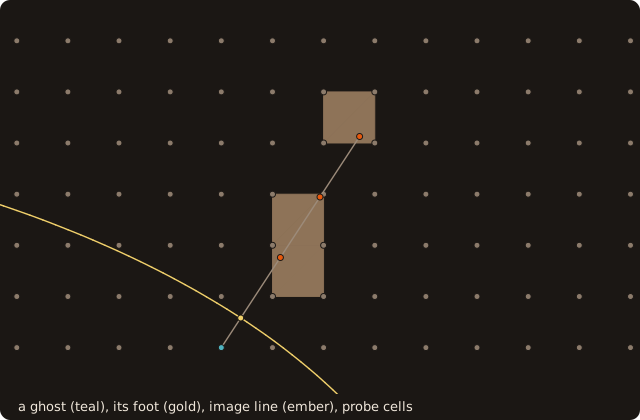
Image-line closure (Funada & Imamura 2023; Chaudhuri 2011). Ask for the m probes of an image line (lengths = [l, 2 l, ...]); the solver interpolates its flow at each probe in probe_cell, imposes the wall value at the foot (velocity for the no-slip condition) and extrapolates along the normal to the ghost at distance (< 0). A probe that is not visible lies behind another part of the wall: shorten the line or switch the closure there. Two samples per ray (wall-modelled LES, van Noordt 2022) are the same table with m = 2.
ILW closure and the curvature condition (Tan & Shu 2010; Liu 2025). ilw_t gives the wall point on each grid line through the ghost, ilw_normal the normal there: the solver converts the normal derivatives of its boundary condition to derivatives along that line. A slip wall adds the curvature condition ∂ₙv_t = S v_t (Wall curvature): ilw_kappa and ilw_direction give S at the crossing, kappa and direction at the foot.
Wall fields. A wall value that varies along the wall (a temperature or a deformation per vertex, a value per facet) is read at the feet and the ILW crossings by transfer_to_closure: Surface loads.
First step: an eikonal extension fed by exact geometry. A solver that extends its fluid values into the solid by an eikonal equation along the normal needs the signed distance and the normal at the ghosts: distance and normal (or foot) replace a level set computed on the grid, with no other change to the solver.
What accuracy to expect
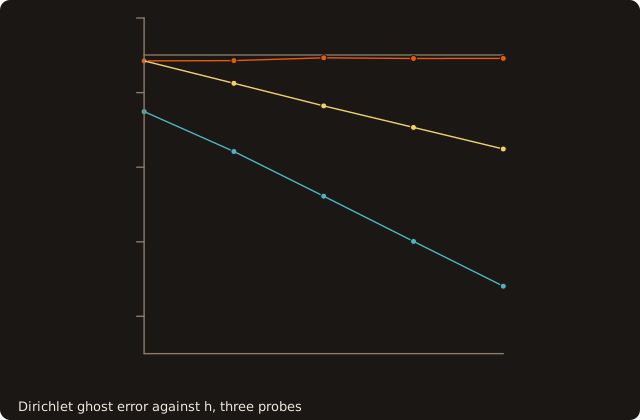
The table is exact for the faceted wall: its foot, normal and distance are those of the planar facets, not of the smooth body they sample. How much accuracy a closure keeps is therefore a question about the facets, answered by the validation program fossil_val_fd_closure (a geometry study, no flow solve). A circle and a sphere of radius R = 0.5 (vertices on them: a regular polygon of N segments, an icosphere) sit on uniform point lines of spacing h (h halved from level to level: R/8 to R/1024 in 2-D, R/4 to R/64 in 3-D), reach 2. At every ghost an image-line closure rebuilds the smooth field u = cos(1.1 x − 0.7 y + 0.3) e^{0.5 x} + sin(0.9 y) (3-D: e^{0.6 z} and sin(0.9 y + 1.2 z)) from m probes at l, 2 l, …, m l (l = √2 h), interpolated from the grid values from their probe_cell (tensor Lagrange on 4 points per axis, 5 for m = 3), and one wall datum at the foot; the polynomial of degree m along the normal is evaluated at the ghost's distance. The wall data are those of the true wall: u (Dirichlet) or ∂ₙu (Neumann, along the table's normal) at the point of the circle or sphere nearest the foot. The error is the largest |u_ghost − u(ghost)| over the ghosts, in three regimes:
- exact geometry: the same ghosts with the foot, normal and distance of the circle or sphere: the closure's own error, of design order m + 1;
- h_s = c h: facets refined with the grid (longest edge h_s about 1.05 h in 2-D, 1.3 h in 3-D);
- h_s frozen: the coarsest of those meshes at every level.
The circle with three probes, five levels (a docs program on other point lines than the validation's, so other ghosts and errors, the same orders), and the loop that builds the ghost values from the table:
do kk = 1, M                                                ! u at the probes: the solver's interpolation
   ui(kk) = interp(probe(:, kk), cell(:, kk))
enddo
wall = field(pw)                                            ! Dirichlet datum of the wall at the foot
call lagrange([0._R8P, t%lengths], [wall, ui], eta, q, l0)  ! along the normal, at the ghost's distance
ed(k, regime) = max(ed(k, regime), abs(q - field(t%points(:, g))))
dwall = dot_product(grad(pw), pw / R)                       ! Neumann datum: d_n u along the closure's normal
q = neumann(t%lengths, ui, dwall, eta)
en(k, regime) = max(en(k, regime), abs(q - field(t%points(:, g))))
$ fig_ref_fd_closure_accuracy
circle R = 0.5, reach 2, image line of 3 probes (l = sqrt(2) h), max |u_ghost - u(ghost)|
Dirichlet Neumann
h exact h_s = c h frozen exact h_s = c h frozen
6.25E-02 3.09E-04 7.08E-03 7.08E-03 1.50E-04 1.42E-02 1.42E-02
3.12E-02 2.63E-05 1.78E-03 7.22E-03 1.47E-05 4.63E-03 1.10E-02
1.56E-02 1.66E-06 4.41E-04 8.58E-03 9.76E-07 1.15E-03 4.60E-03
7.81E-03 1.02E-07 1.17E-04 8.19E-03 5.92E-08 4.06E-04 3.21E-03
3.91E-03 6.41E-09 3.07E-05 8.28E-03 3.76E-09 8.63E-05 1.76E-03
order 3.99 1.92 -0.02 3.97 2.24 0.87
frozen facets: Dirichlet floor 8.28E-03, estimate Lambda |d_n u| s = 1.02E-02 (Lambda 6.01, |d_n u| 1.58, sag s 1.07E-03)The sphere, from the validation (Dirichlet; the observed order of the two finest levels in the last row):
| h | ghosts | exact, m = 1 | m = 2 | m = 3 | h_s = c h, m = 1 | m = 2 | m = 3 | frozen, m = 1 | m = 2 | m = 3 |
|---|---|---|---|---|---|---|---|---|---|---|
| R/4 | 219 | 6.7e-2 | 1.5e-2 | 4.9e-3 | 8.0e-2 | 3.3e-2 | 5.6e-2 | 8.0e-2 | 3.3e-2 | 5.6e-2 |
| R/8 | 1 112 | 1.7e-2 | 2.1e-3 | 3.3e-4 | 2.2e-2 | 1.3e-2 | 2.1e-2 | 4.0e-2 | 5.4e-2 | 7.7e-2 |
| R/16 | 4 892 | 5.0e-3 | 3.5e-4 | 2.1e-5 | 6.0e-3 | 3.2e-3 | 4.9e-3 | 3.4e-2 | 5.2e-2 | 7.3e-2 |
| R/32 | 20 490 | 1.3e-3 | 4.1e-5 | 1.3e-6 | 1.5e-3 | 8.6e-4 | 1.3e-3 | 3.2e-2 | 5.3e-2 | 7.8e-2 |
| R/64 | 83 830 | 3.2e-4 | 5.3e-6 | 8.0e-8 | 4.0e-4 | 2.4e-4 | 3.6e-4 | 3.6e-2 | 5.9e-2 | 8.5e-2 |
| order | 2.03 | 2.96 | 4.03 | 1.96 | 1.85 | 1.83 | −0.14 | −0.15 | −0.13 |
- The closure is exact to its order. With the exact geometry the Dirichlet and Neumann errors fall at orders 2.00–2.03, 2.96–3.02 and 3.97–4.03 for m = 1, 2, 3 (design 2, 3, 4), in 2-D and 3-D: the probes, their cells and the extrapolation along the normal carry no hidden error.
- Planar facets cap the Dirichlet closure at second order. The faceted foot lies inside the true wall by up to the sag s of its facet (h_s²/(8R) for a chord, about h_s²/(6R) for a triangle), so the wall datum is imposed at the wrong place: an error Λ_m |∂ₙu| s at the ghost, Λ_m the weight of the wall datum in the extrapolation (2.4, 4.1, 6.0 for m = 1, 2, 3 at reach 2). With h_s = c h that is O(h²) whatever m (orders 1.83–1.99): m = 2 and 3 converge no faster than m = 1, their error is the facets' (m = 3 above m = 2 by its larger Λ_m, a factor 1.4–1.5), and m = 1 is close to its own truncation error.
- Frozen facets give a floor, not a slower rate. The Dirichlet error stops (orders −0.15 to 0.01) at 0.85–0.89 of the estimate Λ_m |∂ₙu|_max s (2-D: s = 1.07·10⁻³ for N = 48, floors 3.6·10⁻³ to 8.7·10⁻³; 3-D: 320 facets, s = 8.9·10⁻³, floors 3.6·10⁻² to 8.5·10⁻²).
- The Neumann closure degrades more gently. Its datum enters with a weight of order h, so the normal tilt of a facet, O(h_s/R), costs O(h h_s/R): first order with frozen facets (orders 0.98–1.23, no floor), second order with h_s = c h (the max-norm orders scatter from level to level: 1.45–1.64 between R/32 and R/64 in 3-D, 1.85 between R/512 and R/1024 in 2-D).
- What it means for a solver. To keep a Dirichlet closure of order m + 1 the facets must shrink faster than the grid: Λ_m |∂ₙu| h_s²/(8R) below the closure's own error C h^{m+1}, so h_s = O(h^{(m+1)/2}) (h_s ∝ h^{3/2} for order 3, h_s ∝ h² for order 4). On a body of fixed resolution, refining the grid past the point where Λ_m |∂ₙu| s dominates buys nothing.
- Curvature and wall velocity. At the feet of the h_s = c h tables the principal curvatures of the sphere are within 8.4·10⁻², 2.2·10⁻², 5.8·10⁻³, 1.5·10⁻³, 3.7·10⁻⁴ of 1/R (order 2), the circle's 1/R to round-off. The wall velocity of a spinning body at a pose is the rigid field at the faceted foot to the last bit, and differs from the rigid field at the true wall point by at most |ω| s (attained in 2-D).
Example
The NACA 0012 section (the wing cut at z = 0.5, chord from −0.25 to 0.75) on cell-centred lines of spacing chord/64, reach 3; then a sphere on node lines in 3-D, checked against the device path.
call wing%load_from_file(file_name='naca0012-ascii.stl', guess_format=.true.)
call slice_surface(wing, 3_I4P, 0.5_R8P, section)            ! the airfoil in the plane z = 0.5, chord -0.25 .. 0.75
h = 1._R8P / 64._R8P
xc = [(-0.375_R8P + (i - 0.5_R8P) * h, i = 1, 80)]           ! the solver's cell centres
yc = [(-0.125_R8P + (j - 0.5_R8P) * h, j = 1, 16)]
call ghost_points_2d(section, xc, yc, [3_I4P, 3_I4P], gp)    ! reach 3: three ghost layers
print '(A,I0,A,I0,A,I0)', 'cell centres ', size(xc) * size(yc), ', ghost points ', gp%n, ', reach ', gp%reach(1)
print '(A,I0,A,I0)', '  seeing fluid below (-v) ', count(iand(gp%mask, GHOST_YM) /= 0), &
                     ', above (+v) ', count(iand(gp%mask, GHOST_YP) /= 0)
layer = 0
do g = 1, gp%n                                               ! the layer: steps to the nearest fluid point
   k = minval(gp%steps(:, g), mask=gp%steps(:, g) > 0) ; layer(k) = layer(k) + 1
enddo
print '(A,3(I0,:,", "))', '  layers 1, 2, 3: ', layer
g = 1
print '(A,2I4,A,2F9.5,A,B4.4,A,4I2)', 'ghost 1: ij', gp%ijk(:, g), '  point', gp%points(:, g), '  mask ', gp%mask(g), &
' steps', gp%steps(:, g)do k = 1, 33 ; do j = 1, 33 ; do i = 1, 33 ! a sphere of radius 0.5 by marching cubes
f(i, j, k) = norm2([i - 17._R8P, j - 17._R8P, k - 17._R8P] / 16._R8P) - 0.5_R8P
enddo ; enddo ; enddo
call extract_isosurface(values=f, bmin=vector_R8P(-1._R8P, -1._R8P, -1._R8P), bmax=vector_R8P(1._R8P, 1._R8P, 1._R8P), &
iso=0._R8P, surface=facets)
call sphere%adopt_facets(facets=facets)
xn = [(-0.6_R8P + 0.05_R8P * i, i = 0, 24)] ! node lines, the sphere's poles on them
call ghost_points_3d(sphere, xn, xn, xn, [2_I4P, 2_I4P, 2_I4P], gp)
call ghost_points_3d(sphere, xn, xn, xn, [2_I4P, 2_I4P, 2_I4P], gd, device=.true.)
print '(A,I0,A,I0)', 'sphere: points ', size(xn)**3, ', ghost points ', gp%n
print '(A,I0,A,I0)', ' first layer ', count([(any(gp%steps(:, g) == 1), g = 1, gp%n)]), &
', second only ', count([(all(gp%steps(:, g) /= 1), g = 1, gp%n)])
print '(A,L1)', ' device path = host path: ', gd%n == gp%n .and. all(gd%ijk == gp%ijk) .and. &
all(gd%mask == gp%mask) .and. all(gd%steps == gp%steps) .and. all(gd%points == gp%points)$ ref_fd_closure
cell centres 1280, ghost points 304, reach 3
seeing fluid below (-v) 174, above (+v) 174
layers 1, 2, 3: 122, 104, 78
ghost 1: ij 20 5 point -0.07031 -0.05469 mask 0101 steps 1 0 1 0
sphere: points 15625, ghost points 1788
first layer 978, second only 810
device path = host path: T- The section is symmetric, so as many ghosts see the fluid below as above (174 each).
- The first ghost, at (−0.0703, −0.0547), is below the nose: its mask
0101sets −u and −v, one step each. - On the sphere, 978 ghosts have the fluid one step away along some axis; the 810 others only at two steps.
- The device path returns the same list (
T).
The cookbook has the shortest program; another recipe builds the closure table.
Design: host and device paths
Both paths compute the inside flags first, then classify every point with the same !$acc routine seq kernels: ghost_mask_oac (the mask, 0 for a fluid point or a solid point that sees no fluid within reach) and ghost_fill_oac (the mask and the steps), both built on ghost_side_oac (the walk along one direction).
- Host: a count pass, then a fill pass in lexicographic order.
- Device (
device=.true.): the flags on the device (3-D:cut_cells_3d_nodes_device, one thread per z line; 2-D:node_parityper point over the rows ofnode_rows), then one thread per point counts its ghost (0 or 1), an exclusive prefix sum of the counts (links_scan_dev) gives every ghost its slot, and one thread per point fills its slot. The output is copied back.
The closure table runs the same way (fossil_fd_closure, free routines: the module uses the surface, curve, ghost-point and cut-cell modules). The host path calls ghost_points_3d / _2d, query_many, probe_many, line_crossings and the ILW selection kernel ilw_select_oac; the device path runs the ghost kernels, the kernel of query_many_device on present arrays (query_points_present; curves: query_present, probes_present, curvature_present), the probe kernel bvh_segment_blocked_oac, foot_principal_oac and the ILW kernels (3-D: one traversal per direction slot into a private buffer of 16 crossings, sorted and selected; a slot with more takes a count, scan and exact-size fill; 2-D: one walk of the row or column bucket; then a compacted query of the crossings): the same routines, so the same bits (fossil_test_fd_closure_3d, _2d; bench lines closure device vs serial mismatches).
The ghost outputs are integers and copied coordinates, so the two paths agree bit for bit; built without OpenACC the device loops run on the host in order, and the tests compare the two (fossil_test_ghost_points_3d, _2d). The 3-D device path needs the surface's SAH BVH (the default tree); an octree surface is refused with STATUS_INVALID_INPUT, the host path accepts both.
API
call ghost_points_3d(surface, x, y, z, reach, gp [, status] [, device])
call ghost_points_2d(curve, x, y, reach, gp [, status] [, device])
call fd_closure_3d(surface, x, y, z, reach, table [, status] [, lengths] [, pose] [, linear_velocity] &
                   [, angular_velocity] [, centre] [, ilw] [, device] [, resident])
call fd_closure_2d(curve, x, y, reach, table [, status] [, lengths] [, pose] [, linear_velocity] &
                   [, angular_velocity] [, centre] [, ilw] [, device] [, resident])
call fd_closure_3d_bodies(surfaces, x, y, z, reach, table [, status] [, poses] [, lengths] [, linear_velocities] &
                          [, angular_velocities] [, centres] [, ilw] [, shared_distance] [, device] [, resident])
call fd_closure_2d_bodies(curves, x, y, reach, table [, status] [, poses] [, lengths] [, linear_velocities] &
                          [, angular_velocities] [, centres] [, ilw] [, shared_distance] [, device] [, resident])
call table%enter_device ; call table%update_host ; call table%exit_device ; call ib_closure_reset(table)
n = ib_closure_mismatches(a, b)| Argument | Meaning |
|---|---|
x(:), y(:)[, z(:)] | The solver's point lines, strictly increasing, at least two points each (2-D: u, v) |
reach(d) | Stencil half-width per axis, >= 1 (d = 3 or 2 entries) |
gp | ghost_points_t, reset first: n, dims, ni, nj, nk (1 in 2-D), reach(3), ijk(dims, n), points(dims, n), mask(n), steps(2 dims, n) |
status | STATUS_OK; STATUS_INVALID_INPUT on bad lines or reach, or (device, 3-D) a surface without a SAH BVH: gp%n = 0 |
device | Device path (default .false.), the same output bit for bit |
table | ib_closure_t, released and reset first (The closure table) |
lengths(m) | Probe lengths, absolute, + outward (default: no probe) |
pose | rigid_pose_t (2-D rigid_pose_2d_t): the body at the pose |
linear_velocity(d), angular_velocity(3) (2-D scalar), centre(d) | Rigid wall velocity (Wall velocity) |
ilw | ILW crossings (default .false.) |
resident | Leave the table mapped on the device (implies device) |
surfaces(nb), curves(nb) | The bodies (Several bodies); every non-empty surface needs its SAH BVH |
poses(nb) | Their poses (absent: no body posed) |
linear_velocities(d, nb), angular_velocities(3, nb) (2-D (nb)), centres(d, nb) | Rigid velocity per body |
shared_distance | Clearance below which a ghost is shared (default: largest reach(a) × largest spacing along a) |
fd_closure_* return STATUS_INVALID_INPUT (and an empty table) on bad lines or reach, a velocity or centre of the wrong size, or on the device path a surface or curve not mapped, or with its curvature built but not mapped (a stderr message). fd_closure_*_bodies also on no body, size(poses) or a velocity array of the wrong shape, or (3-D) a surface with an octree; curvature is filled when every non-empty body has it built.
ghost_points_reset(gp) releases a set. A surface without facets or a curve without vertices has no ghost. The routines are free procedures of the module fossil_ghost_points, re-exported by use fossil.
Limitations
- Ghost points alone are not resident.
ghost_points_3d(device=.true.)returns its ghosts to the host (the 3-D node states go to the host and back between its stages); the closure table keeps everything on the device. - A pose costs O(facets) per call in 3-D. The posed vertices and the refitted tree are built for each call (on the device on the device path); a solver that calls the table several times per pose pays it each time. An octree surface (host path only) still takes a moved copy (
moverebuilds the octree). - The ILW normal is the pseudo-normal of the crossing point (a closest-point query of it): at a crossing within round-off of an edge it is the edge's pseudo-normal.
- One block. A ghost needs its fluid point inside the block: across a block boundary the solver's halo exchange, not FOSSIL, decides. Points of other blocks are not seen.
- Several bodies: the shells of one surface are one body. The clearance and the visibility look at the other surfaces of the array, not at the other shells of the owner's surface: pass bodies that may come close as separate surfaces. The host path of
fd_closure_3d_bodiesneeds the SAH BVH (an octree surface is refused). - Open surfaces. The flags are parities of crossings; on an open surface they are as meaningful as the cut cells' (
pieces = -1there): checkis_watertightfirst.