
Cotangent Laplacian + barycentric mass
What it does
Builds the two discrete differential operators that drive most of discrete differential geometry on a triangle mesh:
- The cotangent Laplacian
L— a sparse symmetric matrix whose action on a per-vertex scalar field approximates the surface Laplace–Beltrami operator.L ugives the discrete "how much doesudiffer from the local average of its neighbours" at every vertex. - The barycentric mass matrix
M— diagonal, withM_ii = (1/3) Σ A_Tsummed over trianglesTincident to vertexi.Mrepresents the area each vertex "owns" on the surface, and it turnsL ufrom a difference into an integrated quantity ((L u, v)is an inner product on the surface).
Together they unlock the discrete-differential-geometry features in FOSSIL:
- mesh smoothing (the implicit variant — explicit + Taubin use a different Laplacian).
- per-vertex curvature (mean curvature is literally
(1/2) M⁻¹ L V). - §2.2 heat-method geodesics (deferred until a sparse SPD solver is bound).
A note on the dependency: L is a populate, not a factorise. A single per-triangle pass writes into CSR storage and the operator is ready to use. A sparse solver is only needed when you want to invertL (heat method, implicit smoothing). Everything that just multiplies by L and M⁻¹ ships today. A Jacobi-preconditioned conjugate gradient for symmetric positive-definite CSR systems now exists (fossil_linear_solver%cg_solve, used by the hole fairing); the heat method and implicit smoothing have not been built on it yet.
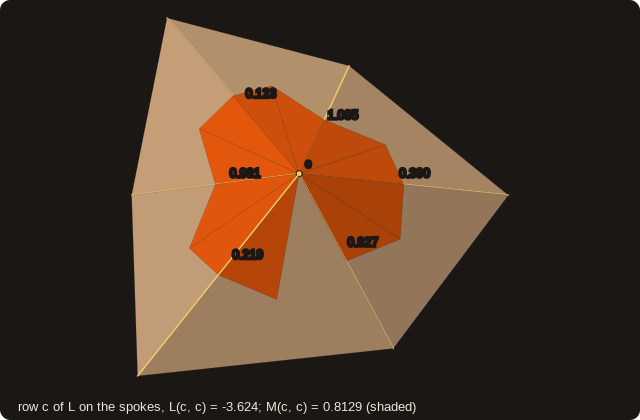
The row of one vertex: six spokes with weights from 0.123 to 1.085, the diagonal L(c, c) = -3.624, their negated sum, and M(c, c) = 0.8129, the shaded third of the six triangles. The figure is drawn by docs/examples/src/fig_ref_cotangent_laplacian_stencil.f90.
Pipeline
For each triangle T with vertices (i, j, k) and the opposite-vertex angles (α_i, α_j, α_k):
Cotangents from edges, not angles. Compute cotangents from the dot/cross identity
where
e_ki = p_i - p_k. This is well-conditioned across the full(0, π)angle range, including obtuse triangles wherecos(α)/sin(α)viaacos(dot/norms)would blow up.Off-diagonal contributions to
L:- To
L(i,j)andL(j,i)add(1/2) cot α_k. - To
L(j,k)andL(k,j)add(1/2) cot α_i. - To
L(k,i)andL(i,k)add(1/2) cot α_j.
- To
Diagonal mass contribution to
M:- To
M(i,i),M(j,j),M(k,k)addarea(T) / 3.
- To
Post-pass: enforce
L_ii = -Σ_{j ≠ i} L_ij. Done explicitly after the per-triangle sweep so the constant-vector kernelL · 1 = 0is exact in floating point — independent of how cotangents accumulate per row.
The result is a CSR-stored L (symmetric, sparse, negative-semidefinite on any mesh, since u; its off-diagonal entries are non-negative only where no two opposite angles sum above π) and a diagonal M. Both are returned to the caller via csr_matrix_t containers; the diagonal M is just a length-N CSR with one entry per row.
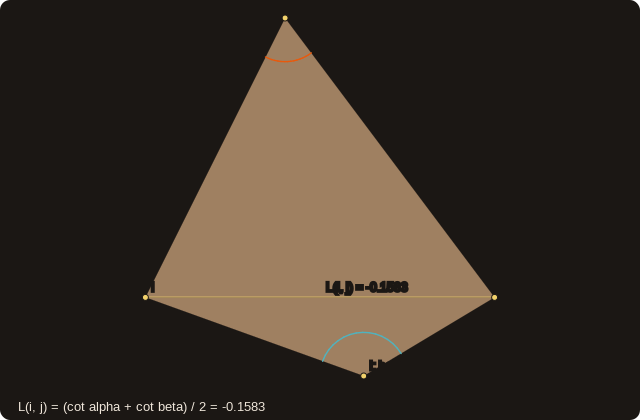
Step 2 on one edge: the acute angle at k gives cot α = 0.500, the obtuse angle at l gives cot β = -0.817, and L%get_value(i, j) returns their half-sum, -0.1583. An obtuse opposite angle can make a weight negative: L is then not an M-matrix, and the discrete maximum principle that non-negative weights give does not hold.
API
call surface%cotangent_laplacian(L, M, status)
   class(surface_stl_object), intent(in)            :: self
   type(csr_matrix_t),        intent(out)           :: L
   type(csr_matrix_t),        intent(out)           :: M
   integer(I4P),              intent(out), optional :: status   ! LAPL_STATUS_*
Outputs:
L— sparse cotangent Laplacian. Dimensionsn_vertices × n_vertices.L%get_value(i,j)is0for non-edges,(cot α + cot β)/2for shared edges (α, βare the opposite-vertex angles in the two incident triangles), and-Σ_j L_ijon the diagonal.M— diagonal barycentric mass.M%get_value(i,i) = (1/3) Σ A_Tover trianglesTincident to vertexi. Off-diagonals are zero.
Status codes:
LAPL_STATUS_OK— operator built successfully.LAPL_STATUS_BAD_INPUT— empty surface or uninitialised vertex pool.LAPL_STATUS_DEGENERATE_TRIANGLE— at least one triangle had area below the tolerance and was skipped. The operator is still returned;L_ii = -Σ_j L_ijis enforced on the surviving contributions only.
Example
Three identities of the operator, checked on cube-01.stl (the unit cube, 8 facets per face): its kernel, its mass, and its quadratic form.
call cube%load_from_file(file_name='cube-01.stl', guess_format=.true.)
call cube%cotangent_laplacian(L=L, M=M, status=status)
if (status /= LAPL_STATUS_OK) error stop 'cotangent_laplacian failed'
n = L%get_nrows()
print '(A,I0,A,I0,A,L1)', 'vertices ', n, ', nonzeros of L ', L%get_nnz(), ', symmetric ', L%is_symmetric(tol=0._R8P)allocate(ones(n), Lones(n), x(n), Lx(n))
ones = 1._R8P
call L%multiply_vector(x=ones, y=Lones) ! constants are in the kernel
print '(A,ES9.2)', 'max |L 1| ', maxval(abs(Lones))
mass = 0._R8P
do i = 1, n
mass = mass + M%get_value(i, i)
enddo
print '(A,F12.9,A,F12.9)', 'sum of M_ii ', mass, ', area ', cube%get_area()
do i = 1, cube%get_facets_number() ! the x coordinate of every pool vertex
f => cube%facet_at(i)
do k = 1, 3
x(f%vertex_id(k)) = f%vertex(k)%x
enddo
enddo
call L%multiply_vector(x=x, y=Lx)
print '(A,F12.9,A)', 'x^T L x ', dot_product(x, Lx), ', exact -4 (area of the faces not normal to x)'$ ref_cotangent_laplacian
vertices 26, nonzeros of L 170, symmetric T
max |L 1| 0.00E+00
sum of M_ii 6.000000000, area 6.000000000
x^T L x -4.000000000, exact -4 (area of the faces not normal to x)- Size. One row per pool vertex (26 for this cube), and 170 nonzeros: the 26 diagonal entries and two per edge.
is_symmetricwith tolerance 0 holds:Lis assembled symmetric, bit for bit. - Kernel.
L · 1is zero to the last bit, because the diagonal is set to minus the row sum of the off-diagonals. Any constant field is harmonic, on any mesh. - Mass. The barycentric masses
M_ii(a third of the area of every incident triangle) partition the area: their sum equalsget_area(), 6. - Quadratic form. For a linear field the cotangent formula is exact on every triangle:
. On the cube, on the four faces parallel to x and 0 on the two normal to it, so the sum is their area, 4. The form is negative semi-definite with this sign convention (positive off-diagonals).
The action of L on a curved surface, where the coordinate field is no longer harmonic, is in the figure below.
Visual reference
The Laplacian itself is a sparse matrix — there is nothing to "see" in the operator. What is worth visualising is its action. Below, M⁻¹ L x is mapped onto a unit sphere, where x is the per-vertex x-coordinate field (the remeshed marching-cubes sphere of the curvature page, 1305 vertices; each facet shows the mean of its three vertex values, halved, so that the colour saturates at ±2):
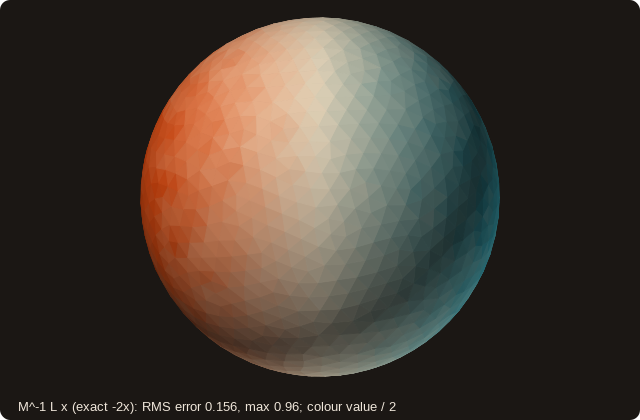
The x-coordinate is harmonic in the plane (Δx = 0), so on a flat mesh L · x would be zero everywhere. On the curved sphere it is not: x is an eigenfunction of the Laplace-Beltrami operator, Δ_S x = -2x on the unit sphere, and M⁻¹ L x is its discrete version (the raw L x carries the vertex area M_ii as a factor, which varies from vertex to vertex; up to that scaling it is the x-component of the mean-curvature normal). Hence the dipole aligned with the ±x axis: +2 on the −x cap, −2 on the +x cap, zero on the band x = 0. The facet-scale speckle is the operator's pointwise error on an irregular mesh (RMS 0.16 against -2x, up to 0.96 at a few vertices: the same non-convergence discussed on the curvature page), not marching-cubes noise: the sphere was remeshed. The figure is drawn by docs/examples/src/fig_ref_cotangent_laplacian.f90.
Known limitations
- Barycentric mass, not mixed-Voronoi. Meyer et al. 2003 propose a mixed-area scheme that switches to the Voronoi region around vertex
iwhen the incident triangle atiis non-obtuse ati, and to a truncated Voronoi (area / 4 or area / 2 depending on which angle is obtuse) otherwise. This is more accurate near obtuse triangulations and is a documented follow-up. The barycentric form FOSSIL ships is sufficient for all current downstream consumers (smoothing §2.3, curvature §2.4) on the well-conditioned triangulations produced bysanitizeand isotropic remeshing. - Obtuse triangles produce negative off-diagonals. When one angle exceeds π/2, its cotangent is negative, which means at least one
L_ij < 0. The matrix is no longer "weakly diagonally dominant" in the M-matrix sense. The constant-kernel still holds (because the diagonal post-pass enforces it), and most downstream geometry uses are robust to it, but iterative solvers (when §2.2 lands) may converge slower. The fix is the mixed-area Voronoi mass above, which is designed to make the effective operatorM⁻¹ Lan M-matrix. - Boundary vertices. FOSSIL targets closed solids, so boundary handling is not a first-class concern. On open meshes (e.g. an STL with one facet deleted), boundary vertices have a one-sided cotangent sum and the operator is not symmetric on the boundary subset. This is the standard cot-Lapl behaviour and matches libigl's.
See also
- mesh smoothing — the implicit smoothing variant solves
(M − τL) V_new = M V; shipped variants (explicit, Taubin) use a different Laplacian (uniform weights, not cotangent) for stability reasons. - per-vertex curvature — mean curvature is literally
H_i n_i = (1/2) M⁻¹ (L V)_i, so this page is its direct prerequisite. csr_matrix_t— the CSR container returned bycotangent_laplacian. Hasget(i,j),matvec(x, y),get_nrows(),get_nnz().- Constants —
LAPL_STATUS_*.
References
- Pinkall & Polthier, Computing discrete minimal surfaces and their conjugates, Experimental Mathematics 2(1), 1993. The original cotangent formula.
- Meyer, Desbrun, Schröder & Barr, Discrete differential-geometry operators for triangulated 2-manifolds, VisMath 2003. The mixed-Voronoi mass and the obtuse-triangle robustness story.
- Crane, Discrete Differential Geometry: An Applied Introduction, SIGGRAPH course notes 2013–2023. The canonical pedagogical reference; the FOSSIL builder follows Crane's algorithmic skeleton.
- Botsch, Kobbelt, Pauly, Alliez & Lévy, Polygon Mesh Processing, A K Peters 2010, Chapter 3. The book-length treatment, including the CSR-storage discussion that informed the FOSSIL implementation.