Alpha wrapping
What it does
Takes any triangle soup — broken, holed, self-intersecting, non-manifold, or all of the above — and wraps it in a closed, 2-manifold surface at the scale α and the offset ε (Portaneri et al. 2022), the "make any CAD junk usable for CFD" primitive. The wrap is the boundary of the space a ball of diameter α carves from outside, laid on the surface at distance ε from the input:
- a gap wider than about
α + 2εlets the ball in, and the wrap lines both of its sides (a gap is a feature to keep); - a narrower gap, a hole or a crack, is closed by a cap where the ball stops;
- everywhere the ball reaches the input, the wrap lies on the
ε-offset surface.
The existing surface%sanitize pipeline only fixes local defects: degenerate facets, duplicate facets, near-coincident vertices, normal orientation. It cannot recover from missing facets, large self-intersections, internal walls, or non-manifold patches. For AMR cut-cell tagging on CAD-derived STL, an irrecoverably broken input silently produces wrong inside/outside labels — is_watertight() returning .true. is necessary but not sufficient for a usable solid. Alpha wrapping is what makes that assumption true.
Pipeline
Portaneri et al. carve a 3-D Delaunay triangulation. FOSSIL carves a uniform grid of cells of size h (α/4 at first) instead, with the same rule, and puts the vertices on the offset surface (issue #50):
- Distance. The unsigned distance
uto the input at every cell centre, by the input's AABB tree. Blocks of cells far from the input are culled. - Flood fill. Free cells are those where the ball fits outside the offset surface,
u > α/2 + ε. A flood fill from the grid corner over free cells gives the reached set: where the ball's centre can go from outside. Cavities it cannot reach are filled. - Carving. A cell is carved if a ball whose centre is reachable covers it, which holds within
u(r) − εof a reached centrer. That is an exact power-distance transform, separable like the squared distance transform. A cell that touches the input is never carved, so the input always lies in solid cells, even a sheet of zero thickness carved on both sides. This is the offset-surface barrier: the two sides of a wall are separate surfaces and never collapse onto each other. - Well-composed. Carved cells are turned solid until no 2×2 square has a checkerboard and no 2×2×2 block has an isolated diagonal pair. Marching Cubes on such a lattice gives a closed 2-manifold.
- Extraction. Marching Cubes on the cell centres. Each carved–solid edge gets one vertex, computed once:
- the first point from the carved centre where
u = ε(sphere tracing, which never passes the first root, so it stays on the carved side of any wall); - if the edge never comes within
εof the input, its midpoint projected onto the offset surface; - on a cap, the point where the carving balls end.
- the first point from the carved centre where
- Repair. A triangle that meets the input, or crosses another wrap triangle, has its vertices moved halfway back towards their cell faces, where the Marching Cubes surface is embedded, for up to 6 rounds; a vertex that ends closer than
εto the input goes back onto the offset surface. A chord across a convex edge of the input, with its ends on the offset surface, cuts the input when the cells are larger thanε. The contact test is exact (orient3d); the crossing test is in floating point, with the exact test inside a1e-8band. - Coarsening. Edges shorter than
α/2are collapsed onto one of their ends, cheapest first by the quadric error of the planes around them (issue #52). A collapse is accepted only if the wrap stays a closed 2-manifold and no moved triangle flips, becomes a sliver (shape quality below 0.2), meets the input or crosses the wrap. The kept end is a wrap vertex, so every vertex stays atεor farther. This removes 80% to 95% of the triangles. - Refinement loop. A level that still has a defect is redone with
h/2, up tomax_iterationslevels (default 5) and2^23cells.
API
call surface%alpha_wrap(alpha, offset, max_iterations, wrapped, status)
   class(surface_stl_object), intent(in)            :: self
   real(R8P),                 intent(in),  optional :: alpha          ! default bbox_diag/50
   real(R8P),                 intent(in),  optional :: offset         ! default alpha/30
   integer(I4P),              intent(in),  optional :: max_iterations ! grid levels, default 5
   type(surface_stl_object),  intent(out)           :: wrapped
integer(I4P), intent(out), optional :: status ! AWRAP_STATUS_*alphais the diameter of the carving ball: the scale below which gaps are closed. The defaults follow CGAL'sAlpha_wrap_3. The coarsened output has edges up to aboutα/2on flat parts, so halvingalpharoughly quadruples the facet count.offsetis the distance from the input at which the wrap lies.max_iterationsis the number of grid levels the refinement loop may use.wrappedis a fresh output surface;selfis unchanged.status:AWRAP_STATUS_OK: the wrap encloses the input without touching it and does not cross itself.AWRAP_STATUS_NOT_CONVERGED: the finest level allowed still has a triangle that touches the input or crosses the wrap. The wrap of that level is returned, still closed and 2-manifold.AWRAP_STATUS_BAD_INPUT: empty surface,alpha ≤ 0, oroffset ≤ 0.AWRAP_STATUS_DEGENERATE:alphaat least the input's bounding box diagonal. The wrap is empty.
Example
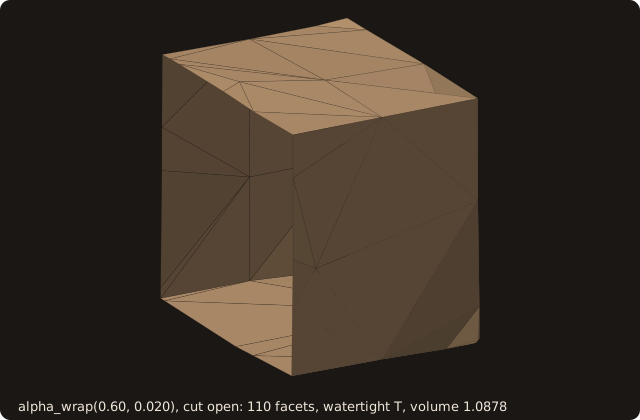
A "broken" cube, cube.stl minus one facet (a triangular hole of inradius 0.29), wrapped twice:
program ex_alpha_wrap
use fossil
use fossil_facet_object, only : facet_object
use penf,   only : I4P, R8P
implicit none

type(surface_stl_object) :: source, holed, wrapped
type(facet_object), pointer :: facets(:)
type(facet_object), allocatable, target :: holed_facets(:)
integer(I4P)            :: status, i

! Build a "broken" cube by dropping one facet from cube.stl.
call source%load_from_file(file_name='src/tests/cube.stl', guess_format=.true.)
facets => source%facets_ref()
allocate(holed_facets(size(facets) - 1_I4P))
do i = 1_I4P, size(holed_facets, kind=I4P)
   holed_facets(i) = facets(i + 1_I4P)
enddo
call holed%adopt_facets(facets=holed_facets)
print '(A,L1)', 'input watertight? ', holed%is_watertight()  ! .false. — has a hole

! A ball larger than the hole: the wrap caps it.
call holed%alpha_wrap(alpha=0.6_R8P, wrapped=wrapped, status=status)
print '(A,I0,A,L1,A,F8.4)', 'output status=', status, &
      '  watertight? ', wrapped%is_watertight(), &
      '  vol = ', wrapped%get_volume()
endprogram ex_alpha_wrap
With alpha = 0.6 the ball cannot pass the hole: status is AWRAP_STATUS_OK, the wrap is watertight and manifold (116 facets), and its volume is 1.089. The cube grown by the offset (0.02) has volume 1.124; the difference is the dimple the cap makes into the hole and the chords of the coarse wrap across the rounded edges. With the default alpha (0.035) the hole is far wider than the ball. The wrap is then one closed shell lining both sides of every wall, of volume 0.0135 and not a solid. Check get_volume(), not only is_watertight().
Visual reference
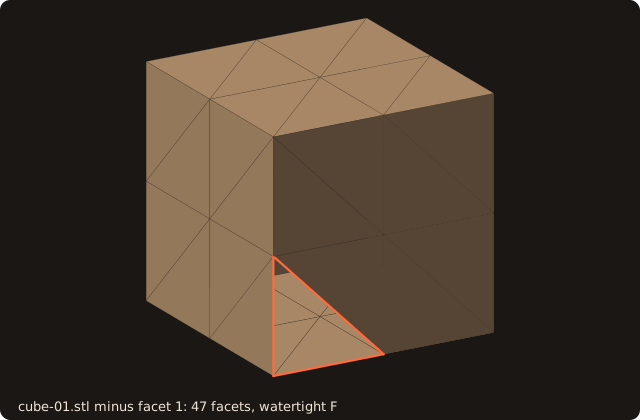
A unit cube minus one facet (cube-01.stl, 8 facets per face, minus its first facet: a triangle of legs 0.5 on the face x = 0, its boundary in ember):
After alpha_wrap with alpha 0.15 and offset 0.033, cut open by the plane y = 0.83 through the hole:
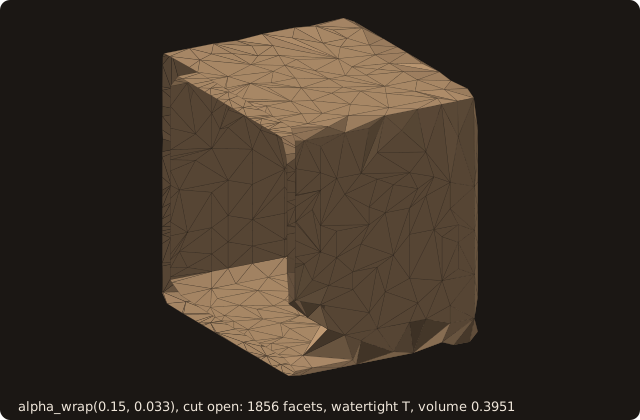
The ball, of diameter 0.15, fits through the hole (inradius 0.146 > 0.075 + 0.033). The wrap is one closed shell: one layer outside each wall, one inside, 2ε apart, joined around the rim of the hole. The barrier keeps the two layers apart: a cell touching the wall is never carved, so each layer's vertices are traced from its own side.
With alpha 0.6 (and offset 0.02) the ball does not fit, and the wrap closes the hole with a cap that dips into it:
Known limitations
Measured behaviour (issues #50, #52).
cube-01.stl(closed) and the same cube without one facet, defaultoffset(α/30). Every wrap is status OK, watertight and manifold:αclosed: volume, facets holed: volume, facets 0.035 1.007, 18272 0.015, 35640 0.1 1.020, 2382 0.050, 4590 0.3 1.053, 276 1.052, 290 0.7 1.113, 116 1.111, 106 The closed cube's volume is the cube grown by the offset,
(1 + 2ε)³, less the rounding of the edges and corners and the chords the coarse wrap lays across them: atα = 0.1the Minkowski sum is 1.0201, atα = 0.7it is 1.1438. The hole (inradius 0.146) lets the ball in forα/2 + ε < 0.146, that isα < 0.27, but the flood fill needs a cell centre where the ball fits, so on the grid the hole closes earlier: open atα = 0.1and 0.15, closed at 0.2 (cells ofα/4). Below the threshold the wrap is a hollow shell.dragon.stlwith the defaults is status OK, watertight and manifold, with 11370 facets and volume 487.5 (the dragon's is 465.9); 94% of its vertices lie on the offset surface.Output size and time. The time goes mostly into
analyzeof the output, so it follows the facet count: 3.4 s for the closedcube-01at the defaultα(18272 facets), 11 s for the holed one (35640, a shell lining both sides of every wall), 6 s for the dragon (11370), single core. Before the coarsening (issue #52) these were 161k, 309k and 127k facets, in 16 s, 195 s and 13 s.Vertices off the offset surface. On caps the wrap lies where the ball stops, up to about
α/2 + εfrom the input. A vertex the repair pass moved lies between the offset surface and its cell face; if that is closer thanε, it goes back onto the offset surface (issue #53). No wrap vertex is ever closer thanε: on a coarse marching-cubes sphere 98.6% of them lie exactly atε, the rest farther. The triangles between them can come closer, as chords of the offset surface do.Concave detail below
αis not carved, by design. The ball does not enter a groove narrower thanα + 2ε, so the wrap bridges it.
See also
surface%alpha_wrapAPI entry — the formal signature with intent declarations.- Marching Cubes — the extraction stage, here on a binary lattice.
surface%sanitize— for inputs that are already manifold-modulo-local-defects (degenerate / duplicate facets, near-coincident vertices).sanitizeis much cheaper thanalpha_wrap; reach foralpha_wraponly when sanitize cannot recover the topology.surface%decimate— to coarsen the wrap.- Issue #50: the diagnosis of the first, voxel-shell implementation and the design of this one.
References
- Portaneri, Hemmer, Birdal, Mandad & Alliez, Alpha Wrapping with an Offset, SIGGRAPH 2022. The reference algorithm.
- CGAL
Alpha_wrap_3package documentation. The reference implementation that defines the canonical defaults (α = bbox_diag/50, offset = α/30) FOSSIL inherits. - Felzenszwalb & Huttenlocher, Distance Transforms of Sampled Functions, Theory of Computing 8 (2012). The separable transform used for the carving.
- Lorensen & Cline, Marching Cubes, SIGGRAPH 1987; Latecki, Discrete Representation of Spatial Objects in Computer Vision (1998), on well-composed sets.