

Feature edges
What it does
Finds the edges an immersed-boundary grid must resolve (issue #61, roadmap #58):
- sharp edges, where the two facets meet at more than an angle (30° by default);
- boundary edges, with one facet: the rims of holes and open surfaces;
- non-manifold edges, with three or more facets;
- the corners, where feature edges meet or turn sharply;
- the polylines that chain the edges from corner to corner.
IB methods smear sharp corners and edges unless the grid is refined there. This is the output that drives feature refinement in CFD meshers (OpenFOAM's surfaceFeatureExtract feeds snappyHexMesh with it).
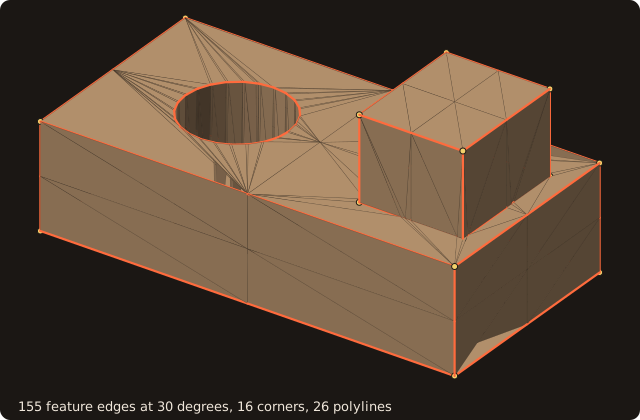
The part is built with boolean: a block, united with a boss, minus a 24-sided hole. Its 12 block edges, 8 boss edges and 4 edges where the boss meets the block are sharp, which gives 16 corners and 24 polylines. The hole's two rims are closed polylines without corners: the hole's facets meet at 15°, below the threshold, so the hole wall itself has no features.
Method
- Edges. The half-edges of all facets are sorted by (lower vertex, higher vertex, facet) with a stable merge sort, so the result is deterministic. Each unique edge records its number of facets and its first two.
- Sharp. A two-facet edge is sharp when the unit normals of its facets make an angle above
angle:. The normals come from the vertex order, so the facets must be consistently oriented, as sanitizeleaves them. A facet of zero area has no normal. Its edges are not classified as sharp, and are counted indegenerate. - Corners. A feature vertex is a corner when it has a number of feature edges other than 2, or exactly 2 that turn by more than
corner_angle(30° by default). - Polylines. From every corner, each unused feature edge is followed through the other feature vertices until the next corner. The edges left form closed loops, and each loop starts and ends at the same vertex.
- Shared with the remesher.
isotropic_remesh(preserve_features=.true.)locks its features with the same sharp predicate and the same 30° threshold (is_sharp_dihedral,feature_cosinfossil_feature_edges), so the two cannot drift apart. Its results are unchanged, bit for bit.
API
call surface%feature_edges(edges, kinds, corners, polyline_start, polyline_vertices, angle, corner_angle, &
                           include_boundary, include_nonmanifold, degenerate, status)
   integer(I4P), allocatable, intent(out), optional :: edges(:,:)           ! [2, ne] vertex-pool ids
   integer(I4P), allocatable, intent(out), optional :: kinds(:)             ! FEATURE_EDGE_SHARP / _BOUNDARY / _NONMANIFOLD
   integer(I4P), allocatable, intent(out), optional :: corners(:)           ! vertex-pool ids
   integer(I4P), allocatable, intent(out), optional :: polyline_start(:)    ! [np + 1], CSR offsets
   integer(I4P), allocatable, intent(out), optional :: polyline_vertices(:) ! polyline p: start(p) .. start(p+1)-1
   real(R8P),                 intent(in),  optional :: angle, corner_angle  ! degrees, default 30
   logical,                   intent(in),  optional :: include_boundary     ! default .true.
   logical,                   intent(in),  optional :: include_nonmanifold  ! default .true.
   integer(I4P),              intent(out), optional :: degenerate           ! edges skipped for a zero-area facet
integer(I4P), intent(out), optional :: status ! STATUS_OK, STATUS_INVALID_INPUT- Vertex ids index the vertex pool:
surface%get_vertex_pool(),pool%coord(id). - Edges are listed in increasing (low id, high id) order.
status = STATUS_INVALID_INPUTon an empty surface, or an angle outside [0°, 180°].
Refinement along the features
The feature edges drive AMR refinement through a tree of their segments, built once:
call surface%build_features(angle, corner_angle, include_boundary, include_nonmanifold, status)
call surface%box_feature_many(lo, hi, touched, status)          ! lo(3, n), hi(3, n): which boxes touch a feature edge
call surface%box_feature_many_device(lo, hi, touched, status)   ! the same on the device (build, then enter_device)
call surface%tag_block(x, y, z, band, tags, ..., feature_band=fb, feature_tags=ft) ! Chebyshev cells to the featuresbuild_featuresstores the feature edges as segments in a bounding-volume hierarchy (median split, at most 4 segments per leaf,fossil_feature_bvh). The queries take the surfaceintent(in), so the tree is built explicitly, asenter_deviceis.analyze(any geometry change) andmovedrop it. Asking before building returnsSTATUS_INVALID_INPUT.box_feature_manyis a separating-axis test of each segment against the box inflated bybox_tolerance, the same conservative inflation as the box–triangle test of AMR tagging: a contact is never missed. The test checks the 3 box axes and the 3 cross products of the segment direction with them. The CPU loop and the device loop call the same routine,feature_box_touch_oac, so their results are bit-identical.tag_block(feature_band=, feature_tags=)adds, alongside the signed surface tags, the Chebyshev cell distance to the nearest cell touched by a feature, capped atfeature_band + 1. A solver refines wherefeature_tagsis small, as it does near the wall withtags.
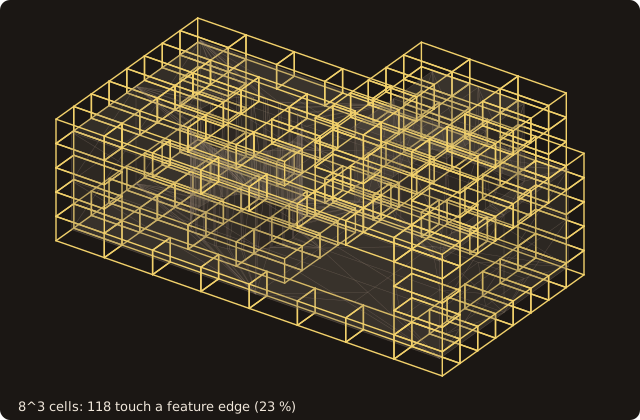
On blocks of 8, 16 and 32 cells per side, 118 (23 %), 260 (6 %) and 532 (2 %) cells touch a feature edge: the features are a set of curves, so the tagged fraction halves with each refinement.
Distance to the nearest feature
call surface%query_many(points, distances, ..., feature_distances=fd) ! and query_many_devicefeature_distances(i) is the distance from points(i) to the nearest feature edge: a depth-first descent of the feature tree, pruning nodes farther than the best so far, with the exact distance to each segment (clamped projection on the segment). A ghost-cell or image-point closure can switch its stencil near a corner where this distance is below a few cells. It works with pose= (body-frame points, as the other outputs). The device twin runs the same routine, feature_point_distance_oac, and gives the same bits. build_features must come first (and enter_device for the device), else STATUS_INVALID_INPUT.
2-D: corners
For a curve the features are its corners:
call curve%feature_corners(corners, angle, status)                       ! turning above angle, ends of open loops
call curve%tag_block(x, y, band, tags, ..., feature_band=fb, feature_tags=ft, feature_angle=a)
call curve%query_many(points, distances, ..., feature_distances=fd, feature_angle=a) ! and query_many_device- Corners. A vertex of a closed loop is a corner when the angle between its incoming and outgoing segments exceeds
angle(30° by default). Both ends of every open loop are corners too. - No build step. The corners take O(n) to find, so the curve procedures compute them at each call; there is no
build_featuresin 2-D. feature_tagsis the Chebyshev cell distance to the nearest cell holding a corner. A corner on a cell edge marks both cells.feature_distancesis the distance from each point to the nearest corner. On the device it runs as an OpenACC loop with the same arithmetic, so it gives the same bits.
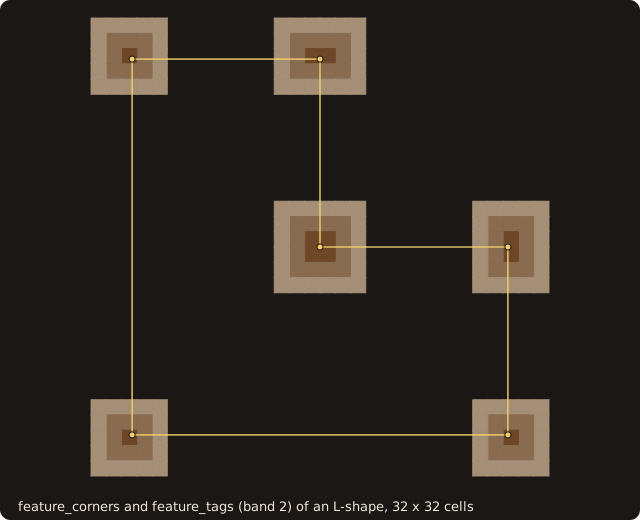
The L-shape has 6 corners; with feature_band=2, 171 cells lie within two cells of one.
Example
program ck_feature_edges
use fossil, only : surface_stl_object, FEATURE_EDGE_SHARP, FEATURE_EDGE_BOUNDARY, FEATURE_EDGE_NONMANIFOLD, STATUS_OK
use penf,   only : I4P, R8P
implicit none
type(surface_stl_object)  :: dragon
integer(I4P), allocatable :: kinds(:), corners(:), ps(:), pv(:)
integer(I4P)              :: status

call dragon%load_from_file(file_name='dragon.stl', guess_format=.true.)
call dragon%feature_edges(kinds=kinds, corners=corners, polyline_start=ps, polyline_vertices=pv, status=status)
if (status /= STATUS_OK) error stop 'feature_edges failed'
print '(A,I0,A,I0,A,I0)', 'sharp ', count(kinds == FEATURE_EDGE_SHARP), ', boundary ', &
                          count(kinds == FEATURE_EDGE_BOUNDARY), ', non-manifold ', count(kinds == FEATURE_EDGE_NONMANIFOLD)
print '(A,I0,A,I0)', 'corners ', size(corners), ', polylines ', size(ps) - 1
call dragon%feature_edges(kinds=kinds, angle=60._R8P, include_boundary=.false., include_nonmanifold=.false.)
print '(A,I0)', 'sharp above 60 degrees only: ', size(kinds)
endprogram ck_feature_edges
$ ck_feature_edges
sharp 5104, boundary 0, non-manifold 61
corners 2630, polylines 4729
sharp above 60 degrees only: 2508The dragon as loaded has 5104 sharp edges at 30°: its scan is coarse, and neighbouring facets often meet at steep angles. It has no boundary edge: its 62 duplicated facets (removed by sanitize, tutorial chapter 2) put three or more facets on 61 edges, which count as non-manifold. Raising the angle to 60° and excluding the other kinds keeps 2508 creases.
Output for inspection
call surface%save_features_into_file(file_name, angle, corner_angle, include_boundary, include_nonmanifold, status)The file is legacy ASCII VTK POLYDATA, which ParaView opens directly:
- the feature vertices are
POINTS; - every corner is a
VERTEX; - every feature edge is a 2-point
LINE; - a cell scalar
kindis 0 on the corners and theFEATURE_EDGE_*code on the edges.
From the command line:
fossilizer -i part.stl --features part-features.vtk [--feature_angle 45]feature edges at 30.00 degrees
sharp 24 boundary 0 non-manifold 0
corners 8 polylines 12
written to part-features.vtk(the output for cube-01.stl). src/tests/fossil_test_features_cli.f90 reads the summary and the VTK file back: 20 points, 8 vertices, 24 lines and 32 cell scalars.
Validation
src/tests/fossil_test_feature_edges.f90:
| Case | Expected |
|---|---|
cube-01 (48 facets) | 24 sharp edges, all on the cube's 12 edges, of total length 12; the 8 cube corners; 12 polylines |
| A 32-sided cylinder, caps fanned | the two cap rims (64 sharp edges), no corners, two closed polylines of 32 edges |
cube-01 without one facet | 3 boundary edges; none with include_boundary=.false. |
| Three triangles sharing one edge | 1 non-manifold edge, 6 boundary edges |
dragon.stl, sanitized | the same count after a translation; non-increasing as the angle goes 10°, 20°, 30°, 45°, 60° |
src/tests/fossil_test_feature_tagging.f90:
| Case | Expected |
|---|---|
Before build_features | box_feature_many, tag_block(feature_tags=): STATUS_INVALID_INPUT |
cube-01, a block of 14³ cells | the touched cells equal a brute force over every segment with the same predicate (448 of 2744) |
tag_block(feature_band=2) | the feature tags equal cell_bands of the brute-force set; the surface tags unchanged |
box_feature_many_device (host build: device code, directives inert) | equal to the CPU |
After analyze | the tree is dropped: STATUS_INVALID_INPUT |
| A face centre, a cube edge | not touched, touched |
src/tests/fossil_test_feature_distance.f90:
| Case | Expected |
|---|---|
Before build_features | STATUS_INVALID_INPUT |
cube-01: below an edge, at a face centre, beyond a corner, on an edge | 0.5, 0.5, √0.29, 0 (to 1e-15) |
| 500 random points | equal bit for bit to a brute force over every segment |
pose= | equal to the query of the body-frame points (6e-16) |
query_many_device (host build: device code, directives inert) | equal to the CPU |
The GPU check (fossil_test_distance_bench) prints feature device vs serial mismatches, over the touched cells of a block of 24³ cells and the feature distances of their centres, required 0.
src/tests/fossil_test_curve_features.f90, the 2-D twin:
| Case | Expected |
|---|---|
| A unit square; a regular 64-gon; the 64-gon at 1° | 4 corners; none (5.6° per vertex); all 64 |
| A NACA 0012 of 200 points | the trailing edge only |
| An open polyline with a 10° bend | its two ends |
| Corner tags of the square on 10 × 10 cells | equal to a brute force |
| Corner distances | √0.5 and 1 at closed-form points, 0 at a corner; the device path equal to the CPU |
The curve bench (fossil_test_curve_bench, the tests-nvidia-curve gate) prints feature device vs serial mismatches for the corner distances of a 64² grid.
fossil_test_isotropic_remesh gives the same output as before the shared predicate (compared line by line against a build of the previous commit).
See also
- Isotropic remeshing:
preserve_featureslocks these edges. - AMR tagging: the grid the features are meant for.