
Styles
Every colour and size of the interface and of the plots can be chosen. Four terms name what is chosen, and this page uses them in this sense only:
- a style: every colour and size at once, chosen by a built-in name with
app%set_style('seal','paper', ...): a look and a palette, or Dear ImGui's own geometry and colours (Named styles); - a look: the geometry alone, the rounding, padding, spacing and borders (Looks);
- a palette: the colours alone, twelve colour roles from which every colour of Dear ImGui and ImPlot is derived (Palettes);
- a theme file: a TOML file that gives a style, a look and a palette (or a
baseof Dear ImGui's colours) with single colours and variables over them, applied withapp%load_style(Theme files); each built-in style is one, embedded in the library.
Over any of them, a single colour or variable of Dear ImGui and ImPlot is set by its own name.
Named styles
app%set_style(name [, lines] [, stat]), after init (or init_headless, init_remote), sets the geometry and the colours of the interface, of the plots and of the window's background:
| Name | Look | Text contrast (lowest) |
|---|---|---|
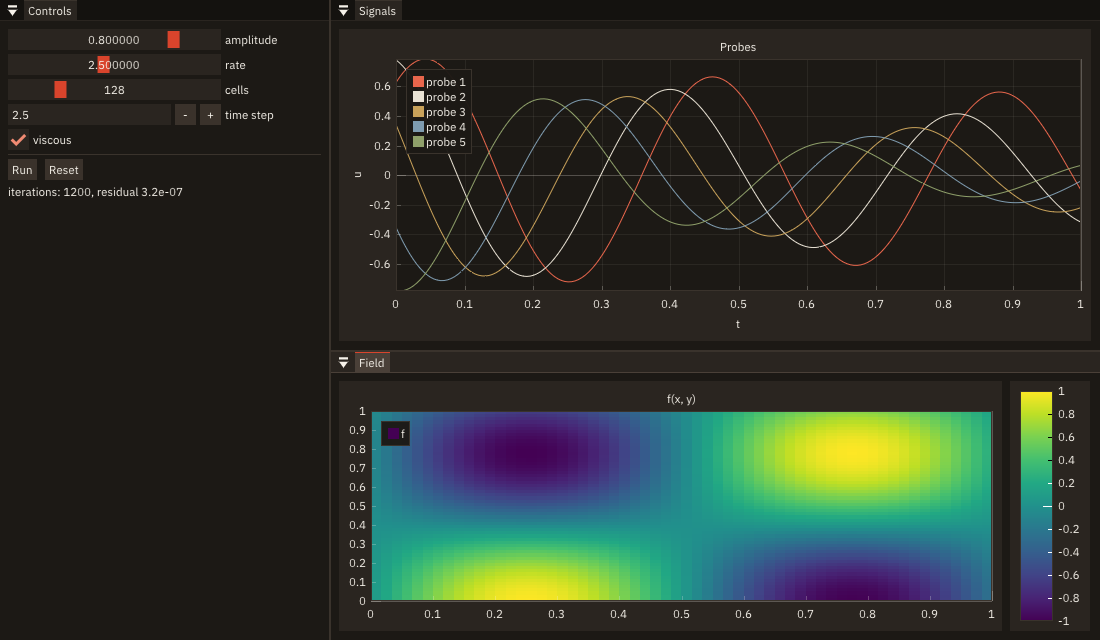
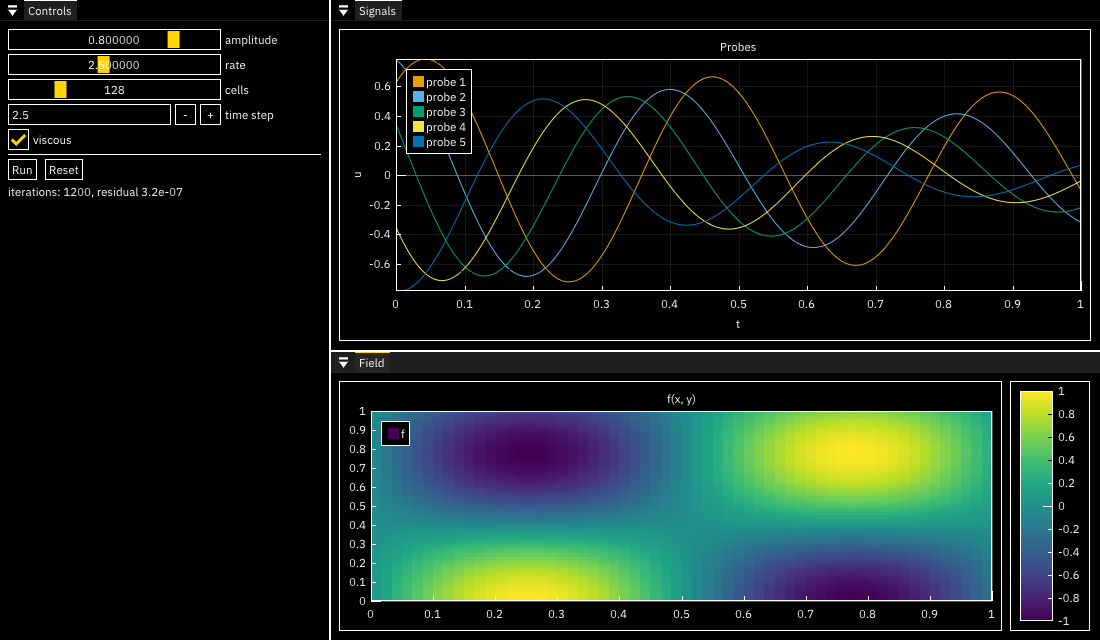
'seal' | the default: FIGURE's style, from the palette of its mark: ink windows, paper text, vermilion spent only on what the user touches (slider grabs, check marks, pressed buttons) and on the first plotted line; square corners | 7.4:1 |
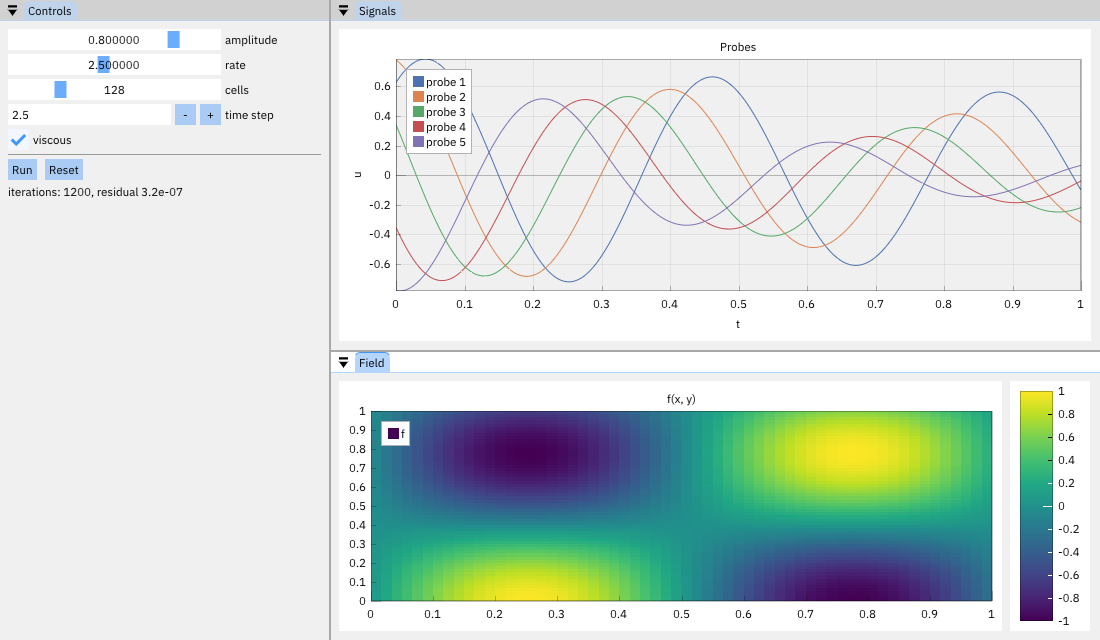
'seal-light' | the same on paper | 11.7:1 |
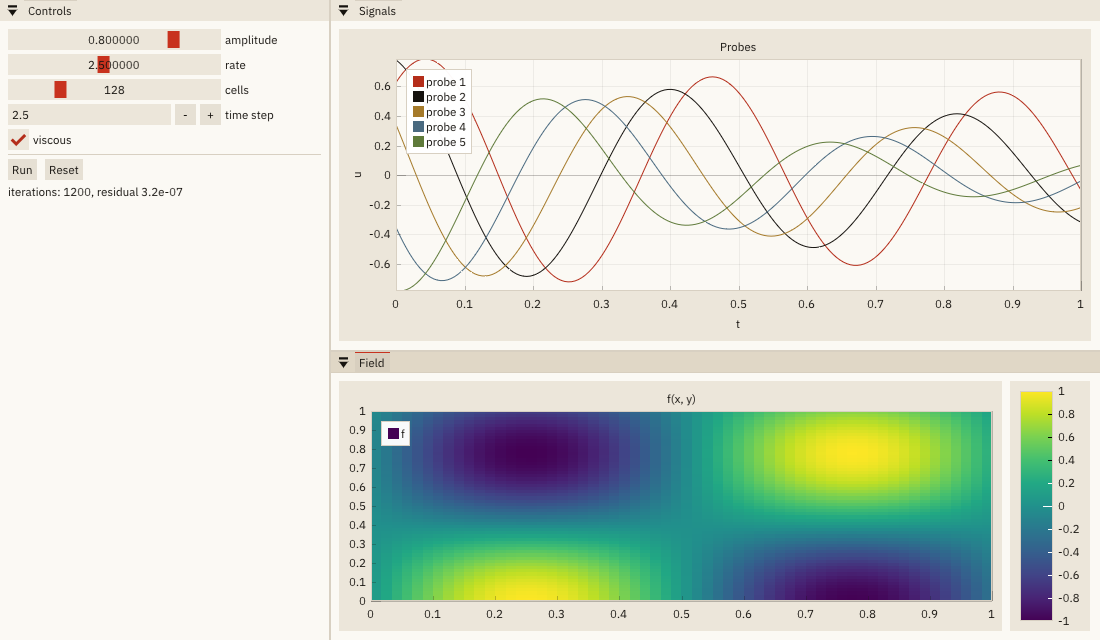
'paper' | for publication: black on white, thin borders, a light grid, line colours that keep 3:1 on white and stay apart in greyscale | 15.9:1 |
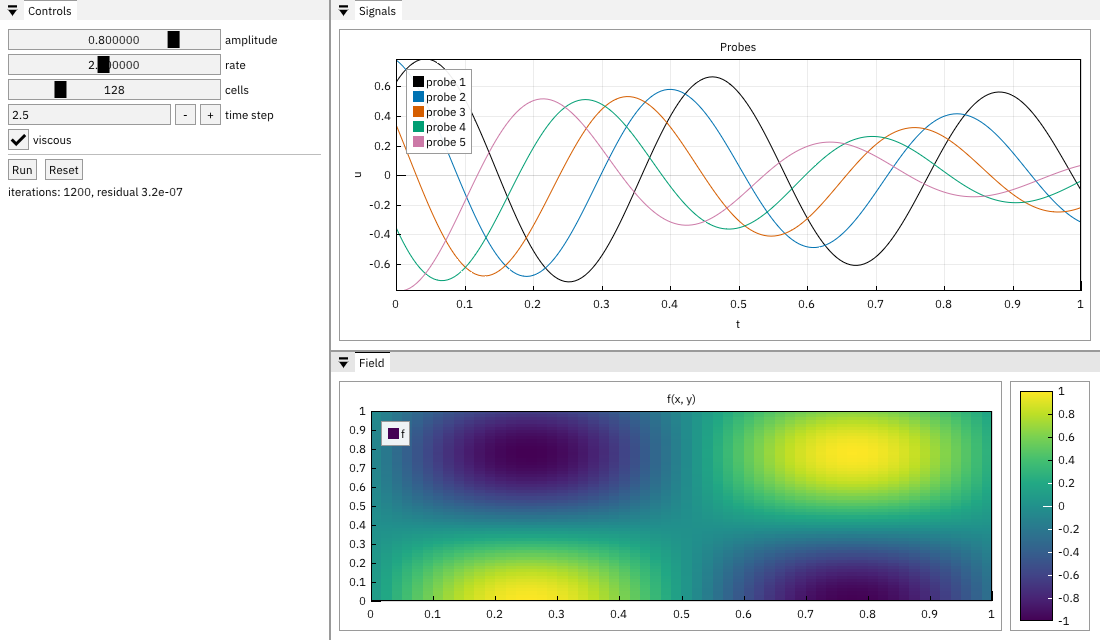
'high-contrast' | white on black with yellow accents, a border on every frame, colour-blind-safe lines | 12.6:1 |
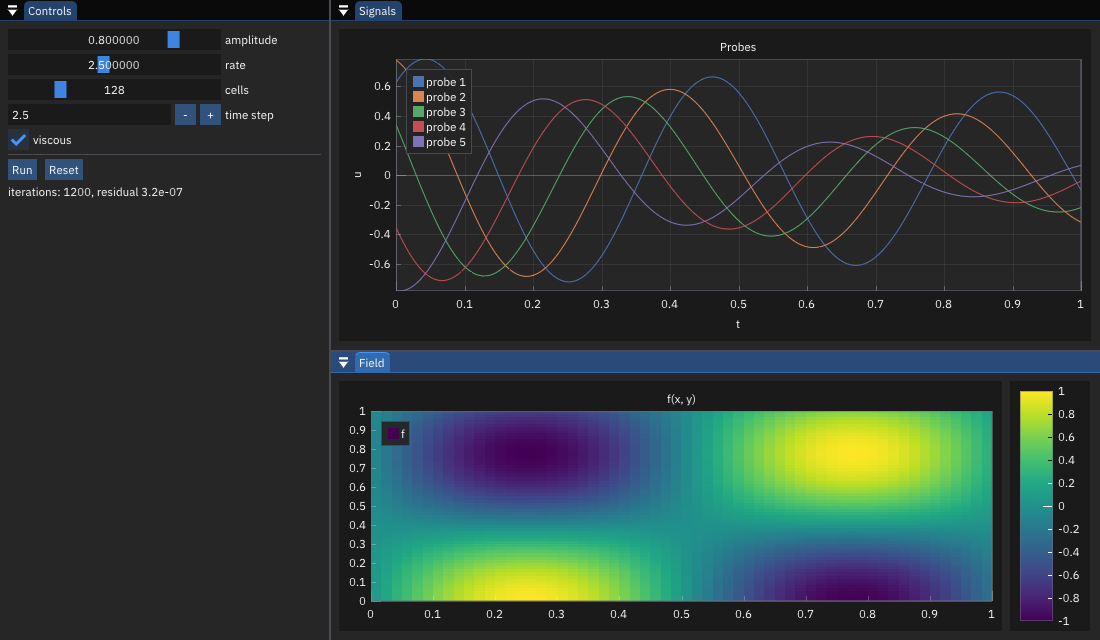
'dark' | Dear ImGui's dark style, with ImPlot's default line colours | 3.0:1 |
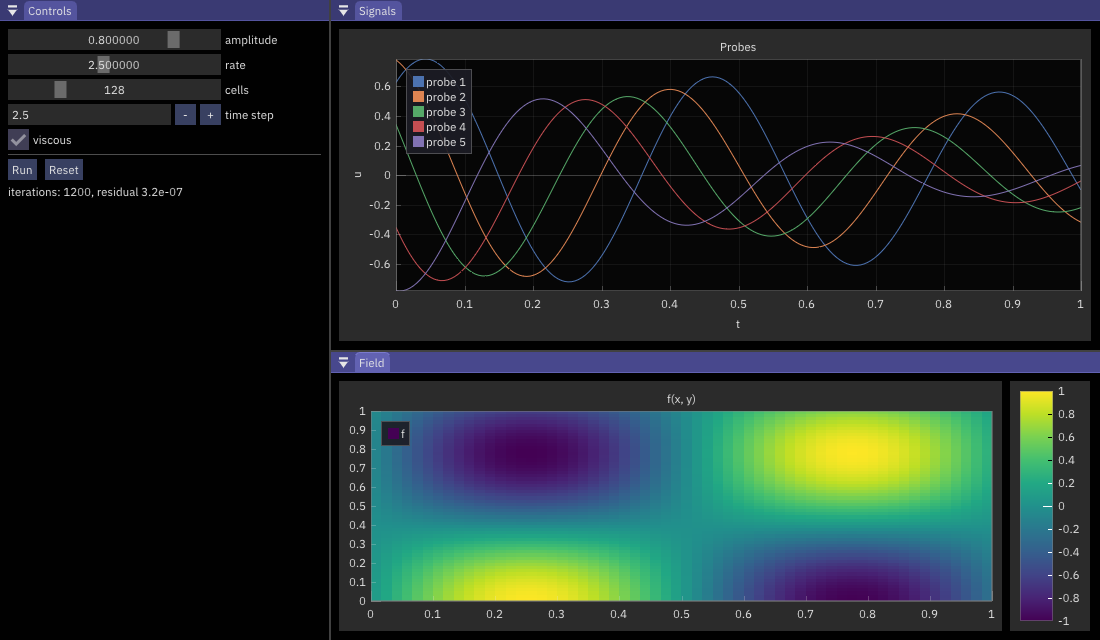
'light', 'classic' | Dear ImGui's other two styles | 7.0:1, 4.9:1 |
lines='okabe-ito' replaces the style's line colours with Okabe and Ito's colour-blind-safe set (orange, sky blue, bluish green, yellow, blue, vermilion, reddish purple), whatever the style:
call app%set_style('paper') ! or: call app%set_style('seal', lines='okabe-ito')The contrast column is measured by src/tests/figure_test_themes.F90 on the colours in effect, as WCAG 2 defines it: Text against every surface it is drawn on (window, popup, frames, buttons, title bar, header), the lowest reported. FIGURE's styles are held to a target in the test: 4.5:1 (WCAG AA) for seal and seal-light, 7:1 (AAA) for paper and high-contrast, and 3:1 for every line colour against the plot background (WCAG 1.4.11, graphics). Dear ImGui's own styles are measured, not held to one: dark reaches only 3:1 on a hovered button.
Each of FIGURE's four styles is a look and a palette: the look seal with the palette of the same name (paper and high-contrast add borders to it). Dear ImGui's three are its own geometry with its own colours, no palette. The same test holds every built-in style to recorded colours and sizes, bit for bit: those it had before styles were split into looks and palettes, but for the two changes of v0.3.0 below (palettes), recorded again with them.
The environment variable FIGURE_STYLE picks the style at initialisation, without changing the program (FIGURE_STYLE=paper exe/examples/figure_hello); a set_style call in the program comes later and wins. An unknown name or palette is FIG_ERR_ARGUMENT (or a stop, without stat). The font and its size are kept; every other colour and variable comes from the style (its base and its theme file), so changes made by name (below) or through the raw bindings are reset. Heatmaps are unaffected: their colormap is the one passed to ip_heatmap (the line colours of a style are a qualitative colormap, not meant for fields). In remote mode the browser takes the style's background too. Every picture of this documentation is recorded in the default style, 'seal'; the gallery shows the others.
Gallery
One program, docs/examples/src/gallery.F90 (a docked layout: controls, five plotted lines, a heatmap with its colour bar), in every built-in style. The heatmap keeps its own colormap (Viridis) in all of them; the lines take the style's.
Looks and palettes
A style has two parts, chosen separately:
- a look: the geometry, the variables of Dear ImGui (
ImGuiStyle) and ImPlot (ImPlotStyle) that size and shape the widgets: rounding, padding, spacing, border widths, the scroll bar; - a palette: the colours, twelve roles from which every colour of Dear ImGui and ImPlot is derived, plus the window's background and the line colours of the plots.
| Procedure | Does |
|---|---|
app%set_style([name] [, lines] [, stat] [, look] [, palette] [, auto_dark] [, auto_light]) | a named style, then a look, then a palette, then line colours: each argument optional, what is not given is kept |
app%palette_color(role, rgba [, stat]) | the colour of a role of the palette in effect, rgba(4) in [0, 1] |
test_system_theme(theme [, stat]) | (figure_testing) the system's light or dark setting changes at the next frame: 'light', 'dark', 'system' |
call app%set_style(look='fluent', palette='nord') ! the geometry of Windows 11, the colours of Nord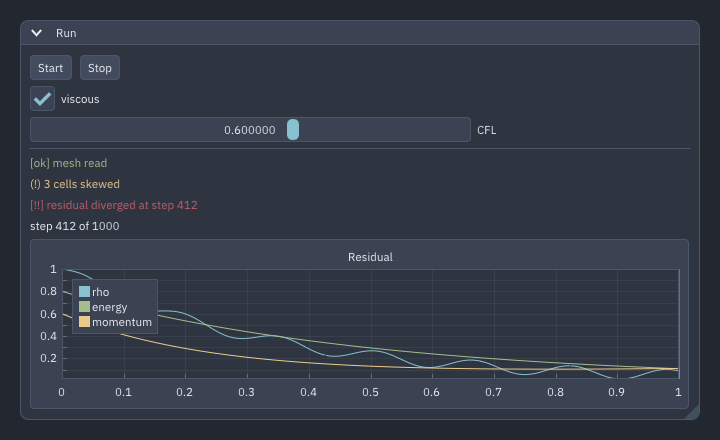
- Changing one part keeps the other:
look=replaces every variable and keeps the colours;palette=replaces every colour, the window's background and the line colours, and keeps the variables. Anamesets both, thenlookandpalettereplace their part of it. - All or none: the arguments are checked before anything changes; an unknown name, look or palette, or a palette below the contrast rule, is
FIG_ERR_ARGUMENT(or a stop, withoutstat) and leaves the style in effect as it was. A call with no argument isFIG_ERR_ARGUMENTtoo. - Names without their trailing blanks: a name, look, palette or line palette is taken without its trailing blanks, so an element of a blank-padded array (
looks(k)) needs notrim. The same holds for every name FIGURE takes: a font or its file (set_font,ig_push_font), a theme file (load_style,save_style), a palette role (palette_color), a colour or variable by name, a colormap and its file (ip_colormap,ip_load_colormap). - Colours and variables changed by name are reset by the part that sets them: a new palette resets the colours, a new look the variables. The font and its size are never changed.
- Modes: the same in window, headless and remote mode (in remote mode the browser takes the palette's background); only
palette='auto'differs.
Looks
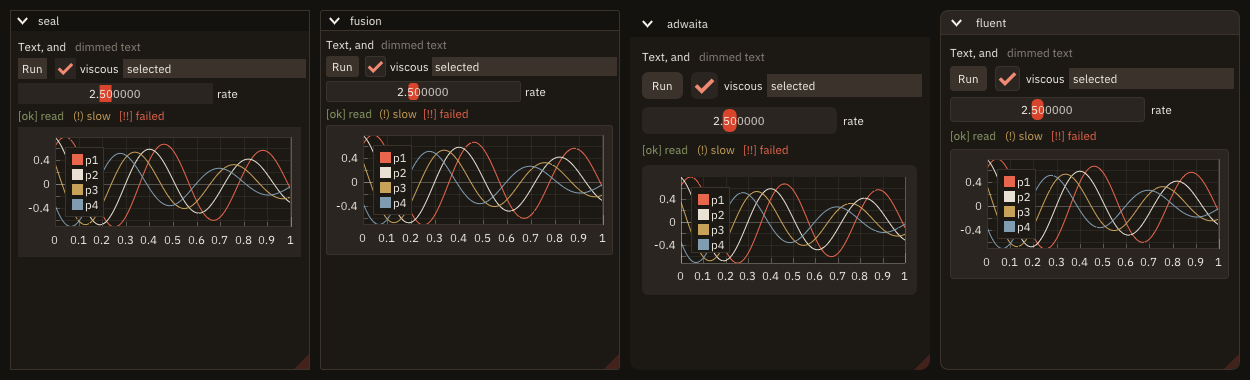
| Look | Close to | Geometry |
|---|---|---|
'seal' | FIGURE's own (the default) | square corners, Dear ImGui's compact spacing |
'fusion' | Qt's Fusion style | corners of 2 pixels, a border on fields and windows, dense rows |
'adwaita' | GNOME's Adwaita (GTK 4) | corners of 6 to 10 pixels, round slider grabs and scroll bars, roomy padding, no borders on fields and windows |
'fluent' | Windows 11 (Fluent 2) | corners of 4 pixels on controls and 8 on windows, framed fields, round slider grabs |
Dear ImGui draws no gradients, shadows or translucency effects: a look reproduces the proportions of its model, not its rendering. Each look is a file, themes/looks/<name>.toml, with [imgui.vars], [implot.vars] and [figure.vars] only (sizes in logical pixels), embedded in the library; a style without a look ('dark', 'light', 'classic') has Dear ImGui's own geometry.
FIGURE's own variables ([figure.vars] of a look or a theme file): TitleBarHeight, the height of the title bar FIGURE draws with decorations='figure' (the window's frame), in logical pixels in [0, 200]; 0, or absent, is the default: the menu bar's height (Dear ImGui's frame height, the font plus twice FramePadding's height). A height below the menu bar's is the menu bar's. The bundled looks set none. A new look sets it again (to the look's, or the default), as it does every other variable; app%save_style writes it when it differs from the look's.
Palettes
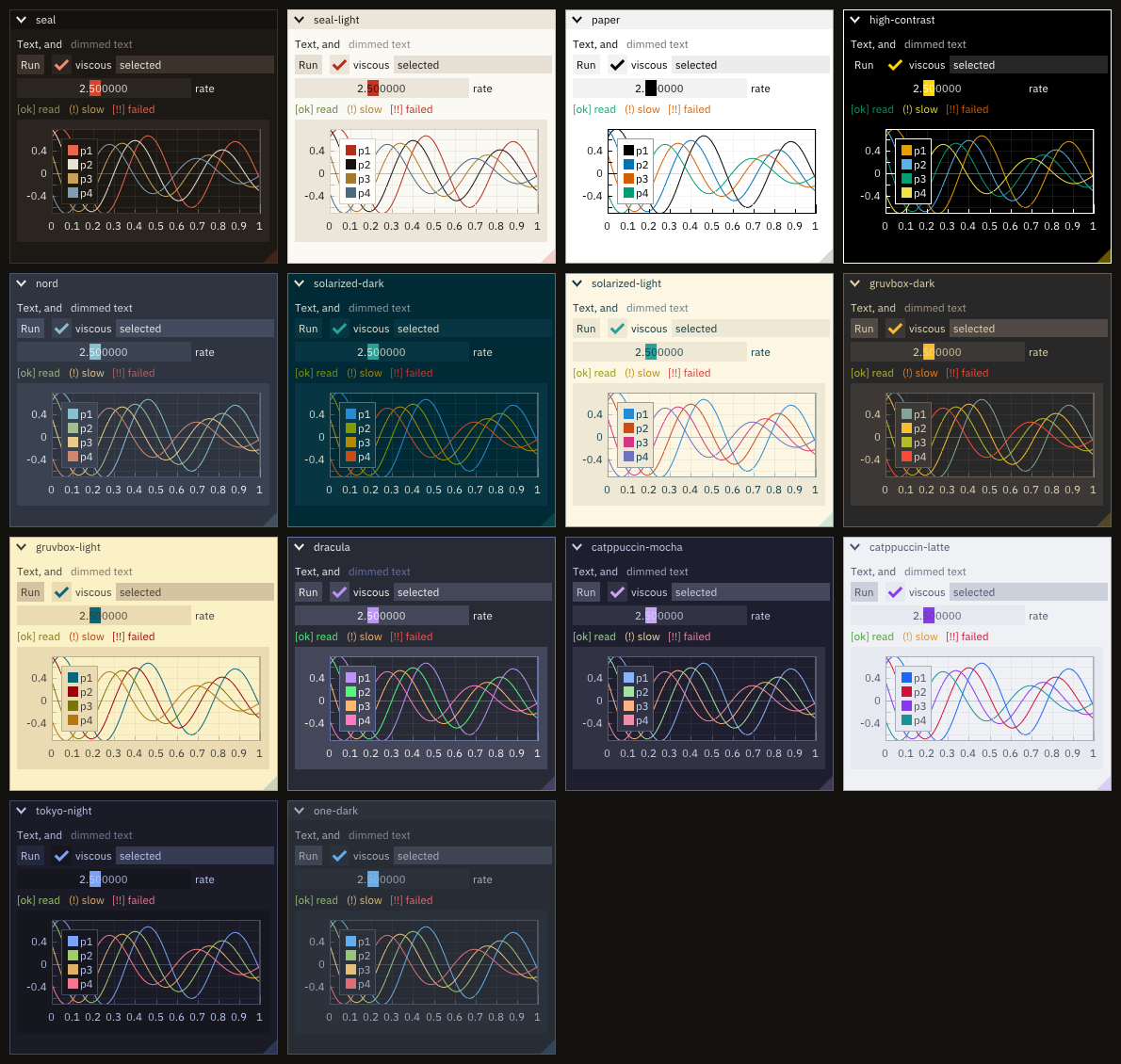
| Palette | Light or dark | Source |
|---|---|---|
'seal', 'seal-light' | dark, light | FIGURE's: ink, paper, one vermilion |
'paper' | light | FIGURE's: black on white, for publication |
'high-contrast' | dark | FIGURE's: white on black, yellow accents |
'nord' | dark | Nord, MIT |
'solarized-dark', 'solarized-light' | dark, light | Solarized, MIT |
'gruvbox-dark', 'gruvbox-light' | dark, light | Gruvbox, MIT |
'dracula' | dark | Dracula, MIT |
'catppuccin-mocha', 'catppuccin-latte' | dark, light | Catppuccin, MIT |
'tokyo-night' | dark | Tokyo Night, MIT |
'one-dark' | dark | One Dark, MIT |
'auto' | the system's | auto_dark or auto_light, below |
Each palette is a file, themes/palettes/<name>.toml, embedded in the library. The hex values are the upstream projects' own, named after each role in the file; where an upstream colour fails the contrast rule in its role, another colour of the same palette takes its place, and the file's comment says which (Nord's comment grey is too dark for dimmed text, so its nord4 is used; Solarized's blue is too weak under text, so its cyan is the accent). Their licences are in THIRD_PARTY.md. FIGURE's four palettes give most Dear ImGui colours by hand (the colours of the styles of the same name); the others are derived from their roles, as every colour of the other palettes is.
Changed in v0.3.0. Until v0.3.0 the colours FIGURE's four styles did not set were Dear ImGui's dark or light style's: a bluish CheckboxSelectedBg in seal, a blue DragDropTarget in paper, a grey dimming behind modals. They are now derived from the palette's roles:
| Colour | seal, seal-light | paper | high-contrast |
|---|---|---|---|
CheckboxSelectedBg | surface | surface | surface |
TableRowBg, TableRowBgAlt | background (transparent); text at 4 % | the same | the same |
NavWindowingHighlight | text at 70 % | text at 70 % | (unchanged) |
NavWindowingDimBg, ModalWindowDimBg | black at 30 % and 45 % | the same | the same |
PlotLinesHovered, PlotHistogramHovered | (unchanged) | accent, accent toward text | the same |
TreeLines | (unchanged) | border | border |
DragDropTarget, DragDropTargetBg | (unchanged) | accent, accent at 10 % | the same |
paper also has MinorAlpha = 0.5 in effect (ImPlot's default is 0.25): the minor grid lines are drawn at half the alpha of the major ones, so they show on white, under the major ones. The line was in the theme file before but never took effect.
Palette roles
| Role | Colours |
|---|---|
background | window backgrounds (WindowBg), title bars, the plot background |
surface | fields, popups, menu bars, tabs, the plot frame (FrameBg, PopupBg, MenuBarBg, Tab) |
raised_surface | buttons and the selected tab (Button, TabSelected) |
border | borders, separators, scroll bar grabs, table and tree lines |
text | text, the input cursor, the plot's text and grid |
dimmed_text | disabled text (TextDisabled), ImGui's own small line plots |
accent | what the user touches: check marks, slider grabs, the selected tab's line, links, resize grips, the docking preview |
text_on_accent | text drawn on an accent fill, by FIGURE's own widgets |
selection | selected lines and headers (Header), selected text (TextSelectedBg) |
success, warning, error | not used by Dear ImGui: for the program's own messages, through app%palette_color |
The roles are opaque colours. app%palette_color(role, rgba) gives the program the roles in effect, so its own messages follow the palette; with a style that has no palette ('dark', 'light', 'classic', a theme file without one) the roles are read from Dear ImGui's colours (WindowBg, FrameBg, Button, Border, Text, TextDisabled, CheckMark, Header), and success, warning and error are Okabe and Ito's bluish green, orange and vermilion. An unknown role is FIG_ERR_ARGUMENT. Colour is never the only carrier of meaning: a mark or a word goes with it.
call app%palette_color('success', ok)               ! the roles of the palette in effect
call app%palette_color('warning', warn)
call app%palette_color('error', bad)call ig_text_colored('[ok] mesh read', ok) ! a mark with the colour: never colour alone
call ig_text_colored('(!) 3 cells skewed', warn)
call ig_text_colored('[!!] residual diverged at step 412', bad)How the colours are derived
One function of the native layer maps the twelve roles to every colour of Dear ImGui (ImGuiCol_*); ImPlot's colours (ImPlotCol_*) are left automatic, so ImPlot derives them from Dear ImGui's: the plot frame from FrameBg, the plot background from WindowBg, the axis text, grid and ticks from Text, the legend from PopupBg.
- Fills are the roles:
WindowBgthe background,FrameBgthe surface,Buttonthe raised surface,Headerthe selection. - Hovered and active fills are mixes toward the text colour (8 % and 16 % for fields and headers, 10 % and 20 % for buttons), or away from it where the mix would bring the text below 4.5:1 on them.
- Disabled text is the dimmed text; scroll bar grabs are the border mixed toward the text.
- Accents: check marks, slider grabs, links, the selected tab's line and the navigation cursor are the accent; separators, resize grips and the docking preview are the accent with transparency.
- The window's background, behind the windows, is the background darkened (by 25 % for a dark palette, 8 % for a light one), unless the palette file gives one.
- Line colours are the palette file's
lines, or ImPlot's default (Deep) if it has none.
Explicit colours still override: a palette file's or a theme file's [imgui.colors] and [implot.colors] are applied after the derivation.
The contrast rule
A palette is checked when it is applied, with the WCAG 2 contrast ratio:
| Pair | At least |
|---|---|
text on background, surface, raised_surface and selection | 4.5:1 |
dimmed_text on background | 3:1 |
text_on_accent on accent | 4.5:1 |
A palette that fails is refused with FIG_ERR_ARGUMENT, and the message names the first failing pair, its ratio and its colours. A theme file my-theme.toml with palette = "nord" and, in its [palette] table, text = "#4c566a" (Nord's comment grey) gives load_style: my-theme.toml: [palette]: text on background is 1.69:1, below 4.5:1 (#4c566a on #2e3440). src/tests/figure_test_themes.F90 holds every bundled palette to the rule, and further to text at 4.5:1 on every fill it is drawn on (hovered and active included) and to line colours at 3:1 on the plot background.
Follow the system's light or dark setting
call app%set_style(palette='auto', auto_dark='nord', auto_light='solarized-light') ! follows the systempalette='auto' takes auto_dark (default 'seal') when the system is set to dark and auto_light (default 'seal-light') when it is set to light, and changes palette when the setting changes while the program runs. The geometry and the line colours given with lines= are kept through the change; colours changed by name are not. auto_dark and auto_light given alone change the pair of an 'auto' in effect.
Modes: in window mode the setting is SDL's (SDL_GetSystemTheme), read again on its theme-changed event; an unknown setting counts as dark. In headless and remote mode the setting is unknown, so 'auto' is auto_dark (in remote mode the browser's own setting is not read). In every mode test_system_theme (from figure_testing) changes the setting at the next frame, as the event would, for tests; 'system' gives it back.
Colours and variables by name
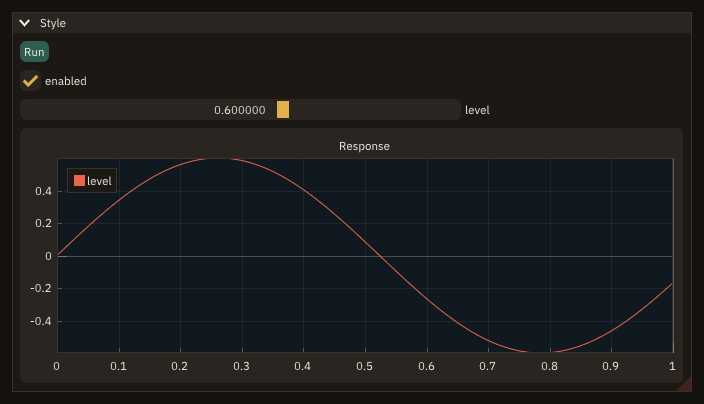
call ig_set_style_color('Button', '#2f5d50')            ! colours: hex or [r, g, b(, a)] in [0, 1]
call ig_set_style_color('ButtonHovered', '#3d7a69')
call ig_set_style_color('SliderGrab', '#e0b04c')
call ig_set_style_color('CheckMark', '#e0b04c')
call ig_set_style_var('FrameRounding', 6.0_real64)      ! a number
call ig_set_style_var('ItemSpacing', [10.0_real64, 8.0_real64]) ! a pair
call ip_set_style_color('PlotBg', '#101820')            ! ImPlot's colours, the same way
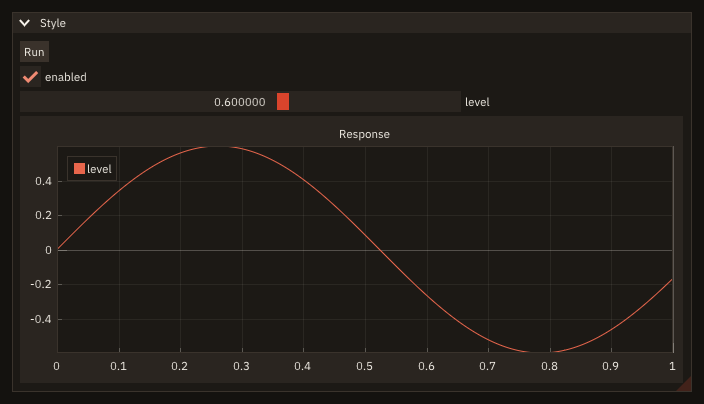
The same program without those lines (cb_style plain), in the default style:
| Procedure | Does |
|---|---|
ig_set_style_color(name, color [, stat]) | a Dear ImGui colour; color is '#rrggbb', '#rrggbbaa', or [r, g, b] / [r, g, b, a] in [0, 1] |
ig_get_style_color(name, rgba [, stat]) | a Dear ImGui colour, as rgba(4) in [0, 1] |
ig_set_style_var(name, value [, stat]) | a Dear ImGui style variable: a real(real64), a pair real(real64) :: v(2), a logical, or an integer(int32) for an enumeration (WindowMenuButtonPosition), as the variable holds |
ig_get_style_var(name, values, n [, stat]) | a Dear ImGui style variable: values(2), and n, how many it holds (1 or 2); a logical reads 0 or 1 |
ip_set_style_color, ip_get_style_color, ip_set_style_var, ip_get_style_var | the same for ImPlot; a variable is a number, a pair or a logical (UseLocalTime, UseISO8601, Use24HourClock), none an integer |
Names are the libraries' own:
- colours: Dear ImGui's
ImGuiCol_*without the prefix (Text,TextDisabled,WindowBg,FrameBg,FrameBgHovered,TitleBgActive,Button,ButtonHovered,ButtonActive,SliderGrab,CheckMark,Header,Separator,Tab,DockingPreview, ...), ImPlot'sImPlotCol_*without the prefix (FrameBg,PlotBg,PlotBorder,LegendBg,LegendText,TitleText,AxisText,AxisGrid,Selection,Crosshairs, ...); - variables: the fields of Dear ImGui's
ImGuiStyle(Alpha,WindowPadding,WindowRounding,WindowBorderSize,FramePadding,FrameRounding,ItemSpacing,ItemInnerSpacing,IndentSpacing,ScrollbarSize,GrabMinSize,GrabRounding,TabRounding,ButtonTextAlign,AntiAliasedLines, the arrows'SymbolArrowSizeFactorandSymbolArrowThicknessFactor, ...) and of ImPlot'sImPlotStyle(PlotBorderSize,MinorAlpha,MajorTickLen,MajorGridSize,PlotPadding,LabelPadding,LegendPadding,FitPadding,PlotDefaultSize, ...). The list is generated from the bound libraries' metadata, so every field of the bound version is there (fonts are set through the font API; the colour arrays through the colour names). Line weights and marker sizes are per item in ImPlot:ip_spec.
An unknown name, a malformed colour, a component outside [0, 1] or a pair given to a single-value variable are FIG_ERR_ARGUMENT (or a stop, without stat). Variables in pixels hold the values Dear ImGui uses, already multiplied by the display's content scale (Content scale).
ig_set_style_color and ig_set_style_var change a Dear ImGui colour or variable, ip_set_style_color and ip_set_style_var an ImPlot one; ig_get_style_color, ig_get_style_var, ip_get_style_color and ip_get_style_var read them back. ip_get_style_color gives ImPlot's automatic colours (derived from Dear ImGui's) as ImPlot draws them. Sets and gets need no frame: they work before the first next_frame and between frames, after init*.
A change applies to everything drawn afterwards, globally, until it is changed again; app%set_style resets them all to the named style.
Changes for a block
A colour or a variable can also change for a few widgets only: push it before them, pop it after. Pushes and pops pair like ig_begin and ig_end; one stack holds the colours of both libraries, another the variables.
call ig_push_style_color('Button', '#b42d1a')         ! this button only
call ig_push_style_color('ButtonHovered', '#d9442c')
call ig_push_style_color('ButtonActive', '#e8664c')
call ig_push_style_var('FramePadding', [16.0_real64, 6.0_real64])
if (ig_button('Stop')) running = .false.
call ig_pop_style_var()
call ig_pop_style_color(3)                            ! the three colours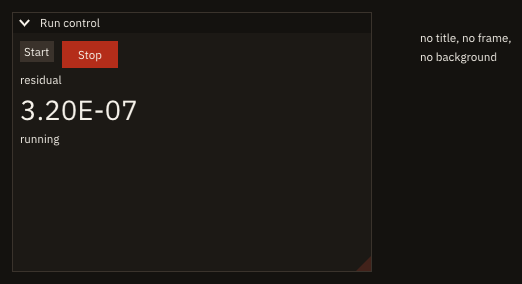
| Procedure | Does |
|---|---|
ig_push_style_color(name, color [, stat]) | change a Dear ImGui colour ('#rrggbb[aa]' or components) until its pop |
ig_pop_style_color([n] [, stat]) | undo the n newest colour pushes (default 1) |
ig_push_style_var(name, value [, stat]) | change a Dear ImGui style variable until its pop: a number, a pair, a logical, or an integer(int32) for an enumeration |
ig_pop_style_var([n] [, stat]) | undo the n newest variable pushes (default 1) |
ip_push_style_color, ip_pop_style_color, ip_push_style_var, ip_pop_style_var | the same for ImPlot (a variable: a number, a pair or a logical) |
ip3_push_style_color, ip3_pop_style_color, ip3_push_style_var, ip3_pop_style_var | the same for ImPlot3D: ImPlot3DCol_* without the prefix, the fields of ImPlot3DStyle (a number or a pair) (3-D plots) |
Every colour and every variable of the name tables can be pushed, not only those Dear ImGui's own PushStyleVar covers. ig_push_style_color, ig_push_style_var, ip_push_style_color and ip_push_style_var (and the ip3_ ones) change a value until ig_pop_style_color or ig_pop_style_var undoes it; ip_pop_style_color and ip_pop_style_var pop the same stacks. Unlike the sets, pushes and pops need a frame open: outside one they are refused with FIG_ERR_STATE, a usage error (Pairing and frames). More pops than pushes are FIG_ERR_STATE.
Fonts
The interface is drawn in IBM Plex Sans at 15 logical pixels, a font made for technical interfaces, bundled with FIGURE (OFL-1.1, THIRD_PARTY.md) and embedded in the library: programs need no font file. Its monospace sibling, IBM Plex Mono, is bundled the same way, for text whose columns must line up: input files, tables of numbers, the output of a tool. The symbols either lacks (Greek in Plex Mono, ∇ in both) come from a bundled fallback, Noto Sans Math (below).
| Procedure | Does |
|---|---|
app%set_font(font [, size] [, stat]) | the default font: 'plex-sans' (the default), 'plex-mono' (IBM Plex Mono, monospace), 'proggy' (Dear ImGui's own 13-pixel bitmap font) or the path of a TrueType/OpenType file; size in logical pixels |
ig_push_font(font [, size] [, stat]), ig_pop_font([stat]) | another font and/or size for the widgets in between (font='' keeps the current one): a title, a value shown large |
call app%init_headless(640_int32, 480_int32)
call app%set_font('plex-sans', 15.0_real64) ! the default font, at its default sizecall ig_push_font('plex-mono') ! columns of numbers that line up
call ig_text(' step residual')
call ig_text(' 100 1.25e-03')
call ig_text(' 1000 4.10e-07')
call ig_pop_font()
call ig_new_line() ! an empty line, of the text's height
call ig_push_font('', 28.0_real64) ! a big value, in the current font
call ig_text('3.1416')
call ig_pop_font()app%set_font('proggy') gives Dear ImGui's classic bitmap font; a file is given by its path, app%set_font('/usr/share/fonts/truetype/dejavu/DejaVuSans.ttf', 16.0_real64).
'plex-mono' gives every character the same advance, so the columns of a text line up; it is the font for a multi-line field showing a file, pushed around it:
if (ig_button(ICON_SAVE//' Save')) then
   call write_text(trim(file), buffer%text())
   write(output_unit, '(A,I0,A)') 'saved '//trim(file)//': ', buffer%length(), ' bytes' ! UTF-8: bytes, not characters
   modified = .false.
endif
call ig_same_line()
if (modified) then
   call ig_text('(!) modified: '//trim(file))
else
   call ig_text('saved: '//trim(file))
endif
call ig_push_font('plex-mono')         ! columns line up: every character as wide
if (ig_input_text_multiline('##text', buffer, width=-1.0_real64, height=-1.0_real64, tab_input=.true.)) &
   modified = .true.
call ig_pop_font()
Fonts are rasterised on demand at every size used (Dear ImGui's dynamic font atlas): any size stays sharp, and the display's content scale applies on top. A file that cannot be read is FIG_ERR_FAILED; one that is not a font, or a size outside (0, 200], is FIG_ERR_ARGUMENT. A theme file can name the font and its size (font, font_size).
Symbols: the fallback fonts
| Procedure | Does |
|---|---|
app%add_fallback_font(file [, stat]) | a TrueType/OpenType file of the program's own, asked for the glyphs every other font of a text font lacks |
(Dear ImGui's merged fonts: ImFontConfig::MergeMode, the sources of a font asked in order for each glyph.)
A text font is a stack of fonts asked in order for each character; the first that has a glyph draws it:
| Order | Font | Gives |
|---|---|---|
| 1 | the text font: IBM Plex Sans, IBM Plex Mono, Proggy or the file of set_font/ig_push_font | its own glyphs: Plex Sans has Latin, Greek and most operators; Plex Mono has Latin and the operators but no Greek, nor ∇; both have the super- and subscript digits |
| 2 | Lucide (bundled) | the icons, ICON_*, in the Private Use Area |
| 3 | Noto Sans Math (bundled, OFL-1.1) | what the two before lack: the Greek letters and ∇ in Plex Mono, ∇ in Plex Sans, the mathematical operators and arrows |
| 4, 5, ... | the program's own, in the order added | what all of the above lack |
The symbols CFD writes were checked glyph by glyph (fontTools, on the bundled files) and have a glyph in both text fonts: the Greek letters, upper and lower case; ∇ ∂ Δ ∞ ≈ ≤ ≥ ± × · √ ∑ ∫; the superscript and subscript digits ⁰ ¹ ² ³ ⁴ ⁵ ⁶ ⁷ ⁸ ⁹, ₀ ₁ ₂ ₃ ₄ ₅ ₆ ₇ ₈ ₉. Noto Sans Math has every one of them except · and the super- and subscript digits, which both Plex fonts have. figure_test_text checks each one's bitmap in both fonts.
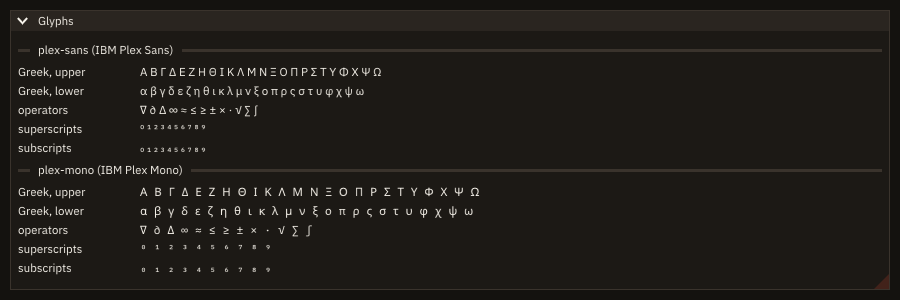
call ig_push_font('plex-mono')
call ig_text('field    residual   reference')
call ig_text(RHO//'        1.2e-06    '//RHO//INF)          ! Greek and the operators: Noto Sans Math
call ig_text(NABLA//'p       3.4e-05    |'//NABLA//'p|'//SQUARE) ! the superscripts: Plex Mono's own
call ig_pop_font()
A program's own fallback, for a script Plex and Noto Sans Math lack (a CJK font, a font of its own symbols):
if (file /= '') call app%add_fallback_font(trim(file)) ! after Plex, the icons and Noto Sans Math, in every text fontThe program prints, headless, which font gives each symbol (test_glyph, Headless testing): Plex Mono's own A and ², Noto Sans Math's ρ and ∇, and the file's ά (alpha with tonos, in Plex Sans but in neither Plex Mono nor Noto Sans Math):
$ ./cb_fallback_font --check ../../../third_party/fonts/IBMPlexSans-Regular.ttf
symbol       plex-mono                plex-sans
A            IBM Plex Mono            IBM Plex Sans
rho          Noto Sans Math           IBM Plex Sans
nabla        Noto Sans Math           Noto Sans Math
infinity     IBM Plex Mono            IBM Plex Sans
square       IBM Plex Mono            IBM Plex Sans
alpha tonos IBMPlexSans-Regular.ttf IBM Plex Sans- Sizes: a fallback's letters are scaled to the text font's em (Dear ImGui sizes a font by its height from ascent to descent, which differs between fonts: Noto Sans Math's at the size of Plex would be 13 % smaller), and stand on its baseline: Noto Sans Math's capitals are 2 % taller than Plex's (cap heights 714 and 698 per 1000 of the em).
- When: after
init*. Called between frames, it applies at once; inside a frame, from the next frame (a font is changed between frames). It reaches every text font, those loaded already and those loaded later. A file added already is not added again; the fallbacks last untildestroy. - Status: a file that cannot be read is
FIG_ERR_FAILED; one that is not a TrueType/OpenType font, or a fourteenth fallback,FIG_ERR_ARGUMENT(Dear ImGui keeps 16 fonts in one: the text font, Lucide, Noto Sans Math and 13 of the program's); beforeinit*,FIG_ERR_STATE. Messages:app%add_fallback_font: cannot read the font FILE,app%add_fallback_font: FILE is not a TrueType or OpenType font,app%add_fallback_font: 13 fallback fonts already (Dear ImGui's 16 per font),app%add_fallback_font: figure is not initialized. Withoutstat, the program stops with the message (Error handling). - Modes: the same in window, headless and remote mode.
- Threads: the frame loop's thread; a task is refused (
FIG_ERR_STATE). - What it does not do: a fallback's glyphs keep their own advance: inside a monospace text (Plex Mono) a Greek letter or
∇from Noto Sans Math is proportional, so a column after it can shift by a fraction of a character. Code points beyond the Basic Multilingual Plane (U+10000 and up: the mathematical alphanumerics𝑥 𝛼, emoji) are not drawn: FIGURE builds Dear ImGui with 16-bit characters. No font is looked up on the system: a program names its files.
Icons
The Lucide icons (ISC licence, bundled and embedded like the font) are merged into every text font FIGURE loads: the two bundled ones, Proggy, and any font file given to app%set_font or ig_push_font. An icon is a UTF-8 string, ICON_<NAME>, exported by use figure: it goes in any label, before or after the text, and takes the size and colour of the text around it.
if (ig_button(ICON_PLAY//' Run')) runs = runs + 1_int32
call ig_same_line()
call ig_text(ICON_TRIANGLE_ALERT//' 3 warnings')
call ig_push_font('', 32.0_real64)                      ! a big icon, alone: the current font, larger
call ig_text(ICON_CHART_LINE)
call ig_pop_font()
The names are those of the Lucide gallery, upper-cased, with - turned into _, after ICON_: file-pen is ICON_FILE_PEN, chart-line is ICON_CHART_LINE. All 2171 names of the bundled Lucide 1.61.0 are there, the older names of renamed icons included (ICON_ALERT_CIRCLE and ICON_CIRCLE_ALERT are one glyph); src/lib/figure_icons.F90 lists them with their code points. Icons are as wide as the font is high, and centred on the capitals of the text. The constants are generated from the font's code point map by scripts/gen_icons.py.
Theme files
Every named style is a small text file in the repository, themes/<name>.toml, embedded in the library when the native layer is built: adding a file there adds a style. The format is a subset of TOML:
# A theme file, every kind of entry (themes/seal.toml, the default style, sets two: look and palette).
look = "fluent"                                # a look: its geometry first (default: Dear ImGui's)
palette = "nord"                               # a palette, or "auto" (default: none, the colours of base)
auto_dark = "nord"                             # the palettes of "auto" (defaults: seal, seal-light)
auto_light = "solarized-light"
base = "dark"                                  # dark | light | classic: the colours without a palette
font = "plex-sans"                             # plex-sans | plex-mono | proggy | a font file (default: the font in effect)
font_size = 15                                 # logical pixels (default: the size in effect)
background = "#14120f"                         # behind the windows (default: the palette's, or the base's)
lines = ["#e8664c", "#e9e2d4", "#c9a25a"]      # ImPlot's line colours, in order, or "okabe-ito" (default: the
                                               # palette's, or ImPlot's Deep)

[palette]                                      # roles: all twelve, or some over the named palette
accent = "#d08770"

[imgui.vars]                                   # ImGuiStyle fields: a number, [x, y], true or false
WindowRounding = 0
FramePadding = [4, 3]

[imgui.colors]                                 # ImGuiCol_* names: "#rrggbb", "#rrggbbaa", ["#rrggbb", alpha]
Text = "#f6f2ea"                               # or [r, g, b, a] in [0, 1]
PopupBg = ["#1c1915", 0.97]

[implot.vars]                                  # ImPlotStyle fields
[implot.colors]                                # ImPlotCol_* names

[figure.vars]                                  # FIGURE's own variables
TitleBarHeight = 40 # the title bar of decorations='figure' (0: the menu bar's)- Names are those of colours and variables by name;
#starts a comment. - The order: the colours come from the palette (derived from its roles) or, without one, from
base; the variables from the look or, without one, from Dear ImGui's defaults; then the file's own[imgui.vars],[imgui.colors],[implot.vars]and[implot.colors]override them. With a palette,basegives no colour. - A
[palette]table gives roles: withpalette = "name"it overrides single roles of that palette; without, it must give all twelve. Either way the contrast rule applies to the result. - Everything not given comes from the look, the palette or
base: a theme file lists only what it changes, and a newer Dear ImGui adding style colours never leaves a theme file incomplete. - Sizes are in logical pixels, multiplied by the display's content scale when the theme file is applied.
- ImPlot's colours not given are derived from Dear ImGui's (ImPlot's automatic colours), so a theme file that sets only Dear ImGui colours gives matching plots.
- A malformed file is reported with its line:
themes/x.toml:12: unknown Dear ImGui colour "Buton".
A look file (themes/looks/) holds [imgui.vars], [implot.vars] and [figure.vars] only; a palette file (themes/palettes/) holds a complete [palette] table and, optionally, background, lines, [imgui.colors] and [implot.colors]. Adding a file there and rebuilding the native layer adds a look or a palette.
The built-in styles' theme files: seal, seal-light, dark, light, classic, paper, high-contrast.
Load, tune and save
| Procedure | Does |
|---|---|
app%load_style(file [, stat]) | apply a theme file; FIG_ERR_FAILED if it cannot be read, FIG_ERR_ARGUMENT if it is malformed (the message gives file and line) |
app%save_style(file [, stat]) | write the style in effect as a theme file: its look and palette (or its base), background and line colours, and every colour and variable that differs from what they give, including the changes made by name or in the style editor |
ig_show_style_editor([open] [, stat]) | Dear ImGui's and ImPlot's own style editors in a window, "Style editor": every colour and size, live; inside a frame (outside one: FIG_ERR_STATE) |
ig_show_style_editor opens Dear ImGui's and ImPlot's style editors in a window of their own: every colour and size changes the interface live, and app%save_style keeps the result as a theme file that app%load_style reads back.
FIGURE_STYLE also takes a file: a value with a / or ending in .toml is loaded as a theme (FIGURE_STYLE=./my-theme.toml exe/examples/figure_hello).
call ig_show_style_editor()                          ! every colour and size, live
call ig_set_next_window(20.0_real64, 20.0_real64, 520.0_real64, 400.0_real64)
if (ig_begin('Sample')) then
   if (ig_button('Save theme')) then
      call app%save_style('my-theme.toml', stat=stat) ! what differs from the base, as a theme file
      if (stat == 0_int32) then
         saved = 'saved to my-theme.toml'
      else
         saved = 'cannot write my-theme.toml'
      endif
   endif
   call ig_text(trim(saved))
The file written in the recording above begins:
# FIGURE theme, written by app%save_style

base = "dark"
background = "#14120f"
lines = ["#e8664c", "#e9e2d4", "#c9a25a", "#7f9cb0", "#8fa06a", "#a77a95", "#d98b6a", "#a3998c"]

[imgui.vars]
FramePadding = [12, 3]
FrameRounding = 6
FrameBorderSize = 1
ScrollbarRounding = 0
GrabRounding = 6
TabRounding = 0
...
save_style writes sizes in logical pixels (whatever the display's content scale) and colours as 8-bit hex, with their alpha exact; load_style reads the file back to the same style. A look and a palette are written by name (look = "fluent", palette = "nord", and for 'auto' its pair), a palette given as a [palette] table as its twelve roles; what follows is only what differs from them. Edit the file freely: everything not in it comes from the look, the palette or base.