Named patches

What it does
A CFD body carries several boundary conditions: walls, inlets, outlets, porous or heated regions. Exporters write them as named solid <name> … endsolid blocks of one ASCII STL, or as one STL file per patch. FOSSIL keeps them (issue #66): every facet carries a patch id (facet%patch), an index into the surface's table of patch names.
Reading and writing
load_from_filereads one patch persolidblock of an ASCII file, named after the block, in file order; blocks with the same name merge. A file with one block, or a binary file, is one patch named after the header.load_from_files(file_names)reads several files as one surface, one patch per file (or per block), named after thesolidname or, when that is empty, the file name.save_into_file(is_ascii=.true.)writes one block per patch; a single-patch surface writes exactly the file it wrote before. Binary STL has no names: all patches go into one.get_patches_number(),patch_name(i),facet_patch(f)read the table;set_patch(facets, name)moves facets to a named patch, created if new.
Before issue #66 the ASCII reader stopped with "malformed STL" at the first endsolid of a multi-solid file.
Through the pipeline
The patch id travels with the facet, so every operation that keeps or copies facets keeps it:
sanitize: degenerate and duplicate facets are removed with their ids; of two duplicates in different patches the first one in the file wins.rotate,translate,mirror,resizemove vertices only.clipkeeps the patch of every facet, and the remainder keeps the name table.merge_solids(other)mapsother's patches into the surface's table by name: equal names merge, new names are appended.fill_holesgives the new facets the patch of the hole's boundary when every boundary facet is in one patch, and a patch namedfilledotherwise (a hole across a wall/inlet edge has no single right answer; the caller canset_patchit).
Through booleans
boolean and resolve_self_intersections keep the patch of every facet: a sub-triangle of the arrangement takes its parent facet's patch, so the area of a patch in the result is the area of its parent patch outside (or inside) the other body, as the operation selects. The other surface's patches join the table by name before the arrangement: A ∪ B of a body with patches low, high and one with b_low, b_high has all four, and equal names merge.
Through remeshing
Patch boundaries are kept where they are, like the sharp edges of feature edges, and every facet keeps a patch:
isotropic_remesh: the vertices of the edges between two patches are locked (whateverpreserve_featuressays), so those edges are never flipped or collapsed; a split facet's halves keep its patch, and a midpoint on a boundary edge becomes a boundary vertex.decimate: two boundary vertices never merge, and an interior vertex merges onto a boundary one at its place; the boundary vertices are the input ones exactly.smooth: the boundary vertices do not move.alpha_wrap: each facet of the wrap takes the patch of the input facet closest to its centroid.
In the queries
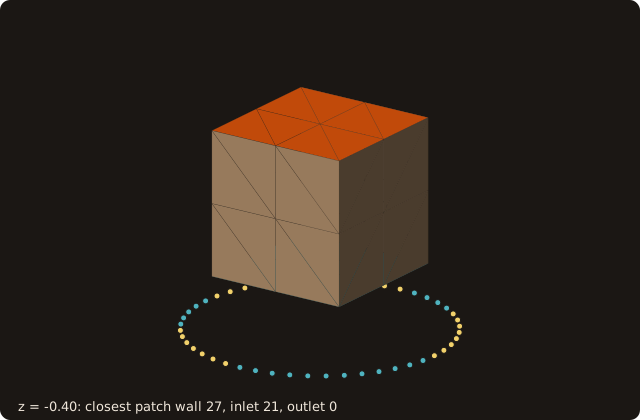
query_many(patches=), query_many_device(patches=), probe_many(patches=) and image_points(patches=) return the patch of the facet that holds each query's closest point: the boundary condition to apply at an image point or a forcing point. The device path looks it up on the host from the facet ids the device returns, so it is bit-identical to the CPU path (the GPU bench line patch device vs serial mismatches is 0).
2-D curves
A curve carries a patch per segment (segment i runs from vertex i to the next). In the loop format, a line # patch <name> puts the segments starting at the vertices that follow in that patch; it does not end the loop. A curve without directives has one unnamed patch and is written back without them. repair keeps every segment's patch through joins, merges and reversals; slice_surface gives each segment the patch of the facet it is cut from, and the curve takes the surface's names. query_many(_device)(patches=), probe_many(patches=) and image_points(patches=) return the patch of the closest segment (device: host lookup, bit-identical). API: get_patches_number, patch_name, segment_patch, set_patch.
# patch wall
0 0
1 0
1 1
# patch inlet
0 1
Command line
fossilizer -i body.stl --patches prefix_ prints the patches (facets and area each) and writes each one to prefix_<name>.stl.
Example
The cookbook recipe wall, inlet and outlet from one STL tags the faces of a box, writes them as three blocks, reads them back and queries the patch at three points.
API
See Patches in the API reference.