

Mass properties
What it does
Computes, for the closed body bounded by a surface:
- the mass and the centre of mass;
- the inertia tensor, about the centre of mass or about any given point;
- the principal moments and principal axes.
The results come from exact polyhedral integrals: the only error is floating-point round-off. A body moved by the fluid (6-DOF fluid–structure interaction) needs them to integrate the Newton–Euler equations, alongside the prescribed kinematics of moving bodies (issue #59, roadmap #58).
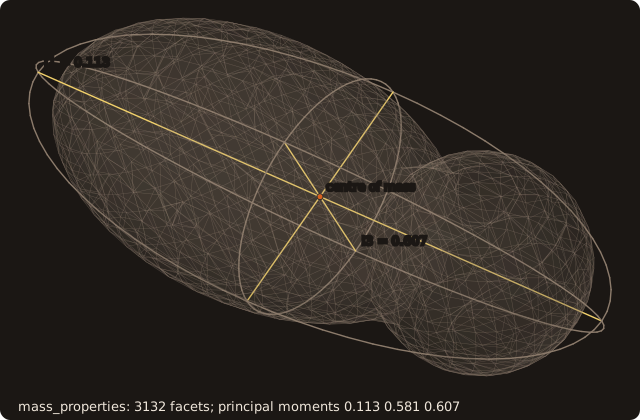
The figure shows a body with no symmetry: the union of a tilted ellipsoid and an off-centre ball, from marching cubes. It is drawn with its centre of mass, its principal axes and the equivalent inertia ellipsoid. That is the uniform ellipsoid with the same mass and inertia tensor, drawn as its three principal sections. Its longest semi-axis lies along the axis of the smallest moment.
Method
Each facet (a, b, c) and a reference point o form a signed tetrahedron. With a, b, c taken relative to o and
where
The principal moments and axes are the eigenvalues and eigenvectors of
Choices that keep it exact in practice
- The reference point is the bounding-box centre, not the origin. Far from the origin the sums would cancel: a box at
from the origin loses its tensor entirely with o = 0 (relative error 36 in the test), and keeps it to round-off with o = the box centre. - Only the vertices enter, in their stored order, as for the volume. A stale stored facet normal cannot change the result.
- The sums are compensated (Neumaier) and run in a fixed order. The error stays O(ε) instead of O(N ε), and the result does not depend on the thread count.
- The principal axes are orthonormal and right-handed (det = +1). The moments are sorted ascending. The sign convention is fixed: in axes 1 and 2 the largest-magnitude component is positive, and axis 3 = axis 1 × axis 2. With repeated moments (a sphere, a cube) the axes are not unique, and any orthonormal set returned is valid.
API
call surface%mass_properties(mass, center, inertia, principal_moments, principal_axes, density, about, volume, status)
   class(surface_stl_object), intent(in)            :: self
   real(R8P),                 intent(out), optional :: mass                 ! density * volume
   real(R8P),                 intent(out), optional :: center(3)            ! centre of mass
   real(R8P),                 intent(out), optional :: inertia(3,3)         ! about center, or about `about`
   real(R8P),                 intent(out), optional :: principal_moments(3) ! ascending
   real(R8P),                 intent(out), optional :: principal_axes(3,3)  ! columns, right-handed
   real(R8P),                 intent(in),  optional :: density              ! uniform, default 1
   real(R8P),                 intent(in),  optional :: about(3)             ! point of the tensor
   real(R8P),                 intent(out), optional :: volume               ! enclosed volume
integer(I4P), intent(out), optional :: status ! STATUS_OK, STATUS_INVALID_INPUT- The surface must be watertight with a positive enclosed volume (outward orientation). Otherwise
statusisSTATUS_INVALID_INPUTand every output is zero: never a silently wrong tensor. Runsanitize, withfill_holes=.true.if needed, first. - Voids are fine. An inner shell wound inward subtracts its volume and its moments.
principal_momentsandprincipal_axesalways refer to the tensor about the centre of mass, whateveraboutis.- The procedure does not modify the surface and needs no extra memory beyond a few scalars.
Frames and poses
The tensor is computed in the frame of the surface's coordinates (the body frame of moving bodies). Two free functions, exported by fossil, change frame:
inertia_w = inertia_to_world(inertia, pose)       ! type(rigid_pose_t): R I R^T
frame = principal_frame(center, principal_axes) ! rigid_pose_t: principal coordinates -> body coordinatesinertia_to_worldgives the tensor of the body placed atpose(x_world = R x_body + t): R I Rᵀ. The translation does not enter, because the tensor is about a point that moves with the body (the centre of mass). The body moved bymove(pose)gives the same tensor to round-off (5e-16 in the test).principal_frameis the pose whose rotation is the principal axes and whose origin is the centre of mass: in its coordinates the tensor is diagonal (off-diagonal 1e-16 of the largest moment in the test). Compose it with a world pose to place a body integrated in its principal frame, as the animation below does.
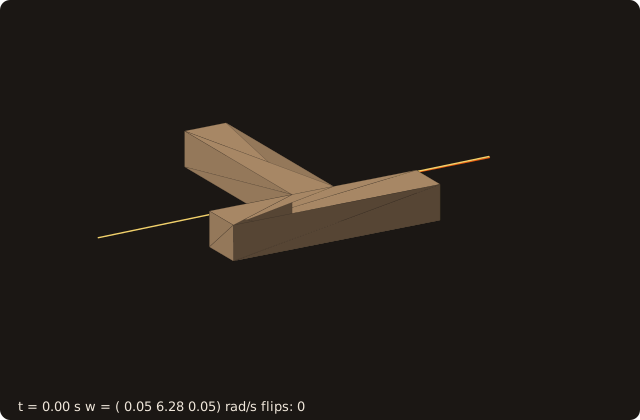
The animation is a T-handle spinning about its intermediate principal axis, the tennis-racket (Dzhanibekov) effect. The program (docs/examples/src/anim_mass_properties.f90) does three things:
- it takes the principal moments and axes from
mass_properties; - it integrates Euler's equations
in the principal frame together with the orientation, using RK4 with a fixed step; - it draws the body at each pose with
principal_frameandmove.
The angular velocity is drawn in ember from the centre of mass; the line of the angular momentum, fixed in space, in gold. A spin about the intermediate axis is unstable: the handle flips over twice in 6 s. Over the whole run the kinetic energy and the angular momentum drift by 3e-12 and 2e-11 relative, which is the integrator's error.
2-D: curves
curve%mass_properties gives the same quantities, per unit depth, for the region bounded by a closed curve. Green's theorem over each segment
The sums are taken about the bounding-box centre and compensated, as in 3-D. Holes, wound clockwise, subtract.
call curve%mass_properties(mass, center, second_moments, polar_moment, principal_moments, principal_angle, &
                           density, about, area, status)
second_moments = [I_uu, I_vv, I_uv]about p = the centroid (or about). These are the second moments of the region, not of inertia about the axes:is the beam engineer's second moment of area for bending about the u axis. polar_momentis the inertia per unit depth for a rotation in the plane: the of the extruded body divided by its depth (checked against the 3-D path to round-off). principal_moments(2)are the eigenvalues of the 2×2 matrix of second moments, ascending, andprincipal_angle(radians, in (−π/2, π/2]) is the direction of the axis of the larger one: the long axis of the section.- Every loop must be closed and the enclosed area positive; otherwise
status = STATUS_INVALID_INPUT.
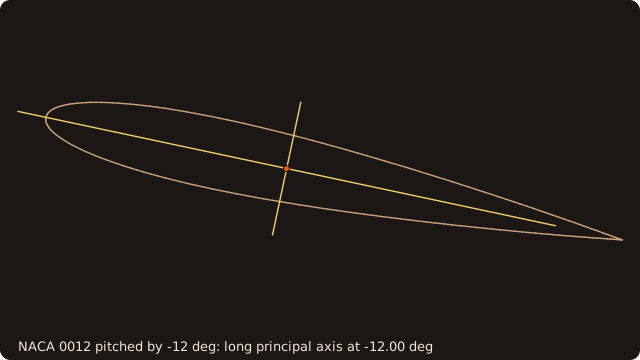
A NACA 0012 section of unit chord pitched by −12° (200 points). Its area is 0.0817, its centroid is at 0.42 chord, and principal_angle returns the pitch, −12.00°.
program ck_mass_properties_2d
use fossil, only : curve_object, STATUS_OK
use penf,   only : I4P, R8P
implicit none
type(curve_object) :: tube
real(R8P)          :: area, center(2), sm(3), polar
integer(I4P)       :: status

! A hollow rectangular section 0.1 x 0.2 m, walls 0.01 m: the outer loop counter-clockwise, the hole clockwise.
call tube%adopt_loops(u=[-0.05_R8P,  0.05_R8P, 0.05_R8P, -0.05_R8P,   -0.04_R8P, -0.04_R8P, 0.04_R8P,  0.04_R8P], &
                      v=[-0.10_R8P, -0.10_R8P, 0.10_R8P,  0.10_R8P,   -0.09_R8P,  0.09_R8P, 0.09_R8P, -0.09_R8P], &
                      loop_sizes=[4_I4P, 4_I4P])
call tube%mass_properties(area=area, center=center, second_moments=sm, polar_moment=polar, status=status)
if (status /= STATUS_OK) error stop 'not a closed section'
print '(A,ES12.5,A)',  'area                 ', area, ' m^2'
print '(A,2F9.5)',     'centroid             ', center
print '(A,ES12.5,A)',  'int v^2 dA (bending about u) ', sm(2), ' m^4'
print '(A,ES12.5,A)',  'int u^2 dA (bending about v) ', sm(1), ' m^4'
print '(A,ES12.5,A)',  'polar moment         ', polar, ' m^4'
print '(A,ES12.5)',    'by hand: (b h^3 - b''h''^3)/12 = ', (0.1_R8P * 0.2_R8P ** 3 - 0.08_R8P * 0.18_R8P ** 3) / 12
endprogram ck_mass_properties_2d
$ ck_mass_properties_2d
area 5.60000E-03 m^2
centroid 0.00000 0.00000
int v^2 dA (bending about u) 2.77867E-05 m^4
int u^2 dA (bending about v) 8.98667E-06 m^4
polar moment 3.67733E-05 m^4
by hand: (b h^3 - b'h'^3)/12 = 2.77867E-05Example
program ck_mass_properties
use fossil, only : surface_stl_object, STATUS_OK
use penf,   only : I4P, R8P
use vecfor, only : ex_R8P, ey_R8P, ez_R8P
implicit none
type(surface_stl_object) :: block
real(R8P)                :: mass, center(3), inertia(3,3), moments(3), axes(3,3)
integer(I4P)             :: status, i

call block%load_from_file(file_name='cube-01.stl', guess_format=.true.)   ! the unit cube
call block%resize(factor=0.1_R8P * ex_R8P + 0.2_R8P * ey_R8P + 0.3_R8P * ez_R8P)  ! a 0.1 x 0.2 x 0.3 m block
call block%analyze
call block%mass_properties(mass=mass, center=center, inertia=inertia, principal_moments=moments, &
                           principal_axes=axes, density=7850._R8P, status=status)           ! steel, kg/m^3
if (status /= STATUS_OK) error stop 'not a closed body'
print '(A,F10.4,A)',  'mass              ', mass, ' kg'
print '(A,3F10.4,A)', 'centre of mass    ', center, ' m'
print '(A)',          'inertia tensor about the centre, kg m^2:'
do i = 1, 3
   print '(3F12.6)', inertia(i,:)
enddo
print '(A,3F10.6)',   'principal moments ', moments
call block%mass_properties(inertia=inertia, density=7850._R8P, about=[0._R8P, 0._R8P, 0._R8P])
print '(A,3F10.6)',   'about the corner: diagonal ', (inertia(i,i), i = 1, 3)
endprogram ck_mass_properties
$ ck_mass_properties
mass 47.1000 kg
centre of mass 0.0500 0.1000 0.1500 m
inertia tensor about the centre, kg m^2:
0.510250 0.000000 0.000000
0.000000 0.392500 0.000000
0.000000 0.000000 0.196250
principal moments 0.196250 0.392500 0.510250
about the corner: diagonal 2.041000 1.570000 0.785000The block is 0.1 × 0.2 × 0.3 m, so
Command line
fossilizer --mass_properties prints the mass properties of each input after the other operations, with an optional uniform --density (default 1). A surface that is not closed is reported, not measured:
fossilizer -i cube-02.stl --mass_properties --density 2mass properties, density 2.000000000000000E+00
mass 2.000000000000000E+00
centre of mass 5.000000000000000E-01 5.000000000000000E-01 5.000000000000000E-01
inertia tensor about the centre of mass:
3.333333333333334E-01 -1.355252715606881E-19 -1.355252715606881E-19
-1.355252715606881E-19 3.333333333333334E-01 1.355252715606881E-19
-1.355252715606881E-19 1.355252715606881E-19 3.333333333333334E-01
principal moments 3.333333333333333E-01 3.333333333333361E-01 3.333333333333361E-01
principal axes (columns):
...The cube's three moments are equal, so its principal axes are any orthonormal set (the printed ones are one). src/tests/fossil_test_mass_cli.f90 reads these lines back.
Validation
src/tests/fossil_test_mass_properties.f90, against closed-form results:
| Case | Checked | Measured error |
|---|---|---|
| Box a×b×c, density 2 | mass, centre, tensor; tensor about a corner | 0 (exact) |
| L-shaped prism (one shell) | the two boxes' tensors moved to the common centre | 2.4e-16 |
| Hollow box (inner shell reversed) | outer minus inner | 1.7e-16 |
| The box under a rotation R | R I Rᵀ, principal moments, axes = R's columns up to sign | 3.2e-16, 1.1e-15, 0 |
| The box at 10⁶ from the origin | tensor about the centre unchanged | 0 |
cube-04.stl (3072 facets) | volume 1, centre 0.5, tensor = get_volume(), get_centroid() | 2.3e-14, 0, 1.7e-16 |
| Marching-cubes unit sphere, 3 grids | mean moment → 2/5 m r² | observed order 2.01 |
| Open box, inside-out box | STATUS_INVALID_INPUT | |
symmetric3_eigen, 200 random matrices | A v = w v, det v = 1, vᵀv = 1 | < 1e-13 |
The L prism moved by move(pose) | tensor = inertia_to_world, centre = to_world | 5.5e-16, 1.5e-16 |
principal_frame | Rᵀ I R diagonal, the principal moments on it | 1.2e-16, 8.5e-16 |
src/tests/fossil_test_curve_mass_properties.f90, the 2-D path:
| Case | Checked | Measured error |
|---|---|---|
| Rectangle away from the origin, density 3 | area, centroid, A a²/12, A b²/12, 0 | 0 |
| Right triangle | centroid (a/3, b/3), A a²/18, A b²/18, −A a b/36 | 7.4e-17 |
| L-shape | the two rectangles moved to the common centroid | 1.2e-16 |
| Annulus of regular N-gons, N = 64, 128, 256 | the polygon formula of each loop; J → π(R⁴ − r⁴)/2 | 1.4e-16; order 2.00 |
| Ellipse polygon | I_vv → π a b³/4 | order 2.00 |
| The L rotated by 0.6 rad | R M Rᵀ, polar moment, principal values and angle | 3.6e-16 |
| The rotated L moved by 10⁶ | the same rounded polygon moved back exactly | 1.8e-16 |
| Open loop, clockwise outer loop | STATUS_INVALID_INPUT | |
| The L extruded to a 3-D prism | mass A d, I_zz = d J, I_xx = d I_vv + A d³/12, I_xy = −d I_uv | 0 |
The sphere converges at second order because the marching-cubes surface is a second-order approximation of the sphere: the integrals over that polyhedron are exact.
See also
- Moving bodies: poses, body-frame queries, swept geometry.
surface_stl_object:get_volume,get_centroid(the same volume integrals).
References
- G. Bashein, P. R. Detmer, Centroid of a polygon, Graphics Gems IV, 1994 (the polygon area moments).
- B. Mirtich, Fast and accurate computation of polyhedral mass properties, Journal of Graphics Tools 1(2), 1996.
- F. Tonon, Explicit exact formulas for the 3-D tetrahedron inertia tensor in terms of its vertex coordinates, Journal of Mathematics and Statistics 1(1), 2004.
- D. Eberly, Polyhedral Mass Properties (Revisited), Geometric Tools, 2002.
- A. Neumaier, Rundungsfehleranalyse einiger Verfahren zur Summation endlicher Summen, ZAMM 54, 1974.