

Body–body distance
What it does
surface%distance_to(other, distance, ...) gives the distance between two bodies: the minimum over all pairs of their facets, with the two facets that realize it and the witness points on each, and whether the bodies touch or cross (issue #67). With several moving bodies the solver needs it for contact detection, lubrication corrections when two walls come within a few cells, and collision response.
Method
- Pair distance (
fossil_body_distance%tri_tri_distance): 0 when the exact classification offossil_tritri_exactsays the two triangles meet (crossing, touching, or overlapping in a common plane, decided by exactorient2d); otherwise the minimum of the 6 vertex–triangle and 9 edge–edge distances (the closest pair of two disjoint triangles is one of these), each the norm of a residual. - Best-first descent of the two AABB trees: a heap of node pairs ordered by the distance between their boxes; a pair is dropped when its box distance exceeds the best found; leaf pairs are evaluated in a fixed order. Facet pairs at equal distance are tie-broken by the smaller (facet_self, facet_other), so the result, facets and points included, is bit-identical to the brute-force loop over all pairs (
body_distance_brute). - Poses (
pose_self=,pose_other=): the bodies are taken wheremovewould put them, without refitting either tree. Each facet is moved byto_world(the bitsmovewrites), and each tree node is bounded by the box of its eight moved corners, a conservative bound. The result equals the one aftermove, bit for bit. - Many bodies:
proximity_pairs(cutoff, pairs, distances)gives the pairs of bodies of one surface (its shells,facet_body) closer thancutoff, andproximity_pairs_of(surfaces, cutoff, ...)the pairs of a list of surfaces: pairs whose bounding boxes are farther thancutoffare skipped, the others getdistance_to. - Curves (2-D twin):
curve%distance_to(other, distance, point_self, point_other, segment_self, segment_other, intersecting, pose_self, pose_other). Two segments meet when the exactorient2dsays they cross or touch (collinear overlaps included); otherwise their distance is the least of the four endpoint–segment distances. The segment pairs are evaluated in order behind a box test, with the same tie rule; poses (rigid_pose_2d_t) move the endpoints asmovedoes, so the result equals the one aftermove, bit for bit. - CPU only: one query per pair of bodies, not a batch over points.
Example
call a%distance_to(b, distance=d, point_self=pa, point_other=pb, facet_self=fa, facet_other=fb, &
                   intersecting=hit)
call a%distance_to(b, distance=d, pose_self=pose_a, pose_other=pose_b) ! moving bodies, trees as built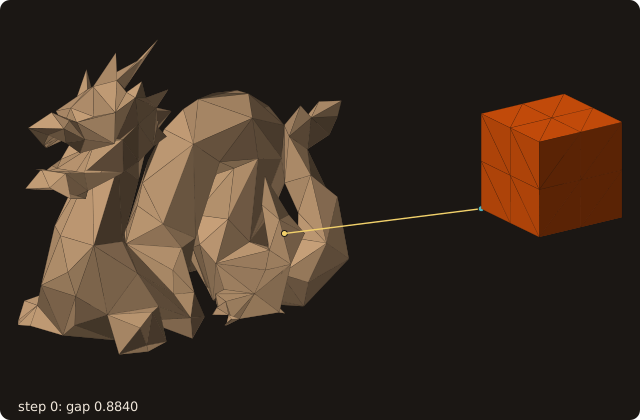
Each frame calls distance_to(..., pose_other=) with the cube's tree as built (fig only moves a copy to draw it); the program is docs/examples/src/anim_body_distance.f90.
Command line
fossilizer --distance other.stl prints, for each input, the distance to the body of other.stl, whether they touch or cross, and the two closest facets and points:
fossilizer -i a.stl --distance b.stlsrc/tests/fossil_test_distance_cli.f90 reads the distance back for a cube against a copy 0.25 away and against itself.
Accuracy
The pair distance rests on two closest-point kernels, both checked against quadruple precision (src/tests/fossil_test_segment_distance_accuracy.f90, 4000 fixed-seed cases each):
- Segment–segment (
closest_segment_segment). The longer segment is the reference: the distance from a point of the other to it is a distance in the plane normal to its direction, while the foot stays inside it, so the least distance is a point-to-segment distance in that plane, or an endpoint distance. Each projection costs ~ε L, so near-parallel segments (angles down to 1e-15) stay within 0.62 ε L of the reference. The textbook solve (Ericson 5.1.9) used until issue #69 goes through a e − b² = |d₁ × d₂|² and lost ~ε L / angle: 139 of the 4000 cases were more than 16 ε L off, some by more than 1e5 ε L. - Point–triangle (
closest_on_triangle). It calls the point kernel of the distance queries,triangle_closest_st(Eberly's solve, the residual formrobust_ston needles, issue #39): within 33 ε L on needles of aspect up to 1e8. The Voronoi-region form (Ericson 5.1.5) used until issue #69 had 113 cases over 64 ε L.
Both paths of body_distance (the descent and body_distance_brute) call the same kernels, so they stay bit-identical.
Validation
src/tests/fossil_test_body_distance.f90: cubes apart (exact distance), touching at a vertex, an edge, a face, and overlapping (0, intersecting), faces 1e-12 apart, and a sphere against a torus at six rigid motions, bit-identical to brute force. src/tests/validation/fossil_val_body_distance.f90: the bunny (20 000 facets) against the dragon (5 000) under 20 motions, bit-identical to brute force. src/tests/fossil_test_curve_distance_to.f90: squares apart (exact distance), touching at a corner, along a side, and crossing, and a circle against a square at six poses, equal to the result after move.
API
See distance_to and the curve's queries.