
Collar blocks
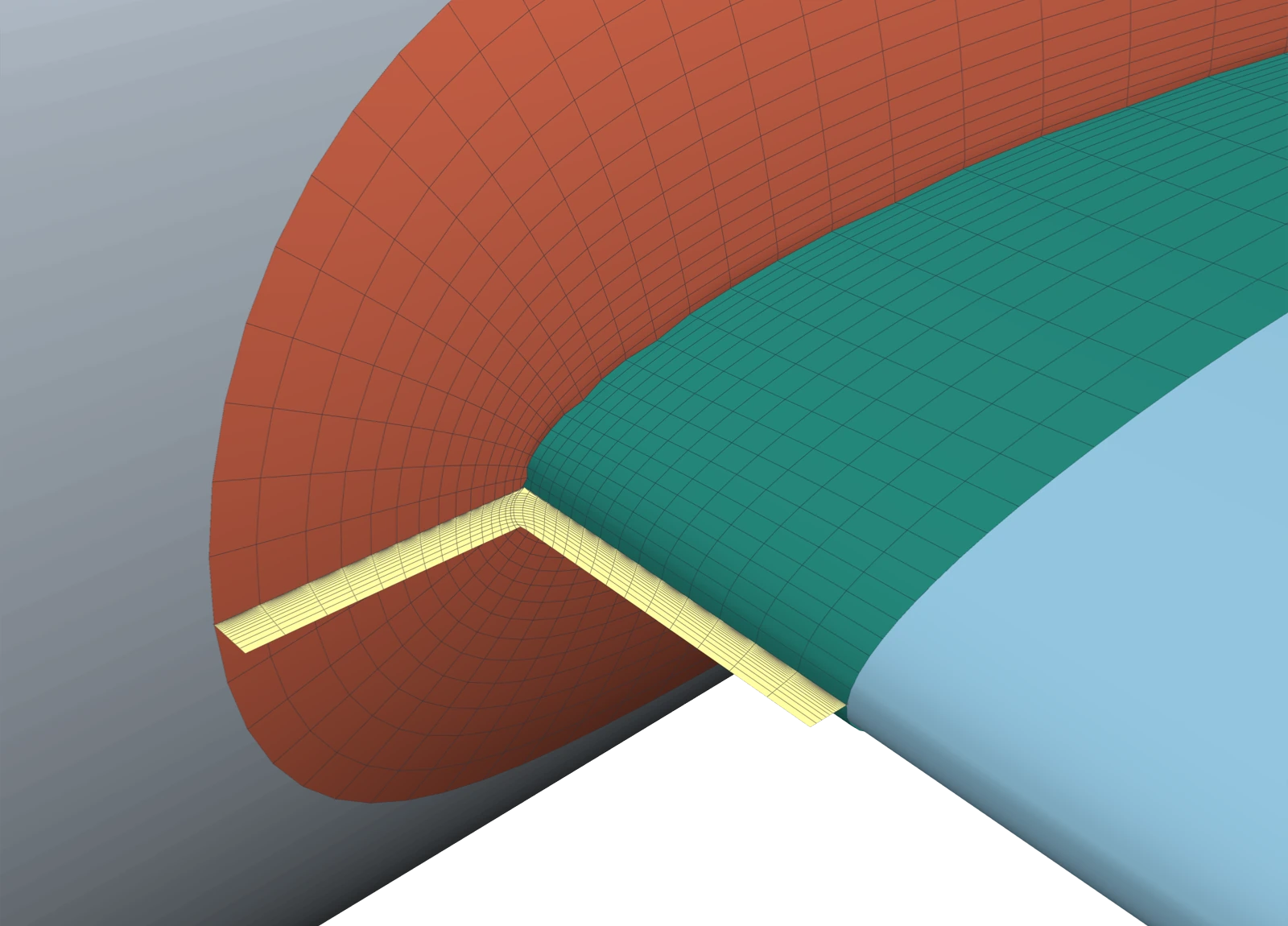
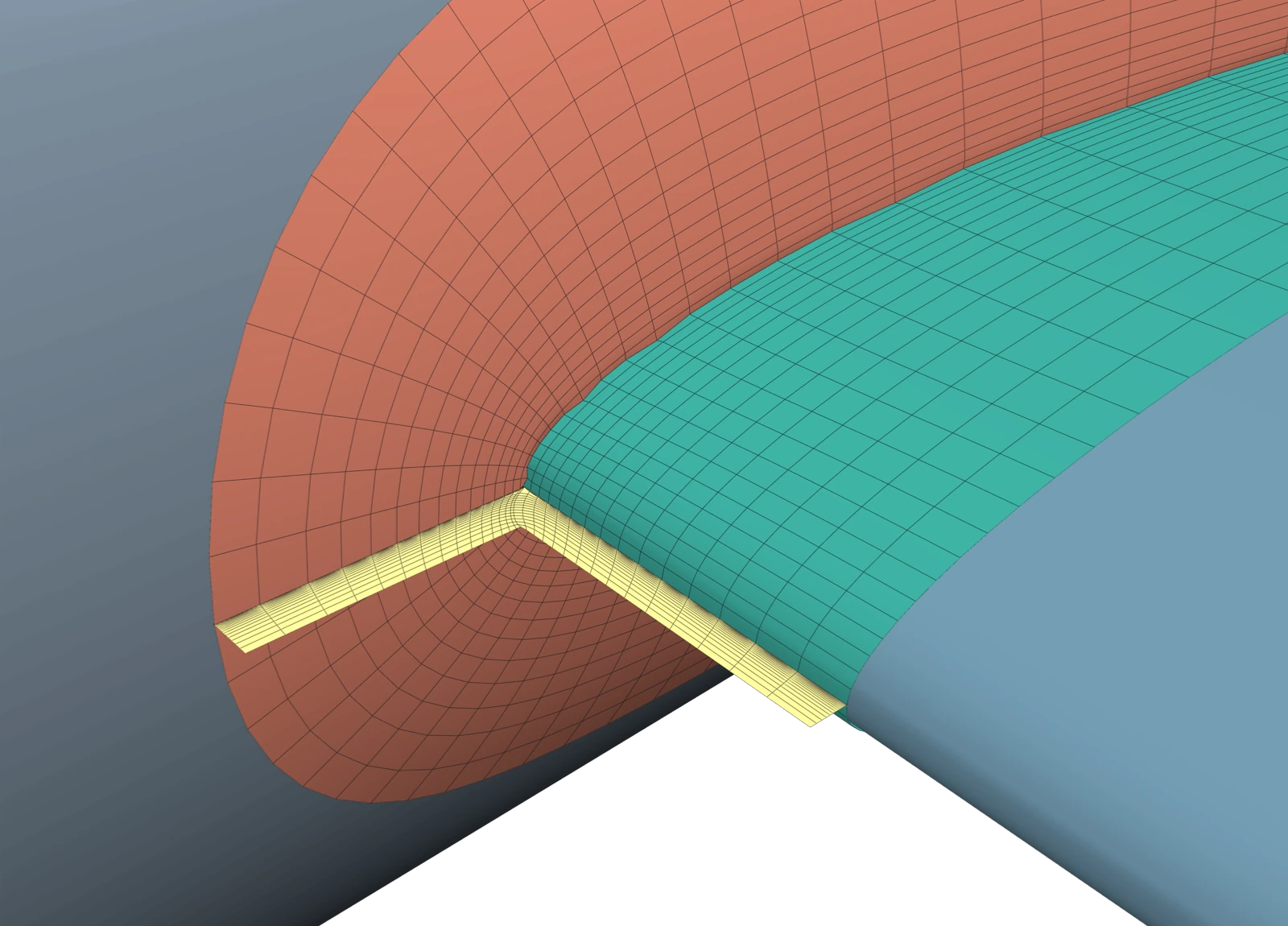
A Chimera collar is a volume block wrapped round the junction of two components: a wing root on a fuselage, a strut on a plate, an appendage on a hull. The body grids of the two components cannot resolve the concave corner where they meet; the collar does, and overlaps both. SHORE builds it from three kernels:
shore.collar.build_collar(body_a, body_b, seed, *, n_loop, steps_a, steps_b, steps_k) returns one HexBlock of (len(steps_b) + len(steps_a) + 1, n_loop, len(steps_k) + 1) nodes. The collar is sum(steps_k) thick. shore collar and Project.build_collar wrap it and build the steps as ds_surface * growth_surface**j (m_a of them on A, m_b on B) and ds_wall * growth_wall**k (nk of them).
The wall
- j runs along the junction curve (Intersection curves): periodic for a closed collar, as in an O-grid.
- i runs from B's far edge, through the junction row at
i = len(steps_b), to A's far edge. Each side is a surface grid marched away from the other body (Surface marching). - k leaves both walls;
k_lois WALL, the other faces FREE.
The wall is creased along the junction row, typically at 60–120°. That crease is what makes the volume hard.
The volume
Plain hyperbolic extrusion folds every junction, always in the three rows next to the crease, and always once the layer thickness
So the volume is built in four steps:
- Near-wall layers by the hyperbolic volume kernel, while they are thinner than half the junction spacing (
hyperbolic_fraction0.5;is the smaller first surface step on either side), where they cannot fold. - Outer boundary. The last near-wall layer is offset by the remaining thickness. At the concave junction the offset forms a swallowtail; it is trimmed at its self-intersection, and the nodes are placed by arc length with the trimmed crease mapped onto the junction row.
- Interior by TFI between the near-wall layer and the outer boundary, using the k schedule.
- Winslow smoothing per loop station with Thomas–Middlecoff control functions (as in Surface grids), which keeps the wall clustering. It is solved by Picard iteration with one SuperLU factorisation per step for all stations and coordinates at once, converged to
of the collar thickness.
On the four analytic junctions of the acceptance spec (64 loop nodes, 15 surface rows steps_k[0] and the outer layer within 0.3 % of the thickness. Each collar takes about 2 s.
Outer boundary: smoothed and stations
CollarParams.volume selects the outer-boundary construction.
"stations" (original) | "smoothed" (default) | |
|---|---|---|
| per station | i-line offset in its best-fit plane | i-line offset as a 3-D polyline; the swallowtail found in the best-fit plane, its crossing the midpoint of the two 3-D crossing points |
| along the loop | stations independent | offsets smoothed along the loop by a Gaussian of 0.5 × the thickness, one kernel for all i, only near corners at the collar's scale (the loop turns by 60° or more within ± one thickness) |
| repair | — | where the outer boundary advances along the loop by less than 0.5 of the inner row, local 1-2-1 smoothing; then each station is trimmed again |
Station-by-station construction fails at loop corners: one station alone cannot fan round a convex corner, nor stop crossing its neighbour at a concave one, once the collar is thicker than the loop spacing. On 49 test junctions (rectangles, L-shapes, blunt wings, split collars, at 1.9 to 11.8 junction spacings), the folded cells outside a folded wall fall from 2367 (stations) to 72 (smoothed). Smoothing is restricted to corners because smoothing everywhere shortens offsets whose directions rotate on a smooth curved loop (1.4 % of the envelope on cylinder × cylinder).
Projects saved before format 3 replay their collars with "stations", so their grids still match on load. To reproduce an old grid outside a project use CollarParams(volume="stations") or --collar-volume stations.
Half-collars on a symmetry plane
With plane=(point, normal), build_collar traces the open junction curve of a half model, marches both halves with their ends on the plane, and returns an open block (periodic_j false) whose j_lo and j_hi faces lie on the plane with FaceBC.SYMMETRY (written to cc.par as natural-BC code 2).
The volume is the half of the closed collar built on the mirrored wall: the wall is reflected across the plane into a closed wall of extrude_collar), and the first
When the curve meets the plane obliquely (end tangent more than 1° off the plane normal, oblique_deg), the bodies are not mirror-symmetric there and build_collar warns: the mirrored wall is then not a valid surface and the block's quality is not guaranteed.
Corners and the split collar
Junctions through edges (trailing edges, struts) have corner nodes. What the single block can do there:
| Junction (96 loop nodes, | Single block |
|---|---|
| convex 90° (rectangular strut) | valid up to about 4.7 loop_curvature 1) with stations; much thicker with smoothed (11.8 |
| concave 90° (L-shape) | a few folded cells from about 5 smoothed |
| blunt trailing-edge base | valid wall; 2–15 folded volume cells at 96 loop nodes |
| sharp corner, > 105° (sharp TE, lens tip) | the wall folds: the surface grid cannot fan round the turn |
Sharp corners need a different topology. shore.collar.split_collar (Project.build_collar(split=True), shore collar --split) takes the C-grid's wake cut to the collar:
- Cut. The loop is cut at each tracer corner turning by more than 105° (
sharp_deg). - Wake. Each piece is extended at both ends by a wake line on A, along the bisector of the corner's two loop directions, with cells starting at the corner's loop spacing and growing by at most 1.2 (
wake_ratio) up towake_length(default: the collar's width on A,sum(steps_a)). - Sheet. Over the wake the wall is a virtual sheet: the corner's grid line on B translated along the wake. B is marched with its two ends held on the two sheets. The sheets of neighbouring pieces are joined by a SHARED seam (
k_lotok_lo, i same, j reversed), as at a C-grid wake cut. - Blocks. Each piece is extruded as one open block and split at the junction row and at its two corners into six blocks,
{label}_{piece}_{wake_lo|body|wake_hi}_{b|a}.
The front on A then turns by half the wedge angle (8° on a NACA 0012 TE) instead of 164°. On the sharp-TE STL wing at 1.9 split_collar returns build_collar's block, bit for bit.
Parameters
CollarParams (defaults; not per-case tuning knobs):
| Field | Default | Meaning |
|---|---|---|
hyperbolic_fraction | 0.5 | hyperbolic layers while thinner than this × |
max_iterations | 400 | Winslow Picard steps |
tolerance | 1e-12 | largest node update, relative to the thickness |
control_limit | 1.5 | bound on the control functions |
oblique_deg | 1.0 | half-collar warning threshold |
sharp_deg | 105 | split collar: corners turning more are cut |
wake_ratio | 1.2 | split collar: largest ratio of adjacent wake cells |
volume | "smoothed" | outer boundary: "smoothed" or "stations" |
offset_smoothing | 0.5 | Gaussian width along the loop, × thickness |
backstep_ratio | 0.5 | outer row advances at least this × the inner |
backstep_iterations | 200 | local repair passes |
The choices that matter are the user's: n_loop and the loop distribution (loop_spacing, loop_curvature; try curvature 1 on rounded sections), the surface steps (the collar's width on each body), and steps_k (first cell and thickness).
Example
import numpy as np

from shore.collar import build_collar
from shore.geometry.stl import StlGeometry
from shore.quality import scaled_jacobian
from shore.shapes import cylinder, sphere

ball = StlGeometry(sphere(radius=1.0, subdivisions=4))
post = StlGeometry(cylinder(radius=0.4, height=3.0, sections=64))
steps = 0.01 * 1.12 ** np.arange(15)

collar = build_collar(
    ball, post, np.array([0.4, 0.0, 0.9]),
    n_loop=64,
    steps_a=steps, steps_b=steps,
    steps_k=1e-4 * 1.2 ** np.arange(30),  # 0.118 thick
)
print(collar.nodes.shape, scaled_jacobian(collar.nodes).min())  # (31, 64, 31, 3), about 0.74
Limits
- Thick collars at sharp junctions (well over 12 junction spacings at junctions sharper than 90°) fold; the tilted-plane prototype folded 1203 cells at 32 spacings.
- Concave corners and notches. A few cells fold from about 5 junction spacings. If the march on A runs deeper into a concave notch than the notch is wide, the surface grid bunches at the bisector and the volume folds there: keep the collar's width on that body small. At 96 loop nodes such collars are valid up to 1.9 junction spacings thick.
- Extreme clustering. With strong curvature clustering at corners (192–384 loop nodes), walls are valid but volumes fold when the collar is 100–300 × thicker than the corner spacing. Keep the collar thinner than about 10 × the smallest loop spacing at corners, or cluster less there.
- Split collars: no half-collars with sharp corners; a sharp corner on an edge of A raises.
- No body association. The collar's wall lies on two bodies, so the block carries none;
snapdoes not apply to it. - Two planes: half-collars end on one symmetry plane only.
See also
- ADRs: 0010 — Collar block, 0013 — Half-collar, 0018 — CLI and projects, 0024 — Split collar, 0025 — Volume at corners, 0026 — Smoothed by default, 0028 — Extreme clustering.
shore.collar—build_collar,split_collar,extrude_collar,CollarParams;Project.build_collar.shore collar(CLI), Collar tutorial, Half models.- Chimera grids.