
Surface projection
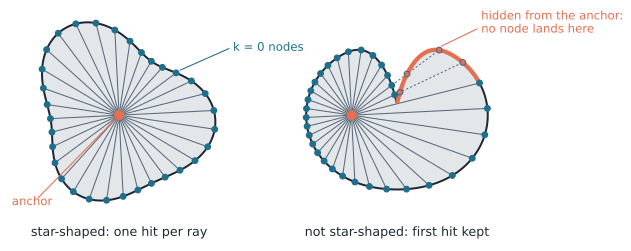
Surface projection turns an unstructured body surface into a structured array of surface nodes. Rays leave one anchor point inside the body along a structured set of directions; each ray's hit on the body is a k=0 node. The projector knows nothing about blocks: the k=0 construction decides which directions to cast.
Inputs and outputs
| Input | the body, an anchor point inside it, and unit directions of shape (N, 3) |
| Output | ProjectionResult: locations (N, 3) (NaN where a ray failed), status per ray, distances from the anchor |
| Code | shore.surface.projector.Projector (STL); AnchoredCaster for CAD bodies |
Anchor
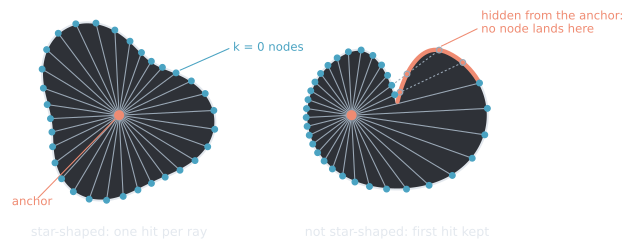
All rays share one origin, so the body must be star-shaped from the anchor: every ray must cross the surface exactly once. resolve_anchor picks the anchor; Body.from_stl / Body.from_file use the auto strategy:
| Strategy | Anchor |
|---|---|
auto (default) | incenter, else bbox, each validated; raises if both fail |
incenter | centre of the minimum enclosing sphere of the vertices |
bbox | bounding-box centre |
centroid | volumetric centroid (can lie outside a non-convex body) |
user | a given point, validated |
Validation is a mesh.contains test. A body whose anchor cannot be resolved still loads: the error is kept and raised when the projector is first used, so open half-model bodies can still serve collar grids (ADR 0018).
Ray casting
For an STL the Projector builds a trimesh BVH (RayMeshIntersector) once per body and reuses it for every call, so a batch costs one vectorised query. Each hit is classified, in this priority:
| Status | Condition |
|---|---|
DEGENERATE | NaN in the hit |
BACKFACE | the hit triangle's normal does not face along the ray (inverted or wrong-side facet) |
TOO_NEAR | hit closer than 5 % of the body's bounding-box diagonal |
TOO_FAR | hit farther than 5 bounding-box diagonals |
MISSED | no hit |
HIT | everything else |
Only the first hit along each ray is kept. project(dirs, on_failure=...) decides what a non-HIT ray does: "raise" (default, MeshInputError with the counts per status), "nearest" (fall back to the closest surface point and keep the status flag) or "skip" (leave NaN).
For a CAD body the caster ray-casts the merged tessellation and then snaps every hit to the exact surface, so the k=0 nodes lie on the CAD faces, not on the facets (ADR 0002).
Who supplies the directions
- Cubed sphere:
build_cap_k0casts a gnomonic diamond at each pole, thenbuild_equatorcasts slerped great-circle meridians between the two cap seam rings; the seam rows are copied from the caps, not re-cast (k=0 construction). - O-grid:
sphere_latlon_directionsbuilds a lat-lon grid of directions over colatitudes, cast in one batch. - OH hybrid: the cubed-sphere directions with
theta_capand the azimuth offset both pinned to.
Failure modes
| Symptom | Cause |
|---|---|
MeshInputError naming the anchor | anchor outside the body: the body is not closed, or not star-shaped from any of the tried points |
MeshInputError with missed / backface counts | some rays leave through a gap, or hit an inverted facet; repair the STL |
| several hits along a ray, only the first kept | the body is not star-shaped from the anchor: the grid skips the hidden surface; nothing warns, so inspect the k=0 layer |
For bodies that cannot be star-shaped, see Pipeline limits.
See also
- k=0 construction: how the projected nodes become the 6 cubed-sphere blocks
- Geometry: the STL and CAD backends behind the caster
shore.surface.projector,shore.surface.anchor,shore.surface.remesh