
Surface marching
Surface marching grows a structured grid over a body from a curve on it, one row at a time, the way hyperbolic volume marching grows layers off a wall. It is the kernel of SHORE's collar grids: from the junction curve, a surface grid is marched away from the other body on each component. The scheme is the SURGRD type of Chan & Steger (1992) and Chan & Buning (1995): a hyperbolic system for orthogonality and cell area, linearised and solved once per layer, with every new layer projected onto the body.
shore.surface.march.march_surface(geometry, curve, steps, *, periodic=False, entity=BODY, plane=None) returns an (n, m + 1, 3) array: row 0 is the curve, row Geometry.project (with normals) is used, so it works on STL and CAD bodies alike.
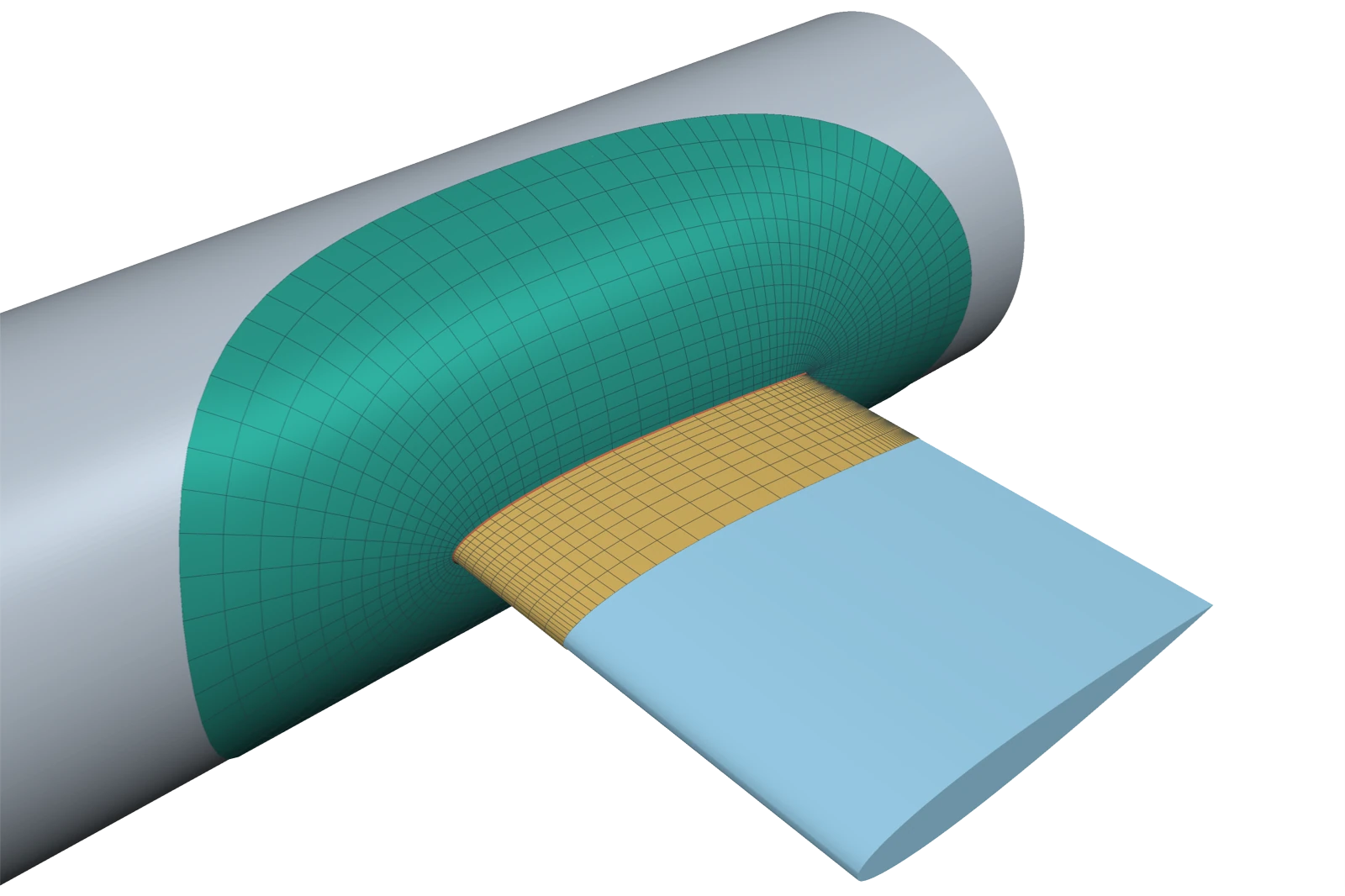
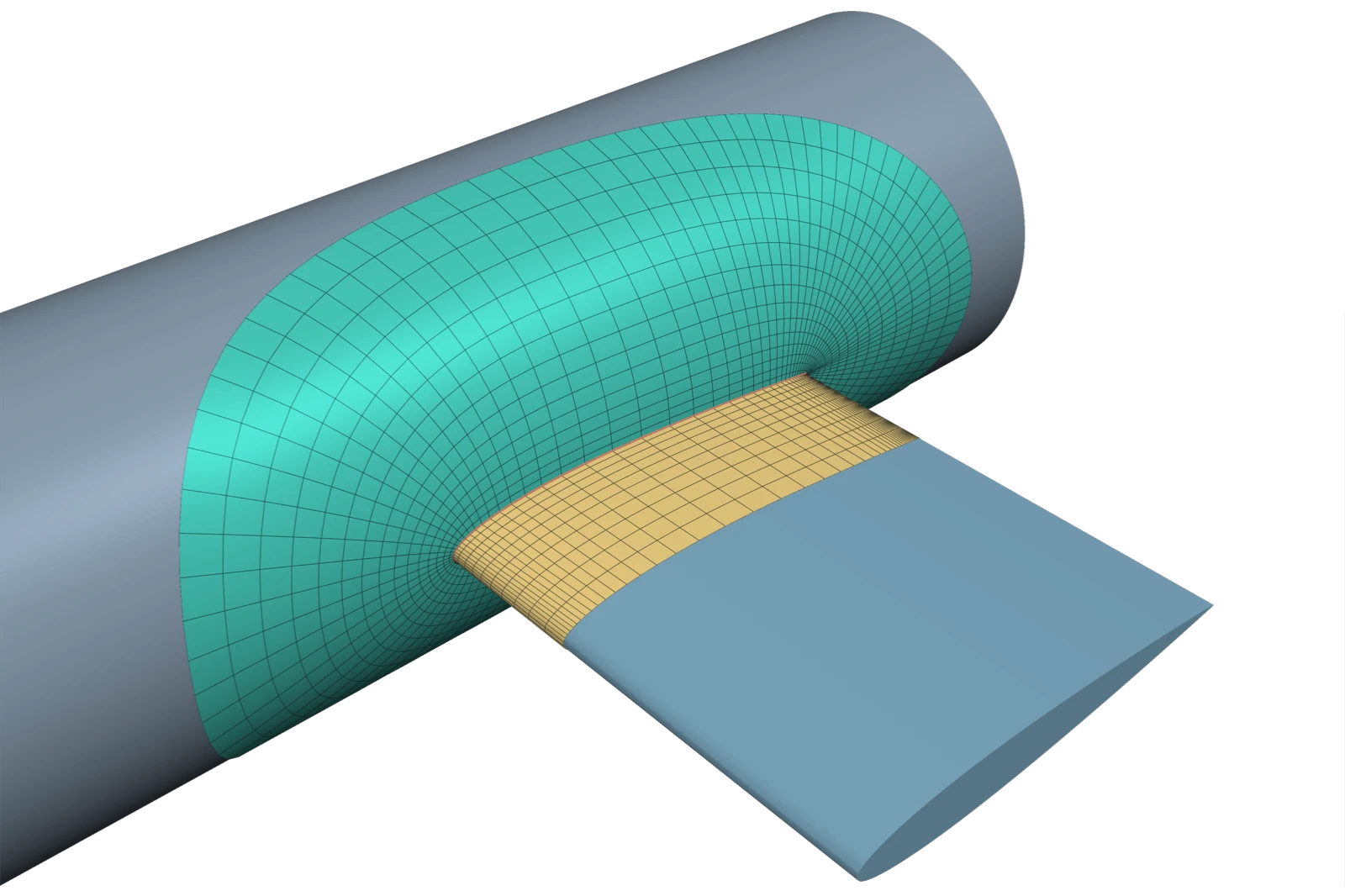
The linearised system
Let
with
Stabilisation
Every term is ramped by
- Area smoothing. The prescribed area
is blended towards its neighbours ( area_smoothing0.5 ×, 2 passes). Fronts that collide at a concave corner share their area instead of crossing. The marching distance is kept within . - Contraction sensor. Where the area-smoothed pure-normal trial row contracts, the dissipation is raised:
and , with the contraction.
The same stabilisation lengthens the steps of converging fronts: marching north from a sphere's equator overshoots the schedule by 3.5 % (accepted bound 5 %). Pure normal marching, the alternative, folds at concave corners (2 cells on the spec's concave L, where this scheme gives a minimum angle of 23.9°).
Measured on exact surfaces (25 rows, steps
Ends of open curves
- Free (
plane=None): the end nodes march along their own. - On a symmetry plane (
plane=(point, normal)): each end is solved as an interior node whose missing neighbour is a mirror ghost, the image of its inner neighbour across the plane, both in the differences (tangent, Laplacian, contraction sensor) and in the linear system (the ghost's increment is the reflected increment). After the projection, alternating projections put the end on both the body and the plane (toof the diagonal). On mirror-symmetric bodies the result equals the mirrored periodic march of the whole curve to of the first step, and the end tangent is within 0.12° of the plane normal. Snapping freely marched ends onto the plane afterwards gives up to 5° instead. A curve whose ends are off the plane, or planewithperiodic=True, is refused.
STL vertex normals are interpolated barycentrically, so on a coarsely triangulated flat face they tilt (up to 14° on a coarse half box), and a half mesh's normals are not the mirror of the whole mesh's. Marches on such STL half models keep their ends on the plane and stay valid, but do not match the mirrored whole-body march.
Creases and corners
Junction loops with corners (blunt and sharp trailing edges, struts) put nodes of the front on edges of the surface. Three mechanisms, each triggered only where it is needed, so marches that do not trigger them are bit-identical:
| Situation | Trigger | Treatment |
|---|---|---|
| Crease: a front corner on a surface edge; the node's normal leans along | crease_tolerance) | the marching frame uses |
| Sharp crease: the front folds back on itself (a sharp TE) | at a crease, sharp_crease) | |
| Clustered corner: the step dwarfs the front spacing | step > 24 × the smallest spacing of the nodes not closer than on the starting curve (max_step_ratio) | the row is marched in substep_ratio 2) |
| Fold: converging fronts overtake each other | a cell reversed against the majority, or a front segment pointing backwards | nodes within 2 of the fold smoothed along the front (1-2-1) and re-projected, up to 200 times (untangle_*) |
Why each is needed:
- Creases. The scheme assumes
. At a crease the area row divides by , the marching distances vary from node to node, and the orthogonality row turns that into tangential drift: up to 0.13 chord marching up a prismatic blunt wing, with 10–73 flipped cells. After the fix: 0 flips, drift 0.011–0.060. - Sharp creases. Across a 16° fold the central difference is about
of the spacing, and the prescribed area gives an outsized step that drags the neighbours. The periodic march of a sharp-TE wing with curvature clustering flipped 66 cells; after the fix none. - Sub-steps. With curvature clustering the corner spacing is
– while the first step is . Counting only nodes not closer than on the starting curve keeps converging fronts (whose spacing shrinks legitimately) from triggering it. - Untangling. At a concave corner, sub-stepping does not converge; the corner cells shrink until nodes overtake each other along the front.
After these, collar walls (single and split) no longer fold on any of the tested junctions: L-shape plates, blunt bases and sharp creases at loop sizes 96–384 with curvature 0–3. Checked with a four-corner cell sine (each corner of each surface cell): at least 0.06 everywhere.
Parameters
MarchParams holds the defaults; they are not per-case tuning knobs.
| Field | Default | Meaning |
|---|---|---|
eps_implicit | 1.0 | implicit dissipation at |
eps_explicit | 0.5 | explicit tangential dissipation at |
area_smoothing | 0.5 | area blend towards the neighbours at |
area_iters | 2 | area smoothing passes |
convergence_gain | 16 | extra dissipation per unit of front contraction |
distance_clip | 2 | distance kept in |
crease_tolerance | 0.1 | |
sharp_crease | 0.5 | |
max_step_ratio | 24 | sub-step trigger |
substep_ratio | 2 | sub-steps of at most this × the spacing |
untangle_iterations | 200 | smoothing passes at a fold |
untangle_reach | 2 | nodes smoothed each side of a folded cell |
end_tolerance | 1e-14 | ends on surface and plane (× diagonal) |
end_iterations | 100 | alternating projections at an end |
Example
import numpy as np

from shore.geometry.stl import StlGeometry
from shore.shapes import cylinder, sphere
from shore.surface.intersect import intersection_loop
from shore.surface.march import march_surface

ball = StlGeometry(sphere(radius=1.0, subdivisions=4))
post = StlGeometry(cylinder(radius=0.4, height=3.0, sections=64))
loop = intersection_loop(ball, post, np.array([0.4, 0.0, 0.9]), 64)

steps = 0.01 * 1.12 ** np.arange(15)
on_ball = march_surface(ball, loop, steps, periodic=True)  # away from the post
on_post = march_surface(post, loop[::-1], steps, periodic=True)  # away from the ball
print(on_ball.shape, on_post.shape)  # (64, 16, 3) twice
Limits
- Converging fronts overshoot the step schedule by a few per cent (3.5 % on the sphere): the price of the concave-corner robustness.
- Concave notches. Marching deeper into a concave notch than the notch is wide concentrates the front's loss of length on the cells at the bisector; they become long and thin (aspect about 2700 on the L-shape plate). The surface grid stays valid, but a collar volume built on it folds there. Spreading bunched fronts was tried and not adopted (ADR 0029, 0030).
- Run time. Sub-stepping makes strongly clustered loops (384 nodes with curvature) take minutes: up to 150 s for a blunt-wing collar, uncapped by decision.
- Not fixed: the sharp STL wing at 384 loop nodes with curvature (spacing
on sliver triangles) still flips a few cells. - Two planes.
march_surfaceholds both ends on one plane; the split collar uses a private variant with one plane per end.