
O-grid topology
The O-grid is a single block wrapped around the body: closed (periodic) in one surface direction, so the grid lines around a cross-section look like the letter O. In SHORE it is a lat-lon grid ray-cast onto the body and marched outward, built by shore mesh --topology ogrid (or [grid] topology = "ogrid" in a config). It writes one <stem>.geo.
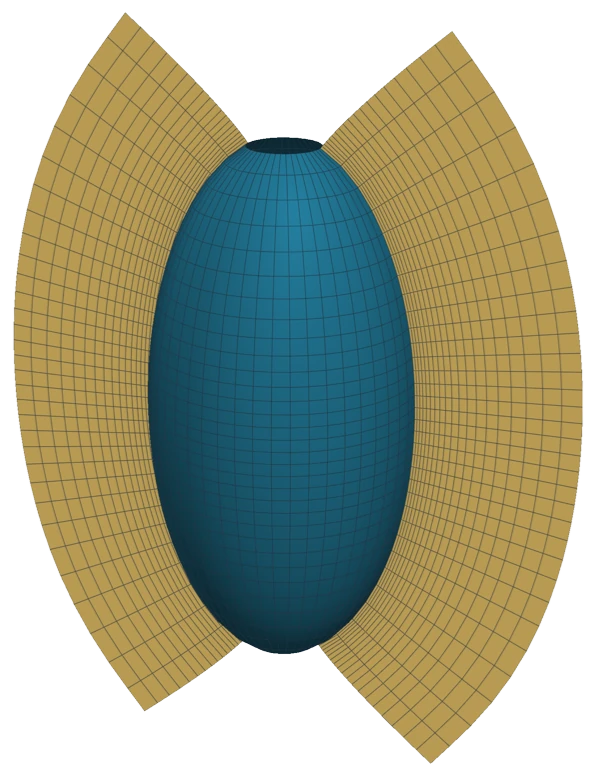
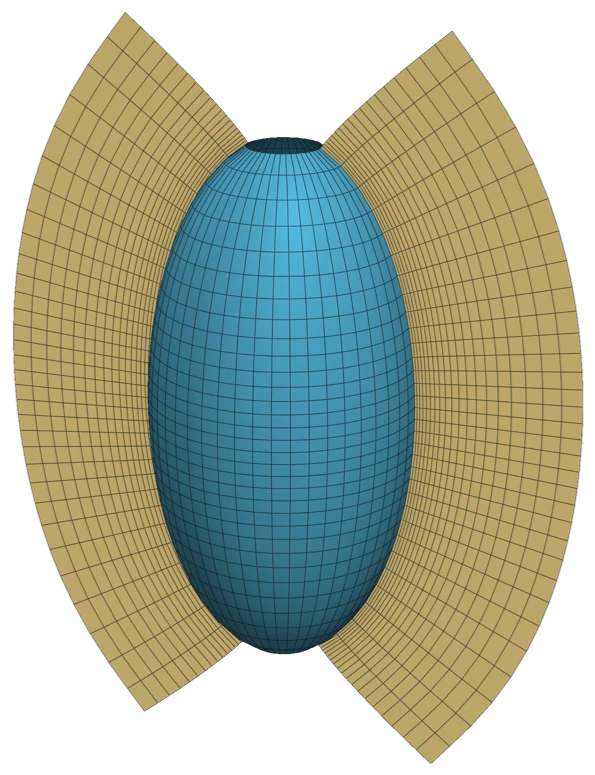
Block
| Index | Direction | Range | Periodic |
|---|---|---|---|
| i | colatitude | no | |
| j | longitude, nj nodes around the body | yes: j = nj − 1 is adjacent to j = 0 | |
| k | wall normal | wall to outer layer | no |
The directions come from sphere_latlon_directions and are cast from the anchor in one batch (Surface projection). The block's k_lo is WALL; normals, smoothing and the Jacobian check wrap around j with modular indexing; the i boundaries use one-sided tangents.
The poles are not covered
The first and last i-rows are rings at colatitude theta_cap (default 9°; the cubed sphere's is 30°) from each pole, not points. The two polar regions inside those rings have no cells. The O-grid is therefore an open band around the body: in an overset assembly the poles must be covered by another grid. Use the cubed sphere for a closed wall grid.
Compared with the cubed sphere
| O-grid | Cubed sphere | |
|---|---|---|
| Blocks | 1 | 6 |
| Poles | uncovered (rings at theta_cap) | covered by two caps |
| j direction | periodic | four sub-blocks with SHARED seams |
| Output | <stem>.geo | six <stem>_<label>.geo |
| Use | a single periodic block for tools that expect one | wall grids of closed bodies |
Parameters
All shore mesh surface and marching flags apply: --ni, --nj (the block's j node count directly), --nk, --theta-cap / --theta-cap-deg, the surface i/j and wall-normal spacing laws, --march-scheme, --smooth*. --surface-j-spacing tanh2 clusters toward longitude Mesh.march reads the override (Spacing laws).
Python
from shore.mesh import Mesh, OGridTopology, Spacing1D

m = Mesh.from_stl(
    "sphere.stl",
    topology=OGridTopology(),
    ni=40, nj=60, nk=30,
    theta_cap_deg=9.0,
    spacing_k=Spacing1D(law="geometric", ds=0.02, growth=1.1),
)
m.march(ds=0.02, growth=1.1)
m.write_geo("sphere")  # sphere_ogrid.geo (Mesh.write_geo appends the block label)
See also
- Cubed sphere: the closed six-block alternative
- Surface projection, Marching
shore mesh,OGridTopology