
Block model
Every grid SHORE makes, whichever way it is made, ends as a list of structured hexahedral blocks. A block is an object, not a bare array: it owns its node array and a typed description of its 8 corners, 12 edges and 6 faces. The face descriptions carry the boundary conditions and the seams to other blocks; the writers (.geo, .grd, cc.par, CGNS, Plot3D) read everything they need from them.
The classes live in shore.mesh: Block (abstract) and HexBlock (shore.mesh.block), Vertex, Edge, Face, FaceBC and AxisMap (shore.mesh.face), and Spacing1D (shore.mesh.spacing).
Nodes
A HexBlock holds nodes, an array of shape (ni, nj, nk, 3): node (i, j, k) has coordinates nodes[i, j, k] = (x, y, z).
ni,nj,nkare node counts. A block has(ni - 1)(nj - 1)(nk - 1)cells. The.grdheader is the only place where cell counts appear, and the writer converts.kis the wall-normal direction of body-fitted blocks:k = 0is the wall,k = nk - 1the outer boundary.- A valid cell is right-handed:
, with pointing away from the wall. The quality metrics and the marchers' Jacobian guards use this orientation (see Grid quality). .geofiles store the nodes i-fastest (Fortran order), as Xall reads them.
nodes is often a numpy view into a buffer the topology builder allocated for several blocks, so that neighbouring blocks share their seam nodes in memory (see Seams below).
Vertices, edges and faces
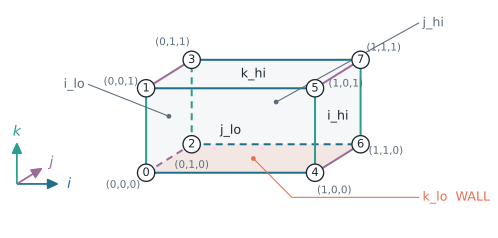
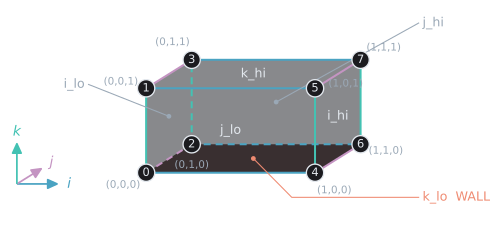
| Entity | Count | Naming | Example |
|---|---|---|---|
| Vertex | 8 | v0 … v7, index | v5 is nodes[-1, 0, -1] |
| Edge | 12 | the two fixed sides, e.g. j_lo_k_lo runs along i at j = 0, k = 0 | i_lo_j_lo is the k-edge nodes[0, 0, :] |
| Face | 6 | i_lo, i_hi, j_lo, j_hi, k_lo, k_hi | k_lo is nodes[:, :, 0] |
Each entity has a nodes(block) accessor returning a view of its nodes, and an association slot that links it to geometry (see Association). The same vertex order (index v0 … v7 mean the same corners in journal lines like p.associate('box', 'v5', ...).
Each face has two along-axes, the block axes that lie in it, in a fixed order (FACE_ALONG_AXES): i_* faces have (j, k), j_* faces (i, k), k_* faces (i, j).
Face boundary conditions
A face carries one FaceBC. A new HexBlock has k_lo = WALL and every other face FREE; the topology builder rewires the rest.
FaceBC | Meaning | cc.par (Xall) | CGNS |
|---|---|---|---|
WALL | body surface (k = 0 of a body-fitted block) | BC 1 (viscous wall) | BCWall |
FREE | outer boundary, decided downstream: overset fringe or natural BC | per block free_face_bc, default 40 (chimera); a background uses a positive natural code in [1, 19] (e.g. 9 far field); a face's bc_code overrides | BCTypeUserDefined, descriptor shore:FREE |
SHARED | the same nodes as a partner face, usually shared in memory | connection patch, 3-digit orientation code from the AxisMap | GridConnectivity1to1_t |
DIRICHLET | the same nodes as a partner face, held as a copy (the cubed sphere's cap–equator seams, whose axes are permuted) | as SHARED | GridConnectivity1to1_t |
PERIODIC | wraps to a face of the same block | no native code: 40 with a UserWarning | GridConnectivity1to1_t |
SYMMETRY | lies on a symmetry plane (half models, ADR 0013) | natural BC 2 | BCSymmetryPlane |
The cc.par orientation digits follow the reading of Xall's overset pre-processor (ADR 0036); the CGNS Transform comes from the same AxisMap (ADR 0035).
AxisMap and the wiring invariant
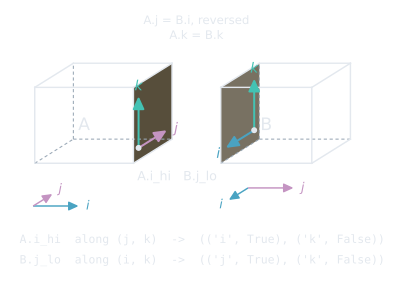
Two faces on a seam need not use the same axes in the same direction. An i_lo face may meet a partner's j_hi face whose i runs backwards. The AxisMap records, for each along-axis of this face (in FACE_ALONG_AXES order), the partner's axis and whether it is reversed:
from shore.mesh.face import AxisMap

AxisMap.identity("i_hi")                       # along=(("j", False), ("k", False))
AxisMap.from_pairs(("i", True), ("k", False))  # j -> reversed i, k -> k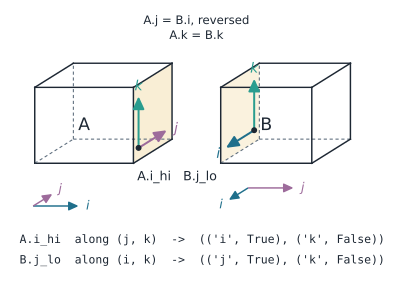
Wiring invariant. HexBlock._set_face_bc(name, bc, partner, axis_map) is the one place a face is wired. For SHARED, DIRICHLET and PERIODIC it requires a partner and an AxisMap, and checks the map's partner axes against the partner face's own along-axes; WALL, FREE and SYMMETRY must have neither. A topology builder that wires a seam wrongly fails at construction, not later as a wrong cc.par:
import numpy as np

from shore.mesh.block import HexBlock
from shore.mesh.face import AxisMap, FaceBC

# one buffer of 9 x 5 x 5 nodes on [0, 2] x [0, 1] x [0, 1]
x, y, z = np.meshgrid(
    np.linspace(0, 2, 9), np.linspace(0, 1, 5), np.linspace(0, 1, 5), indexing="ij"
)
buffer = np.stack([x, y, z], axis=-1)

# two blocks cut from it: node plane i = 4 belongs to both (a view)
a = HexBlock("a", buffer[:5], periodic_j=False)
b = HexBlock("b", buffer[4:], periodic_j=False)
a._set_face_bc("i_hi", FaceBC.SHARED, b.face("i_lo"), AxisMap.identity("i_hi"))
b._set_face_bc("i_lo", FaceBC.SHARED, a.face("i_hi"), AxisMap.identity("i_lo"))

print(np.shares_memory(a.nodes, b.nodes))  # True

# the wrong map is refused at wiring time:
# AxisMap.from_pairs(("i", False), ("k", False)) on i_hi -> i_lo raises
# ValueError: partner axes ('i', 'k') do not match 'i_lo''s along-axes ('j', 'k')
HexBlock defaults to periodic_j=True (the legacy single-block O-grid); pass periodic_j=False for an open block. Both sides of a seam are wired explicitly, and AxisMap.inverse gives the partner side's map.
The face graph (BCs, partners, axis maps, associations) is what .adjacency.json stores (version 3); cc-par, the CGNS writer and a project loaded without replay all read it back.
Seams: views and write-through
A seam is one set of points seen from two blocks. SHORE keeps it closed in two ways.
- Views. Builders allocate one buffer and cut the blocks from it, so a
SHAREDseam is the same memory: writing one side writes the other. This works only where the seam's axis map is an identity or a flip in a buffer the builder laid out. Permuted seams (the cubed sphere's cap–equator edges) areDIRICHLETcopies, and blocks read back from saved grids (ADR 0033) hold copies of every seam. - Point matching.
shore.mesh.seams.seams(blocks, tol)pairs each connected face once and locates the smaller face inside the larger one by its nodes, giving SIDS index ranges and aTransformon both sides. This is how a face shared with several partners is handled, such as the CH hybrid'sbody.k_hiunder three channel blocks (shared_faceslists such faces). Nodes that do not coincide withintolraiseParameterError. - Write-through (ADR 0040).
Aliasesgroups the nodes that are one point acrossSHAREDandDIRICHLETseams (a node where several blocks meet is one group). After an in-place edit,syncgives each group the value of its last member the edit changed, in block order, as views would ("last writer wins"); groups the edit left alone, or changed alike, are untouched.Snap,FillFace,Redistribute,OrthogonalizeandWallLayerrun inside this write-through, so a one-sided association or a loaded project does not open a seam. A seam not point-matched within× the bounding diagonal makes the edit warn and run without closing seams.
PERIODIC seams do not coincide and are not aliased.
Spacing per edge
Every Edge carries a Spacing1D (law uniform, tanh, tanh2, geometric or pinned, with its parameters; see Spacing laws). Defaults: uniform along i and j, geometric with ds = 1e-3, growth = 1.15 along k.
Identity rule. HexBlock.__init__ gives all four edges of an axis the same Spacing1D instance and remembers it. The wall-normal resolver treats a k-edge whose spacing is not that instance as a user override:
- no k-edge replaced: the march uses the
(ds, growth)it is given; - all four replaced and equal by value: that law sets the k-steps;
- some replaced, or replaced with different values:
UserWarning, default kept.
All blocks of one Mesh share a single k-step schedule, because k-coupled seams must stay coincident layer by layer. Block 0 wins, with a UserWarning if another block asks for a different one. Editing an existing grid's spacing is a separate command, redistribute (ADR 0041), which resamples the lines of an axis and carries the change through the seams.
Edge.first_step / last_step request a C1 match at an end of the edge; builders read them, and Spacing1D(law="pinned") is the law that honours them.
See also
- ADR 0003 (associations on vertices, edges, faces), ADR 0035, ADR 0036, ADR 0040, ADR 0041
- API:
shore.mesh.block,shore.mesh.face,shore.mesh.edge,shore.mesh.vertex,shore.mesh.seams,shore.mesh.spacing - Per-edge spacing, Redistribute an edge
- Association, Grid quality