Pipeline overview
SHORE turns a triangulated STL surface into a structured body-fitted volume mesh through a fixed pipeline. This page is the high-level map; the Algorithm section drills into each stage, and the Topologies section catalogues how the stages are assembled into block layouts.
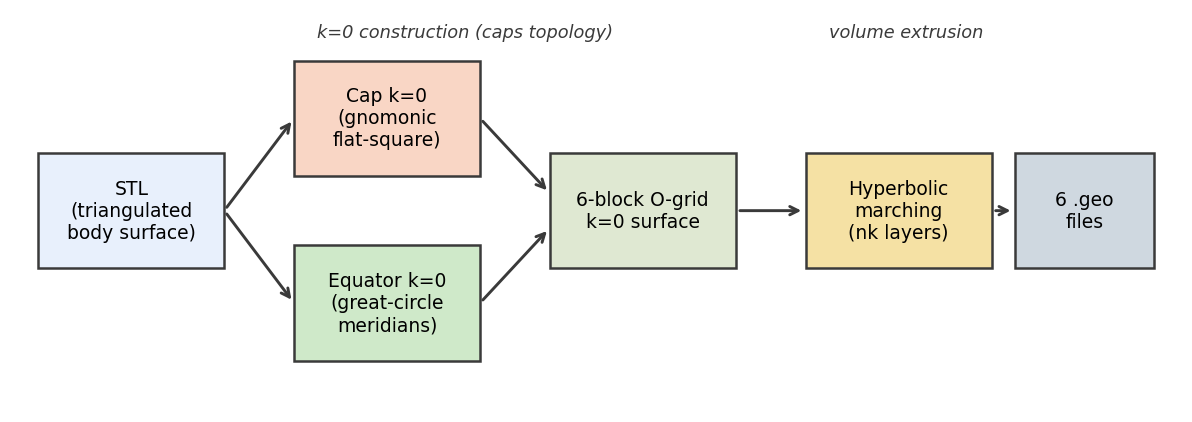
Stages
| Stage | Output | Algorithm reference |
|---|---|---|
| 1. Surface projection | (N, 3) k=0 surface nodes | projection |
| 2. k=0 mesh construction | 6-block surface (cubed-sphere topology) | k0-construction |
| 3. Hyperbolic marching | 6-block volume (ni, nj, nk, 3) per block | hyperbolic-marching |
| 4. Seam-aware refinement | Continuous spacing across multi-block seams at every layer | seam-aware-normals |
Stages 1 and 2 produce the k=0 layer — the body-conforming surface mesh from which the volume is extruded. Stage 3 is the hyperbolic extrusion. Stage 4 is integrated into stage 3: it changes how each block's normals are computed at multi-block seams so that spacing continuity is preserved layer by layer.
Topology
The pipeline above is run per topology. The topology determines the block layout and how stages 2 and 3 stitch the blocks together. SHORE's production default is the cubed-sphere topology (6 blocks). Other CLI-selectable topologies are the single-block O-grid (--topology ogrid), the airfoil C-grid (--topology cgrid, 3-/4-block sharp / blunt TE), and the airfoil CH hybrid (--topology ch, C-grid wrap + far-field channel, 12-/14-block). The OH hybrid (--topology oh) extends the cubed-sphere wrap with a 6-face H-channel. The full catalogue lives in the Topologies section.
Inputs
| STL | A single watertight trimesh.Trimesh. The body must be star-shaped from the anchor (default centroid). See Surface projection for the failure modes. |
| Resolution | ni (equator meridional), nj (longitude), nk (wall-normal layers including k=0). |
| Cap angle | theta_cap (default |
| Spacing laws | i_spacing, j_spacing, volume_k_spacing — see Spacing laws. |
Outputs
The CLI writes 6 .geo files (one per block) plus optionally a ParaView .vtm MultiBlock if shore export is used:
<stem>_sub0.geo .. <stem>_sub3.geo   # 4 equatorial sub-blocks
<stem>_cap_north.geo                 # north polar cap
<stem>_cap_south.geo                 # south polar cap
The .geo format is Xall compatible: ASCII header ni nj nk, then x, y, z arrays in Fortran column-major order.
Visualization
Two independent paths after the volume is generated:
ParaView (VTK export)
# Per-block .vts
shore export sphere_sub0.geo

# Combined MultiBlock for the 6-block cubed-sphere topology
python -c "
from shore.io.geo import read_geo
from shore.io.vtk import write_caps_vtm
labels = ['sub0', 'sub1', 'sub2', 'sub3', 'cap_north', 'cap_south']
blocks = [read_geo(f'sphere_{lbl}.geo') for lbl in labels]
write_caps_vtm('sphere.vtm', blocks, with_jacobian=True)
"
paraview sphere.vtm
shore export attaches a Jacobian cell-data array; the write_caps_vtm helper bundles all 6 blocks under one MultiBlock with the same metadata.
PyVista (interactive / Jupyter)
shore view sphere_sub0.geo # desktop windowFrom Python or Jupyter:
import pyvista as pv
from shore.io.geo import read_geo
from shore.io.vtk import open_to_pyvista

grid = read_geo("sphere_sub0.geo")
sg = open_to_pyvista(grid, with_jacobian=True)
pl = pv.Plotter()
pl.add_mesh(sg, scalars="Jacobian", cmap="RdYlGn", show_edges=True, opacity=0.7)
pl.show()
Limitations
Star-shaped constraint
The surface projection requires that every ray from the body anchor hits the STL exactly once. Bodies with re-entrant cavities, holes, or multiple disconnected components must be repaired or decomposed first. See Surface projection.
No smooth far field
The outer boundary of the volume (k=nk-1) currently inherits the shape of the cap-equator seam topology — it is not morphed to a box or matched to the Xall background grid. Far-field morphing is the next planned feature.
Cap-equator size compatibility
The C1 cap-equator seam pin (per-j first-step matching) requires (ni, nj, theta_cap) to land in a compatibility window. Out of window, the equator falls back to its unpinned i_spacing law and emits one UserWarning per build. See k=0 mesh construction for the rule of thumb.
See also
- Algorithm overview
- Topology catalogue
- Quick start — worked CLI examples
- Chimera context — overset mesh generation