Hyperbolic marching
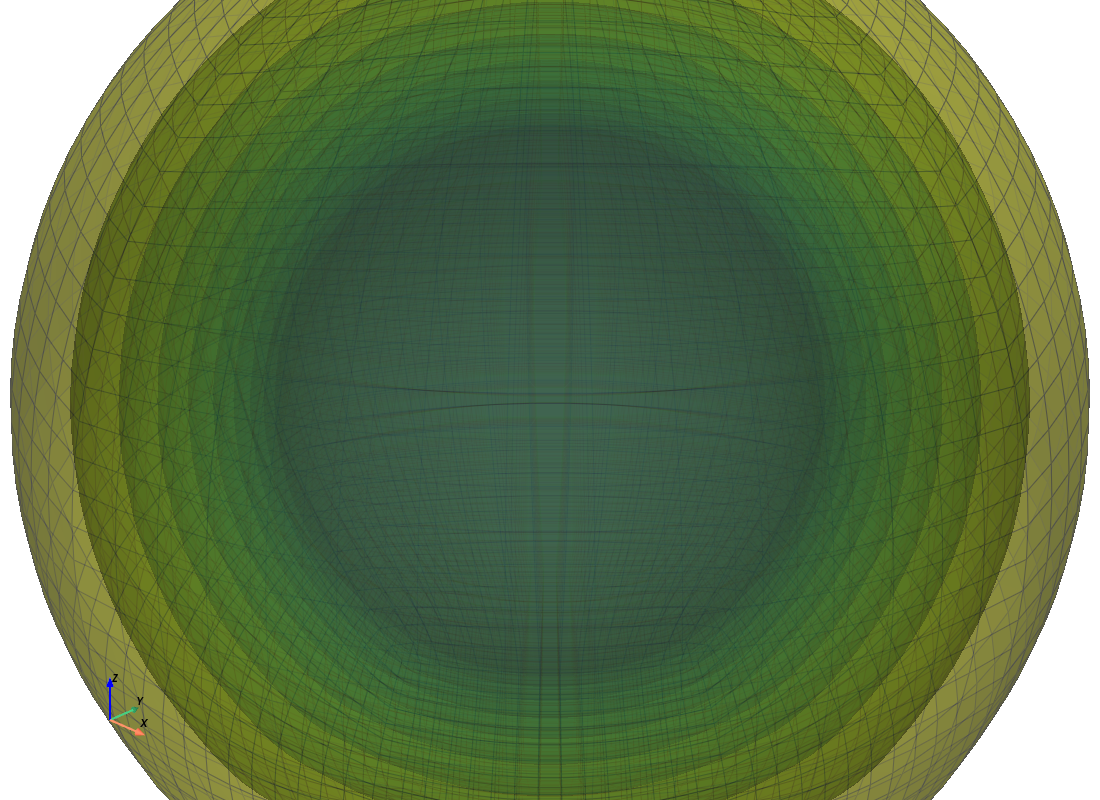
Hyperbolic marching (also called normal extrusion or advancing layers) extrudes the k=0 surface outward layer by layer, with each layer advanced along the local outward normal direction. The governing equations are hyperbolic in the wall-normal direction — hence the name.
In SHORE the marcher operates on all 6 blocks of the cubed-sphere topology simultaneously with seam-aware normals at multi-block boundaries so that block-to-block spacing continuity is preserved at every layer.
Governing equation
Given the k=0 layer
where
Per-layer recipe
For each layer index k = 0, 1, ..., nk − 2, SHORE does:
Snapshot the k-layer of all 6 blocks (a consistent state for ghost-row construction across blocks).
Compute outward normals for every node of every block. Boundary tangents use centred differences against ghost rows supplied by the partner blocks; no one-sided fallback at multi-block seams.
Step outward:
. Laplacian smoothing: a few sweeps of in-plane averaging:
with
the 4-neighbour average and the blend factor ( --smooth, default 0.2). The k=0 wall row and non-periodic boundary rows are clamped.Cap re-pinning: each cap's 4 boundary edges are overwritten by the equatorial sub-block pole rows for layer
k+1(_overwrite_cap_boundaries). This keeps cap-equator conformity bit-exact at every layer, regardless of what the cap's interior normal march would have produced.Jacobian guard: compute the minimum cell Jacobian between layers
kandk+1. If it falls below the tolerance the marcher raisesMarchingErrorimmediately — no silent bad meshes.Sub-sub stitching: average the SHARED j-columns between adjacent sub-blocks to absorb FP-noise from the Laplacian smoother. With seam-aware normals this should be sub-FP-noise; the averaging is a belt-and-braces guard.
Commit all 6 blocks to layer
k+1.
Step sizes (spacing_k)
The per-layer step sizes Spacing1D:
| Law | Behaviour | Required knobs |
|---|---|---|
geometric | ds, growth | |
tanh | One-sided Roberts clustering toward the wall. Fixed total thickness. | total_thickness, beta |
tanh2 | Two-sided Roberts clustering at wall and far-field. | total_thickness, beta |
See Spacing laws for the closed-form expressions.
Normal estimation
For an interior node, both tangents are centred differences:
In the legacy single-block O-grid the j-direction is periodic, so the boundary at j = 0 wraps to j = nj − 1. In the cubed-sphere topology both i and j are non-periodic — the boundary tangent uses centred differences against ghost rows from the partner block, see Seam-aware normals.
Laplacian smoothing
After each step, the new layer is relaxed by smooth_iters Jacobi sweeps (default 2) of in-plane averaging. The k=0 wall row is always clamped; non-periodic boundary rows/columns are clamped too. The blend strength α (--smooth, default 0.2) trades smoothness against cell- size uniformity.
Smoothing suppresses high-frequency wiggles that accumulate when the surface has local curvature gradients. It is not a substitute for elliptic volume smoothing — for production-quality grids, a post- processing elliptic smoother (Sorenson, Thompson–Thames–Mastin) can be applied after marching.
Jacobian check
The cell Jacobian between layers k and k+1 is the scalar triple product of three edge vectors:
where
In the cubed-sphere topology all 6 blocks have open boundaries, so the marcher uses _jacobian_field_open (no periodic wrap). The four corner cells of each cap (where 4 sub-blocks meet at one node) are excluded from the check: those cells have near-zero signed volume by construction. The tolerance for the remaining cells is -1e-6 to absorb floating-point noise from the centred-difference normals.
Optional: STL-normal blending
For sharp-feature bodies the grid-computed normals near the body lag the true STL surface normals (the structured grid only "sees" body geometry through its k=0 layer). The --blend-normals-k flag blends grid normals with STL surface normals queried via trimesh.proximity.closest_point for the first K layers.
The STL normal at each marching node is the barycentric blend of the closest triangle's three vertex normals at the closest point — C0- continuous across triangle edges, which suppresses the facet-aligned banding that flat face normals would produce on a coarse STL. trimesh's vertex_normals are area-weighted across incident faces and require a clean mesh (consistent face orientation, no degenerate faces, merged vertices) — all three are enforced unconditionally by load_stl's hygiene step. The legacy flat-face behaviour is still available via the interpolate=False kwarg of _stl_normals for regression debugging.
At k = 0 the layer extrudes along pure STL normals; the blend linearly fades to pure grid normals at k = K.
Interaction with the seam-aware kernel
The grid normal
A previous implementation also re-extruded each sub-block's cap-equator seam rows along pure STL normals every layer ("pole-row override"). The pole-row override pre-dated the seam-aware kernel and was needed to compensate for the Laplacian boundary clamp pulling the seam rows inward; with the seam-aware kernel in place that clamp produces only sub-FP-noise drift and the override itself amplified the C1 seam deviation by a factor of ~2 at k = NK − 1. The override has been removed and the regression is locked down by TestBlendNormalsK_C1SeamSurvives.
Failure modes and remedies
| Symptom | Cause | Remedy |
|---|---|---|
MarchingError at small k | High curvature; normals converging | Reduce ds; increase smooth_strength |
| jmin → 0 at large k | Outer layers collapsing | Reduce nk or growth |
| Visible kink at multi-block seam | Seam-aware normals disabled | Should not happen — seam-aware normals are always on for the cubed sphere |
| Jagged grid near sharp body features | Grid normals not tracking body | Use --blend-normals-k 5 to blend STL normals near the wall |
Comparison to elliptic methods
| Property | Hyperbolic marching | Elliptic (Thompson–Thames–Mastin) |
|---|---|---|
| Direction | Wall-normal (one sweep) | All directions (iterative) |
| Near-wall orthogonality | Good by construction | Controlled via source terms |
| Far-field smoothness | Bounded by step law | Excellent |
| Computational cost | ||
| Failure mode | Inversion at concave surfaces | Slow convergence; fold-over |
For Chimera near-body grids, hyperbolic marching is the preferred choice: the near-wall region is the critical one for the solver, far-field smoothness is handled by the background grid, and the single-sweep cost is orders of magnitude lower than iterative methods.
References
- Steger, J. L. & Sorenson, R. L. (1979). Automatic mesh-point clustering near a boundary in grid generation with elliptic partial differential equations. J. Comput. Phys., 33(3), 405–410.
- Chan, W. M. & Steger, J. L. (1992). Enhancements of a three- dimensional hyperbolic grid generation scheme. Appl. Math. Comput., 51(2–3), 181–205.
- Blazek, J. (2015). Computational Fluid Dynamics: Principles and Applications, Chapter 9.
See also
- Seam-aware normals — centred differences across multi-block seams
- Spacing laws —
Δs_kformulas shore.volume.hyperbolicandshore.topology.sphere_cap(Python API)- Cubed-sphere topology — block layout + connectivity