Surface projection (k=0 ray-casting)
The first algorithmic step turns an unstructured triangulated STL into a structured array of surface nodes by ray-casting from a single anchor point through a set of pre-chosen direction vectors onto the body. The output is the k=0 layer that all subsequent stages build on.
Inputs and outputs
| Input | A watertight trimesh.Trimesh and a set of unit direction vectors dirs of shape (N, 3) from a single anchor inside the body. |
| Output | A (N, 3) array of intersection points on the body surface, one per ray. |
| Module | shore.surface.projector.Projector |
Anchor selection
The anchor is the common origin of all rays. SHORE places it at the body centroid by default (Body.from_stl), with a mesh.contains check that the chosen point sits inside the closed surface. The body must be star-shaped from the anchor: every ray from the anchor must hit the body exactly once. This rules out concave geometries with re-entrant features visible from the centroid; for those, you'd need to pre-decompose the body into star-shaped pieces.
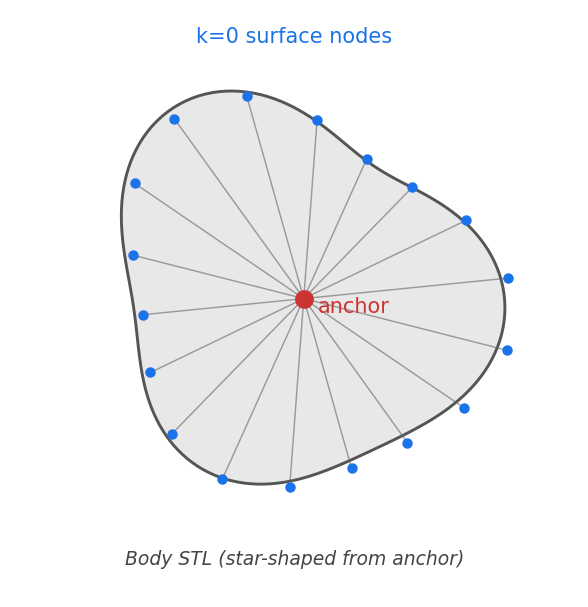
The diagram shows a 2D cross-section: the anchor (red) is inside a slightly distorted blob; rays fan outward; each ray's first intersection with the body is a k=0 node (blue).
Ray-cast machinery
Projector.__init__ builds a trimesh.RayMeshIntersector once and caches it. Subsequent Projector.project(dirs) calls reuse the same acceleration structure (BVH), so the per-ray cost is O(log T) in the triangle count.
from shore.surface.projector import Projector

proj = Projector(mesh, anchor)        # builds BVH once
result = proj.project(dirs)           # ray-cast, status array per ray
hits   = result.locations             # (N, 3) hit points
status = result.status                # 'hit' / 'miss' / 'tooNear' / ...
The ProjectionResult.status field flags rays that miss the body, hit too close to the anchor (likely the anchor itself if it grazes a face), or hit too far. By default Projector.project(dirs, on_failure="raise") raises MeshInputError if any ray is non-HIT; pass "warn" or "none" to relax.
Direction vectors
The projector itself is topology-agnostic — it casts whatever directions you give it. The directions for the cubed-sphere topology come from two places:
- The cap k=0 builder (
shore.surface.cap.build_cap_k0) computes directions for a flat tangent-plane diamond at each pole and feeds them through the projector. See k=0 mesh construction. - The equator builder (
shore.surface.equator.build_equator) computes per-meridian slerp-interpolated directions from south seam to north seam and feeds the interior nodes through the projector. The seam nodes themselves are bit-exact copies of the cap edges, so they skip the projector round-trip.
For the legacy single-block path, shore.surface.remesh.sphere_latlon_directions generates a uniform lat-lon grid of directions that Body.project() ray-casts as a single batch.
Performance
A single Projector.project(dirs) call vectorises over all rays. For a 20k-triangle STL with a 60×60 cap (3600 rays) the projection takes single-digit milliseconds on a modern CPU. The BVH build is the dominant cost on first use, ~30 ms for the same triangle count.
Failure modes
- Anchor outside the body:
mesh.contains([anchor])returns False; raisesMeshInputErroratBody.from_stl. - Body not star-shaped from anchor: some rays miss, some hit twice (only the first hit is recorded).
Projector.projectraises with theMISSstatus by default. - Mesh not watertight: rays may pass through gaps in the surface; raises with the
TOO_FARstatus.
See also
- k=0 mesh construction — how the projected nodes are arranged into the 6-block cubed-sphere topology
shore.surface.projector(Python API)- Cubed-sphere topology — full pipeline view