Seam-aware normals
When SHORE marches the 6 blocks of the cubed-sphere topology outward, each block computes its own outward normals from its own grid. At a multi-block seam — a column or row shared between two blocks — the two blocks' boundary tangents disagree if each uses a one-sided difference internal to itself. Marching with mismatched normals accumulates that disagreement layer by layer as a visible spacing jump on the outer surface.
Seam-aware normals fix this by computing the boundary tangent as a centred difference against a ghost row drawn from the partner block's data. Both blocks then arrive at the same normal at the shared node and march in step.
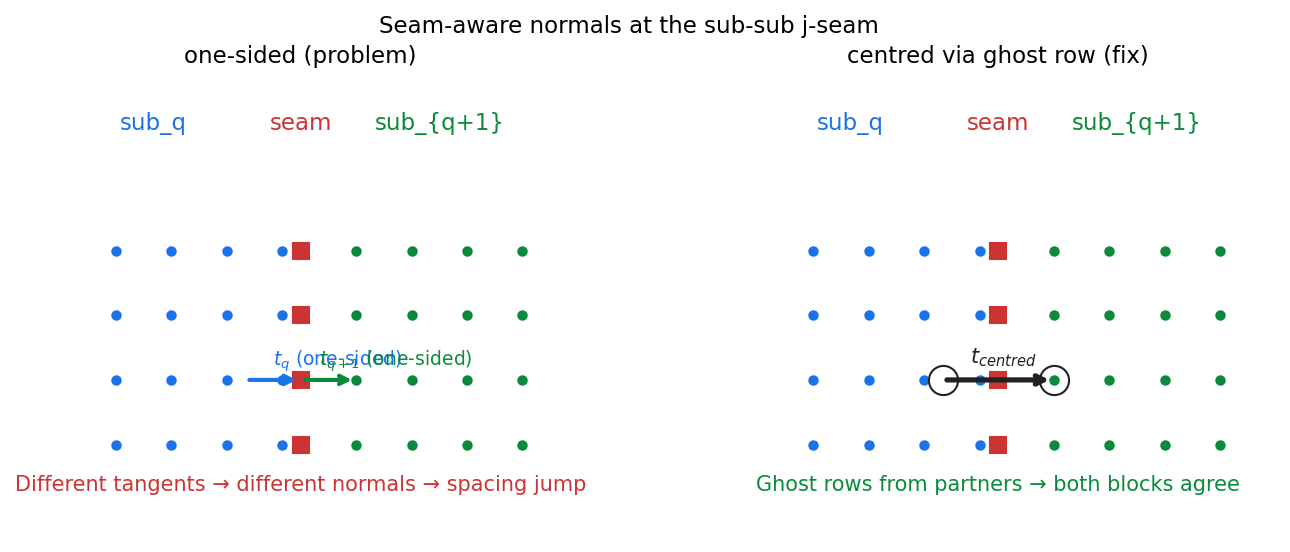
The problem (one-sided differences)
Sub_q's j_hi boundary is the same column of nodes as sub_{q+1}'s j_lo boundary. Without ghost rows:
- Sub_q computes the j-tangent at its
j_hiboundary aslayer[:, -1] - layer[:, -2]— backward, internal to sub_q. - Sub_{q+1} computes the j-tangent at its
j_loboundary aslayer[:, 1] - layer[:, 0]— forward, internal to sub_{q+1}.
These two tangents have different magnitudes and (generally) different directions, so the cross-product normals that drive the march also differ. Both blocks then advance the same shared node in two inconsistent directions, the post-march averaging of the SHARED column absorbs the discrepancy in position, but the underlying velocity mismatch persists. After many layers the outer surface shows a stripe across each block seam.
The fix (centred difference via ghost rows)
Each block's _compute_normals accepts an optional ghost_rows dict with one entry per face:
ghost_rows = {
    "j_lo": <(ni, 3) row from the partner block>,
    "j_hi": <(ni, 3) row from the next partner>,
    "i_lo": <(nj, 3) row from cap_south>,
    "i_hi": <(nj, 3) row from cap_north>,
}
When a face has a ghost row, that boundary's tangent becomes a centred difference between the next interior row and the ghost row — the same formula both blocks would compute on their side. Both blocks now agree on the normal at the shared node, and march along the same velocity by construction.
Where the ghost rows come from
Sub-sub j-seams are easy: sub_q's j_hi ghost row is sub_{q+1}'s column-1 (one in from sub_{q+1}'s j_lo boundary), and symmetrically on the other side.
Cap-equator i-seams are harder because the cap and sub-block grids are rotated and possibly reversed relative to each other, per the existing _overwrite_cap_boundaries mapping. The _sub_ghost_rows(q, sub_k, cap_n_k, cap_s_k) helper bakes in this mapping, so for each q it returns the cap row that, after the appropriate reversal, lines up with sub_q's i-boundary. Same for _cap_ghost_rows(pole, sub_k, ni) from the cap's perspective.
The ghost rows are gathered once per layer, from a snapshot of all 6 blocks at the current k. This gives a consistent set of partner data across all 6 blocks (no race condition where one block has already been advanced when its neighbour reads the ghost).
Numerical evidence
On a unit-icosphere mesh (ni=60, nj=60, nk=20, theta_cap=π/6), the j-step ratio across the sub_q/sub_{q+1} seam at marching layer k, defined as
stays close to 1 at every layer:
| Layer k | Max
The deviation shrinks with k — centred differences damp the small initial disagreement out of the system over the march.
Cap interior at seam vertices
Where 3 multi-block edges meet (cap corner: 2 cap-seam edges + 1 equator meridian), the seam-aware normals propagate the per-j C1 seam pinning outward with bit-exact agreement. The cap blocks' i-boundary normals draw their ghost row from the appropriate sub-block's i-2 row (mapped per _overwrite_cap_boundaries); the sub-block's i-boundary normals draw theirs from the cap's row 1 (the same mapping inverted).
The result: at every layer, cap-edge first cells equal the equator meridional first cells equal each other to FP precision, even after 20 layers of marching.
See also
- Hyperbolic marching — where the normals are used
- k=0 mesh construction — the C1 seam pin that this propagates outward
shore.volume.hyperbolic—_compute_normalswith theghost_rowskwargshore.topology.sphere_cap—_march_one_layer/_march_cap_layerwithghost_rowsshore.mesh.mesh._sub_ghost_rowsand_cap_ghost_rows— the helpers that build the ghost-row dicts per layer