Appearance
Generalized / fast winding number
What it does
Returns a continuous scalar w(q) that measures how many times the input surface wraps around a query point q. For a closed, outward-oriented surface:
w(q) ≈ 1.0strictly inside the volumew(q) ≈ 0.0strictly outside- intermediate values on the surface boundary
The point of the generalized winding number is what happens when the surface isn't watertight: holes, missing facets, near-coincident duplicate triangles, mixed-orientation patches. The legacy sign algorithms in FOSSIL (SIGN_RAY_INTERSECTIONS, SIGN_SOLID_ANGLE, SIGN_PSEUDO_NORMAL) all degrade unpredictably on dirty input — they'll report some points as inside when they shouldn't be, or oscillate near holes. The generalized winding number degrades gracefully: a query point on the symmetry plane of a cube-with-one-face-deleted returns ~0.5 (half-wrapped), not garbage.
This is the highest-leverage of FOSSIL's advanced primitives. It directly fixes a known correctness gap in FOSSIL's existing signed-distance API on the dirty STLs that motivate sanitize in the first place.
Pipeline
The exact formulation is
where
For a query at
- Brute force (
beta ≤ 0): evaluate the per-facet solid angle directly. O(N) per query, exact within floating-point precision. - Hierarchical Barnes-Hut (default,
beta = 2.0): for each AABB tree node, precompute its dipole momentand centroid. If the query point is far from the node (distance > beta× node diagonal), approximate the entire subtree's contribution with the dipole. Otherwise recurse. Reduces a 70k-facet bunny query from ~70 µs to ~5 µs without measurable accuracy loss.
The same Barnes-Hut traversal works on both the SAH BVH and the octree (tree kind is irrelevant to the algorithm — child enumeration goes through enumerate_children).
API
fortran
real(R8P) function surface%winding_number(point, beta)
   type(vector_R8P), intent(in)           :: point  ! query point
real(R8P), intent(in), optional :: beta ! Barnes-Hut admissibility (default 2.0)pointis the 3D query position.betacontrols the multipole admissibility ratio. Larger β means stricter admissibility (more recursion, more accuracy, slower). Defaultbeta = 2.0is a balanced setting; production use rarely needs tuning.beta ≤ 0forces the exact O(N) sum.
The returned w is the unrounded scalar. To use it as an inside/outside test, threshold at 0.5:
fortran
inside = surface%winding_number(point=q) > 0.5_R8PExample
Closed cube, far-field decay, and the dirty-mesh graceful-degradation property all in one program:
fortran
program ex_winding_number
use fossil, only : surface_stl_object
use penf,   only : I4P, R8P
use vecfor, only : vector_R8P
implicit none

type(surface_stl_object) :: cube
type(vector_R8P)         :: p_in, p_out, p_far
real(R8P)                :: w_in, w_out, w_far

call cube%load_from_file(file_name='src/tests/cube.stl', guess_format=.true.)

p_in  = vector_R8P(0.5_R8P, 0.5_R8P, 0.5_R8P)   ! cube centroid
p_out = vector_R8P(2.0_R8P, 2.0_R8P, 2.0_R8P)   ! outside the bbox
p_far = vector_R8P(1.0e3_R8P, 0._R8P, 0._R8P)   ! far field

w_in  = cube%winding_number(point=p_in)         ! ≈ 1.0
w_out = cube%winding_number(point=p_out)        ! ≈ 0.0
w_far = cube%winding_number(point=p_far)        ! < 1e-10

print '(A,F12.9)', 'inside  : w = ', w_in
print '(A,F12.9)', 'outside : w = ', w_out
print '(A,ES12.4)', 'far     : w = ', w_far
endprogram ex_winding_number
To force exact (non-hierarchical) evaluation — useful for ground-truth testing or for inputs where the AABB tree isn't trustworthy — pass beta = -1.0 or any non-positive value:
fortran
program ex_winding_number_exact
use fossil, only : surface_stl_object
use penf,   only : I4P, R8P
use vecfor, only : vector_R8P
implicit none

type(surface_stl_object) :: cube
type(vector_R8P)         :: q
real(R8P)                :: w_fast, w_exact

call cube%load_from_file(file_name='src/tests/cube.stl', guess_format=.true.)
q = vector_R8P(0.3_R8P, 0.3_R8P, 0.3_R8P)

w_fast  = cube%winding_number(point=q, beta=2._R8P)   ! Barnes-Hut, default
w_exact = cube%winding_number(point=q, beta=-1._R8P)  ! exact O(N) sum

print '(A,F12.9,A,F12.9)', 'fast = ', w_fast, '   exact = ', w_exact
endprogram ex_winding_number_exact
The two are identical to ~1e-12 absolute on small inputs (a 12-facet cube has nothing to truncate); on the dragon mesh the gap is ~1e-3 at β=2.0 and ~1e-5 at β=4.0.
Cube reference image
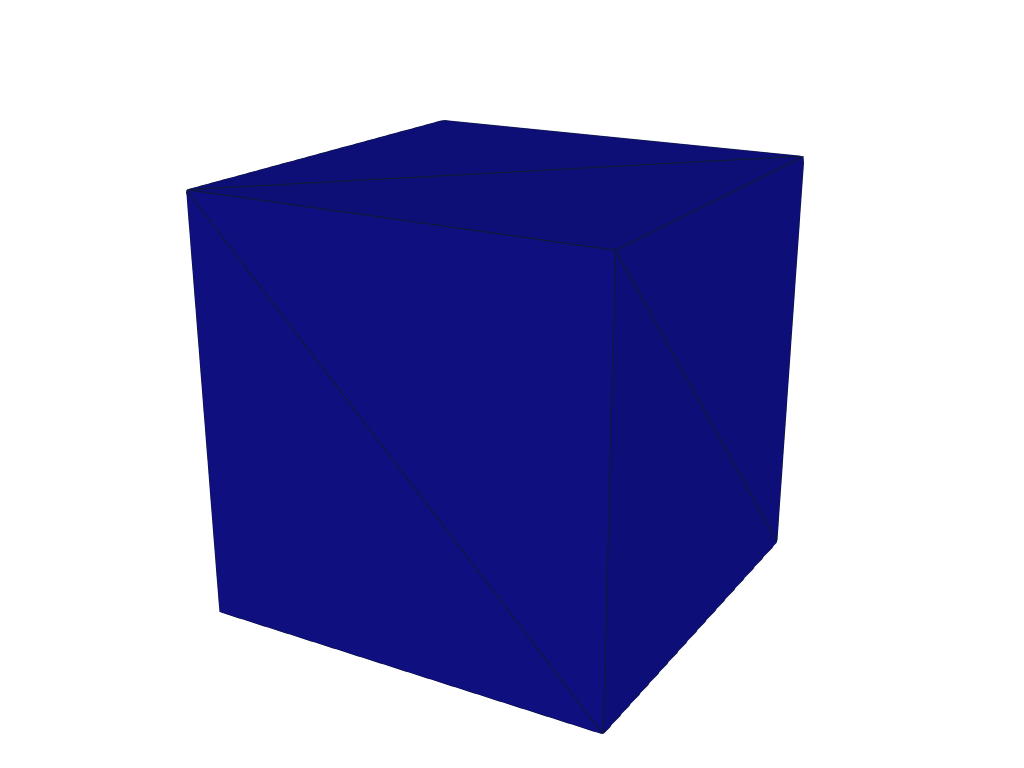
The cube is the simplest test case: 12 facets, three orthogonal diagonal-split faces, axis-aligned. A query at the centroid (0.5, 0.5, 0.5) returns w = 1.0 to floating-point precision; a query at a corner returns w = 0.125 (one octant of the full
Known limitations
- β tuning is empirical. β = 2.0 is fine for typical CAD STL with few thousand to ~100k facets. For dense meshes (~1M+ facets) where query throughput matters, β = 1.5 trades a few percent accuracy for ~2× speedup. For ground-truth tests, force exact (
beta ≤ 0). - At surface vertices and edges,
wreturns the local solid-angle fraction (e.g. 1/8 at a cube corner), not 0 or 1. This is the correct mathematical answer — the "inside vs. outside" question is ill-posed exactly on the surface. Threshold at 0.5 to get a clean binary classifier; query a small offset away from the surface if you need a definite answer at a known vertex. - Non-watertight inputs return values in (0, 1) — that's the whole point, but if your downstream code assumed
w ∈ {0, 1}it'll need updating. Threshold at 0.5 to recover the binary classifier.
See also
distanceand theSIGN_*constants — legacy sign algorithms (kept for back-compat; prefer winding number on dirty input).- Constants —
SIGN_PSEUDO_NORMALis FOSSIL's default fordistance's sign; winding number is its own scalar query with no constant needed. aabb_tree_object— the acceleration structure that carries the per-node dipole moments used by the hierarchical traversal.
References
- Jacobson, Kavan & Sorkine-Hornung, Robust Inside-Outside Segmentation Using Generalized Winding Numbers, SIGGRAPH 2013. The original algorithm — the formulation FOSSIL implements.
- Barill, Dickson, Schmidt, Levin & Jacobson, Fast Winding Numbers for Soups and Clouds, SIGGRAPH 2018. The Barnes-Hut hierarchical evaluation that makes large meshes tractable.
- Van Oosterom & Strackee, The solid angle of a plane triangle, IEEE TBME 30(2), 1983. The closed-form per-facet solid angle.